
The new platform connects to Pipedrive, scores every open deal against sales discipline rules, builds a prioritized daily plan for each rep, and shows owners and sales leaders whether the plan is on track and why. Public launch is scheduled for October 1, 2026.
By Oliver Grand, Founder and CEO, SalesBond · September 3, 2026
SalesBond is an AI-powered sales control platform that connects to Pipedrive, analyzes CRM data around the clock, identifies deals at risk, and shows sales teams which deals need attention and what should happen next. It does not replace the CRM. Pipedrive remains the system of record; SalesBond adds a layer of analysis, prioritization and management visibility on top of it.
SalesBond becomes publicly available to all Pipedrive users on October 1, 2026. It installs from the Pipedrive Marketplace, and every new account starts with a free seven-day trial.
Why a well-kept CRM still doesn’t mean control over sales
Most sales teams already have the data. Pipedrive holds the deals, the stages, the contacts, the activities and the notes. The gap is what happens to that data between pipeline reviews.
A sales leader who wants to know the real state of the pipeline has to open deals one at a time: is the next step scheduled, when was the customer last contacted, is the deal really at the stage it claims to be. Done properly, that review takes hours, which is why in most teams it happens once a week at best. In between, deals age quietly. A follow-up missed on Tuesday becomes visible the following Monday, and a forecast that rests on stale deals looks healthier than it is.
Standard CRM reports and dashboards don’t close this gap, because they summarize what was recorded rather than whether what was recorded is healthy. A pipeline chart can show $300,000 in the Proposal stage without indicating that half of it has had no activity in three weeks.
SalesBond was built to do the review a diligent sales manager would do by hand, for every deal, continuously, and to turn the result into specific actions for the people who can still change the outcome.
How SalesBond works with Pipedrive
SalesBond is installed from the Pipedrive Marketplace, and connecting a Pipedrive account takes a couple of clicks. Once connected, SalesBond reads deals, stages, values, owners, activities and contact details from Pipedrive and keeps them in sync, so the analysis always reflects the current state of the CRM.
Reps and managers keep working in Pipedrive as before. SalesBond adds three modules on top of it, all available at launch: Deal Health, Sales GPS and the Sales Dashboard.
Deal Health: a continuous score for every open deal
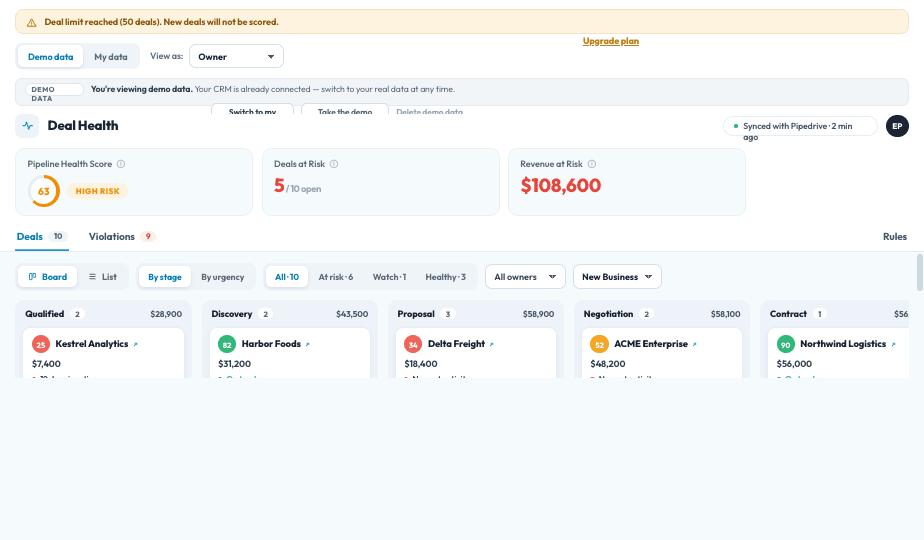
Deal Health checks every open deal in Pipedrive against a set of sales discipline rules, 24 hours a day. More than twenty rules are built in and can be switched on or off in settings, and teams can create their own. The rules describe the things an experienced manager looks for: the contact has no email address or phone number on record, there is no next activity scheduled, the deal has been sitting in one stage longer than the norm, or too much time has passed since the last contact with the customer.
Each deal receives a numeric health score, together with a plain list of the rules it currently violates and what would raise the score if fixed. The point is to make the fix obvious: add the missing phone number, schedule the next call, move the deal to the stage it is really at.
At pipeline level, Deal Health shows a Pipeline Health Score, the number of open deals at risk and the revenue tied up in them. Deals can be viewed as a board by stage or by urgency, filtered by owner, and grouped into At risk, Watch and Healthy. A separate Violations view lists every open issue across the pipeline in one place.
Sales GPS: what to do first, today
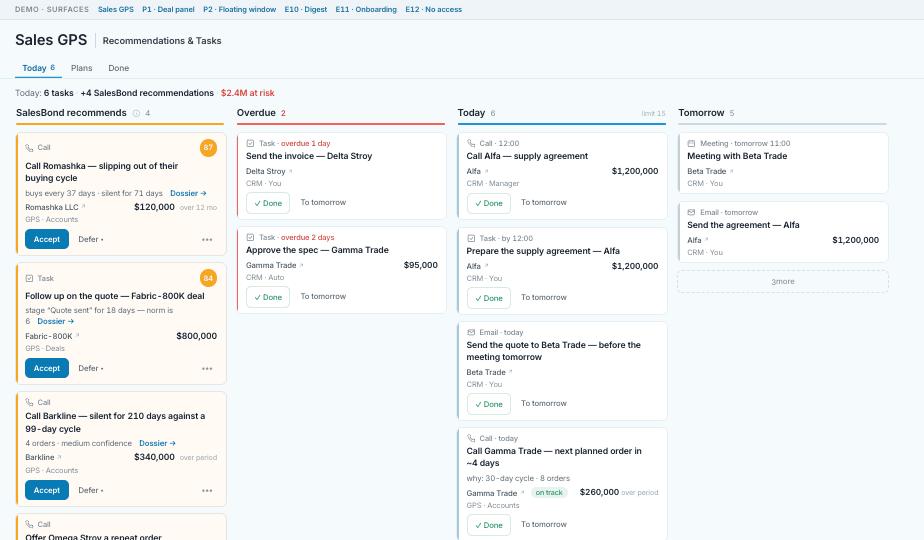
Sales GPS turns that analysis into a daily plan for each rep. It brings together the tasks already scheduled in Pipedrive, sorted into overdue, today and tomorrow, with SalesBond’s own recommendations, which the rep can accept or defer.
Recommendations are ranked, and the ranking is not based on rule violations alone. Sales GPS weighs the deal’s stage, its value and its history to estimate how likely it is to close, so that a rep’s limited attention goes to the deals where it changes the result. The objective is direct: close more of the deals already in the pipeline and hit the plan.
Sales GPS also looks at customers, not only deals. For businesses with repeat orders, it learns each account’s typical buying cycle and flags when the pattern breaks. A customer that usually reorders every 37 days and has been silent for 71 is surfaced with a recommendation to call and a short explanation of why. That kind of signal rarely appears in a pipeline view, because there may be no open deal to look at.
Sales Dashboard: is the plan on track, and if not, why
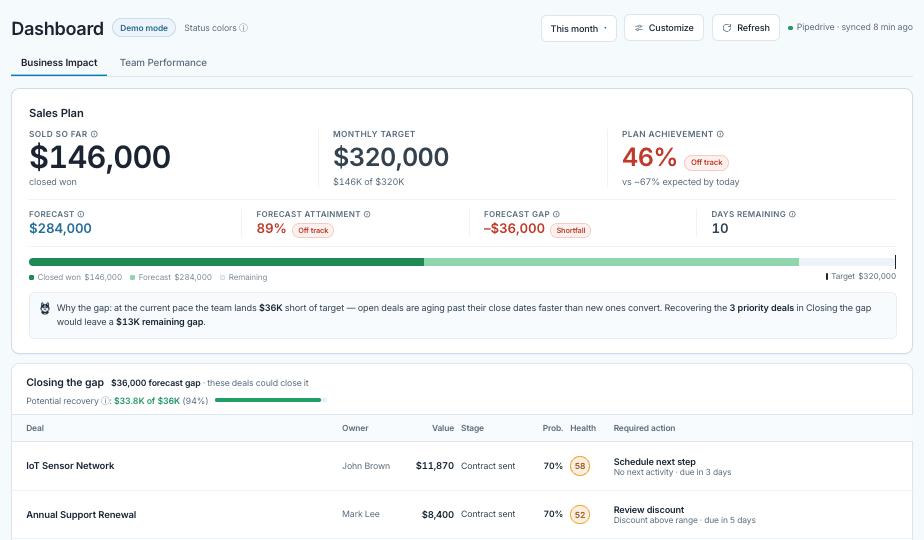
The Sales Dashboard is built for business owners and heads of sales. Its Business Impact view puts the sales plan in one place: revenue sold so far, the monthly target, plan achievement compared with where the team should be by today, the forecast, the forecast gap and the days remaining. The forecast is based on how the team is actually working its pipeline, not on the target.
When the plan is off track, the dashboard says so and explains why in plain language. It then lists the specific deals that could close the gap, each with the action required and its deadline. A separate Team Performance tab focuses on the reps themselves.
The dashboard also keeps track of SalesBond’s own contribution: which recommendations were acted on, what improved as a result, and how many deals were closed where SalesBond’s recommendations were followed. That figure is deliberately framed as deals SalesBond helped close, not deals it closed.
Who SalesBond is for
SalesBond is designed for small and mid-sized B2B companies that run their sales in Pipedrive. Business owners get a single screen that answers whether the plan will be met, without asking the sales team for a status update. Heads of sales and sales operations managers get an automated version of the pipeline review they used to do by hand, with the risks already identified. Reps get a prioritized plan for the day and a clear explanation of what each deal is missing. No knowledge of machine learning or CRM analytics is required.
An illustrative week
Consider a team with a $320,000 monthly target and ten days left. The Sales Dashboard shows $146,000 closed and a forecast of $284,000, a $36,000 gap. Its explanation is short: open deals are aging past their close dates faster than new ones convert. Below the summary sit three priority deals that together could recover most of the gap; one has no next activity scheduled, another carries a discount above the team’s range and needs review.
The head of sales does not need to open thirty deals to find those three. The reps involved already see them at the top of Sales GPS for the day, and Deal Health shows why each was flagged and what will clear the flag. The numbers are illustrative; the mechanics are how the three modules work together.
Results from the closed pilot
Before launch, SalesBond ran a six-month closed pilot with a group of companies the founding team already worked with. According to SalesBond’s own pilot data, sales per rep in participating teams grew by an average of around 30 percent compared with the same period the previous year, with individual results ranging from roughly 15 to 40 percent. Feedback from the reps who used it was positive: the product helped in day-to-day work rather than adding to it.
These are results from a limited pilot and should be read as such. They are also the reason SalesBond is launching publicly now.
Availability, pricing and data protection
SalesBond becomes available to all Pipedrive users on October 1, 2026, through the Pipedrive Marketplace. Every account starts with a free seven-day trial. Paid plans are listed on the pricing page.
SalesBond is GDPR-compliant. Its terms of service, privacy policy and data processing agreement are published in the legal section of the website.
Pipedrive is the first CRM SalesBond supports.
Get started
Install SalesBond from the Pipedrive Marketplace and connect your account, or start a free 7-day trial on salesbond.app. Once Pipedrive is connected, Deal Health shows you which of your open deals are at risk and why.
Frequently asked questions
What is SalesBond?
SalesBond is an AI-powered sales control platform that connects to Pipedrive, scores every open deal for risk, recommends what each rep should do next, and shows business owners and sales leaders whether the sales plan is on track. It becomes publicly available to all Pipedrive users on October 1, 2026.
Does SalesBond replace Pipedrive?
No. SalesBond works on top of Pipedrive. Pipedrive remains the system of record for deals, contacts and activities; SalesBond reads that data and adds analysis, prioritization and management reporting.
How does SalesBond identify at-risk deals?
Deal Health checks every open deal against more than twenty built-in sales discipline rules, such as a missing contact email or phone number, no scheduled next activity, too long in one stage, or too long since the last customer contact. Teams can switch rules on or off and add their own. Each deal receives a health score with a list of the rules it violates and what would fix them.
How is SalesBond different from Pipedrive’s own reports and dashboards?
CRM reports summarize what has been recorded. SalesBond evaluates whether what has been recorded is healthy, ranks what needs attention first, and explains the gap between the plan and the forecast in plain language, with the specific deals and actions that could close it.
How do I connect SalesBond to Pipedrive?
Install SalesBond from the Pipedrive Marketplace and authorize the connection. It takes a couple of clicks. Every new account includes a free seven-day trial.