
Introduction
Most deals that die quietly die the same way. There was one contact, that contact was enthusiastic, and then something happened to them — they left, they were overruled, or they were never the decision in the first place — and the seller found out weeks later, from silence.
Single-threading is the most common structural weakness in a B2B pipeline and the easiest to fix, and it is under-managed because a single-threaded deal looks identical to a healthy one right up until it does not. This article defines the risk precisely, covers the three ways it plays out, and gets specific about multi-threading without going over your champion’s head — the wording, the timing, and why buyers usually say yes.
What Single-Threading Actually Is
A single-threaded deal is one where all of your information and all of your influence flow through one person at the account. It is not about how many contacts exist in the CRM; it is about how many are engaged — have spoken with you, have a view, would reply if you emailed.
The useful definition for tracking purposes: a deal is single-threaded if only one person at the account has had a substantive interaction with your team in the last 30 days. Business cards collected at a conference do not count. A colleague copied on an email and silent throughout does not count.
That definition matters because the comfortable version — “we know several people there” — is how teams convince themselves a deal is threaded when the entire relationship still rests on one person’s continued enthusiasm and continued employment.
The Three Failure Modes
1. The champion leaves
The most brutal because it is the most complete. Your contact changes jobs, moves internally, or goes on extended leave, and the deal loses not just its advocate but its entire institutional memory. Nobody else at the account knows what was discussed, why it mattered, or what was agreed.
What makes this worse than it sounds: their replacement inherits a project they did not choose, championed by someone who is no longer there, from a vendor they have never met. The rational move for that person is to pause everything and review, and “pause and review” is where deals go to die.
2. The champion was never the decision
Common and hard to spot, because the symptom is enthusiasm. Someone loves the product, engages deeply, answers every email — and cannot approve anything. Everything looks healthy until the deal reaches the point where money changes hands, and then it stops.
The diagnostic question is not “are you the decision maker?” — almost everyone answers yes to that, and many believe it. Ask about mechanism instead: what has to happen after they say yes, who has signed off on things like this before, when did they last buy something at this size and what did that process look like.
3. The champion cannot see the blockers
The subtlest of the three. Your contact is real, senior enough, and genuinely trying — and they still cannot tell you what is happening, because the obstacle sits somewhere they have no visibility into. A security review queue, a procurement freeze, a competing project with a louder sponsor.
You experience this as vagueness. “Still working on it.” “Should hear next week.” The contact is not evasive; they simply do not know, and asking them harder produces the same answer with more friction. The only fix is a second relationship somewhere closer to the obstacle.
How to Multi-Thread Without Going Over Their Head
The reason sellers stay single-threaded is fear of exactly one thing: that reaching out to somebody else looks like going around their contact, damages the relationship, and turns an ally into an obstacle. That fear is reasonable, and it is why the mechanics matter.
Ask early, before you need it. Requesting a second contact in week two is a normal part of getting organised. Requesting one in week nine, after silence, reads as an escalation. The single biggest determinant of how the request lands is when you make it.
Frame it as work you are doing for them, not around them. Buyers accept the request when it obviously reduces their effort:
“To put this together properly I’d normally get 20 minutes with whoever owns security — happy to run that separately so it doesn’t land on your plate, or with you on the call if you’d rather.”
Three things work there. It names a purpose, it explicitly offers to save them work, and it gives them control over how it happens. Almost nobody objects to that, because you have made yourself easier to work with rather than harder.
Give them a reason that is about the deal, not about your process. “Our process requires multiple stakeholders” is about you. “If the security question comes up in week six it will cost us a month; getting it asked now means it does not” is about their timeline.
Always report back. After any conversation with a second contact, summarise it to your champion the same day. This is what turns multi-threading from a threat into a service — they get more information about their own organisation than they had before, which is the opposite of being circumvented.
When they say no, respect it and adjust. Occasionally a champion has a genuine reason to keep you contained. Accept it, and treat the deal as higher-risk in your forecast rather than pretending the refusal did not happen.
Making It Measurable
Multi-threading tends to be discussed as a virtue rather than tracked as a number, which is why it never improves. One metric fixes that: the share of open deals with two or more engaged contacts in the last 30 days.
Two notes on making it real. Define “engaged” strictly — a logged, substantive two-way interaction, not a CC. And segment by deal size: single-threading on a small transactional deal is often fine, while single-threading on your three largest opportunities is the highest-concentration risk in your pipeline. A blended number across all deals hides exactly the cases you care about.
A practical review habit: in the weekly pipeline meeting, look at the top five deals by value and ask only one question about each — how many people there have we actually spoken to in the last month. It takes two minutes and it surfaces more risk than a walkthrough of thirty deals.
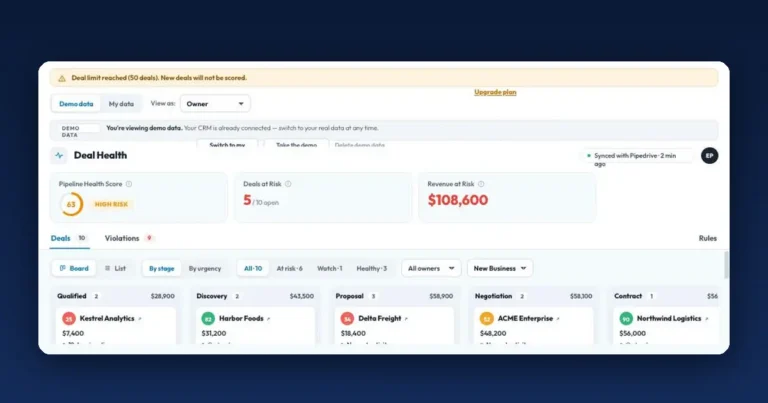
Keeping that visible without manual work is where continuous monitoring helps: Deal Health scores each active deal and maintains an at-risk queue, so structural weaknesses show up alongside stalled deals and missing next steps rather than waiting for someone to notice them in a review.
Worked Example: The Same Deal, Twice
An illustrative example. A $90,000 opportunity, four months in, one champion — an operations lead who found the product, ran the evaluation and pushed it internally.
Version one, single-threaded. Week 14: the champion mentions she is interviewing elsewhere, then goes quiet. Week 16: an out-of-office reveals she has left. The seller emails the generic team address and reaches someone who has heard of the project but knows nothing about it. He asks for a summary and a call in three weeks. At that call, he says the team is reviewing priorities and will come back — which they do not. The deal closes lost at week 23 with the reason recorded as “no decision.” Four months of work, and nothing transferable survives.
Version two, multi-threaded from week three. Same deal, but in week three the seller asked for 20 minutes with whoever owns security, framed as saving the champion a step, and later met the finance partner during pricing. Neither was a big relationship — one call each, plus a summary sent to the champion the same day.
Week 16, same departure. This time the seller emails the security contact, who knows exactly what the project was and why it mattered, and who introduces the interim owner. The review still happens and the deal slips six weeks, but the context transfers with it. It closes at week 29 at a slightly reduced value.
The difference between the two versions is roughly two hours of work in week three.
FAQ
What is a single-threaded deal?
A deal where only one person at the account has had a substantive interaction with your team recently, so all information and influence depend on that one relationship.
How many contacts should a deal have?
At least two engaged contacts for any deal you would be unhappy to lose, and more for larger opportunities where more functions are involved. The right number is driven by how many groups have to be comfortable, not by a rule.
Will multi-threading annoy my champion?
Rarely, if you ask early, explain the purpose in terms of their timeline, offer to include them, and report back afterwards. It is late, unexplained outreach that damages trust — not the existence of a second conversation.
How do I multi-thread when my champion refuses?
Accept the refusal, and treat the refusal itself as information: a champion who will not let you speak to anyone else is either protecting their position or has less influence than they suggested. Adjust the forecast accordingly.
Is single-threading always a problem?
No. On small, fast, low-complexity deals it is often the efficient choice. It becomes a serious risk as deal size, cycle length and the number of internal approvals grow.
Conclusion
A single-threaded deal is one job change away from being unrecoverable, and the failure is invisible until it happens. The three ways it plays out — the champion leaves, was never the decision, or cannot see the blockers — all have the same remedy: a second real relationship, built early, framed as work you are taking off their plate, and always reported back.
Make it measurable so it improves: track the share of open deals with two or more engaged contacts in the last 30 days, segmented by deal size. This week, take your five largest open deals and count how many people at each you have genuinely spoken to in the last month — whatever that count is, it is your most concentrated pipeline risk.