
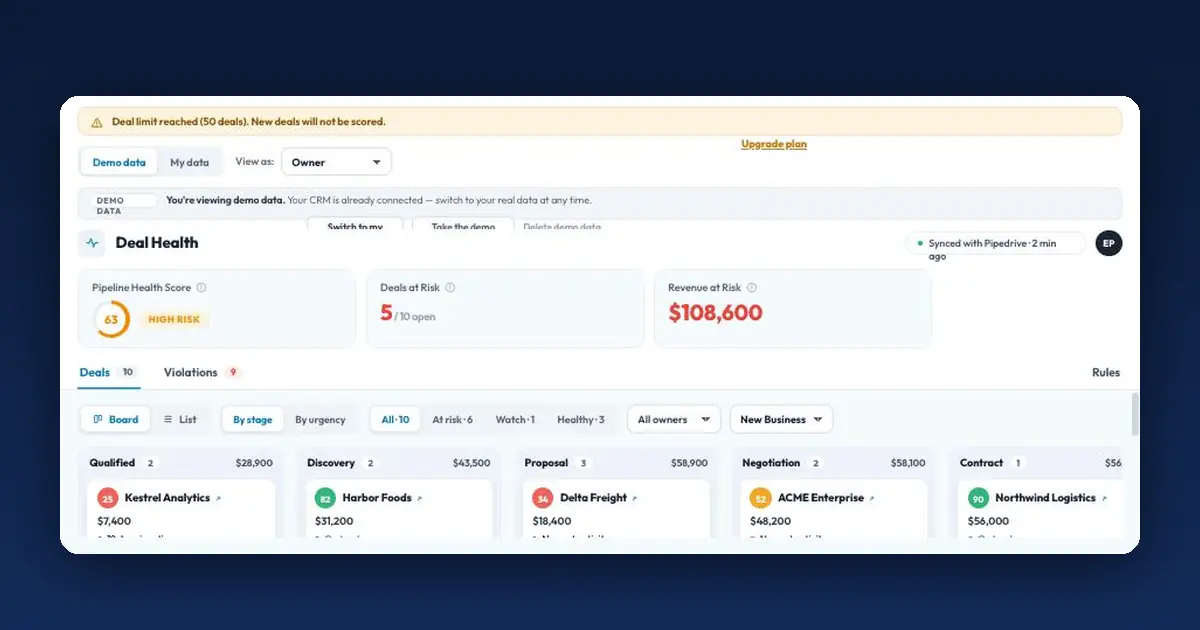
The pipeline looks reassuring. Deals have owners, values and expected close dates. Sales reps are busy, and the weekly report shows enough potential business to support the target.
Then a deal slips into next month. Another buyer stops replying. A proposal has been sitting with a customer for weeks, but nobody has agreed what happens next.
The warning signs were there before the forecast changed. They were scattered across activity logs, overdue tasks, missing fields and repeatedly edited dates.
For a sales leader, the challenge is understanding which opportunities are being actively managed and which are quietly losing momentum. That requires a view of deal health alongside pipeline value.
What makes a deal healthy?
A healthy deal has a clear owner, current information and a credible next step. Communication, deadlines and required actions fit the buyer’s stage and your sales process. Important risks are visible, with someone responsible for addressing them.
Health describes how well the opportunity is being managed. A competitive deal can be healthy when the team understands the obstacles and has a realistic plan. An apparently promising deal can be unhealthy when nobody has spoken to the buyer, the decision process is unclear and the close date is based on hope.
A useful test is whether another team member could open the CRM record and understand where the deal stands, what must happen next and who will make it happen.
Why manual deal reviews leave gaps
Reviewing a deal properly means reading notes and correspondence, checking tasks, inspecting date changes and comparing the record with the company’s requirements. The reviewer also needs enough customer context to distinguish an expected pause from a breakdown in progress.
With hundreds or thousands of opportunities, that becomes difficult to repeat consistently. Weekly reviews provide a snapshot; new issues can emerge between meetings.
Continuous monitoring makes those issues easier to find, leaving managers more time to investigate causes and support the team. That is the wider case for why a CRM needs ongoing management, not just accurate records.
What is Deal Health by SalesBond?
SalesBond is an intelligent sales management system that works on top of your existing CRM. The CRM remains the system of record, while SalesBond adds ongoing oversight, action prioritization and management visibility.
Deal Health at a glance
- Continuously checks deals in the pipelines you select.
- Offers more than 20 ready-made rules, plus the ability to create your own.
- Shows a 0–100 score with specific issues and recommended corrections.
- Lets users accept or postpone recommendations and configure automatic task creation for selected issues.
- Gives leaders visibility into individual deals, recurring team problems and potential revenue at risk.
The warning signs of an unhealthy deal
An unhealthy deal shows gaps in follow-through, information or progress that need attention. A warning sign is a reason to investigate; it does not establish that the buyer will walk away.
Use the following signals as a practical review framework.
| Signal | What it may mean | What to check or do |
|---|---|---|
| A stale deal or unusually long time in one stage | Progress has stalled, or the CRM no longer reflects the buying process. | Confirm the blocker and the milestone required to move forward. |
| No next step | The last interaction ended without a concrete commitment. | Agree a specific action, owner and date; record the buyer’s involvement where relevant. |
| Overdue tasks | A promised follow-up or internal dependency may have been missed. | Check what remains undone, complete it or agree a realistic new deadline. |
| Repeated close-date changes | The expected purchase timeline lacks a reliable basis. | Revisit the buyer’s decision process and remaining approvals. |
| A close date in the past | The forecast or deal status is out of date. | Confirm whether the opportunity is still active and update it accordingly. |
| A long communication gap | The buyer may be disengaged, or recent contact may be missing from the CRM. | Verify the last meaningful exchange and agree an appropriate follow-up. |
| Missing stakeholders | The team may lack access to people who influence or approve the purchase. | Identify the relevant roles and establish how they participate in the decision. |
| Weak activity | The effort or engagement recorded may be insufficient for this stage. | Review the quality and outcome of interactions, alongside their frequency. |
| Missing critical fields | The team may be making decisions without essential information. | Obtain and record the information required at this point in the process. |
| A missed company requirement or an unexpectedly extended buying cycle | The deal has moved outside the agreed process or expected timeline. | Check the required action, understand the exception and confirm a workable plan. |
Context matters. A scheduled procurement review can explain a period of silence. The same silence becomes more concerning when nobody knows who owns the review or when it will finish.
Activity also needs interpretation. Sending another email creates activity, but it may leave the underlying blocker unresolved. The useful question is whether the action advances the buyer’s decision or clarifies the situation.
Some signals deserve a closer look on their own: it helps to be able to tell a stalled deal from a dead one before either distorts the forecast.
How Deal Health differs from a conventional deal score
A conventional deal score often estimates the likelihood of winning or ranks an opportunity’s commercial promise. Predictive scoring can already consider activity, deal progression and close-date changes, and some tools explain the factors behind their scores. HubSpot’s deal-scoring documentation illustrates this approach.
Deal Health focuses on the quality of execution: whether the team is following the selected rules and what needs correcting now.
| Dimension | Conventional deal scoring | Deal Health by SalesBond |
|---|---|---|
| Main question | How promising is this opportunity? | How well is this deal being managed, and what needs attention? |
| Primary focus | Predicted outcome or commercial priority. | Quality of deal management and adherence to selected rules. |
| Signals | Depending on the tool, deal attributes, engagement, activity and progression. | Missed actions, stale stages, overdue tasks, missing information and other rule violations. |
| Explanation | Varies by tool; may include contributing factors. | Specific issues and reasons for a lower health score. |
| Follow-up | May support prioritization or recommended actions, depending on the product. | Suggested corrections that users can accept or postpone, with optional automatic task creation. |
| Configuration | Depends on the scoring system. | Enable or disable ready-made rules and create company-specific rules. |
| Management use | Support opportunity prioritization and forecasting. | Identify execution gaps, guide coaching and monitor corrections. |
The approaches can complement each other. A commercially attractive deal may still need urgent attention because a required action has been missed. A well-managed deal may still lose because the buyer chooses a different supplier.
Keeping both questions visible gives managers a more useful basis for deciding where to spend their time.
Rules should reflect how your company sells
Deal Health includes more than 20 ready-made rules. Users can switch rules on or off, select those relevant to their business and create their own.
The right controls depend on the sales process. A short purchasing cycle and a complex enterprise evaluation require different expectations for communication, stakeholder involvement and time in each stage.
Examples of requirements a company might choose to monitor include:
- Every active opportunity has a planned next action.
- Follow-up tasks are completed by their agreed deadlines.
- Time in a stage stays within the company’s expected window.
- Communication remains current for the relevant stage.
- Repeated close-date changes trigger attention.
- Required decision-making stakeholders are recorded before a defined milestone.
- Critical fields and mandatory actions are completed at the appropriate stage.
These are illustrative requirements, not universal default settings.
Start with rules that protect meaningful commitments and decisions. Review recurring exceptions with the team. An alert that repeatedly flags a legitimate part of the buying process may indicate that the rule needs adjustment.
What the 0–100 health score tells you
The Deal Health score summarizes the quality of deal management against the selected rules. Users can see the detected violations and the reasons the assessment has fallen.
An 80 out of 100 health score does not mean an 80% probability of winning. Read the number together with the underlying issues, their significance and the proposed corrections.
A missing next action requires a different response from missing access to a decision-maker. The score helps direct attention; the explanation helps the user decide what to do.
The practical objective is to address the underlying issue and keep the CRM accurate. Changing a date simply to remove an overdue status leaves the original problem unresolved.
From a detected issue to a concrete action
Deal Health connects monitoring with follow-through.
-
Detect
The system identifies a violation of an enabled rule.
-
Explain
The user sees the issue and why it affects the deal’s assessment.
-
Recommend
Deal Health proposes a correction or next action.
-
Decide
The user accepts the recommendation or postpones it for 3, 7, 14 or 30 days, or chooses another date.
-
Automate where useful
Users can configure automatic task creation for selected violations.
-
Continue monitoring
Deal Health keeps checking the deal after issues are addressed.
Postponement accommodates legitimate timing constraints. If a buyer’s review is scheduled for next week, the user can choose an appropriate follow-up date.
Users determine the applicable rules and automation settings and decide how to respond to recommendations. Negotiation, customer commitments and other significant commercial decisions remain with people.
What sales reps and leaders can see
Sales reps: a clearer view of what needs attention
For a rep, Deal Health makes outstanding issues explicit: which deals need attention, what is missing, why it matters and which action is recommended.
The rep can decide when to act, postpone a recommendation where appropriate and work through tasks created by configured automation. This supports follow-through on commitments that might otherwise be forgotten.
It also makes conversations with a manager more concrete. Both can discuss a specific missing stakeholder or overdue action and agree on the help required.
Sales leaders: visibility across the team
Leaders can review each rep’s average Deal Health score alongside individual deal assessments, critical issues and recurring patterns. They can also see the history of detected and corrected violations, plus the number of deals and customers associated with risk.
An average score is a starting point for investigation. It can hide an important deal with a serious problem, while differences in deal mix can affect comparisons between reps.
Use the detail to guide coaching. Repeated missing next steps may call for better meeting follow-up habits. Recurring stakeholder gaps may indicate a need for support in navigating buying committees. Problems across the whole team may justify a process change.
How to interpret potential revenue at risk
Deal Health can show the potential value associated with deals at risk under the selected control rules. This helps leaders understand the commercial exposure surrounding execution problems.
That amount is not booked revenue or a prediction that the full value will be lost. It describes potential business attached to deals that need attention.
Analytics may also show the value of successfully closed deals in which previously detected issues were corrected before closing. This connects correction history with subsequent outcomes, but it does not establish how much revenue Deal Health caused.
Budget, competition, buyer priorities and the team’s work all remain part of the outcome. Revenue attribution requires a defined methodology.
A practical example: a deal that needs investigation
A deal has spent 21 days in the proposal stage. It has no scheduled next action. The expected close date has moved three times, the last recorded customer email was 12 days ago, and a required decision-maker field is empty.
Assume these conditions breach the company’s enabled rules. Deal Health flags the relevant violations, reflects them in the deal’s assessment and shows the required corrections.
The rep investigates and discovers that the proposal is awaiting finance approval. The contact has not arranged that review, and the rep has been moving the close date without confirming a new timeline.
The practical response is to identify the approval owner, agree a next step with the buyer, establish a credible date and update the missing information. A configured rule can create a follow-up task automatically.
The opportunity may still face budget or competitive pressure. The team now has a specific blocker to address and a clearer basis for the next forecast discussion.
Frequently asked questions
What is Deal Health by SalesBond?
Deal Health continuously monitors the quality of CRM deal management. It checks selected pipelines against enabled rules, assigns a score from 0 to 100, explains detected issues and recommends corrective actions.
How is Deal Health different from a deal score?
A conventional deal score often estimates commercial promise or the likelihood of winning. Deal Health focuses on how well a deal is being managed against selected rules and what needs correcting. The two approaches can complement each other.
Which issues can Deal Health detect?
Examples include stale deals, missing next steps, overdue tasks, communication gaps, repeated close-date changes, past close dates, missing stakeholders, incomplete critical fields and missed process requirements. Detection depends on the rules selected for the company.
Can we create our own rules?
Yes. Deal Health provides more than 20 ready-made rules that users can enable or disable. Users can also create rules to reflect their company’s sales process.
What does the 0–100 score measure?
The score assesses the quality of deal management against the selected rules. Users can review specific violations and reasons for a lower score. It should not be interpreted as a percentage probability of winning.
Can Deal Health create tasks automatically?
Yes. Users can configure automatic task creation for selected violations. Recommendations can also be accepted or postponed for 3, 7, 14 or 30 days, or until a user-selected date.
Does Deal Health guarantee that a deal will close?
No. Deal Health identifies execution risks and supports corrective action. The outcome still depends on factors such as the buyer’s priorities, budget, competition and the work of the sales team.
Bring deal quality into your next pipeline review
Pipeline value shows the size of the opportunity. Deal health helps you examine the quality of the work supporting it.
Start by checking whether each active deal has a credible next step, current information and a clear account of any delays. Use those findings to define the rules your team needs and the actions that deserve attention.
Deal Health by SalesBond applies that discipline continuously across selected pipelines, connecting detected issues with explanations and practical follow-up.