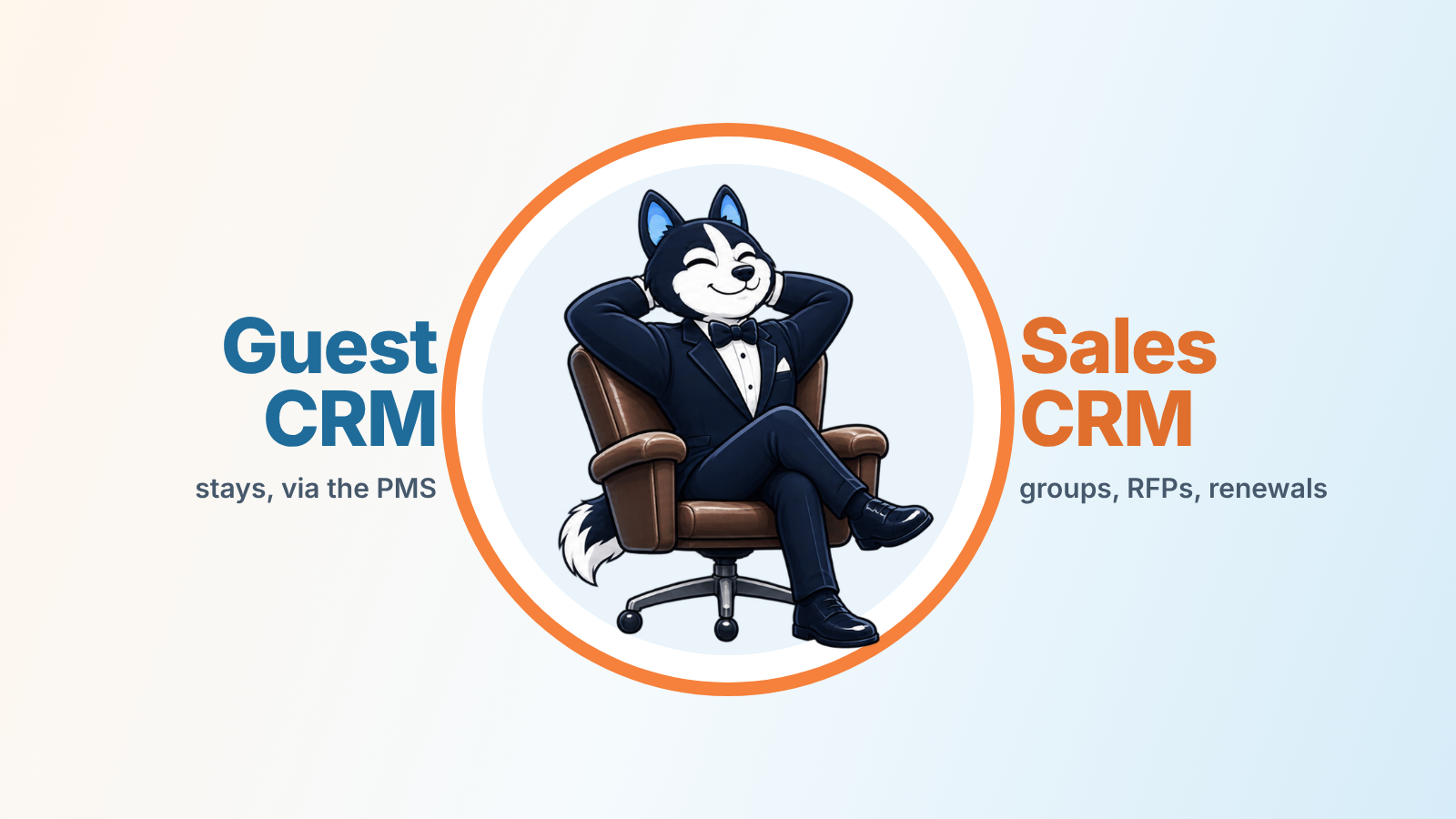
A hotel CRM is one of two things: a guest CRM, fed by the property management system (PMS), or a sales CRM for accounts, groups and RFPs. For a hotel sales team it is the second, and the choice inside it is between a sales and catering system such as Delphi or OPERA Sales and Event Management, when meetings and banquets drive revenue, and a general CRM like HubSpot, Zoho CRM or Pipedrive with hotel fields added, for a small sales office. Test either one on a single question: can it show every open request and its proposal deadline on Monday without a spreadsheet?
Most “best hotel CRM” and “hospitality CRM” lists mix the two up, and the split matters more than any feature. A guest CRM is chosen by the front office and marketing, and it lives or dies on its PMS connection. A sales CRM is chosen by the director of sales, and it lives or dies on whether a group lead from Tuesday still has an owner and a due date on Friday. Vendors sell both under the same name, so the first job on any demo is to ask which one you are looking at.
Quick answer: pick by the job that is losing you business this quarter
Start from the one job that cost you a contract or a group last quarter.
If that job is about the person in the room, you are shopping for a guest CRM. Recognising a returning guest at check-in, keeping preferences from past stays, sending a pre-arrival email and a post-stay offer without anyone pressing send: all of that runs on stay data, and stay data lives in the PMS. The one question to put to the vendor is which PMS it connects to and what updates when a stay closes.
If the job is about the company or the event that books the rooms, you need a sales CRM. That covers a corporate account with a negotiated rate and a contract end date, a group block with a cut-off date, an RFP with a due date that three people have to answer, and a wedding or conference that needs a proposal, a revised proposal and a signed contract. Here the demo should show one record per account or request, with the dates on it, and a list the director of sales can sort by due date.
Most hotels with a sales office end up with both.
Guest CRM or sales CRM: they are not two tiers of the same thing
A guest CRM is closer to a marketing automation tool with a hotel data model than to a sales pipeline.
The sales CRM is built around the account and the request. Its record is a company or an event organiser, and what hangs off it is negotiated rates, group blocks, proposals and the dates they are due. The guest who sleeps in the room may never appear in it at all. Take, for example, a corporate travel manager at a company that books a couple of hundred room nights a year: she is a sales CRM contact, and the engineers she sends are guest CRM profiles.
We think hotels get into trouble when they buy one and expect it to do the other. A guest CRM asked to run group sales ends up with a “group” that is one guest profile with a long note. A sales CRM asked to run guest marketing has no PMS data to work from and sends nothing. Pick the one for the office that is asking, and let the other office pick theirs.
The kinds of hotel sales CRM you will be shown
Four classes of software answer to “hotel sales CRM”. The useful comparison is by what each one is built around.
Hotel sales and catering (S&C) systems. These are built for the hotel sales office from the start: group blocks, function space, banquet event orders (BEOs) and proposals live in the same system. Amadeus calls Delphi a “sales and catering solution” for hotels (Amadeus Delphi). Event Temple describes itself as hotel sales software that “puts leads, bookings, room blocks, proposals, BEOs, payments and reporting in one place” (Event Temple). Oracle’s OPERA Sales and Event Management page covers group blocks and function space in the same product. If meetings and banquets are a large part of revenue, this is the class to see first, and the questions are how it talks to your PMS and who keeps the corporate-account side in it.
A general CRM platform with a hospitality edition. Salesforce presents its travel and hospitality offering as “CRM + AI + Data + Trust for Travel, Transportation, & Hospitality” (Salesforce: Travel, Hospitality, and Transportation Management Software). The appeal is one platform for the sales office and, if the hotel wants it, the guest side as well. Being a platform, the account, group and RFP objects are something you configure, so a small sales office should ask how much of that setup it actually needs.
An events and sourcing platform. Cvent says it provides “software to planners for event management, marketing and attendee engagement, and also helps hotels win business through our sourcing platforms” (Cvent). Look here when most of your group and meeting RFPs arrive through a sourcing channel rather than by email. The class is built around the RFP job; the corporate-account record and the rate renewal calendar usually still need a home.
A general sales CRM set up for a hotel. HubSpot, Zoho CRM and Pipedrive are built for a sales pipeline, and you add the hotel fields yourself: block size, cut-off date, contract end date, proposal due date. Nothing in the box is hotel-specific, and that is the point. A sales director who already knows one of these tools can have a group pipeline running quickly, and the setup moves with teh team if the hotel changes hands. The trade is that nothing connects to the PMS unless you build it, so this class is a sales CRM only, never a guest CRM.
We compared the general CRMs by sales job, without the hotel layer, in CRM software by business type. Travel agencies face a mirror image of this choice, where the agent sells trips rather than rooms and the deciding field is the client’s return date; that one is in best travel agency CRM for agents and agencies, compared by job.
What the hotel sales office actually has to track
Ask a director of sales what went wrong last quarter and the answer is rarely a missing feature. It is a date nobody saw. Three kinds of work make up most of the day, and each one needs specific fields on the record.
Corporate accounts come first. A negotiated rate is an agreement with an end date and, usually, a production expectation, so the account record needs the rate, the contract end date and some way to see whether the account is producing. Leave the end date off the record and renewals get found by the accounting team when the old rate stops applying.
Group inquiries are the second. A group block has a size, a date range and a cut-off date after which unsold rooms go back to inventory. The request moves from inquiry to tentative to definite, and at each move something is owed: a proposal, a contract, a deposit. The cut-off date is the field that most often lives in someone’s head. It’s also the one the CRM should be setting a task from.
Then there are RFPs. A request for proposal has a due date set by the buyer, not by you, and it needs an owner, a stage and that due date in a column a manager can sort by. We wrote up the seller-side routine for this, including how to track an RFP as a deal and what to do with the ones you decline, in how to answer an RFP from the seller’s side and track it in the CRM. The hotel version is the same routine with room nights and function space instead of units and delivery dates.
Meetings and events cut across all three. A conference brings a group block, a corporate account and a proposal with revisions, so if your hotel runs events the proposal has to sit on the the record with its versions rather than go out from someone’s desktop and get forgotten.
The demo test for a hotel sales CRM: one group, one RFP, one renewal
Ask the vendor to run three records in front of you, with your data, and watch where the clicks go. The numbers below are an example; swap in a real group and a real RFP from your own pipeline.
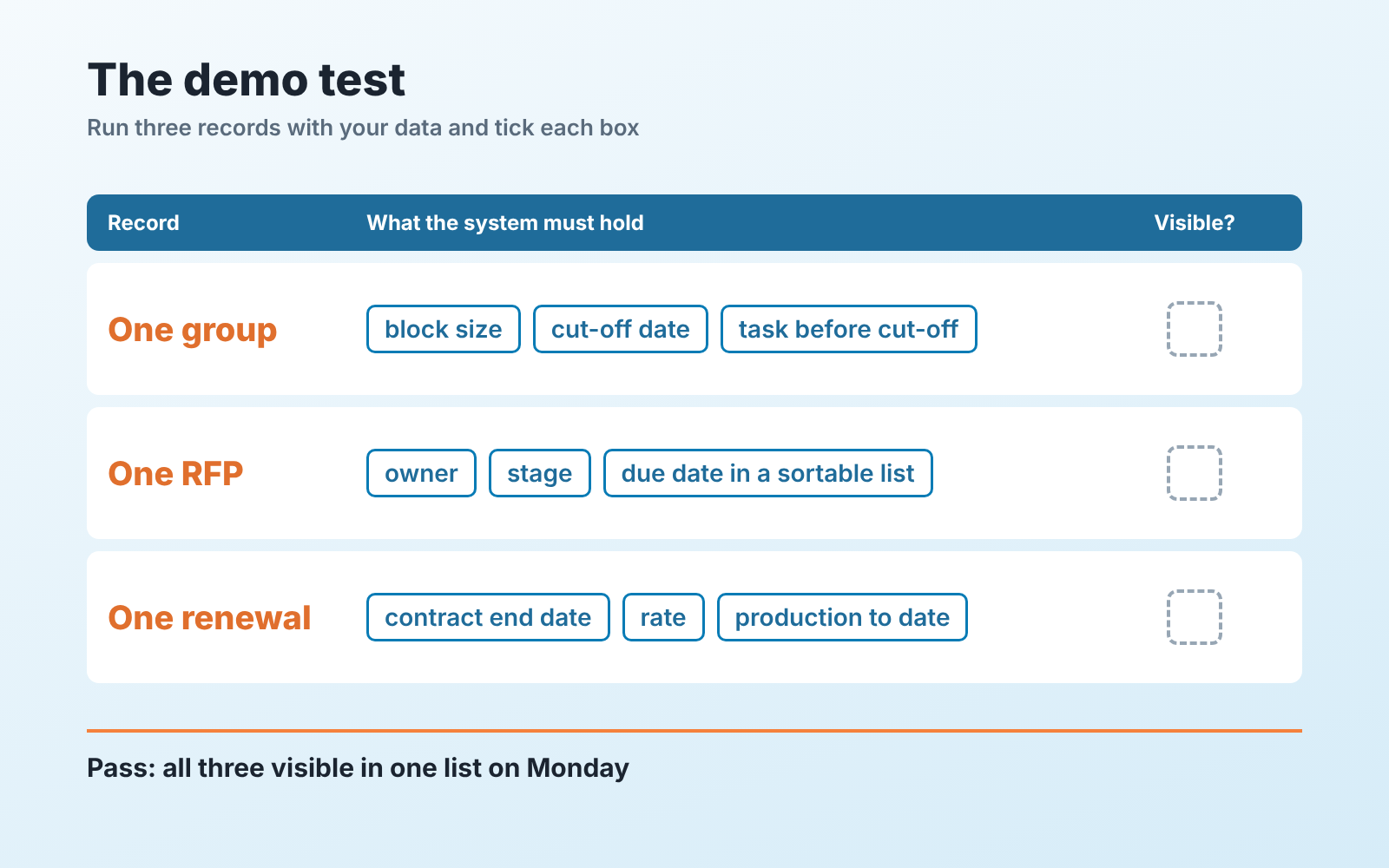
Say the first record is a group of forty rooms over three nights, with a cut-off date four weeks out. The system should hold the block as one record, not forty deals, and a task should appear in the owner’s list ahead of the cut-off. If the vendor types the cut-off date into a note the system does not have the field.
For the second, take an RFP that arrived this morning, due in, say, nine days, that two people will work on. Open it as a deal, set the owner and the due date, then ask to see every open RFP sorted by due date. This is the view the director of sales will use every week. If it takes a report builder to produce it, nobody will open it.
The third is a corporate account whose negotiated rate ends in, for example, sixty days. The record should carry the rate, the end date and some count of what the account has produced, and a task should exist for the renewal conversation. A sales CRM that cannot show production against the account is leaving the renewal to accounting.
One more check, and it isn’t a record. Ask who updates the stage when a proposal goes out.
If the answer is “the salesperson, after the fact”, the funnel you see on Monday is a memory of last week, and no hotel sales system fixes that on its own.
The numbers a director of sales reads on Monday
A hotel sales CRM earns its place with four numbers a week. None of them needs a dashboard project.
- Open requests by stage (inquiry, tentative, definite) for groups and events.
- Requests with a proposal due this week, and how many of those are still unanswered.
- Corporate contracts ending within ninety days, and whether a renewal conversation is scheduled.
- Requests that have not moved in two weeks, by owner.
The fourth is the one that catches trouble early. A group inquiry that has sat in “inquiry” for two weeks has usually been booked elsewhere, and the salesperson knows it and the pipeline does not. We would rather see the request marked lost on Tuesday than carried as open until the quarter review.
If the fields from the demo test exist, reading those four numbers by hand is a short job in any of the general CRMs. We build SalesBond, a sales management layer on top of the CRM a team already uses, and its free CRM audit does a version of that reading for you. It looks at the last 30 days of a connected HubSpot, Salesforce, Zoho CRM, Pipedrive or any other CRM on our integrations list and sends a PDF report: money at risk, a CRM score, the main findings, managers and deal health, the pipeline bottleneck, repeat customers, the top ten clients and up to five fixes sorted by money. Seven days later a second PDF shows what changed. For a hotel sales office, the deal health and bottleneck sections are the closest match to requests that have not moved in two weeks. Check your CRM with SalesBond.
FAQ
Do we need a guest CRM and a sales CRM? Most hotels that sell to groups and corporate accounts end up with both, owned by different offices. A small property with no group business can live on a guest CRM alone; a sales office that handles RFPs and corporate rates cannot.
What is the difference between a hotel CRM and a PMS? The PMS runs the stay: reservations, room inventory, check-in and the guest folio. A CRM holds the relationship around it, either the guest’s history for marketing or the company’s rates, groups and proposals for sales. A guest CRM reads from the PMS; a sales CRM usually needs only availability and what was booked.
Can a general CRM like HubSpot or Pipedrive be a hotel CRM? It can be the sales CRM if you add the hotel fields: group block size, cut-off date, contract end date, proposal due date. It cannot be the guest CRM, because it does not read the PMS.
Where do RFPs belong, the CRM or the sourcing platform? Where they arrive. If most of your meeting RFPs come through a sourcing platform such as Cvent, answer them there and record the outcome in the sales CRM so the account history is in one place. If they arrive by email, the CRM is the only record you have, so open each one as a deal with a due date.
Want to see what your current CRM already knows about stalled requests before you change it? Start with SalesBond.