
A request for proposal (RFP) is a formal document in which a buyer describes what it needs and invites vendors to submit proposals with their approach, price and terms (Wikipedia). The buyer then compares the proposals against criteria it set in advance and awards the work to one vendor, sometimes several (Winvale).
In sales, an RFP is a deal with a hard deadline that someone else set. It needs an owner, a bid or no-bid decision and its own place in the CRM before anyone opens the proposal template.
What is a request for proposal?
RFP stands for request for proposal. If you searched for “RFP meaning”, the short version is this: an RFP is the buyer’s way of running a structured comparison. Instead of calling three vendors and asking for a price, the buyer writes down the problem, the requirements, the questions every vendor has to answer, how the answers will be scored and when they are due.
Responsive calls it a “formal, questionnaire-style document”, and that matches what sellers live through: most of the work is answering questions in the buyer’s order. Writing a pitch is a small part of it (Responsive). Compared with a tender awarded on price and quality alone, an RFP leaves the vendor room to propose an original solution to the buyer’s need (Wikipedia).
RFP vs RFQ vs RFI
The three documents answer three different buyer questions, and they usually arrive in a sequence. An RFI is typically followed by an RFP or an RFQ (Wikipedia).
- RFI (request for information): “What exists, and who can do this?” The buyer is still shaping the need. You send information about your capability, no offer. It is not an invitation to bid and binds nobody.
- RFQ (request for quotation): “What does this cost?” The need is already specified and price is the main or only factor, so there is little to discuss (Responsive).
- RFP (request for proposal): “How would you solve this, and at what price and on what terms?” You send a full proposal, and it is scored on criteria the buyer published.
Two traps in the terminology. In architecture, engineering and construction, “RFQ” often means request for qualifications, a document about experience and certifications rather than price (Responsive; Wikipedia). And an RFI that looks like busywork is the cheapest moment to influence the RFP that follows. Winvale’s point to government contractors is that these early notices shape future RFPs, so answering one gives you a chance to tilt the later document your way (Winvale).
The RFQ has it’s own article on this blog, written from the seller’s chair: the RFQ process from the seller’s side. If what you send back is a priced quote, quote vs invoice vs estimate covers where that document sits in the stages.
What is in an RFP
The clearest minimum comes from US federal procurement. The Federal Acquisition Regulation says an RFP for a competitive acquisition must at least describe the government’s requirement, the anticipated terms and conditions of the contract, the information the offeror has to put in the proposal, and the factors that will be used to evaluate it, with their relative importance (FAR 15.203). Commercial RFPs are looser but they are built from the same four parts: the need, the terms, the questions, the scoring.
We read them in the opposite order from how they are written. Evaluation criteria first, because that is the scoresheet you will be marked against. Submission instructions second, because this is where proposals get thrown out on form: wrong font, missing attachment, late by an hour. The requirements last, once you know what matters and how it has to be delivered. Winvale gives government contractors similar advice and names the sections to start with: instructions (section L), evaluation (section M) and the statement of work (section C) (Winvale).
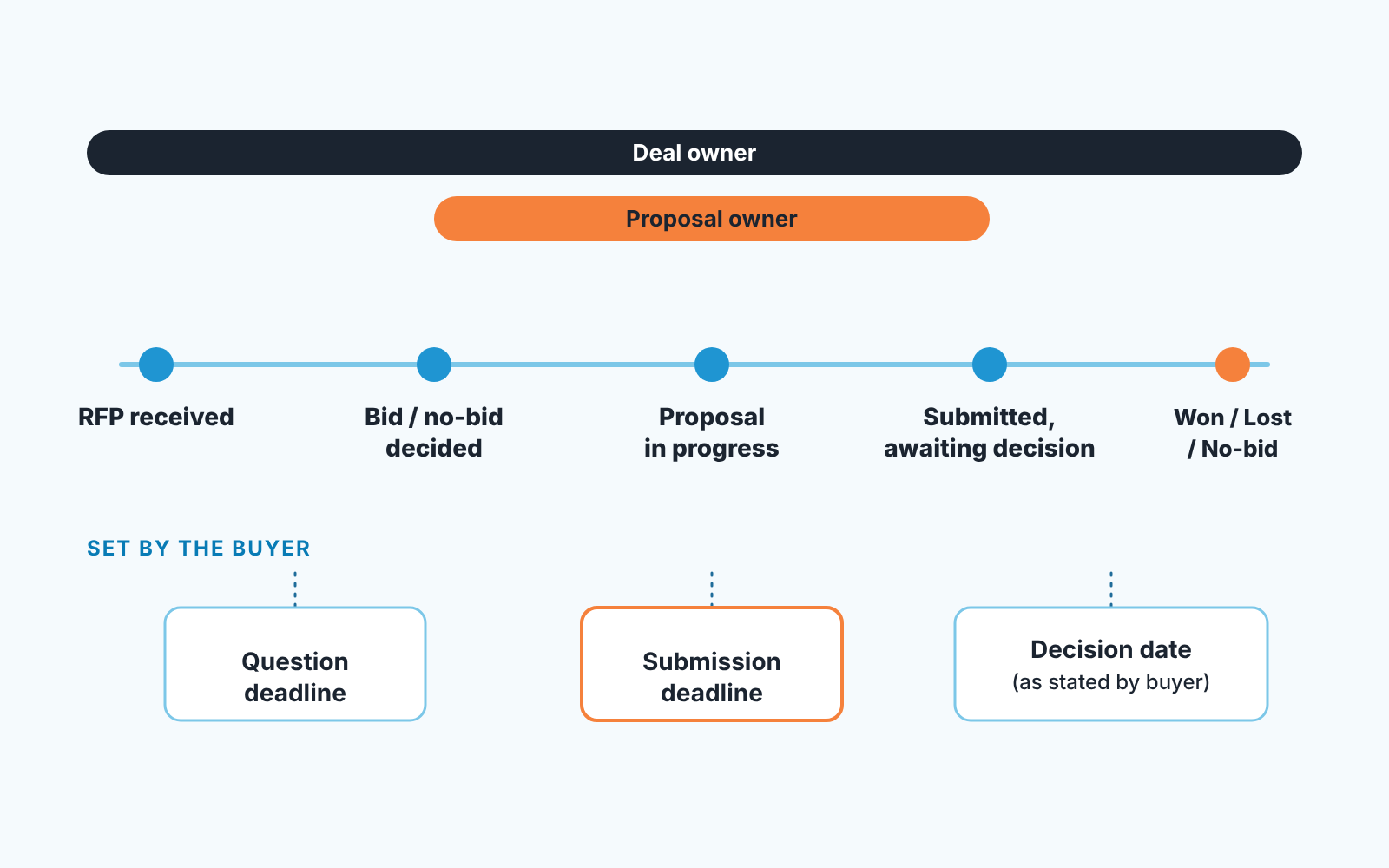
Every date you find on that first read goes into the CRM the same day. The submission deadline, obviously. The question period, if there is one. And the buyer’s anticipated decision date, which good buyers repeat when they remind vendors that the deadline is near (Responsive).
Who sends RFPs
Three kinds of organizations send RFPs: companies, government agencies and grant funders. Companies use them for anything complex enough that a price list cannot settle it; Wikipedia describes the RFP as usually part of a complex sales process (Wikipedia). For US federal agencies, the RFP is the regulated way to solicit proposals in a negotiated acquisition (FAR 15.203). Timing matters there too. Winvale notes that agencies spend a large share of their annual budgets in the last quarter of the fiscal year, July through September, so contractors should expect several RFPs at once (Winvale). Foundations and public funders often post open grants as a request for proposals (Wikipedia: Grant writing). A “grant RFP” is a call for funding applications, and the rest of this article is not about it.
The seller’s side: bid or no-bid
An RFP arrives, usually by email, and the first instinct is to open the template and start answering. We think that is the wrong first move. The buyer wrote the RFP with a shortlist in mind, and you may or may not be on it.
So the first stage of an RFP deal is a decision. Did we know this was coming, or did we hear about it when everyone else did? Can we meet every single mandatory requirement? Reading the evaluation factors, would we actually score, or would we come second on purpose? Do we have the people to hit the deadline without stopping work on deals we are closer to winning?
If the honest answers are bad, a no-bid is a result too: time back for the team and a cleaner win rate. If they are good, a business proposal template for a sales team covers the fields, versions and follow-up of the document you send back.
We worked this out in detail, with a scoring gate and a time limit on the decision itself, in RFP deals in Pipedrive: score the bid before you write a word. The mechanics there are Pipedrive’s; the gate works in any CRM with a custom field.
Deadlines and owners in the CRM
An RFP breaks one assumption most pipelines are built on: that the close date is yours to move. It is not. The buyer set the deadline, and after submission the buyer sets the decision date too. So the RFP deal needs dates of its own, next to the standard ones, and a named owner for each.
- Submission deadline as a date field of its own. Only a field can be filtered, so a weekly check of “RFP deals due in the next 14 days” picks it up without anyone remembering.
- Bid decision: Bid, No-bid, Pending. Pending is allowed for a few days at most.
- Proposal owner: who assembles the answer. Often not the rep who owns the deal.
- Expected decision date: what the buyer said, plus the date you asked.
- Deal type = RFP, or a separate pipeline, so these deals can be filtered and reported apart from the rest. Which of the two is better depends on how many RFPs you see; the Pipedrive article argues both sides.
The next activity on an RFP deal should be the internal step that gets you to the deadline: the review, the pricing sign-off, the reference check. If the only activity on the deal is the submission itself, nobody sees the slip until the day it is due.
After submission: the deal stays open
The proposal goes out and the team exhales. In the CRM the deal moves to a stage that says exactly what is happening, Submitted, awaiting decision, with the expected decision date filled in. This is where RFP deals go quiet, and a quiet deal can sit there for months as a loss nobody recorded.
Tie the follow-up to the buyer’s date. Before the decision date: one message confirming receipt and offering clarifications, nothing else. On the decision date, if nothing has come: a direct question, when is the award now expected? If the date passes twice, the deal is probably lost and the stage should say so, with the reason in a note. Each postponement tells you something about the deal, so put every new date in the CRM as it comes.
This is also where RFP deals do the most damage to a pipeline report. A deal with a passed decision date and no next activity is open on paper and dead in practice, and a pipeline with a few of those is forecasting money that is not coming. Stuck deals like these are what the free CRM audit at SalesBond is for: it looks at the last 30 days of the connected CRM and sends a PDF report with money at risk, deal health and what to fix, then a second PDF seven days later with what changed. Check your CRM with SalesBond, or read what a 30-day CRM check finds first.
Where RFP deals usually go wrong
Most of the mistakes come from treating an RFP like an ordinary deal with a bigger attachment. The deadline goes in as the close date, so the deal looks overdue to every filter the day after submission and then sits in limbo while the buyer decides. The proposal lives in a shared drive, and the CRM says “Proposal sent” with no date, no decision field and no owner. A month later nobody can say whether the deal is waiting or lost. Or one person holds the whole response in their head, which works until that person is on holiday in the week the questions come back.
The quieter mistake is counting RFP outcomes together with everything else. RFPs are won and lost on different terms than deals you sourced yourself; some are won before they are issued, by the vendor who answered the RFI. Mixed into the general win rate they drag it down and teach the team nothing. Kept on thier own line, they answer a useful question: which RFPs should we have declined?
And the one we see most often: no record of the no-bid. A declined RFP that leaves no trace in the CRM comes back from the same buyer next year, and the the team spends a day rediscovering why they said no.
FAQ
What comes first, RFI or RFP?
The RFI. A buyer issues a request for information to learn what the market offers and who can deliver, then follows it with an RFP or an RFQ; the RFI itself is not an invitation to bid (Wikipedia). For a seller, answering the RFI is how you get a say in what the RFP asks.
What is the difference between a request for proposal and a request for quotation?
An RFQ asks for a price for something the buyer has already specified; an RFP asks how you would meet a need, at what price and on what terms (Wikipedia). An RFQ is decided mostly on price. An RFP is scored on the criteria the buyer published. Our RFQ article covers the seller’s side of the shorter document.
What is a grant RFP?
A call for funding applications. Foundations and public funders often post open grants as a request for proposals (Wikipedia: Grant writing). Here you are the one applying for money.
How do you write an RFP?
Start from the four parts the FAR requires of a federal RFP; they serve a commercial one too: the requirement, the contract terms you expect, what the vendor has to include in the proposal, and the evaluation factors with their relative importance (FAR 15.203). Publishing the weights is what turns the RFP into a real comparison instead of a pile of brochures.
What is the process for responding to an RFP?
The RFP process on the buyer’s side runs issue, questions, submission, evaluation, award. On the seller’s side: decide to bid before you write. Name a proposal owner and put the deadline, question date and decision date in the CRM. Read the evaluation criteria and submission instructions before the requirements. Draft, review against the criteria, submit the way the instructions say. Then move the deal to “Submitted, awaiting decision” and follow up on the buyer’s date.
If RFP deals are the ones that go quiet in your pipeline, start with SalesBond and see what the first audit says about them.