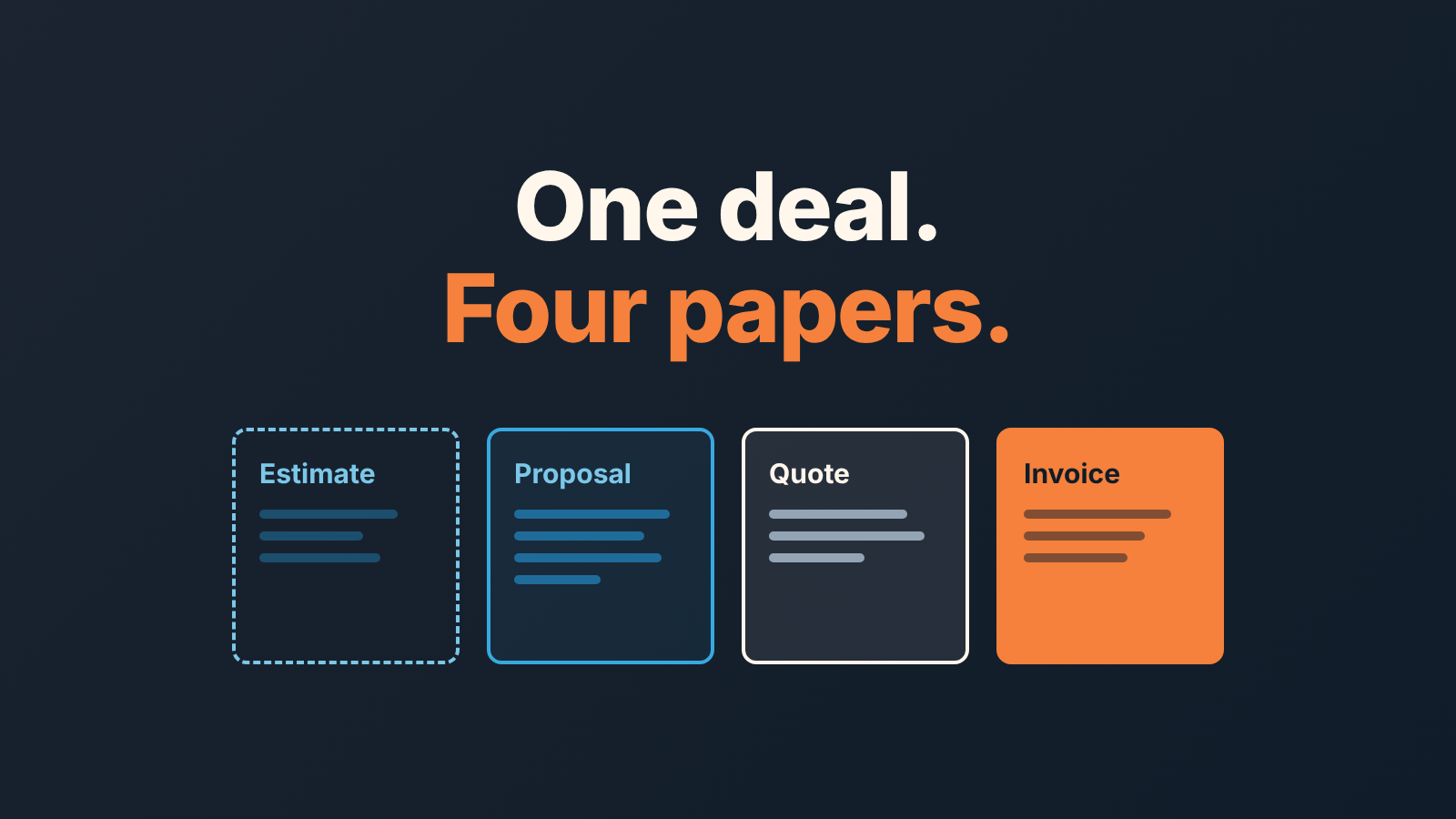
A proposal sells the idea, a quote, or quotation, fixes the price, an estimate is a non-binding guess and an invoice asks for payment. In the CRM they belong to four different moments of a deal, and the deal amount should change only when the document type does. Most of the confusion we see in small sales teams is not about what the words mean. It is about a deal sitting in “Proposal sent” with an estimate’s number in the amount field, or an invoice going out before anyone accepted the quote.
The pages that rank for this question explain the difference the way an accountant would; this one is about which stage, which field and what it does to the forecast.
The four documents in one table: quotation, estimate, proposal, invoice
Several pages that rank for “quote vs invoice” use “quotation” and “estimate” as interchangeable words; Artsyl, for one, treats them as the same document. For a pipeline it is the root of the problem, because an estimate is a number you are allowed to be wrong about and a quote is not. We keep them apart on purpose.
| Document | What it does | Price status | Typical moment in the deal | Deal field it is allowed to set |
|---|---|---|---|---|
| Estimate | Gives the buyer a rough figure so they can decide whether to keep talking | Indicative, expected to move | Early: after discovery, before scope is agreed | None. Note it in the deal, keep it out of the amount |
| Proposal | Argues why the buyer should pick you: problem, approach, options, price | Priced, often with alternatives | Middle: scope agreed, decision not made | Amount, as the option you expect them to take, flagged as proposed |
| Quote | States the exact price and terms you will honor for a set period | Firm until the validity date | Late: the buyer is choosing, and wants the number to stand still | Amount, validity date, payment terms |
| Invoice (also called a bill) | Requests payment for what was agreed or delivered | Final, not negotiable | After acceptance: the deal is won or being delivered | Nothing on the open deal. Invoice fields live on the won deal |
Two rows lean on the sources. A quote is a formal offer with a validity period and a reference number, and it is generally non-binding until the buyer accepts it (Shopify). An invoice is a payment request built on terms already agreed, which is why it leaves no room for negotiation (Artsyl). The proposal and estimate rows are ours. They describe how we think a sales team should treat those two, not a legal definition, and the legal side differs by country anyway.
Who creates each one, and what it commits you to
The estimate is the rep’s document. It comes out of a discovery call, nobody signs it, and it commits you to nothing, which is exactly why reps like giving one early and buyers like asking for one. The trouble starts when the rep writes that figure into the amount field because “the deal needs a number”. Now a guess is in the pipeline report, and the manager reading it can’t tell it apart from a quoted price.
The proposal is still the rep’s, but it carries the company’s name on the approach and the price, so most teams want a manager or whoever owns pricing to look at it first. Nobody signs it either. What it commits you to sits between the other two: if the buyer says yes to option two at the price in the document, you are expected to quote that price.
The quote is where the buyer first touches the paperwork. They accept it by signature, by email or with a purchase order. Shopify notes that a quote may become binding if it is signed as a contract; the rules depend on where you sell, so we treat acceptance as the moment the price stops being yours to change and leave the legal wording to a lawyer. Internally, the quote is the document that needs approval before it leaves, because every discount on it is a discount you will be invoicing at.
The invoice is finance’s document, not sales’. The rep’s job ends at making sure the won deal has everything the invoice needs, and a field that often holds invoices up is the buyer’s PO number. If your buyers run purchasing, the PO number belongs on the deal before anyone raises an invoice, not in an email thread a week later.
Which CRM stage each one belongs to
We keep stage names generic here because the mapping does not change between Pipedrive, HubSpot, Salesforce and Zoho CRM. Only the stage names do. HubSpot and Salesforce quotes also push their total into the deal amount by their own rules: see HubSpot quotes and the deal amount and Salesforce quote sync.
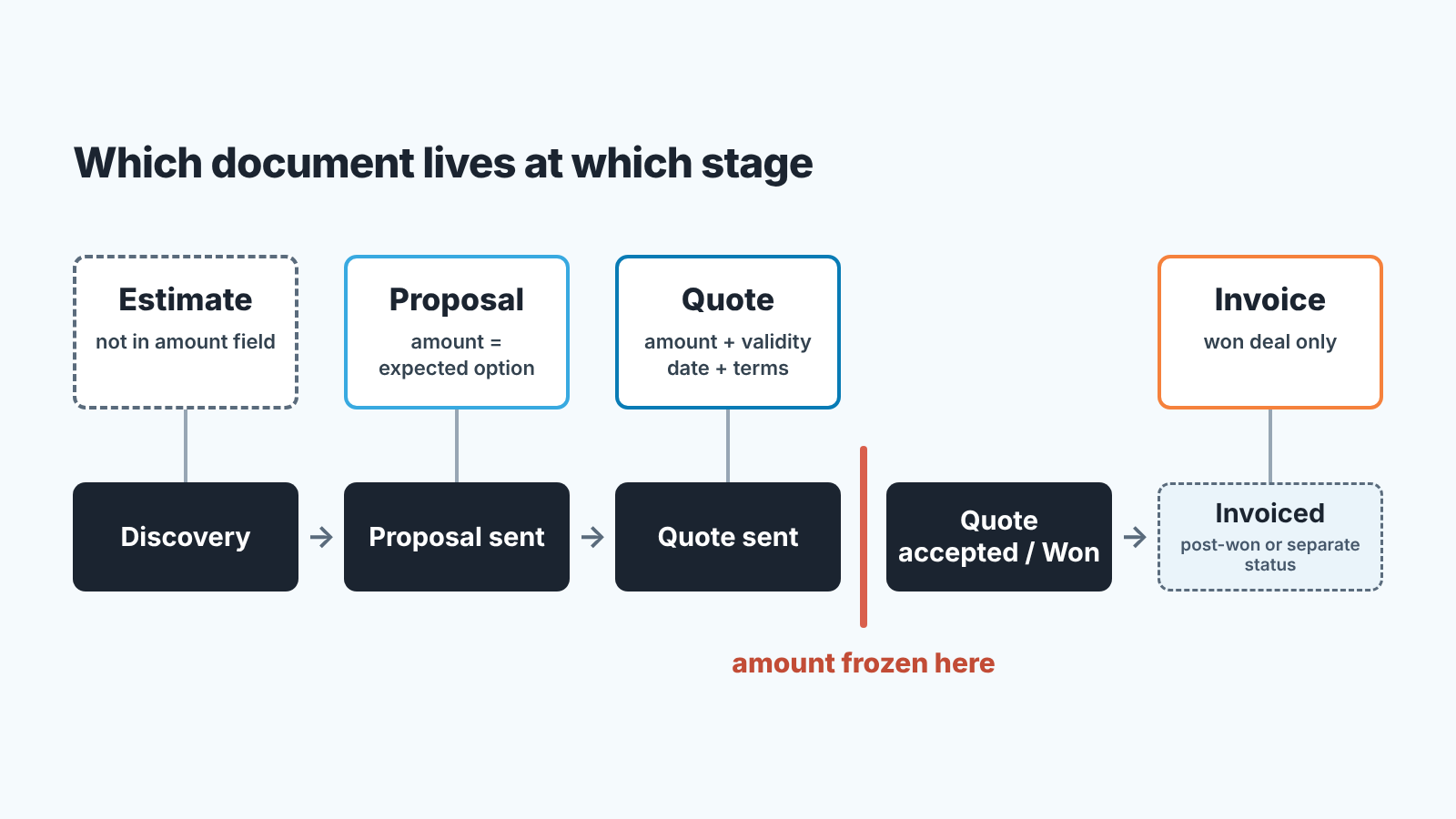
An estimate has no stage of its own. “Proposal sent” means a priced document has gone to the buyer, in writing, and until then the deal stays in Discovery or Qualified.
The proposal moves the deal to Proposal sent. This is the first point where the amount field holds a number a manager can defend, and it should be marked as proposed rather than agreed. Some teams do that with a custom field (Amount status: estimated / proposed / quoted / accepted), some by stage alone. Either works if the report can tell the two apart.
The quote moves the deal to Quote sent, or Negotiation if your pipeline has one. Here the deal picks up its validity date and payment terms, and the amount becomes the quoted figure. A sales order, when you use one, is the confirmed order that follows an accepted quote and comes before the invoice (Erply). In a services pipeline that step usually collapses into acceptance, which is why most CRM pipelines go straight from quote to won.
Quote accepted is the won moment. The price is frozen, the deal closes as won at the quoted amount, and ownership passes to whoever delivers and bills. A quote that expires first gets a decision on the expiry day (quote expiration dates), and a revised price goes out as a new version with its own date, not an edit to the old one (revised quote versions).
A letter of intent that arrives before acceptance is not the won moment; it is a checkpoint on the way to it.
The invoice belongs after won. A post-won stage, a separate pipeline or a pair of fields (invoice date, paid date) on the won deal: that part is a team choice. What we would not do is keep the deal open until the invoice is paid, because that mixes a collections problem into the sales forecast. Won but not paid is a real status and deserves its own list, not a stage in the sales pipeline.
Four fields that quietly break the forecast
Amount is the obvious one. An estimate’s figure in the amount field inflates or deflates the the pipeline by whatever the rep guessed. A proposal with three tiers, entered at the top tier, inflates it again; the deal amount should be the tier you expect to win, and the field logic in good-better-best proposals works the same in any CRM. The rule we hold to: the amount field holds the number on the most recent document the buyer has actually seen. An estimate does not count as a document.
Tax trips up teams selling across borders or to both businesses and consumers. One of the questions Google shows under this search is whether a quotation includes VAT; that depends on your jurisdiction. The pipeline rule is simpler. Decide once, per pipeline, whether the amount field is net or gross, write it in the field description, and never let a quote enter it one way and an invoice the other. A forecast that mixes the two is off by the tax rate on every mixed deal, and each deal still looks plausible on its own.
Validity date exists only on the quote. After the close date it is the most useful date a manager can filter on, because a quote past its validity date with an open deal behind it is a decision nobody made. If the field is not on your deal, add it. A date field, nothing more.
Payment terms appear on the quote and are repeated on the invoice. The forecast cares because terms decide when won revenue becomes cash, and a quote that leaves the building without terms filled in will be renegotiated at invoice time.
The mistakes we keep seeing
Invoice before acceptance is the expensive one. It happens when a buyer says “send me the invoice and I’ll get it approved” and the rep hears a yes. An invoice is built on agreed terms and leaves no room to negotiate, so raising it before acceptance either locks a price the buyer never agreed to or produces a credit note later. Our rule is that the invoice cannot exist while the deal is open. If the buyer needs a document to get budget approved, that is a quote, or a proforma if your finance team uses them. Is a proforma invoice a quotation? In a pipeline it does a quote’s job, so treat it like one.
Quote used as proposal is the quiet one. The rep skips the proposal and sends a one-page price because it is faster. Nothing breaks on the day. What breaks is three weeks later, when the buyer wants to negotiate and the only document you have is one that was supposed to be firm, so every change looks like a concession. Keep the proposal step while scope is open, send a quote once it is agreed.
Estimate treated as price is the common one, and the table above already says why. The fix is not to forbid estimates; buyers need them. Keep them out of the amount field until a proposal exists.
We build SalesBond, a sales management layer on top of the CRM a team already uses; we started with Pipedrive. Deal Health checks every deal in the connected CRM against more than 20 rules and explains what it finds, so if you would rather not run the filters below by hand, you can check your CRM with SalesBond. The filters work without it.
Monday check: three deal filters
Three saved filters, ten minutes, any of the four CRMs.
- Open deals with an amount but no document sent. Stage is Discovery or Qualified, amount is not empty. Every one of these is an estimate in the amount field. Ask the rep where the number came from; if it is a guess clear it, or move the deal to the stage that matches the document that exists.
- Quotes past their validity date, deal still open. Validity date is before today, stage is Quote sent or Negotiation. Each one gets the expiry-day decision: extend, reprice or close.
- Won deals with no invoice date, older than your payment terms: that is a handoff problem rather than a sales one, and the quote-to-cash handoff for a small sales team picks up from there.
If filter one comes back empty two Mondays in a row, your stage definitions are doing thier job and the forecast is built on documents, not guesses.