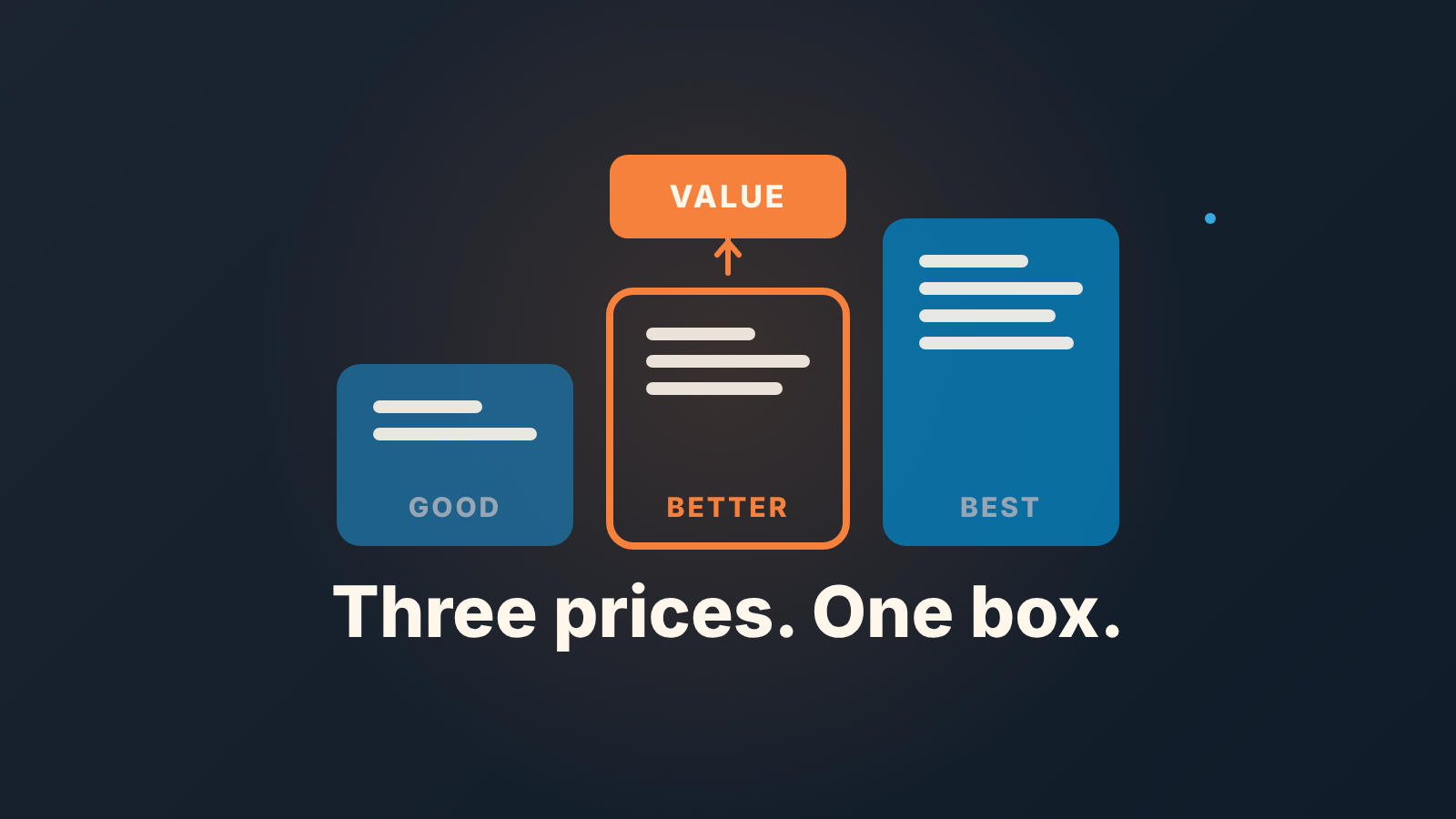
While a customer is still choosing between three packages, the deal value should hold the price of the package you actually discussed with them, usually the middle one. The other two prices go into custom fields on the deal, and you overwrite the value only when the customer picks. That is the whole rule for good better best pricing inside a CRM, and it keeps the forecast honest in both directions: the “best” price does not inflate it, and the “good” price does not drag it down.
Three prices in one email, one cell for the amount
Good better best pricing means offering three packages of rising content and price and letting the customer pick one. This one starts after the proposal leaves.
Picture a proposal that went out on Thursday (made-up scene and numbers, but every manager with a packaged offer has seen it). Good at 4,800. Better at 7,200. Best at 11,000. The rep spent the whole call walking the customer through Better, mentioned Best once, and added Good because the template has three columns.
Now the rep opens the deal in Pipedrive. There is one Value field. It takes one number.
Most teams never decide what goes there. One rep types the top price because it looks good in the pipeline. Another types the bottom one because “that’s what we’re sure of.” A third leaves the old discovery-stage estimate in place. On Friday the manager reads a forecast built from three habits, and nobody can say why the pipeline total does not match the contract that comes back.
Which number goes in the box?
Each common answer breaks a different report.
Put the best price in Value, and every undecided deal is carried at 11,000. When the customer takes Better, as the conversation suggested, the deal was overstated by 3,800 for every week it sat open. Ten such deals in a quarter and the open pipeline was 38,000 heavier than anything you were likely to sign. The pipeline looks great. The rep is also working a deal the system says is bigger than it is.
Put the lowest price in Value, and the forecast is cautious, which sounds responsible. It also breaks average deal size and any conversion you measure by amount, because the won sum arrives higher than the open sum almost every time. A deal the CRM values cheaply gets cheap attention.
The third answer is three deals for one order, one per package. It triples the pipeline for that customer, and when they choose Better, two deals get marked lost. Those are not losses. They are unchosen options, but your win rate cannot tell the difference, and neither can anyone reading your lost reasons later. Of the three habits this is the one that costs the most, because it corrupts the one metric people trust.
Our answer is the middle path, with a condition: Value is the package you discussed, not the package you hope for. Whether that document is a proposal or a quote decides the stage, as in proposal vs quote in CRM stages.
Our rule: the discussed package in Value, the other two in fields
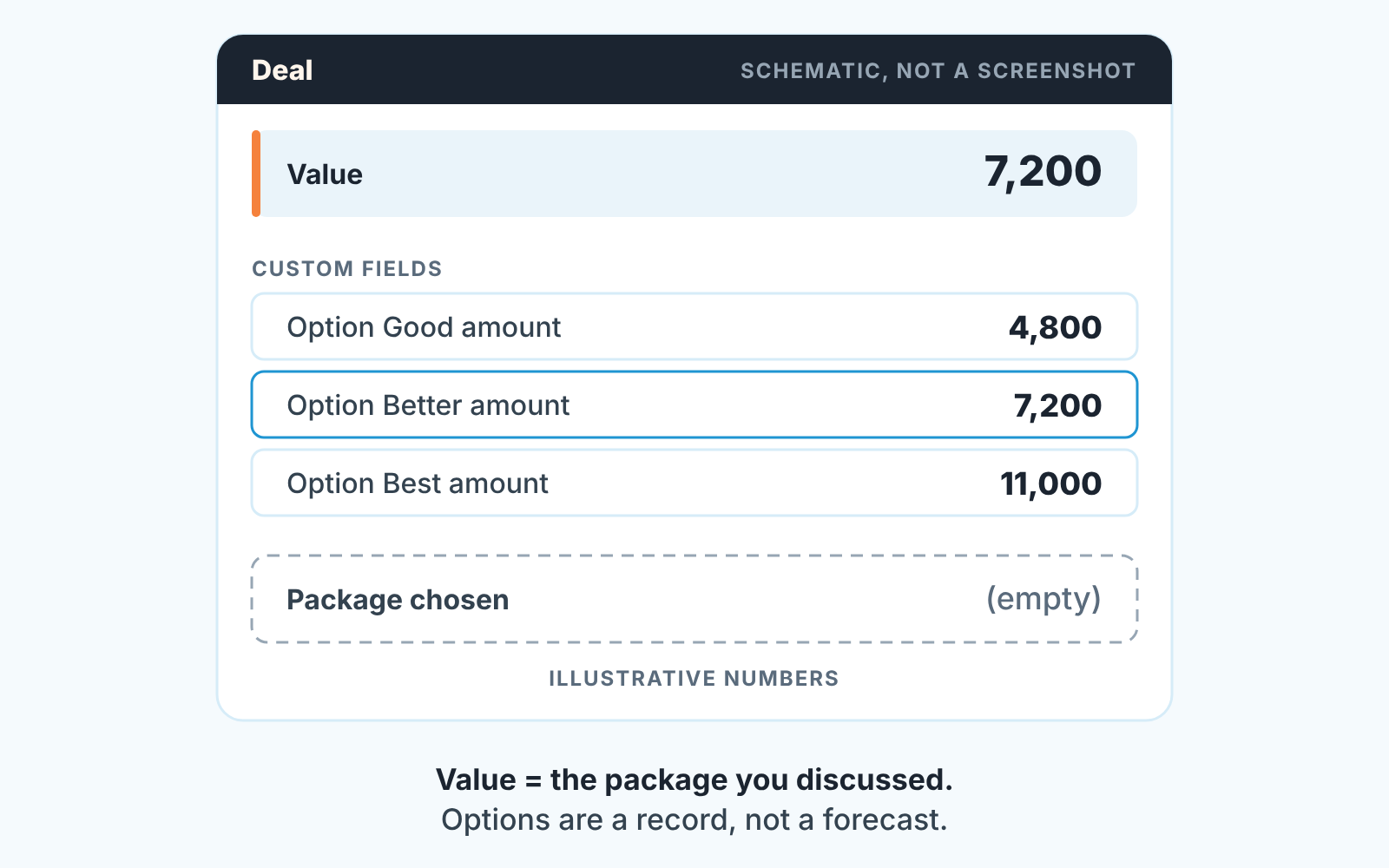
Value is the price of the package the customer and the rep actually talked through; the other two prices sit in custom fields the forecast never reads. Here is the Pipedrive setup.
- Create three monetary fields on the deal. In the account menu, go to Personal preferences > Data fields, pick the lead/deal entity and click “+ Custom field” (Pipedrive: custom fields). Name them
Option Good amount,Option Better amount,Option Best amount. Use the monetary type so the field carries the deal’s currency; if your team sells in more than one currency, the rules in multiple currencies and pipeline totals apply. Adding fields takes the global data-fields permission, so it is an admin’s job, once. - Fill all three the moment the proposal is sent. This is the step reps skip, so tie it to the stage move. Pipedrive can enforce it: a required field can apply to chosen pipelines and stages, so make the three option fields required at “Proposal sent,” and a rep who moves a deal there with an empty field is asked to fill it first (Pipedrive: required fields). Required fields come with the Premium plan and above, important fields (they flag the gap in the deal view without blocking) with Growth and above, per the custom fields help page. Bulk edits, imports and API updates slip past the rule. On a plan without either, make it a team rule and check it in the Monday pipeline review.
- Set Value to the discussed package. 7,200 in our example. Not an average of the three, not the top one.
- Do not link three products to the deal. If you run Pipedrive’s Products feature, linking a product makes Pipedrive calculate the deal’s value from the linked lines (Pipedrive: products). Link all three packages and Value becomes 23,000, a number no customer will ever pay. Link only the discussed package; if the three packages are versions of one service, the price variations described on the same page let you pick the right one. Recurring lines are a separate topic: recurring products vs installments.
- Leave the option fields alone after that. They are a record of what was offered. The choice, when it comes, goes somewhere else.
When the customer answers
The decision goes into Package chosen, a single-option custom field on the deal with four values: Good, Better, Best, Custom. It stays empty until the customer answers, and empty is the honest state of most open deals. “Custom” is for the customer who takes Better plus one item from Best, which happens more than package designers expect.
When the choice lands, the rep does three things the same day. Set Package chosen. Set Value to the chosen package’s price, 11,000 if the customer went up to Best, 4,800 if they came down to Good. Add a note on the deal in plain words: “Client chose Best, was Better.” The note matters because a Value jump with no note looks like a data error to whoever reviews the pipeline next. If the chosen package needs more than one line to describe, write the scope down as a statement of work.
Two edge cases come up every time. Discount first. If the customer takes Best at a reduced price, Value is the price after the discount, because Value is what you expect to invoice. Subscriptions and multi-year contracts are their own question: ACV vs deal value. The discount itself follows your discount policy, and the option field for Best keeps it’s original 11,000 so you can still see what was offered.
Then “they went quiet.” A customer who has not chosen is not a lost deal. Package chosen stays empty, Value stays at the discussed price, and the deal goes through your normal follow-up after a proposal. Mark it lost only when the customer says no to all three, or goes silent for as long as your process allows.
Should Package chosen be required too? Yes, but not from day one, since empty is the correct answer while the customer thinks. Require it at the stage a deal enters after the choice, such as “Contract sent,” and nobody moves a deal forward without recording what was bought. Resist adding a “Not chosen yet” option to the list: a selected option counts as filled, so the rule would wave every deal through. The quarterly review below depends on it.
What the quarter tells you
A single deal with three prices teaches you nothing. Twenty of them start to.
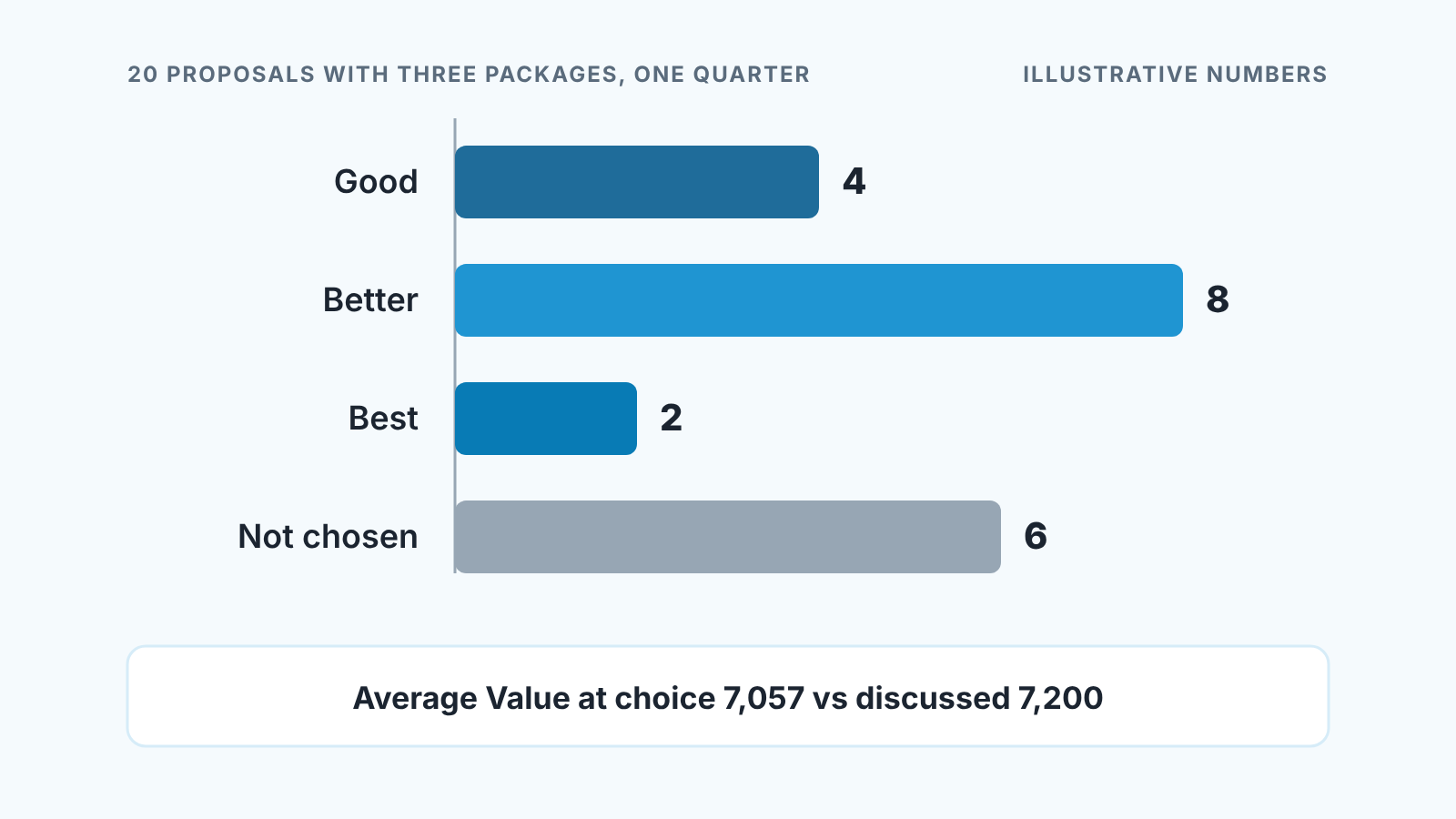
Here is a made-up quarter of the size a small team actually has, so read it as the shape of the analysis, not a benchmark. Twenty proposals went out with three packages. Four customers chose Good, eight chose Better, two chose Best, and six never chose anything. Filter the deal list by Package chosen (custom fields work as list columns and filters and can feed Insights reports, per the same help page), and teh counts are on screen in a minute.
Now the second number. Across the fourteen deals that closed, the average Value at the moment of choice was 7,057. The discussed package in every case was Better at 7,200. Customers moved down more often than they moved up. The question for the sales lead: what did the four Good buyers not see in Better that was worth 2,400 to them? In our experience the answer is usually one line item. The fix is almost never the price. It is moving that one item into Good, or selling it as an add-on, so the step between the packages matches the step in the customer’s head.
Best needs a different reading: two buyers out of fourteen is not a target that works, yet next to 11,000 the 7,200 for Better looked reasonable to eight people. That “the middle package wins” is a popular claim in pricing guides, not a law, and the field data lets you check it on your own customers once there are enough deals to see past the noise.
And the six who chose nothing are not a pricing problem at all. They are proposals without an answer. Pull them out of the package analysis and into the follow-up review. Count them as price losses and you will cut prices for a problem that silence caused.
We build SalesBond, a sales management layer on top of the CRM a team already uses; we started with Pipedrive. Deal Health checks deals against rules, and Sales Plan compares the forecast with the target, and both read the same Value you just stopped inflating, so they are only as honest as the number in that box. If you want to see your pipeline through that lens, check your CRM with SalesBond.
When three packages are the wrong tool
Sometimes three packages were the wrong way to quote in the first place.
A deal worth a few hundred dollars does not need three columns. The customer reads the comparison for longer than it would take them to pay. One price with one optional add-on closes faster and is far easier to record.
A customer in a hurry who asks for “just give me a number” should get a number. Three packages sent in reply to that request read as an evasion. Quote the package you would have discussed and keep the other two for the the follow-up call if it happens.
Packages that differ only in price are a trap. SumoQuote’s guide for estimators lists it among the common mistakes: with the same content in each, the customer simply takes the cheapest (SumoQuote: the good, better, best approach). If your team cannot explain in one sentence what Better includes that Good does not, the proposal template is not ready, and no CRM field will rescue it.
Rewrite the packages first. Then come back to the deal record, where the habit stays the same whatever the structure: write down what you actually expect to invoice.