A business proposal template for a sales team needs six sections: situation, proposed solution, scope, timeline, price and terms, and next step. The proposal is the document where a seller describes the customer’s problem, the solution, the price and the timeline, and the template makes it faster to write. Deals are won by the discipline around it: save the proposal’s version and valid-until date in the CRM, and schedule the next step at the moment you send it.
When we looked at the US search results for “business proposal template” on November 10, 2026, nearly every result was a collection of free files to download. The files are fine. LivePlan’s free template page gives the format as a title page, executive summary, problem statement, proposed solution, timeline, cost breakdown, and a conclusion with a call to action, and on the day we checked it showed 128,713 downloads. Goodocs has a gallery in Google Docs, Sheets, Slides, Word, Excel and PowerPoint formats, with versions for consulting and photography among them.
Those pages stop at the document. A sales team also needs the deal fields and the follow-up routine for the days after it leaves the outbox, and a template in plain text that pastes into any editor.
What a business proposal is, and where a quote or an RFP response fits
A business proposal makes the case for buying: it starts from the customer’s situation, shows what you would do about it, and only then names a price. You write one when the buyer still has to be convinced, or has to convince someone inside the company who never sat in your calls.
Two other documents get mixed up with it in sales teams, and the mix-up costs time.
A quote is narrower. The customer already knows what they want and asks how much, on what terms, until when. Sending a five-page proposal in reply to that question slows the deal down. We covered that document separately in the quote template and the deal fields behind it.
An RFP response is the third case. There the buyer dictates the structure, the questions and the deadline, and your template mostly stays in the drawer. If that is your situation, read how to answer a request for proposal from the seller’s side instead.
So before a rep opens the template, one question on the team call is enough. Does this buyer need an argument, a price, or answers to their own questionnaire?
Six sections that carry a proposal
Situation, proposed solution, scope, timeline, price and terms, next step: those six cover what a buyer needs to say yes in a small or mid-size deal. LivePlan describes a business proposal as three parts (a problem statement, a proposed solution and a pricing estimate) and lists seven elements for the document. We start from the same material and change it in four places, all from watching how proposals actually get read.
We drop the cover page, because a buyer who opens the file on a phone between meetings should see their own problem on screen one. The executive summary folds into the opening section, scope gets a section of its own, and the closing call to action becomes a next step with a named person and a date.
For most deals a small team handles, all six fit on one page, or two if the scope needs a list. We aim for one page because the person who signs often reads a forwarded copy with no context, and a short document survives forwarding with its argument intact.
Business proposal template: six sections to copy
Paste this into Google Docs, Word or whatever editor your team uses, and keep the order. Each section comes with one rule we would enforce in a review.
- Situation. Two or three sentences on what the customer told you is wrong and what it costs them, in their words. If the rep cannot fill this in from call notes, the proposal is early and the deal needs another conversation.
- Proposed solution. What you will do about that situation, written as outcomes the buyer asked for. The feature list goes in an appendix or a link.
- Scope. What is included and what is left out. In our experience the “left out” line heads off more arguments after signature than any other sentence in the document.
- Timeline. Start date, milestones, and what you need from the customer to hit them. Every milestone gets a calendar date or a number of days from signature.
- Price and terms. The total, what it is made of, payment terms, and the date until which the offer stands. A proposal with no valid-until date gives the buyer no reason to answer this month.
- Next step. One action, one named person on each side, one date. “Let us know what you think” does not count.
What does a filled-in Situation look like? A hypothetical example: “Your four field reps log visits in a spreadsheet, so the office hears about a lost order about a week after it happens. Last quarter that delay cost you two renewals you learned about only after the customer had signed elsewhere.” Two sentences, the customer’s numbers, nothing about your product yet.
If you offer options, keep the six sections and vary only scope and price. Our article on a good-better-best proposal shows how to lay the tiers out so the buyer compares them in a minute.
What to record in the deal the moment you send it
Here is where most teams lose track. The proposal sits in someone’s sent folder, the deal sits in a stage called something like “Proposal sent”, and the two know nothing about each other. A manager reviewing the pipeline cannot tell whether the offer went out yesterday or six weeks ago, or whether it has already expired.
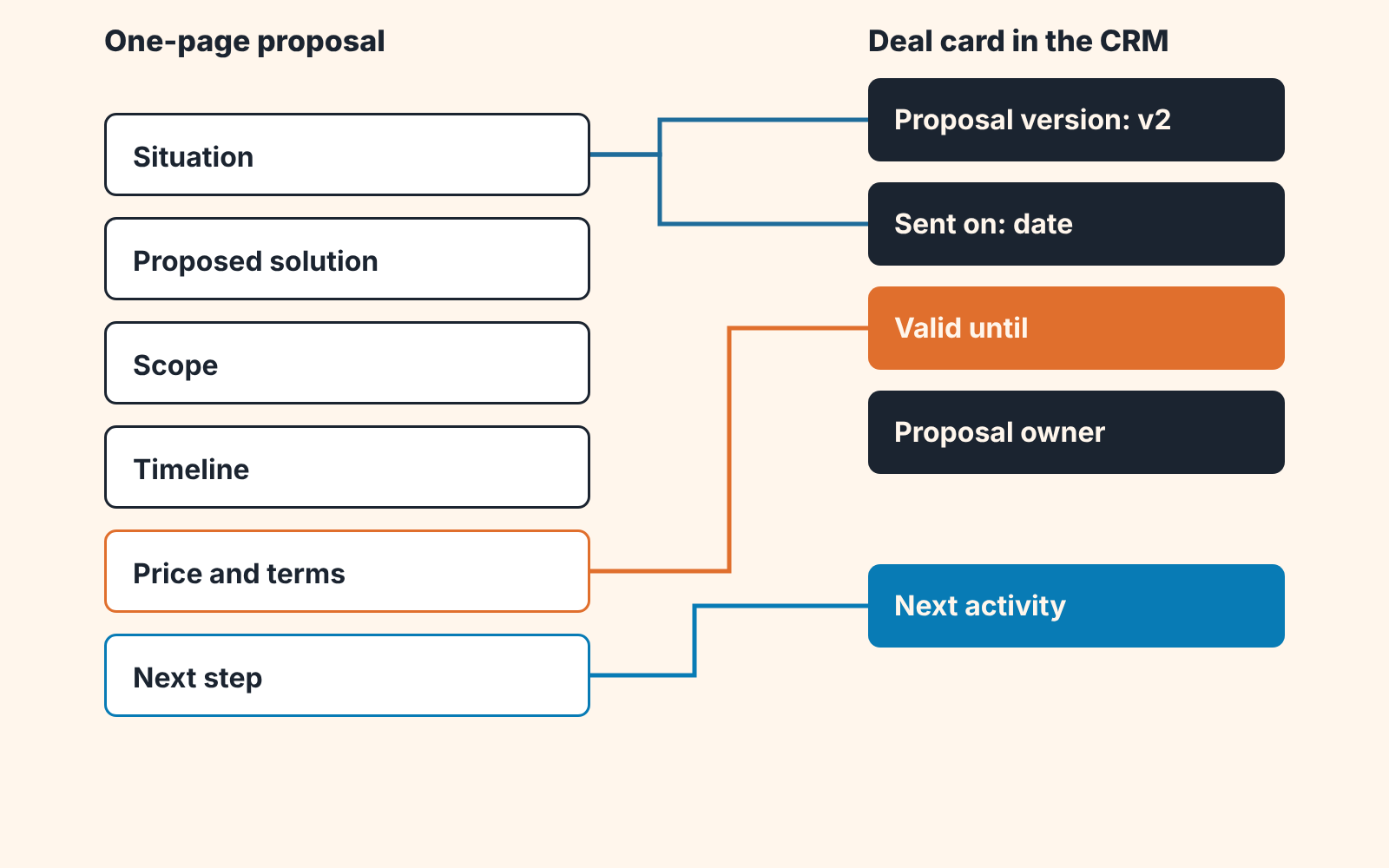
Five entries on the deal fix that. Any CRM with custom fields and activities can hold them, and none takes longer than a minute to fill.
- Proposal version, as a short text or number field. Every change to scope or price gets a new version, including the small ones.
- Sent on, a date field.
- Valid until, a date field copied from section five of the document.
- Proposal owner, if the person who wrote it differs from the deal owner.
- The next activity with a date, created before the rep closes the deal card.
A hypothetical example, with made-up dates: the deal card says version 2, sent on November 17, valid until December 1, next activity “call with the finance lead” on November 20. Anyone on the team can now read the state of that deal in ten seconds without opening the document.
The version field earns its place the first time a buyer says “we agreed on the earlier price”. With v1 and v2 recorded and both files attached to the deal, that conversation is short.
Two more things belong on the deal later. When the proposal is signed, the stage should move the same day, and a recurring check that it did is worth setting up. We described one in the signed proposal and deal stage check. When the deal is lost, fill in the loss reason before closing it and pick it from a fixed list. We use four options for proposal deals: price, timing, went with a competitor, no decision. That is our own choice of fields for a small team, and yours may need one or two more. Keep the list closed, because free-text loss reasons cannot be counted at the end of the quarter.
A disclosure, since we are talking about checks. We build SalesBond, a sales management layer that works on top of the CRM a team already uses. Its Deal Health product checks every deal in the connected CRM against more than 20 rules covering activity, progression, data, ownership and forecast, shows the specific violations and recommends a corrective action for each. Writing the proposal stays with the rep, and Deal Health runs its rule checks on every open deal, so a manager sees the violations without opening each card. If you would rather see the picture once before changing anything, the free CRM audit looks at the last 30 days of your CRM and sends a PDF report with deal health and the pipeline bottleneck in it, then a second PDF seven days later showing what changed. Check your CRM with SalesBond.
When the proposal goes quiet
Silence after a proposal is the normal case. The buyer forwarded it, someone is on holiday, a budget meeting moved. None of that means no.
The routine that works starts before the silence. Because the next activity was created at sending, the rep already has a date, and on that date they call or write with a question that is easy to answer. “Did the scope in section three match what your operations lead needs?” gets replies. “Just checking in” rarely does.
Agree as a team how long a proposal may sit without contact, and write that interval down where reps can see it. In our hypothetical example the first follow-up comes three days after sending. Set your own number, what matters is that it exists and that it lives in the CRM as an activity. For wording and timing of the messages themselves, see how to follow up after a proposal.
The valid-until date gives you one more honest reason to make contact. A few days before it, the rep tells the buyer the offer is about to lapse and asks whether to extend it or revise it. After that date there are only two clean outcomes. Either the buyer wants to continue and you issue a new version with a new date, or the deal is closed as lost with a reason from the list. An expired proposal left in an open deal is how forecasts fill up with money nobody is going to receive.
When you can skip the proposal
Plenty of deals need no proposal at all, and writing one anyway is a common way to waste an afternoon.
Skip it when the customer is reordering something they have bought before. Skip it when they have asked for a price on a defined item, because that is a quote. And skip it when the deal is small enough that an hour of writing is out of proportion to the amount.
The last case needs a line drawn by the manager, otherwise each rep draws thier own. A hypothetical example of such a line would be that deals under $2,000 get a quote and a short email, and everything above gets the one-page proposal. Your threshold will differ. Pick it, announce it, and add it to the stage description in your pipeline so new reps find it without asking.
Mistakes we keep seeing
The most frequent one is sending the proposal as the first serious contact. A rep has a short discovery call, feels momentum, and sends a document whose first section is guesswork. The buyer reads a description of a problem they do not recognize and stops there.
Second comes the edited file with the same name. Price changes, the PDF is overwritten, the version field stays at 1, and a month later nobody can say which numbers the the customer saw.
Third, the next step is left to the buyer. The email ends with an invitation to get back in touch, the deal has no activity, and it sits in the proposal stage until someone cleans the pipeline.
Fourth, the proposal with no valid-until date, and its cousin, the proposal that expired while the deal stayed open at full value.
If you change one thing on Monday, add the valid-until and version fields to your deals and ask every rep to fill them in for proposals that are out right now. The gaps in that list will tell you which deals to talk about first.
FAQ
What is the standard format of a business proposal?
Most downloadable templates open with a cover page and an executive summary, then cover the problem, the solution, the timeline and the cost. For a sales team we use six sections: situation, proposed solution, scope, timeline, price and terms, and next step.
How long should a business proposal be?
For most small and mid-size deals, one page, or two if the scope needs a list. A short document holds up when the buyer forwards it to the person who signs.
How do you follow up after sending a business proposal?
Create the next activity with a date in the CRM at the moment you send the proposal. On that date, ask a specific question about it. A few days before the valid-until date, ask whether the buyer wants the offer extended or revised.