An account executive wins new customers and closes the first deal; an account manager owns the relationship after that and runs renewals and expansion. In a CRM the difference should show up as one rule: who is the record owner before and after Closed Won. If you cannot point at that rule in your pipeline settings or in a one-line team agreement, the two job titles describe people, not how the account is run.
Neither role is “higher” than the other. They are two tracks, measured differently: an AE on new bookings and win rate, an AM on retention, renewals and expansion. Most of what ranks for this question stops at that career view. Breakcold’s comparison, for example, describes the AE as the person focused on acquiring new business and expanding the customer base, and the AM as the one who nurtures existing client relationships and looks after retention (Breakcold: account executive vs account manager). That’s the usual split. Nobody says what happens to the record. We will.
Account executive vs account manager, field by field
Titles vary between companies; one firm’s account manager is another’s customer success manager. So rather than argue definitions, describe each role by the fields it owns, because that is the version you can actually configure.
The new-business deal belongs to the account executive from the first call to Closed Won. The AM isn’t involved, or is at most a follower. The company (or organization) record also stays with the AE, but only until the handoff date, and from that date the account manager owns it. Renewal deals belong to the AM, unless your team runs the “AE keeps it” rule described below; expansion deals usually go the same way, though some teams let the AE keep them by agreement. Customer success, if you have it, rarely owns any of these. CS flags the risk and the AM owns the deal.
The quota lines split the same way. The AE carries new business closed in the period, the AM carries renewal and expansion revenue, and customer success in most small teams is measured on adoption and health rather than revenue.
Notice what’s missing from that list: “relationship”. A relationship isn’t a field, and a CRM can’t report on it. The handoff date, on the other hand, should be a field in its own right. The AE sets it when marking the deal won and the AM’s clock starts there. Most teams skip it and then cannot answer the simplest audit question: when did this account stop being the AE’s?
Where AM ends and customer success begins
The account manager owns money; customer success owns usage. That’s the working line we use, and it matters because in a small team the real danger isn’t missing a role but creating a fourth owner by accident.
In practice the AM is the record owner of the company and of any renewal or expansion deal. Customer success (CS) is a follower on the same records, logs activities and raises a flag when adoption drops, but doesn’t own a deal. The moment CS owns renewal deals, you have two account managers with different titles, and the the renewal forecast is split between two people who each assume the other is on it.
Where there is no CS person at all, the AM covers usage checks too, and the handoff from sales has to carry more context. We wrote down the five fields and one note that make that possible in what a rep must write down before a deal leaves sales. The fields are Pipedrive, the idea is not.
The handoff moment: when does the record owner change
A deal moving to Closed Won doesn’t, on its own, decide who owns the account next. The owner of a deal, a company or a person is a field with a value, and that value changes when a person, or a rule you configured, changes it. So treat “the owner switches at Closed Won” as a team rule you set up and check, not as something the CRM does for you.
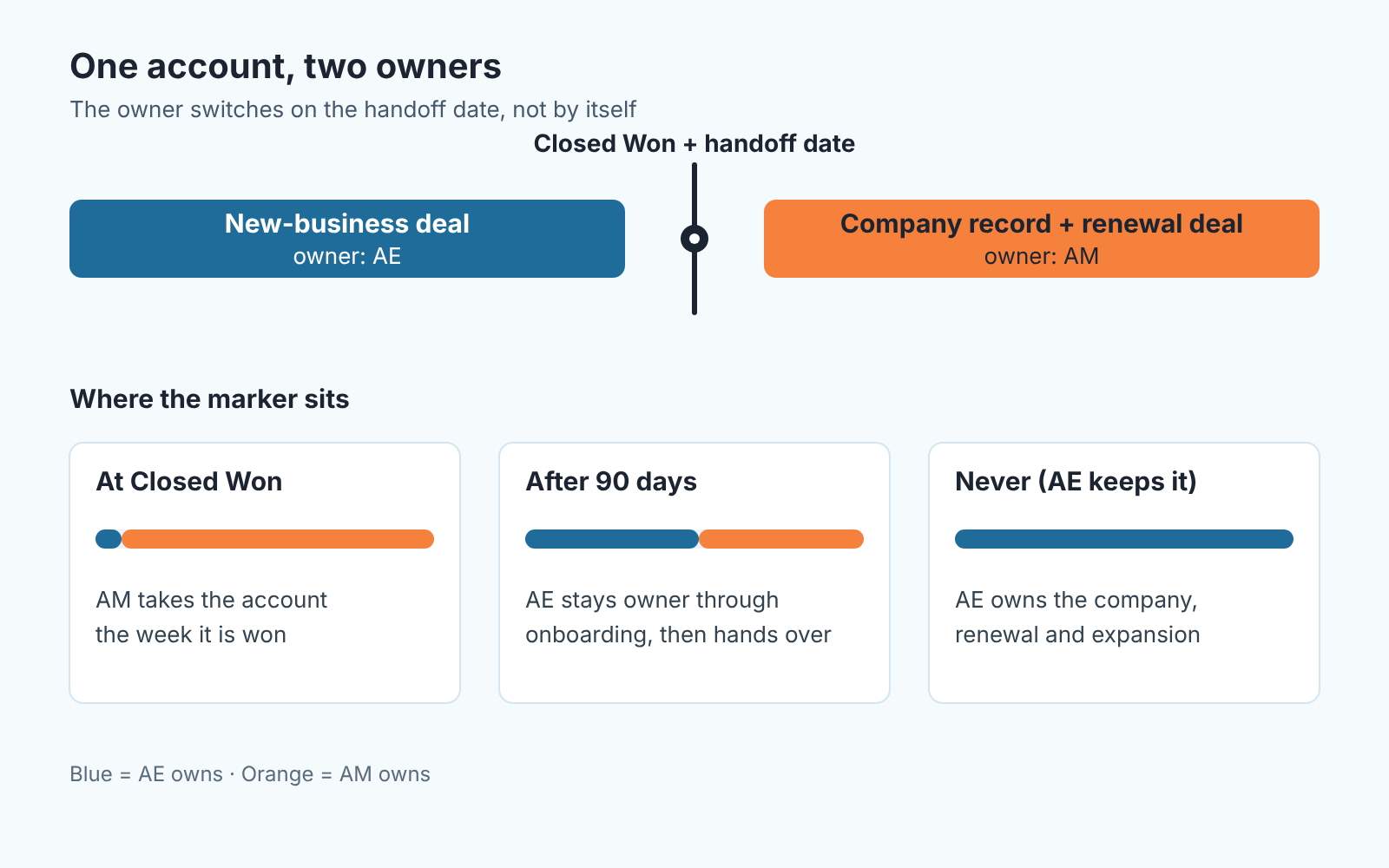
The order we recommend starts before the deal is won. While it’s still open, the AE fills the handoff fields and sets the handoff date; making those fields required at the last stage helps, as long as the team also agrees that deals are won only from that stage, otherwise a deal won early skips the gate. Then the AE marks it Closed Won, and the won deal keeps the AE as owner for good. It is the record of who sold it, and the commission report reads from it. On the handoff date the company record and its main contacts move to the AM, by hand or through an automation your admin builds. Finally the AM opens the renewal deal in a separate pipeline, owned by the AM, with the renewal date as the expected close.
Who sees the account after the switch depends on your visibility settings, so check them before you rely on the rule. Pipedrive’s documentation puts it plainly: “If you own an item in Pipedrive, you have permission to both see and edit it.” Under the stricter “Item owner” setting, the item can be viewed and edited only by the owner, followers, admins of the app and parent visibility group members (Pipedrive: visibility groups). So if the AE should keep reading the account after the handoff, make the AE a follower. Leaving them as owner “so they can still see it” is how renewals end up in the wrong forecast.
Three ownership rules a small team can run on
Pick one. Write it in one sentence where the whole team reads it, and then make the CRM match.
AE keeps it. The AE owns the company record, the renewal and the expansion for as long as teh customer stays. This is the default in a team of three or four with no AM, and it’s honest about that. The cost is predictable: an AE with a growing book spends less time prospecting each quarter, and nobody notices until new business drops. If you run this rule, look at how much of the AE’s week goes to existing accounts every quarter and decide when to hire.
AM takes it at Closed Won. The cleanest rule and the easiest to audit. The handoff date equals the won date, the company owner changes the same week, and the AE never touches the renewal. It works when onboarding is short and the AM can start from the handoff fields alone. It fails when the customer was promised things on calls that never reached the record, which is why the handoff fields come first.
AM takes it after 90 days. The AE stays owner of the company through onboarding and hands over once the customer is live. We like this for products with a real implementation period, because the person who made the promises is the one who sees them kept. The trap is the date. Without a handoff date field, “90 days” turns into “whenever the AE remembers”, and the AM inherits accounts with no history of the first quarter. Put the date on the record on day one and report on accounts past it.
Whichever you choose, “is this account mine?” needs a one-field answer. If it takes a Slack thread, the rule isn’t in the CRM yet.
Quota and commission: who gets credit for the renewal
The money question is the one the career articles avoid, and it’s the reason AE and AM arguments get heated. Our principle: credit follows the deal owner, and the deal owner follows the ownership rule you picked. Pipedrive bakes the first half in, noting that for deals “the owner gets credited for the winning or losing of the deal” (same visibility groups article). Under “AE keeps it”, the renewal counts toward the AE’s number. Under either AM rule, the renewal deal is created and owned by the AM and counts toward the AM’s number. Full stop.
Teams get into trouble with the hybrid. The AM owns the renewal deal, but the AE “still gets a piece” through a side agreement that lives in a spreadsheet. Now the CRM says one thing and payroll says another, and at the end of the quarter someone reconciles the two by hand and gets it slightly wrong. If you want the AE to share in renewals, write that into the compensation plan as part of the commission on the new-business deal the AE does own, not as a claim on a deal they don’t. The pipeline stays readable: one deal, one owner, one quota line.
We won’t give typical percentages or split ratios here. We haven’t seen a public source we would stand behind for small teams, and your margins decide it anyway. Plan shapes that work for teams this size are in sales commission structures for a small team.
One more rule that saves arguments: decide the credit before the renewal deal is created, not when it closes. A deal that changes owner in it’s last week is a dispute waiting to happen.
What to check in the CRM each week
The ownership rule decays. People leave, deals get reassigned for a holiday and never reassigned back, a new rep gets added without the handoff fields. A short weekly check keeps it true, one filter for each of these:
- Companies with no owner, or owned by a deactivated user. Nobody will call them before the renewal.
- Renewal deals owned by someone other than the company’s AM: usually an AE who left or changed roles, sometimes the founder who “just kept a few”.
- Won deals from the last two weeks whose company owner hasn’t changed, if you run an AM rule.
- Companies past the handoff date still owned by the AE (the 90-day rule).
- Companies where the AM is owner but there’s no renewal deal at all. Owned, and still unprotected.
On Salesforce, the same hunt for records nobody owns, applied to leads, is in finding the leads nobody owns in Salesforce queues. The renewal half of the list connects to a renewal pipeline in Pipedrive.
A disclosure, since this is where we would normally talk about tooling: we build SalesBond, a sales management layer on top of the CRM a team already uses; we started with Pipedrive, and today it works with Pipedrive, HubSpot, Salesforce and Zoho CRM. Ownership is one of the rule categories Deal Health checks deals against, so the manager doesn’t have to rebuild every filter by hand each Monday. The company-level filters above are still worth setting up yourself, whatever you use afterwards. If you want to see your pipeline through that lens, check your CRM with SalesBond.
When one person should play both roles
In most teams of three to eight, one person is already doing both. The question is whether to admit it in the CRM.
Admit it. A rep who prospects and also owns twelve renewals should own the company records for those twelve, own the renewal deals in a renewal pipeline, and have the two numbers reported separately: new business closed and renewal revenue retained. The role is one person; the ownership rule and the reports are not. That’s what lets you see, two quarters from now, that the rep closed less new business because the renewal book grew, and that is the signal to hire the first account manager. We looked at the same split from the people side in hunter vs farmer in a small sales team; the CRM side is the fix.
Split the roles when one of two things is true: protecting the renewal book has become a full-time job, or new business is suffering and you can see it in the pipeline rather than just feel it. Hire the AM before that and they spend their first months inventing work. Hire later and you’re hiring to recover churn you could have prevented.
So the thing to set up this week is not a hire. It’s a handoff date field, an owner rule written in one sentence and the first of those five weekly filters.