A COO (chief operating officer) is the executive who runs the company day to day so that the owner, usually also the CEO, can spend their time on strategy, customers and sales. In a small business of 10 to 60 people the owner usually does that job, with the sales manager picking up the pieces that touch deals, until the CRM shows the strain, such as a forecast built by hand, won deals waiting days before delivery hears about them, or a pipeline nobody owns. At that point the owner chooses between hiring a COO, promoting the sales manager, or hiring an operations lead.
What does a COO do?
A COO runs the company’s daily operations and turns the CEO’s plan into how work actually gets done; in most companies the COO is the second in command (Rollins College Crummer: COO vs CEO). The split with the CEO is simple to state: the CEO sets the long-term strategy, the COO carries it out through day-to-day operations (Azeus Convene: COO vs CEO).
Those sources describe a company with a board, a leadership team and a planning cycle. Most of our readers run a company where the “strategic plan” is a page the owner wrote in January and the leadership team is four people in one room. At that size the second person in the company owns four things.
Delivery of what sales promised. The deal is won, the customer is waiting, and someone has to make sure the work starts on the date and with the scope the rep wrote in the CRM.
The handoffs between teams. Lead to rep, won deal to delivery, project to renewal. Work falls on the floor at every joint, and the COO is paid to watch the joints rather then the teams.
The operating rhythm: which meeting happens when, which report exists, who reads it , what changes because of it.
The owner’s calendar: everything that is not strategy, selling or hiring. Kamyar Shah, a consultant who works with companies in the $1M to $10M range, says founders confuse the COO with an operations manager or a chief of staff, while the real job is to build process and remove the bottlenecks that run through the founder (Kamyar Shah: what a COO actually does in a $1M to $10M business). That is one consultant’s view. In our experience, though, the stalled thing in a company this size usually has the owner’s name on it.
If you read that list and thought “that is me, plus whatever the sales manager does on Fridays”, you are the COO of your company today. The question is whether you should be.
COO vs CEO vs CRO vs sales manager: who answers for which number
The titles overlap in a small company because the people overlap. The clean way to separate them is to ask which number each role answers for when it misses.
| Role | Answers for | Reads in the CRM | Typical owner in a 10–60 person company |
|---|---|---|---|
| CEO (usually the owner) | The company’s direction and the target for the year | The owner’s view: plan, forecast, gap | The owner |
| COO | Whether the company delivers what it sold, on time, with the process surviving the owner’s absence | Won deals waiting for delivery, handoff dates, which stage every pipeline stalls in | The owner, by default |
| CRO | One revenue number across new sales, renewals and expansion | Revenue by source, renewals pipeline, the whole forecast | Nobody, usually; see do you need a chief revenue officer in a small company |
| Sales manager | New business closed this quarter against quota | Pipeline by rep, stale deals, next activities, conversion by stage | The sales manager |
Read the COO row twice. A COO does not own the revenue number; that belongs to the CRO, or in a company without one, to the owner and the sales manager together. The COO owns the question “did we do what the CRM says we sold?” A sales manager who chases the project team about start dates is doing that job on the side, and the CRM shows it as deals won on paper and not started in fact.
Here the sales manager is whoever runs the reps and the pipeline, whatever the title; where that role ends and a sales leader begins is covered in what a sales leader owns and the numbers to check weekly in the CRM.
Six signs the owner is still the COO
Hunt Club, an executive search firm, says a COO is usually found in big enterprises, that a startup of two or three people working out of a garage does not need one, and that it may be time to add one once the company reaches 50 or 100 people and operations become overwhelmingly complex (Hunt Club: CEO vs COO). Most of our readers sit between those two pictures, and headcount will not decide it. Where the owner’s week goes will, and the CRM shows it.
The owner builds the forecast by hand. The reps update deals, the sales manager cleans them up on Friday, and then the owner exports the pipeline to a spreadsheet and fixes close dates and amounts from memory. Count the hours. If the forecast can’t be produced without the owner at the keyboard, the owner is doing an operations job, and not even the right one.
Won deals sit before delivery starts. Sort won deals by close date and, for each one, find the date the project, the shipment or the onboarding actually started. The gap is the handoff. If nobody can show the second date because its stuck in a chat thread, that is the sign.
The sales manager is the one who chases delivery. They will do it, because their customer is waiting and thier commission depends on it. Every hour spent asking the project team “has this started?” is an hour not spent on the pipeline you pay them for.
Nobody owns the pipeline as a whole. Ask out loud at the next meeting who owns renewals, or the upsells the delivery team raises. Silence is the answer.
Process changes die when the owner stops pushing. Every won deal gets a kickoff call within a week, for a month. Then the owner spends ten days at a trade show and the CRM shows eleven won deals with no kickoff.
The owner’s calendar is reactive. Count how many of last week’s meetings the owner called, and how many were called by someone who needed a decision only the owner could make. When the second number is larger, the owner is the bottleneck Kamyar Shah describes.
Three or more of these, and the owner is the COO and should either accept the title or hand it to someone. One or two, and the fix is usually a report and a rule, which is cheaper than a hire.
Hire a COO, promote the sales manager, or hire an ops lead?
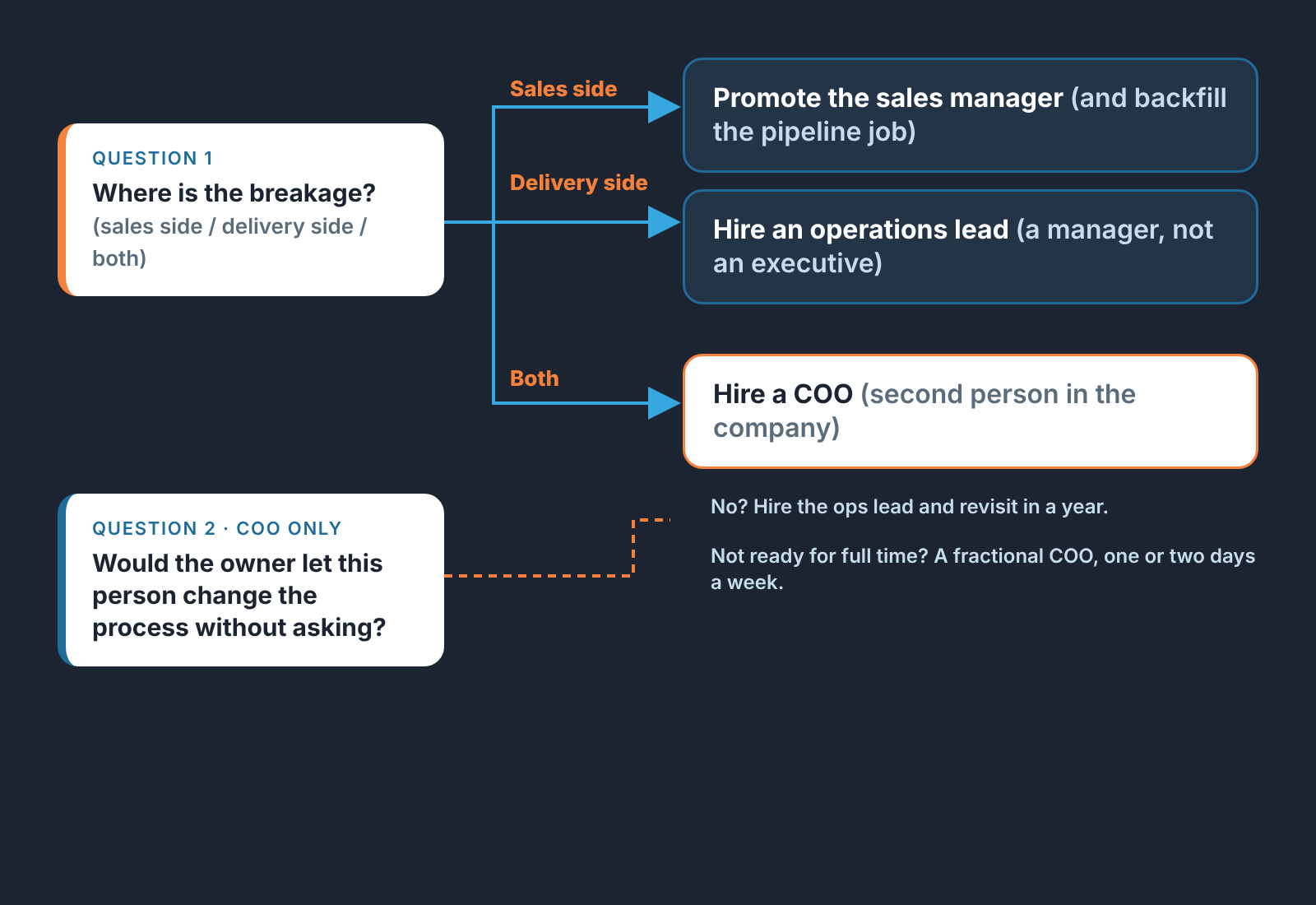
Two questions decide it: where is the operations problem, and who already has the owner’s trust.
Start with the breakage. If the signs are mostly about sales (the forecast, pipeline ownership, the sales manager chasing delivery), the fixer should understand deals. If they are mostly about delivery (won deals waiting, process dying without the owner), selling skill does not help.
Then ask who the owner would let make a decision without asking. A COO who has to check with the owner before changing the kickoff process is not a COO. They are an expensive operations manager, which is exactly the confusion Kamyar Shah warns about.
Promote the sales manager when the breakage is on the sales side, the sales manager already runs the team on process rather than on heroics, and you can backfill the reps-and-pipeline job within a quarter. Don’t do it if their strength is closing: you will lose a closer and gain a reluctant administrator. How they run the pipeline review is a good test; the checks in managing sales managers: the weekly CRM pipeline review show whether they manage the process or the deals.
Hire an operations lead when the breakage is on the delivery side, the owner is willing to keep the strategic and commercial decisions, and the company does not yet need someone who can run the whole business for a month unattended. The job sits at manager level, and at the smaller end of the range it is the cheapest fix and most often the right one. If the person would own the CRM, the sales process and the reports rather than the company’s operations, that is a different hire: see when a small team needs a sales operations manager.
Hire a COO when the breakage runs through both sides, the owner wants out of all daily operations, delivery included, and is prepared to let someone else change how the company works. That is the Rollins definition in full: second in command, executing the plan. If you are not ready to let a second person be second, hire the ops lead and revisit in a year.
There is a path between the last two. A fractional COO is an experienced operations executive who sits in the COO chair part time, typically one or two days a week, builds the system and coaches the team to run it (Kamyar Shah: the fractional COO). Kamyar Shah sells this service, so read his case with that in mind. We think it fits when the breakage runs through both sides but the company can’t yet carry a full-time executive. It fits badly when the real gap is someone in the building every day to chase kickoffs.
One thing we believe and can’t prove with a study: at this size the written list of what the person owns matters more than the title. Write it from the table above before the interview.
What a COO reads in the CRM
Whoever takes the job doesn’t need a new system. They need the existing CRM, read differently. The sales manager looks at the pipeline by rep. The COO looks at it by owner and by handoff.
Pipeline by owner, including people who are not reps. Group open deals by who owns them, including the ones held by the owner, the delivery lead and whoever handles renewals. Often the owner still holds a handful of the largest deals and has not touched them in weeks. That is a forecast problem and an operations problem at once, and the COO is the person who can say so to the owner.
Where each pipeline stalls. Every pipeline has a stage where deals sit longest. In sales that is a coaching question for the the sales manager. In the delivery or renewal pipeline it is the COO’s question, and usually the answer is a person.
The other two readings are signs one and two, turned into a weekly habit. The won-to-delivery gap needs a date field and a required kickoff task after “won”, or it stays a feeling. The forecast the COO reads but does not own: four projects starting next month against capacity for two is the COO’s problem a month before it is the customer’s.
We build SalesBond, a sales management layer on top of the CRM a team already uses; we started with Pipedrive. The Owner Dashboard and the Sales Dashboard are built for this reading: plan, forecast and gap on one side, per-rep execution on the other, with Deal Health flagging deals that break the rules you switch on, like a deal with no next activity scheduled or an expected close date that has passed. To see whether your CRM can answer the COO’s questions at all, start with the free CRM audit: SalesBond looks at the last 30 days of the connected CRM and sends a PDF with money at risk, the pipeline bottleneck, deal health and what to fix, then a second PDF a week later showing what changed. Check your CRM with SalesBond. Run it before you open the vacancy to see whether the data a COO needs is in the CRM or in people’s heads.
The first 90 days: what to measure before and after
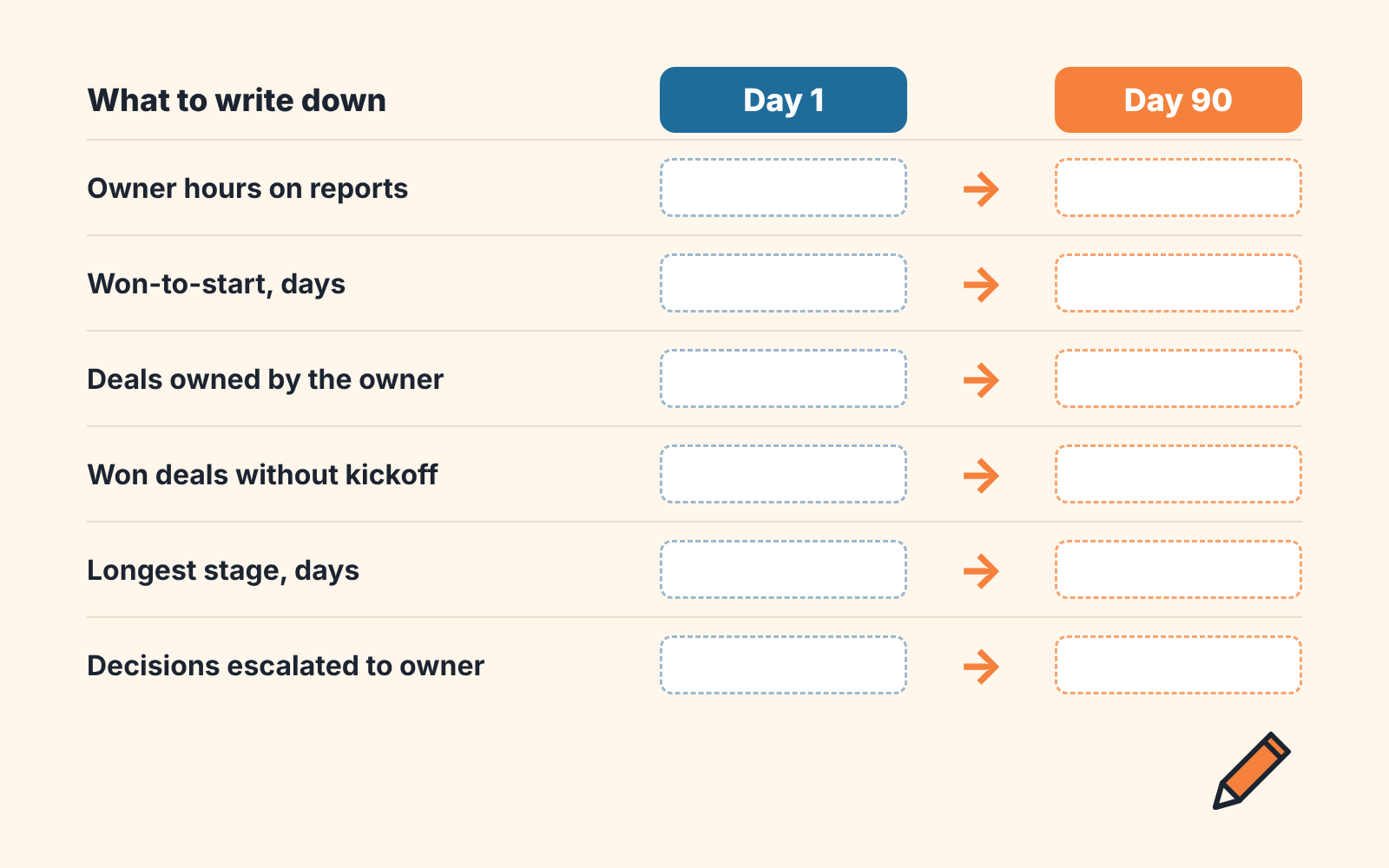
We won’t give you a scorecard with targets. None of the sources here publish benchmarks for a COO’s first quarter in a small company, and an invented target is worse than none. What we can give you is a list of measurements for week one, so that at day 90 the owner and the new COO look at the same before-and-after instead of arguing about whether things feel better.
Take these from the CRM in the first week, write them down with the date, and take them again at the end of the quarter:
- Hours per week the owner spends producing the forecast and other recurring reports. Self-reported, honestly.
- Days between won date and delivery start for every deal won in the last 90 days, median and worst case.
- Open deals owned by the owner, and days since the last activity on each.
- Won deals with no kickoff task, or whatever your equivalent of “delivery has acknowledged this” is.
- The stage in each pipeline where deals sit longest, and how long.
- Decisions last week that reached the owner because nobody else was allowed to make them.
Keep the six lines on one page with both dates. If the COO’s work is real, the first four move visibly and the last one moves most. If none of them move the problem was not operations or the person is not a COO, and ninety days is the right moment to say so.
One warning: don’t let the new COO rebuild the CRM in the first 90 days. The measurements above work on the pipeline you already have. And the weekly checks a sales manager already runs, like the ones in sales manager responsibilities and the weekly CRM check for each, do not move to the COO. They stay with the sales manager, and the COO reads the result.
FAQ
Is a COO the same as an operations manager? No, and the confusion costs companies a hire. An operations manager runs a function the owner has already designed. A chief operating officer (COO) designs how the company runs and is accountable for the whole of it, as the second in command (Rollins College Crummer). If you want someone to run what you built, hire the manager; it is cheaper and they will be happier.
Can the sales manager and the COO be the same person? For a while, at the small end of the range, yes; it is often how the role starts. It stops working when the pipeline and delivery both need full attention. When the sales manager starts skipping their own pipeline review, split the job.
What about a fractional COO? It is a part-time COO, typically one or two days a week, who designs the system and coaches your team to run it (Kamyar Shah). It makes sense when three or more of the six signs are true but a full-time salary is not. Use the same 90-day sheet.
What is the difference between a COO and a chief of staff? A chief of staff works for the founder: priorities, meeting prep, special projects. A COO works for the business: they own its operating system and answer for its performance (Kamyar Shah).
What does a COO earn in a small company? We won’t put a figure here: none of the sources we checked give a salary for a company of this size. Take the range from a current salary survey for your region and compare it with the cost of the owner’s hours from the six-line sheet.