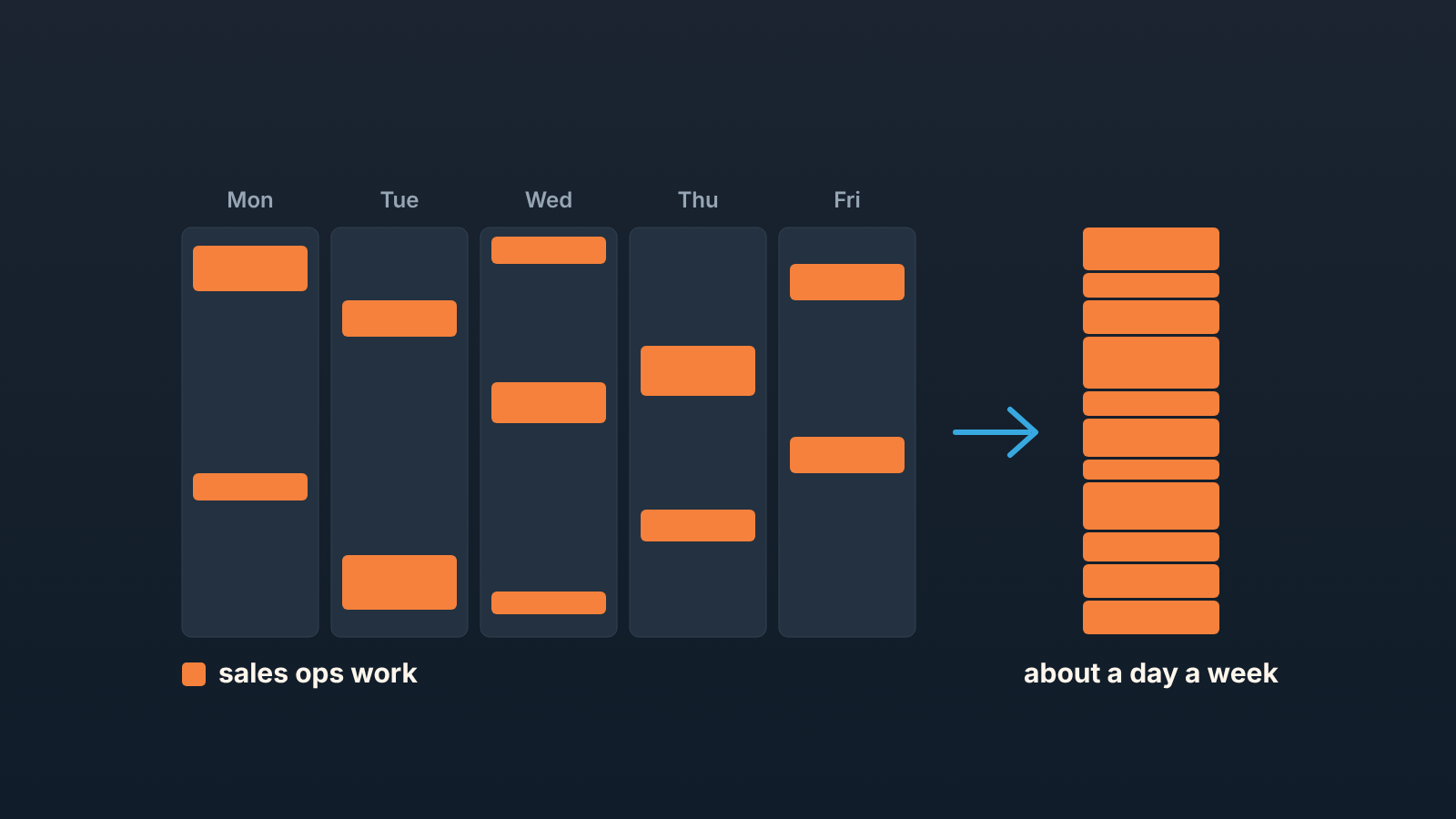
A sales operations manager keeps the sales system running: CRM setup, reports, the forecast process, lead routing and incentive calculations. In a team of 8-20 reps the role is justified when those tasks take the head of sales more than about a day a week. Until then a template, a part-time owner of the CRM or an outside admin covers it, and the hire can wait.
That “day a week” is our own working threshold, with no industry number behind it. Most of this article is about measuring where you are against it.
What a sales operations manager does in a team of 8-20 (and what an analyst does)
We defined the function itself in sales operations for a small team. This one is about the person: whether you need one, and what to do with the work until you do.
Search for the title and you get job descriptions written for a company with a hundred reps. Apollo’s version runs from designing lead-to-close workflows and implementing the CRM to forecast accuracy models, lead assignment rules and quarterly business reviews (Apollo: sales operations manager job description). Salesforce splits the title in two: the manager turns executive direction into day-to-day processes and tools, the analyst uses CRM data to recommend improvements and build performance reports. It also notes that a sales ops team can be one person, and suggests starting with a generalist (Salesforce: what is sales operations).
How is that different from a sales manager? The sales manager owns the people and the number, and sales ops owns the system they work in. Where that person sits is easiest to see on an org chart for a small company with a sales team, and if a smaller first hire is enough, sales coordinator vs sales assistant vs sales support explains who does which CRM tasks.
In a team of 8-20 the generalist already exists. It’s the head of sales, or the owner, doing all of it between calls. The reports are the analyst half, the rules and the process are the manager half, and at this size one person covers both. In our experience the sales manager’s own job description quietly absorbs it until somebody counts the hours.
Six tasks: what a sales operations manager actually does
A sales operations manager in a team of 8-20 owns six tasks: CRM administration, reports and dashboards, the forecast process, lead routing, incentive calculation, and integrations and data. Every team this size does all six, whether or not anyone has been named for them.
- CRM administration. Pipeline stages, required fields, user accounts, permissions, the custom field someone added in March and nobody uses.
- Reports and dashboards. The Monday pipeline view, the monthly summary for the owner, the one-off “can you pull me…” requests that take forty minutes each.
- The forecast process. The routine around the number, meaning who commits what, by when, in which field, and what happens when a deal slips. The mechanics are in capacity planning for a small team.
- Lead routing and territory rules. Who gets the inbound lead, what counts as “mine”, what happens when two reps claim one account.
- Incentive calculation. The commission sheet at month end, the disputes it generates, and the corrections after the disputes.
- Integrations and data. The form that stopped syncing, the duplicates from the last import, the calendar tool that logs meetings twice. The wider list is in the sales tech stack for a small team.
Our sales ops article lists seven duties. That list describes the function and keeps process optimization as a duty of its own; this one counts the work a person would take over, and at 8-20 reps process improvement happens inside tasks 1, 3 and 4.
Task 5 is the one that makes people want to hire, because it’s the one that produces arguments. Before that hire, the manager should be able to check the basics alone, and business acumen for a sales manager sets out what those are.
Count the hours: where the work shows up in your CRM
The sales ops article gives a hypothetical example of the hours. This is the count itself, task by task, from the traces each task leaves in your CRM. No time-tracking app needed.
Take two weeks. For each task, look at who actually touched the thing:
- CRM administration: the change history on pipeline stages, custom fields and automations. Whose name is on the edits?
- Reports: who owns the saved reports and dashboards, and who gets asked for the ones that do not exist yet.
- Forecast: who corrects close dates and deal values before the forecast call, and how many deals they corrected.
- Routing: who gets the message “why is this lead not mine”, and how often.
- Incentives: who builds the commission sheet and who answers the questions about it.
- Integrations: who fixed the last three sync problems.
Next to each task write the hours per week that person spent. A report someone asked for on Thursday afternoon counts, even if it took twenty minutes.
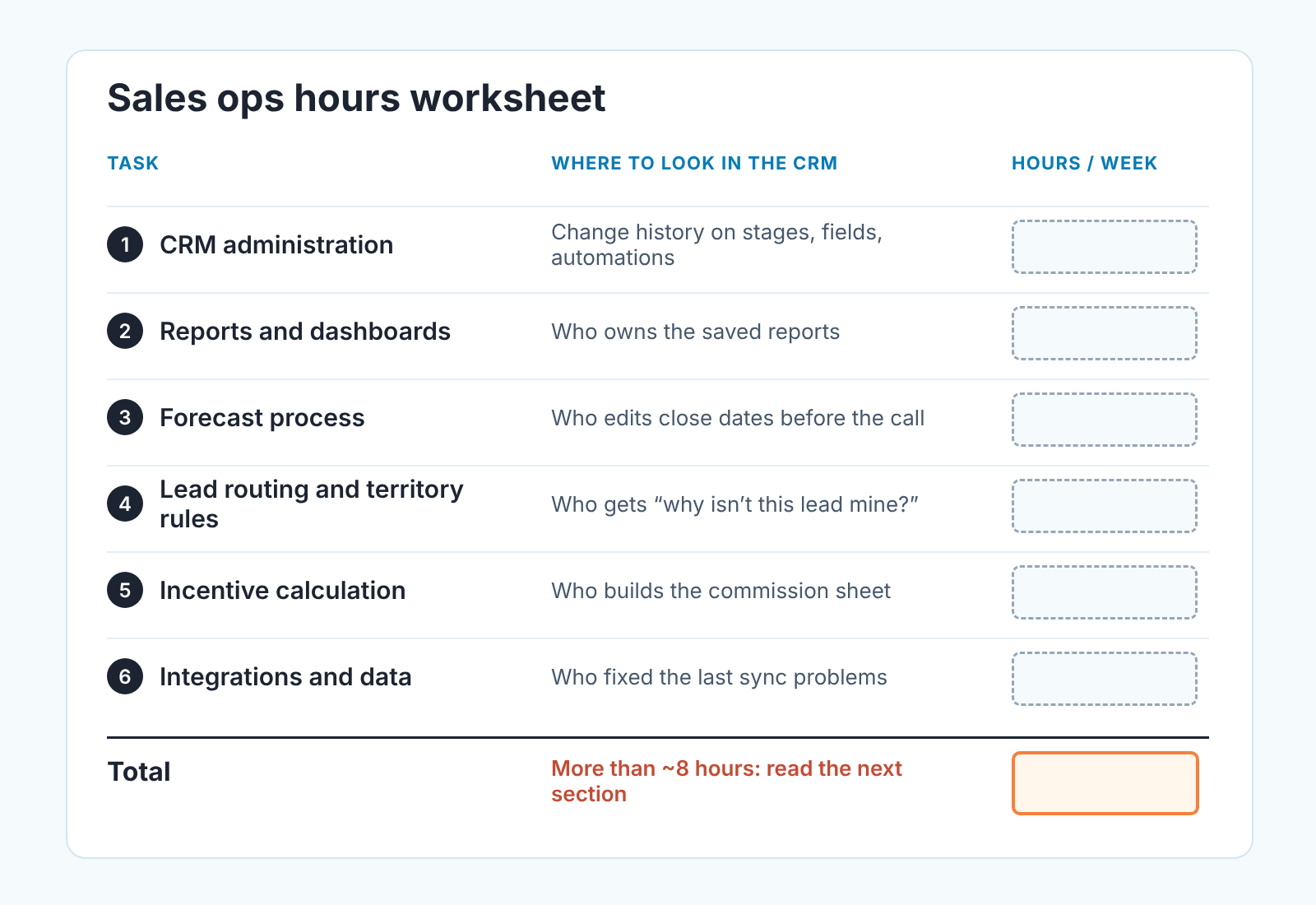
Now add up the column. A few hours a week means the head of sales is doing the job in the margins, and that’s fine. A day a week or more means you already have a sales operations manager. They just also carry a quota, or run the company. If the gap is wider than sales, the question becomes when an owner needs a chief operating officer.
Why a day? Because that’s where the cost stops being invisible. Below it the work fits between calls. Above it the manager starts skipping one-to-ones to build a report, and the team feels the ops work as a missing manager rather then a missing admin. At five or six reps a full day usually means the rules are too complicated. At 8-20 it more often means the work is real.
Three ways to cover the work, from template to hire
Here are three options in the order we would try them. Below about a day a week of ops work, or right on the line, the first two cover it without a full-time hire; the third is the hire itself.
The head of sales keeps it, with a template. One fixed block in the week for ops work, say Friday morning, and nothing ops-shaped outside it. Plus a short written list of what the CRM must have: required fields by stage, the three reports that exist and no others, how a lead is assigned. The template is the point. Without it the hours grow; with it, most of the six tasks become a check rather than a decision.
A part-time owner of the CRM, inside or outside. Inside, a rep or an office manager takes the CRM for a fixed slice of the week, and the head of sales keeps the forecast and the incentive sheet. Outside, it’s a freelance CRM admin or a consultant on a few hours a month. Membrain’s founder and CEO George Brontén argues that on smaller teams the job often isn’t full-time, so the cost of recruiting, onboarding and keeping a full-time employee isn’t justified, and that teams in the middle may be better served by sales operations as a service (Membrain: why you shouldn’t hire a sales operations manager). His company sells that service, so read it as a vendor’s view, though the point about the middle holds. The trap with the inside version is that the rep’s quota does not shrink, and the CRM work loses every time. Cut the quota or it won’t happen.
A dedicated person. The first sales ops hire in a team this size is a generalist who owns all six tasks, and the title matters less than this: the forecast and the commission sheet finally have an owner who doesn’t also carry a number. On day one, the head of sales gets a day back.
When the hours stop falling: signs you need a sales ops hire
A template and a part-time owner bring the hours down for a while. In a team of 8-20, these are the signs they won’t stay down.
The forecast is late more often than it’s on time, and the reason is always the same: the data had to be cleaned first. The commission sheet produces a dispute every month, and the dispute takes longer than the sheet. The owner asks a question about the pipeline that nobody can answer without an export and an afternoon. The team is hiring two more reps this quarter and onboarding each one into the CRM is a week of someone’s time that nobody has.
One of these on its own can be a bad week. When all four show up two months running, the work has grown into a role. If the head of sales is also the person you are about to promote into a VP or director seat, the case is stronger still: the ops work does not follow the promotion, and someone has to catch it.
What to hand over first
Part-time or full-time, don’t hand over all six tasks in one week. Start with reports and dashboards. They carry the lowest risk and give the most visible relief, and the new owner learns the the data by building them. CRM administration comes next, and this is where the template from the head-of-sales option becomes their document instead of yours. Then integrations and data: the sync fixes, the duplicates.
Lead routing waits until they know the data, because every routing change is a fairness question. With the forecast, hand over the preparation and keep the call yourself. Incentive calculation goes last. It touches pay, and whoever calculates it needs to have earned the team’s trust on the other five first.
One thing we would not hand over at all is the decision about which reports exist. The head of sales decides what the team looks at on Monday; ops builds it. If you’re not sure the current set is the right one, audit the CRM automation before anyone rebuilds it.
A disclosure, since reports are where so many of the hours go: we build SalesBond, a sales management layer on top of the CRM a team already uses; we started with Pipedrive. It monitors the health of deals and customers and gives managers and owners a clear picture of execution, forecast and plan, which is one way to take some of the reporting hours off the worksheet before you decide on a hire. Check your CRM with SalesBond. The forecast process and the commission sheet still need a named owner.