
Sales operations is the behind-the-scenes work that keeps a sales team’s process, data and tools in order so reps can spend their time selling. On a small team nobody has that title, and it works out to a few hours a week done by the manager or one organized rep.
That second sentence is the part most definitions leave out. The standard descriptions, like Shopify’s guide to sales operations, describe a department: analysts, a CRM manager, someone who owns territories, someone who owns compensation. If you run five reps out of Pipedrive, that picture is not wrong. It just isn’t yours yet.
So this piece answers the questions a manager of four to ten reps actually asks, in the order they usually come up.
Do we need sales ops at five reps?
You need the work. You do not need the job.
Here is the test I use. Open your pipeline and ask three things. Would two reps describe the same stage the same way? Do deals have a next step and a close date you believe? Could you give a forecast for this month without asking each rep in a DM? If any answer is “not really”, you already have a sales ops problem, and you are paying for it in lost deals and in Monday meetings that turn into data-cleaning sessions.
What you don’t need is a person whose whole week is ops. At five reps there isn’t forty hours of it. There are a few hours of it, and the danger is that those hours never happen because they belong to nobody.
The seven duties, ranked for a small team
Shopify’s article lists seven functions of sales operations, which is as good a map of sales ops responsibilities as any: process optimization, data management and analytics, sales forecasting and pricing, compensation, technology management, territory definition, and lead management. That’s what a mature ops team does. For a small team the order changes a lot, and so does the effort.
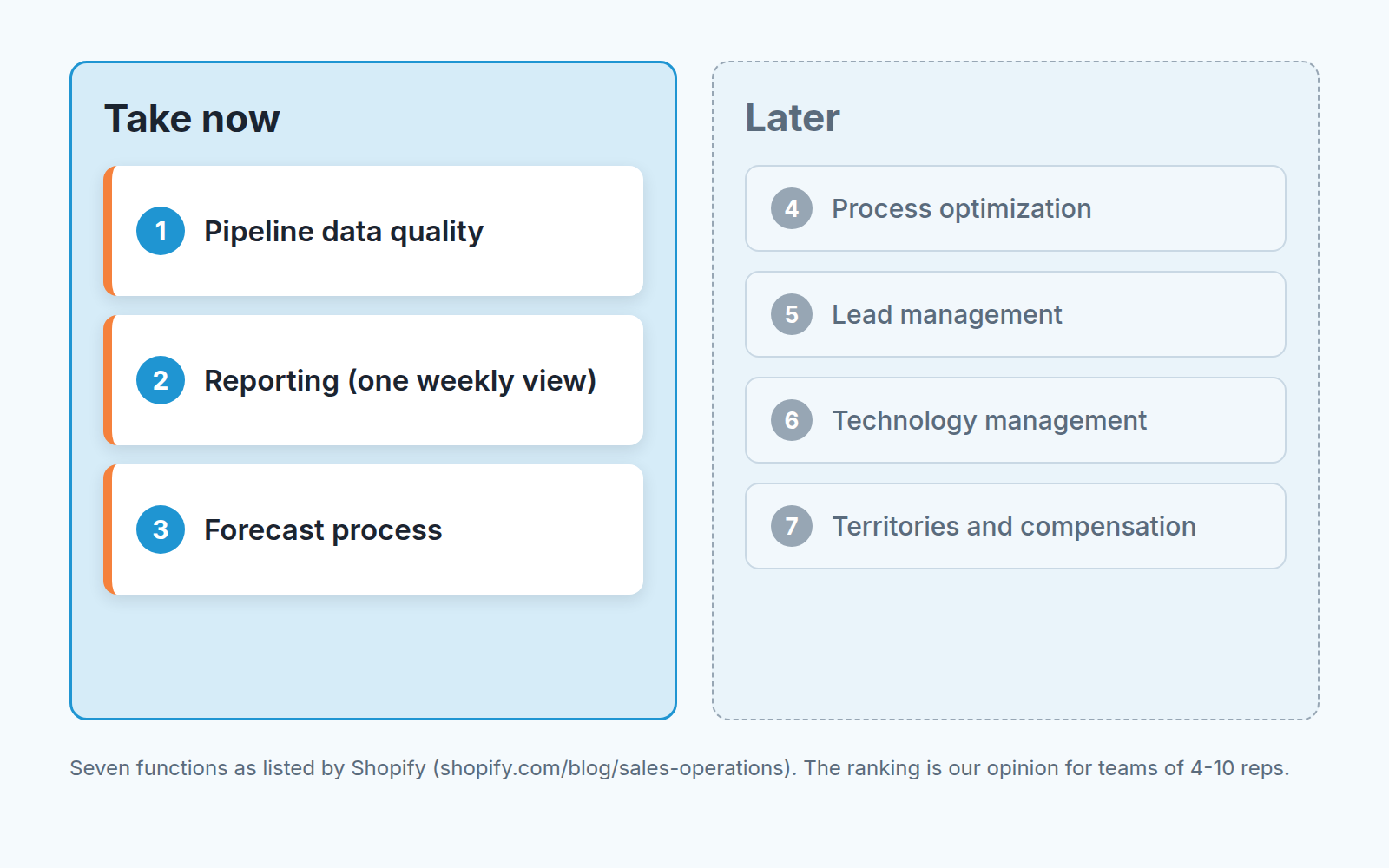
My ranking, with the first three being the ones to take this quarter:
- Pipeline data quality. Stage definitions everyone agrees on, required fields that actually get filled, no deals parked with a close date from last month. Everything below depends on this.
- Reporting. One weekly view the whole team looks at, built from the pipeline, not from a spreadsheet someone rebuilds on Friday.
- Forecast process. A fixed day, a fixed rule for what counts as commit, and a short conversation about the gap.
- Process optimization beyond the pipeline, meaning handoffs, templates and follow-up rules. Worth doing, but only once the data tells you where the leaks are.
- Lead management, which on a small team usually just means “who picks up the inbound lead and by when.”
- Technology management. Mostly a matter of saying no.
- Territories and compensation, which come last and are covered below.
On lead management, we wrote separately about speed to lead in Pipedrive.
Notice that the top three are really one system. Clean data makes the report honest, and an honest report makes the forecast a short meeting instead of a negotiation. If you want a way to measure the first one, we wrote up the CRM data quality metrics we track, and for picking which numbers go in the weekly view, leading vs lagging sales metrics is the place to start.
Who should own it?
Most small teams default to the manager, and most of the time that is the right call, at least for the first few months. The manager is the one who feels the cost of bad data in the forecast, and the manager has the authority to say “a deal without a next activity is not in the pipeline.” Ops work without that authority turns into nagging, and reps learn quickly to ignore a colleague who nags.
The problem is that the manager is also the person with the least spare time. So the pattern I have seen work best is a split. The manager owns the rules: what each stage means, what counts as commit, which fields are required. One rep, usually the one who already keeps the tidiest pipeline, owns the upkeep. That means the weekly sweep for stale deals, fixing duplicates, keeping the report filters from drifting, and flagging when a rule is being ignored. Give that rep a small, explicit slice of time for it and say so in front of the team, otherwise it reads as a favor and quietly stops the first busy month.
One rule worth having early: who reviews a deal with non-standard terms before the rep agrees to them.
A part-time contractor or an agency can make sense for a one-off job, like cleaning a CRM that has years of junk in it or setting up the pipeline from scratch. It works less well as the ongoing owner, because the daily judgment calls (“is this deal really in negotiation?”) need someone who sits in the pipeline review. If you are not sure where your CRM stands before you hand it to anyone, a structured Pipedrive audit is a cheap first step.
What doesn’t work is “everyone owns it.” Everyone owning data quality is the same as nobody owning it, and you will be back to cleaning the pipeline in the Monday meeting.
If you want the split spelled out, who owns which data when there is no ops person covers the rep, manager and admin jobs one by one.
How many hours a week it takes
This is a hypothetical example, not a benchmark. Picture a team of six reps selling a mid-priced B2B service, one manager, pipeline in Pipedrive.
The designated rep spends about an hour on Monday morning going through deals with no next activity or a past close date and pinging the owners. Another half hour on Thursday goes to duplicates and missing fields. The manager spends roughly an hour preparing and running the forecast conversation, plus another hour or so a month adjusting stage rules or report filters when something stops making sense. Call it three hours a week across two people, with a spike in the first month while the rules get written down.
Your numbers will differ. The point of the example is the shape: small, scheduled, split between rules and upkeep. If it is taking a full day a week the rules are probably too complicated or nobody is following them.
What to skip until you hire
Territories are the easiest one to drop. With a handful of reps you can assign accounts by hand, or by a simple rule like round robin on inbound, and revisit it when two reps start fighting over the the same logos. Formal territory design is a solution to a scale problem you don’t have.
When two reps do start fighting over the same logos, here is a one-page way to split accounts without a map.
Compensation plans deserve care, but not an ops process. Write a plan that is simple enough for a rep to calculate their own commission in their head, and change it once a year at most. Modeling scenarios and tracking attainment curves is work for later.
We compared a few simple commission structures for a small team separately.
Tool sprawl is the one I would actively fight. Shawn Khemsurov of the agency Electric Eye told Shopify he has seen stores with 50 apps in use without anyone realizing it. Small sales teams do the same thing with enrichment tools, dialers and sequencing add-ons. Before adding anything, ask whether the problem is really a data or process problem wearing a tool costume. Usually it is.
If you want a way to fight it, a one-hour stack audit maps each tool to the Pipedrive field it owns and who checks it.
Formal lead scoring can wait too. At small volume, a manager reading the inbound list is faster and more accurate than a model trained on too little data.
Sales ops vs sales enablement vs RevOps
People mix these up, so here is the short version. Shopify draws the line this way: sales operations covers the administrative, technical and process side (process, analytics, tools, forecasting, pricing), while sales enablement is about giving reps the resources and training they need, such as skills training, coaching and knowledge about customers. RevOps, or revenue operations, goes a step further: Wikipedia describes it as a function that builds on sales ops by aligning sales, marketing and customer success under one operational strategy. On a team of five, the honest answer is that all three live in the same two heads: yours and your tidiest rep’s. The labels start to matter when you are writing a job description, not before.
Signs it is time for a dedicated hire
You will feel it before you can measure it. The rep who owns upkeep starts losing deals because the upkeep has grown past it’s slice of time. The manager’s forecast prep is eating a morning, not an hour. You have added a second pipeline or a second team, and the stage definitions have started to diverge between them. Someone asks for a report that combines CRM data with billing, and nobody on the team can build it without a week of spreadsheets. New reps take longer to ramp because the process lives in the manager’s head rather than in the CRM.
One of those is a bad month. Three of them at once, lasting a quarter, is usually the signal that the ops work has become a job. Even then, the first hire tends to be a generalist who can own data, reporting and tools together, not a specialist, and the rules you wrote down while it was a three-hour-a-week job become that person’s starting point. That is the real payoff of doing sales ops early and small: when the hire finally comes, they inherit a process instead of a mess. If you want the bigger picture of running a team this way, see managing sales by process.