
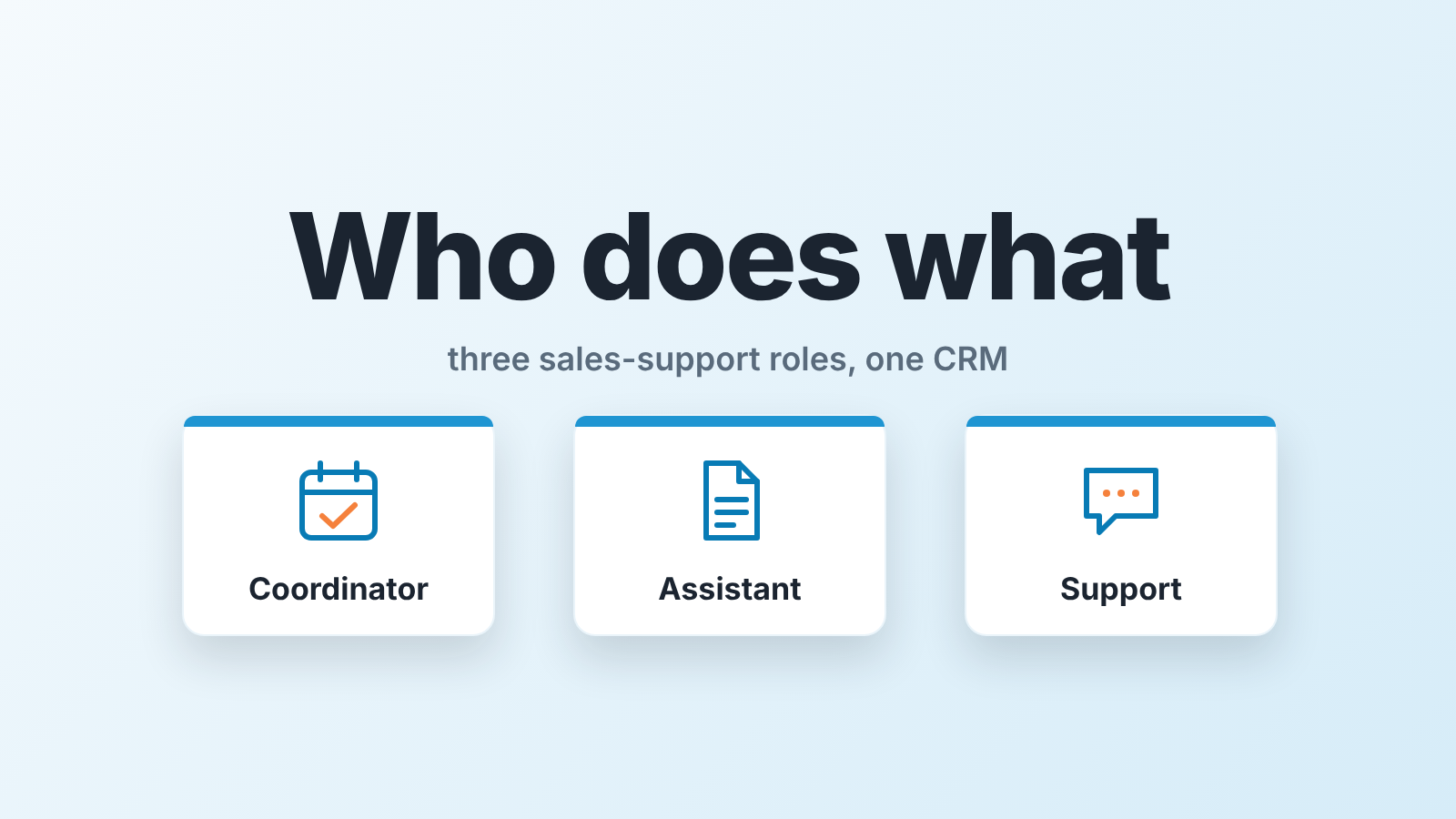
A sales coordinator keeps the sales process on schedule, and a sales assistant handles data entry and documents. Sales support is the slippery title: job ads use it for back-office help to reps before the deal, but the third job we see small teams struggle to cover is looking after customers after the sale. One person often does two of these. Decide by the CRM tasks you want off your reps’ plate, not by the title, and check the result in the data: fields filled, overdue tasks and time to first reply.
Search for any of these titles and you get duty lists and job boards written for the person applying. The person hiring has a simpler question: which of the things my reps do badly or late can I give to someone cheaper, and how will I know it worked?
Three roles by the work they do, not by title
Titles in small companies are mostly accidents, so look at what each role answers for. The same test separates what a sales leader owns versus a sales manager, and there too the answer comes down to numbers in the CRM.
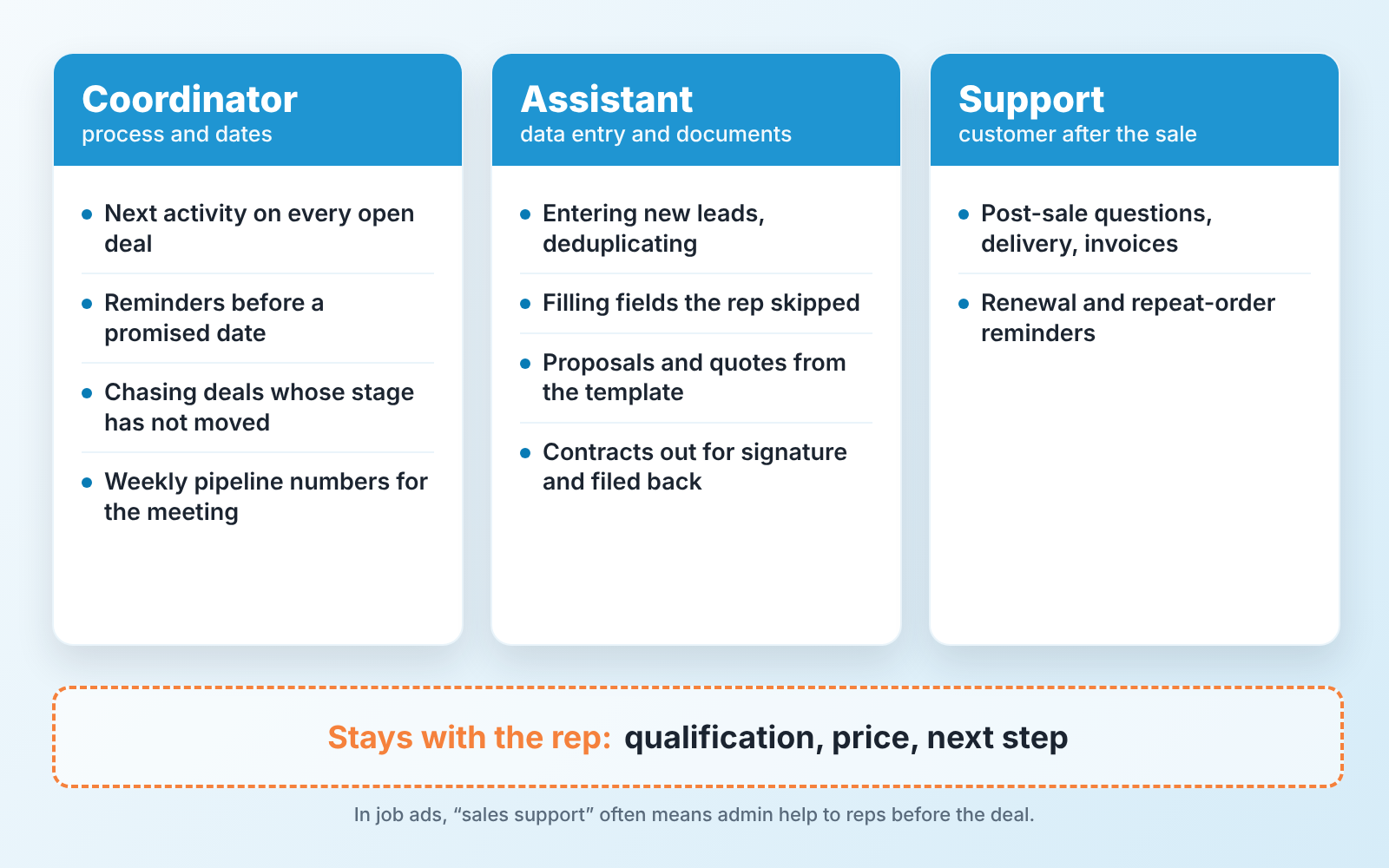
The coordinator owns the process and its dates. If a proposal was promised for Thursday, the coordinator notices on Wednesday that nobody has started it. They chase reps for updates, keep a next step on every open deal and prepare the numbers for the Monday meeting. They don’t sell, but they know where every deal is. Employer templates describe the same core: order processing, sales documentation, coordinating with other departments and helping the reps (AvaHR’s sales coordinator job description).
Is it an entry-level job? Not usually. The same template asks for experience in a sales support or coordination role. We’d hire an assistant for accuracy and train the rest; a coordinator needs to have chased a pipeline before.
The assistant owns the typing. Lead import, the fields the rep skipped, the quote built from a template, the contract out for signature. The assistant works from a queue that someone else defines.
Sales support needs a warning. In job ads it usually means administrative help for reps before the deal closes: quotes, orders, paperwork. AvaHR even lists Sales Support Specialist as another name for a sales coordinator. We use “support” here for the job that starts after the signature (onboarding questions, delivery status, invoice problems), because neither of the other two roles covers it. Post that ad as customer support or account support, or expect a pile of coordinator CVs.
Of the three we’d often hire this one first. An unhappy new customer costs more than a late report.
One person can be coordinator plus assistant, or assistant plus support. We wouldn’t combine coordinator and support. The coordinator’s day runs on the sales calendar, the support person’s on whoever is unhappy right now, and the unhappy customer always wins.
Sales coordinator duties vs assistant tasks: who does what in the CRM
Here is the split we recommend for a team of a few reps on any CRM. The last column matters most: if you can’t check a task from CRM data, you’ll check it by asking, and the hire has added to your workload.
| CRM task | Who does it | How you check it in the CRM |
|---|---|---|
| Entering new leads and contacts, deduplicating | Assistant | Share of new deals with company, contact and source filled on the day they were created |
| Filling fields the rep skipped after a call | Assistant | Required-field completeness on deals that moved stage this week |
| Updating deal stages | Rep moves the stage; coordinator chases the ones that have not moved | Deals with no stage change and no activity for longer than your normal cycle |
| Scheduling the next activity on every open deal | Coordinator | Count of open deals with no next activity |
| Reminders before a promised date | Coordinator | Overdue activities per rep, Monday morning |
| Proposal and quote documents from the template | Assistant, with the rep supplying the numbers | Time from “proposal requested” to the document attached on the deal |
| Contracts out for signature and filed back | Assistant | Deals in the contract stage with no document attached |
| Weekly pipeline numbers for the sales meeting | Coordinator | The report exists before the meeting, built from the CRM, not from a spreadsheet |
| Post-sale questions, delivery, invoices | Support | Open support tasks per customer, time to first reply |
| Renewal and repeat-order reminders | Support, handing warm ones to the rep | Won customers with no activity for a full cycle |
Stage updates are split on purpose. A stage says where the buyer is, and only the person who talked to the buyer knows that. A coordinator who moves stages to make the report look tidy is making your forecast worse.
None of the assistant’s tasks need judgment about the deal. The test is whether a new person could do it correctly from a written instruction and the CRM record alone. If yes, its assistant work. If it needs a conversation with the customer, it isn’t.
What stays with the rep: qualification, price and the next step
Once you have a coordinator it is tempting to let them run the whole process. Don’t. Three things never leave the rep, whatever the support headcount.
- Qualification. The assistant enters the lead; the rep, who has asked the buyer questions, decides whether it’s a deal.
- Price and terms: the discount, the payment schedule, the scope. The assistant builds the quote document, the rep supplies every number in it.
- The next step with the customer. The coordinator makes sure one exists; the rep decides what it is and does it.
A rep who hands off any of these has stopped selling and started supervising. If that’s what you want, you are describing a sales manager, a different job at a different price, and we wrote it up in a sales manager job description built around CRM duties.
Coordinator vs sales ops: when you need a process owner instead
The coordinator runs the process you already have. Sales ops designs it.
If your stages were set up two years ago and never touched, a coordinator will faithfully chase deals through stages that mean nothing, and won’t tell you. With a handful of reps we’d hire the coordinator before any sales ops person, because the owner can design a small process in an afternoon but can’t chase every deal every day. When you find yourself spending evenings rebuilding the CRM instead, that’s the sales ops conversation, and we went through the signals in sales operations manager: first hire or the owner does it. If the hard part is the CRM setup itself, the question is closer to who owns the CRM in a small sales team.
Three checks from CRM data that show the role is working
Don’t judge the hire by how busy they look. The point of the role was to change what the CRM looks like, so look there.
For the assistant, field completeness on new and moved deals. Pick the fields you actually use in reports, count the share of last month’s new deals with all of them filled, and run the the same count a month after the hire. If it hasn’t moved, the queue isn’t reaching the assistant in time.
For the coordinator, overdue activities and open deals with no next activity. Both should fall in the first month and stay down. If overdue activities fall but “no next activity” rises, the coordinator is closing old tasks without scheduling new ones. Ask them to schedule the next activity each time they close one.
For support, time to first reply on post-sale requests, and won customers with no activity for a full cycle: repeat orders nobody is asking for.
Take the baseline before the person starts, or you’ll never know whether the hire moved anything.
A sales coordinator job description in one paragraph
Most posts for these roles are copied from a template. Write yours around the CRM tasks and the check instead. For a coordinator in a small company, a paragraph like this is enough.
You will keep our sales process on schedule. Every open deal in our CRM has a next activity and a realistic close date, and when it does not, you will find out from the rep why and fix it. You will prepare the pipeline numbers for the Monday meeting from the CRM, not from memory, and chase proposals and contracts that are late against the date we promised. You will not qualify leads or set prices; our reps do that. We will judge the role by two numbers: open deals with no next activity, and overdue activities per rep.
Swap the two numbers for the ones in the table if you are hiring an assistant or support. Not sure the role is full-time yet? Count the hours first, the way we did for capacity planning in a small sales team.
A disclosure, since these checks are what we spend our days on: we build SalesBond, a sales management layer on top of the CRM a team already uses; we started with Pipedrive. It analyses deal and customer data, finds risks, explains what needs attention, and helps reps, managers and owners choose their next actions. The checks in this article work in a saved CRM filter just as well; what the layer adds is that nobody has to remember to run them. Check your CRM with SalesBond if you want that list without building it yourself.