
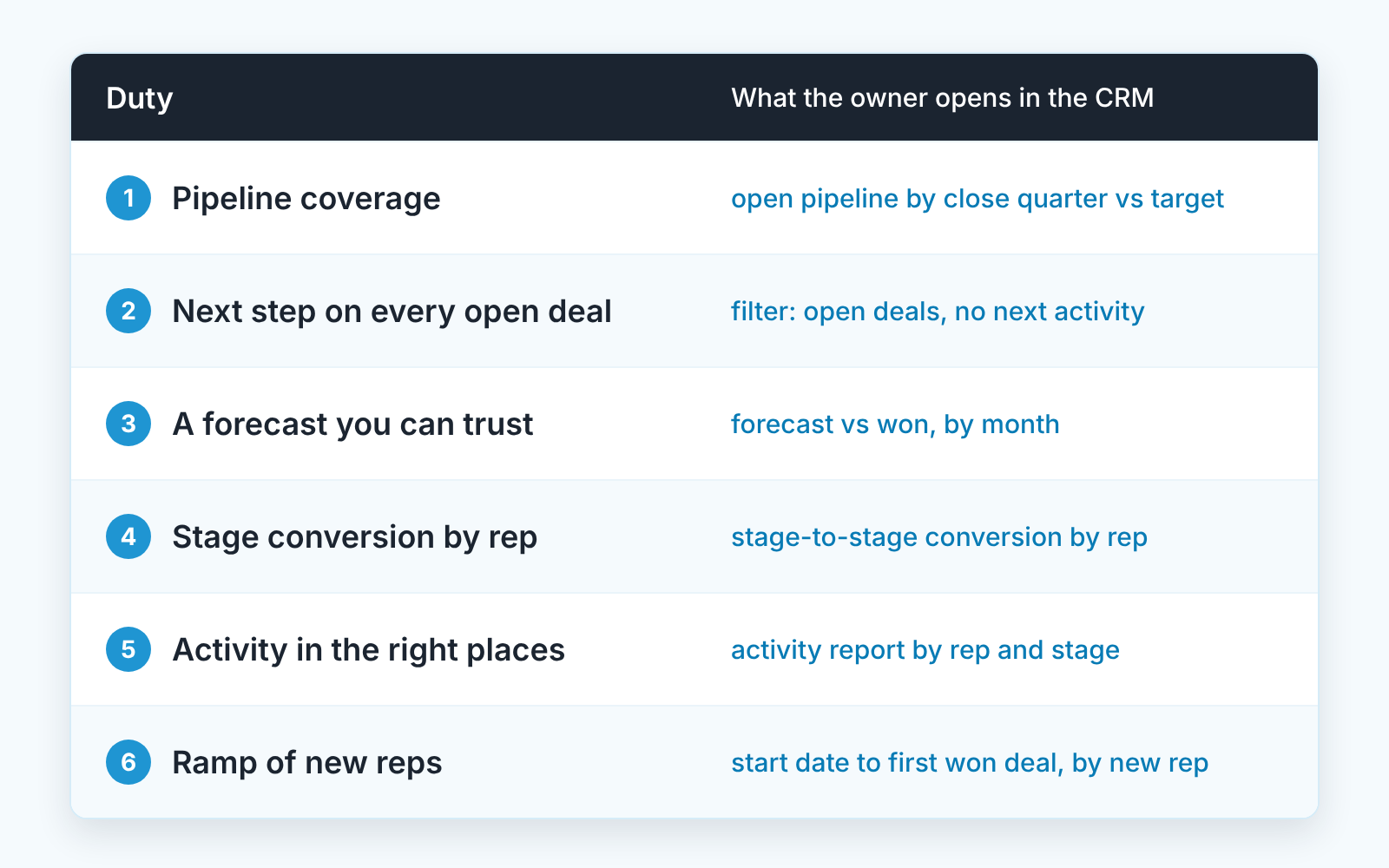
A sales manager job description template for a small company should list six duties and put a number from the CRM next to each: pipeline coverage for the next quarter, deals without a next step, forecast versus actual, stage conversion, activity by stage and ramp time for new reps. If a duty has no number in the CRM, the owner cannot check it. Rewrite the duty.
Why most templates can’t be checked
Most sales manager job descriptions on the first page of results, from staffing agencies to HR templates like Workable’s, have the same shape: a job brief, responsibilities, requirements. The shape is fine. The problem is the duties: “manage the sales team,” “meet revenue targets,” “develop sales strategy.” A year later the owner decides whether the hire worked out, and the only evidence is the revenue line and a feeling.
In a team of 5–20 reps the owner is close enough to the pipeline to want more than a feeling, and far enough from it to not want to read every deal. So every duty below comes in two parts: the duty in plain words you would say to a candidate, and an evidence line naming what the owner opens in Pipedrive, HubSpot, Salesforce or Zoho CRM to see whether it is happening.
How the manager reads those views week to week is a separate piece, the manager’s own weekly CRM checks; this one is the document you post when you hire, and how to write a job description covers the general version for any role.
Core duties for a team of 5–20 reps, each with its CRM evidence
Open the posting with the three lines candidates look for first:
- Reports to: the owner or founder.
- Team: [N] reps selling [what] to [whom].
- Carries own quota: yes or no. Say which. A player-coach with a full quota has less time for every duty below.
Summary line, to adapt: You run the team, you own the pipeline, the forecast and the reps’ development, and the owner will read all three in the CRM.
-
Keep enough pipeline open for the next quarter. You are responsible for the team entering the quarter with enough pipeline coverage (open pipeline divided by the quarter’s target), and for raising the alarm early when it falls short.
Evidence: open pipeline by expected close quarter, next to the target. One ratio, not the deal list. -
Every open deal has a next step and an honest close date. A deal with no next step is a deal nobody is working, and a close date in the past is a forecast nobody updated.
Evidence: two saved filters: open deals with no next activity, and open deals with a past close date. -
Give a forecast the owner can plan around. You commit a number at the start of the month and explain the gap at the end of it, deal by deal, not with “the market was slow.”
Evidence: forecast versus won, by month, with the committed number recorded before the month starts. -
Know where each rep loses deals, and coach there. Coaching is checkable. Your job is to move the weakest stage for the reps who are behind.
Evidence: stage-to-stage conversion by rep, this period against the last. -
Make sure the activity lands on the right deals. Calls on new leads while proposal-stage deals go quiet is the pattern a manager exists to catch.
Evidence: activity report by rep, split by deal stage. -
Hire and ramp new reps. You run the interviews and the first weeks of every new rep. A new hire who is months in without a first deal is your problem before it is theirs.
Evidence: time from each new rep’s start date to their first won deal.
We leave “hit the revenue target” off on purpose. Every duty above exists to make the target happen, and a target line gives the manager nothing to do on a Tuesday. If the hire is a commission-only rep, decide first whether they are an independent contractor or an employee, and what CRM access each one should get.
Add-ons for a head of sales
A head of sales in a small company usually still runs the team directly, so the six duties stay. The role’s place is drawn in an org chart for a small company with a sales team. What changes is who defines the numbers, so add two lines.
- Own the definitions. Which stages exist, what “qualified” means, what a next step must contain, which fields are required. Evidence: the pipeline stages and required fields as set up in the CRM, and the share of open deals that have them filled.
- Own the funnel end to end, including handoffs from marketing in and to delivery out. Evidence: a lead-source field filled on every deal, and a field or activity that marks a won deal as handed off, with the count of won deals where it is empty.
Which level you need is a separate question, answered in VP of sales vs head of sales vs sales director in a small company. The duty text for either level can come from this posting.
Add-ons for a sales director
A director is the first role where managing managers enters the posting, even if a company this size has only one, so add two lines.
- Run the pipeline review with each manager on a fixed rhythm and hold them to the same numbers. Evidence: the same views, cut by team instead of by rep. The review itself: managing sales managers through the CRM pipeline review.
- Set the plan and own its attainment at company level, with the headcount and territory decisions that go with it. Evidence: plan versus actual by team and period, with the plan stored before the period starts.
Requirements and what to ask in the interview
The qualification that matters is having run a team of roughly this size in a CRM. A degree matters less. Can read thier own pipeline without a dashboard built for them. Has had the uncomfortable conversation about a stale deal with a rep.
In the interview, take each duty and ask for the last time the candidate did it, with the number: coverage going into the last quarter, deals without a next step, where the forecast missed and why. A candidate who managed in a CRM answers in numbers, one who managed from memory tells a story. The full set, including questions that test the candidate’s own CRM habits, is in sales interview questions for the hiring manager.
What the job is not
It is not data entry on behalf of the reps. A manager who fills in next steps and close dates so the report looks clean has hidden the one signal the report exists to show. The duty is to make the reps keep the deals honest; the evidence is the filter, and the manager’s weekend stays free of data entry.
Nor is it reading a dashboard once a week and reporting upward. The numbers are evidence that the work was done; the work is the conversation with the rep whose deals have no next step. The owner’s own view of the numbers is in the sales manager dashboard: six numbers. When they drift for one rep, the next document is a performance improvement plan for a small team, and the job description stays as it is.
We build SalesBond, a sales management layer on top of the CRM a team already uses; we started with Pipedrive. It analyses deal and customer data, finds risks, explains what needs attention, and helps reps, managers and owners choose their next actions. For the owner it shows where revenue is at risk and how well-grounded the forecast is, but it does not do the manager’s job. Check your CRM with SalesBond.