
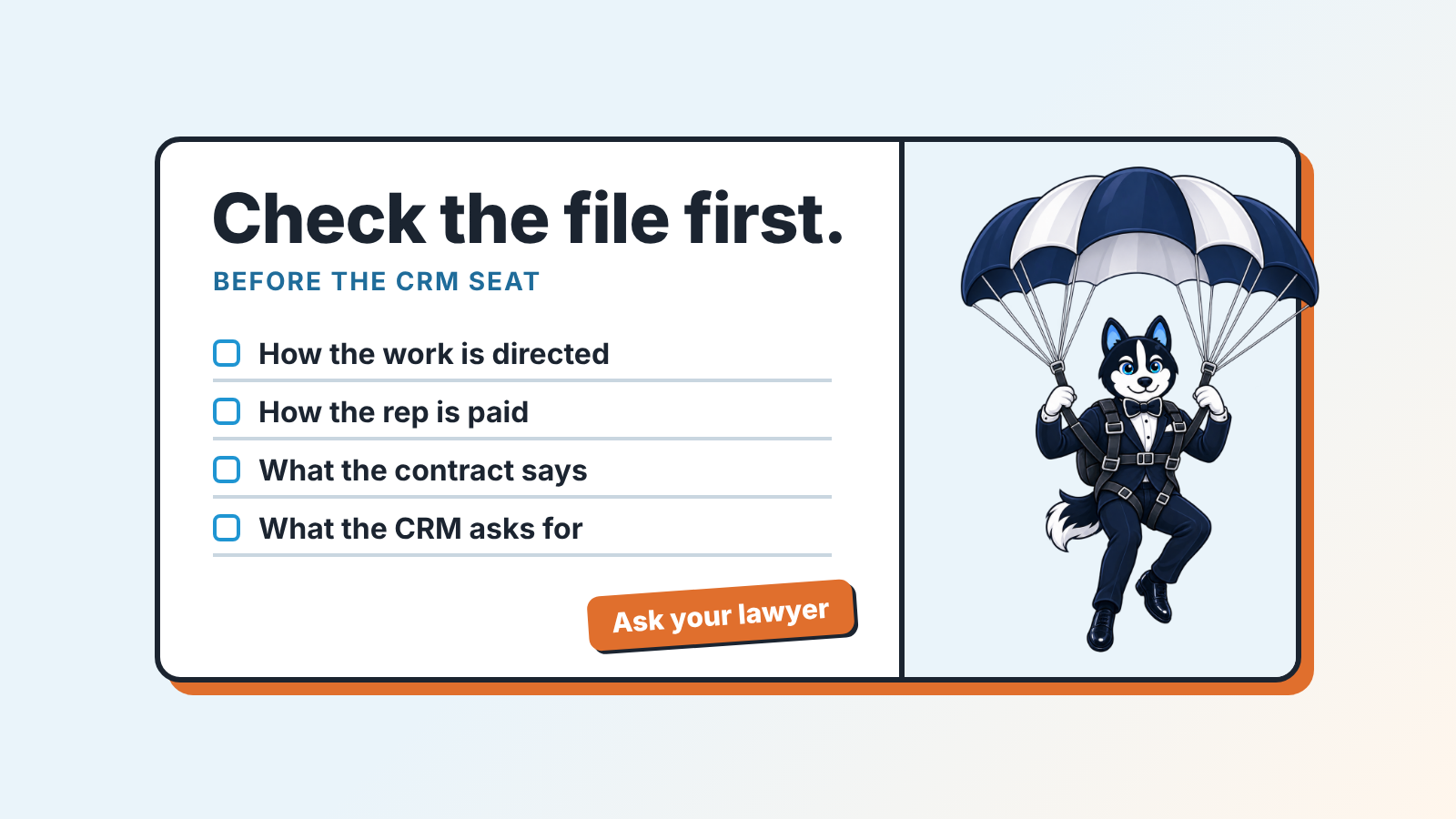
The same sales rep can be an employee or an independent contractor, and what decides it is how the work is organized, whatever the contract calls it. By the IRS general rule, a person is an independent contractor when the business has the right to control or direct only the result of the work, and an employee when the business can control what will be done and how it will be done (IRS: Independent contractor defined, checked November 14, 2026). Paying only commission doesn’t settle the question either: the IRS page Independent contractor (self-employed) or employee? lists how the worker is paid as one of several financial facts. For a commission-only rep, go through the IRS criteria with a lawyer or accountant before you hand over a CRM login and start asking for hourly reports.
This article is general information for US business owners. It is not legal or tax advice. It covers only the federal IRS criteria on the two pages linked here; other agencies, states and countries can apply their own tests, and we haven’t reviewed those.
Two reps on the same 10% commission
Picture two reps (a made-up example) selling the same product for the same 10% commission. Same pay. The first one gets a call list every morning, a script, a 9 a.m. standup and a weekly activity quota. The second gets a price sheet and a territory, decides who to call and when, and sends over signed orders.
On paper both can be “1099 reps”. Under the IRS general rule the first one looks much more like an employee, because the business directs how he sells. The IRS page Independent contractor defined adds that this holds “even if you are given freedom of action”, since what counts is the legal right to control the details. The same page says an employer-employee relationship exists “regardless of what the relationship is called”.
Why does an owner care? Per the IRS page Independent contractor (self-employed) or employee? (checked November 14, 2026), a business generally must withhold and deposit income taxes, Social Security taxes and Medicare taxes from an employee’s wages, pay the matching employer portion and pay unemployment tax. For payments to independent contractors it generally does not have to withhold or pay any taxes. That gap is why “just make them contractors” is such popular advice.
The IRS independent contractor vs employee test, read for a commission-only rep
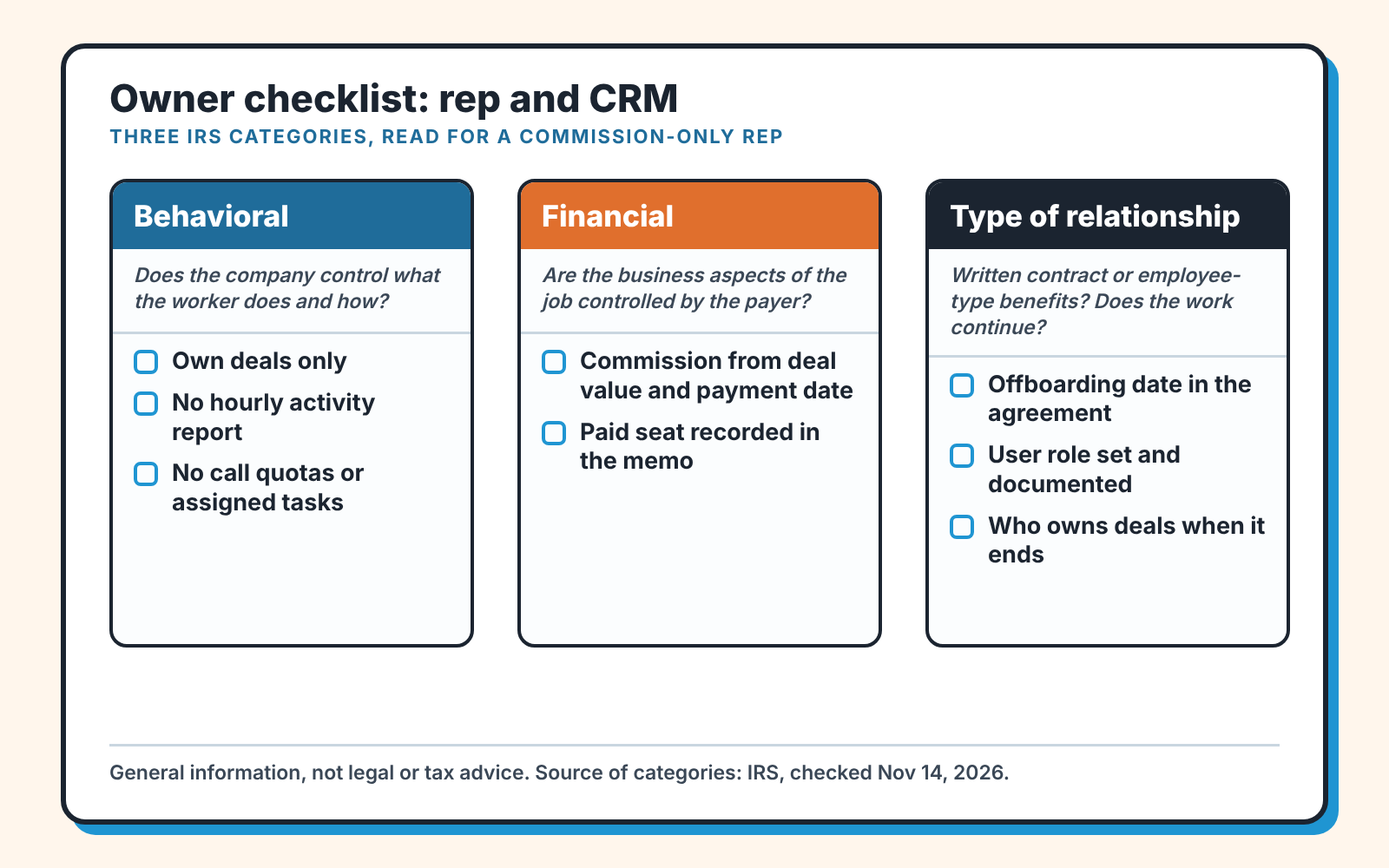
The IRS page Independent contractor (self-employed) or employee? sorts the evidence of control and independence into three categories: behavioral, financial and type of relationship. The questions in the first column of this table are quoted from that page. The second and third columns are our reading for a sales team, written so you can take it to your lawyer. The IRS pages say nothing about CRMs.
| IRS category and question | What it looks like with a commission-only rep | Where it shows up in the CRM |
|---|---|---|
| Behavioral: “Does the company control or have the right to control what the worker does and how the worker does his or her job?” | Scripts, mandatory standups, call quotas, a required order of steps for every deal | Required activity fields, daily activity reports, task assignments from a manager |
| Financial: “Are the business aspects of the worker’s job controlled by the payer?” The IRS lists how the worker is paid, whether expenses are reimbursed, who provides tools and supplies | Commission on closed business, who pays for the phone, travel and software | The seat itself (a tool you provide), deal value and payment status that the commission is calculated from |
| Type of relationship: “Are there written contracts or employee type benefits?” and “Will the relationship continue and is the work performed a key aspect of the business?” | An independent contractor agreement, no vacation pay or insurance, an open-ended arrangement, selling as a core function | User role, offboarding date, who owns the contacts and deals when the agreement ends |
Two sentences on the same IRS page keep owners out of checklist thinking. There is “no ‘magic’ or set number of factors” that makes a worker an employee or a contractor, and “no one factor stands alone”. So if you’re hoping a restricted CRM seat or a signed agreement will settle the status on its own, it won’t. Each one goes into the memo as one fact among all the others you collect.
Spend extra time with your lawyer on the third row. Selling is hard to describe as a side task of a business, and many commission-only arrangements run for years with no end date.
What you can ask for in the CRM, and what starts to look like supervision
Start from what you’re buying. With a contractor rep you’re buying closed deals, so the CRM records you need are the ones that describe the deal: who the customer is, what was quoted, the value, the stage, the expected close date, whether the invoice was paid. You’d ask an outside agency for the same handful of fields, and keeping them current describes the result and the handoff to your team.
Access can follow the same logic. A restricted role where the rep sees and edits only their own deals and contacts gives them what they need to sell and gives you what you need to pay commission. Neither IRS page mentions CRM access at all. Who provides tools is one of the financial facts the IRS lists, though, so record the paid seat in your determination memo along with everything else. The exact steps depend on your CRM; for one tool, our walkthrough of Pipedrive access for commission-only reps shows the visibility groups and permission sets.
Then come the requests that describe the method. The list below is our own reading of the IRS behavioral question applied to a sales team. We’d keep them for employed reps. The IRS doesn’t name any of these items, and the two IRS pages we checked on November 14, 2026 don’t list them either:
- a daily report of hours worked or calls made
- a minimum number of logged activities per day
- mandatory call recording with script scoring
- tasks assigned by a manager with due times (“call this lead by 11”)
- required attendance at pipeline meetings
Does that mean you can’t see a contractor’s call log? If the rep chooses to log calls the record exists and you can read it. We’d draw the line at turning that log into a requirement with a schedule, and where your own line sits is a question for your lawyer.
Can a company tell an independent contractor when to work?
The IRS general rule gives the business control over the result only, so a fixed schedule set by the company leans toward employee status in our reading (IRS: Independent contractor defined). A schedule is a detail of how the work gets done. A deadline for a result, such as a quote delivered by Friday, describes the result itself. Ask your lawyer how this applies to the wording of your agreement.
A common piece of advice says to treat every rep the same in the CRM, with the same fields, dashboards and rules. We disagree. It looks tidy, and on a mixed team it pushes contractor reps into the employee reporting routine one required field at a time. We’d rather run two roles with two sets of required fields and live with a slightly messier activity dashboard.
Deal-level checks fit here. SalesBond’s Deal Health checks every deal in the connected CRM against the enabled rules and has a per-rep view with the deal list and problem areas, so you can see that a contractor’s deals have a value, a next step and a realistic close date without looking at their calendar. It doesn’t determine anyone’s status and it doesn’t do payroll or tax math. For a first read of your CRM per rep, the free CRM audit covers the last 30 days and arrives as a PDF, with a second one seven days later showing what changed. Check your CRM with SalesBond.
Commission and pay records: where they live
Take a hypothetical six-rep team with four employed reps and two commission-only contractors. One contractor wins an $8,000 deal. She marks it won in the CRM, with the value filled in (that record is her job, and the only one she owes you). Your bookkeeper sees the invoice paid in full on March 14 in the accounting system. At the agreed 10% rate the commission sheet shows $800, which goes out with the statement in the March payment run. The CRM holds the won deal and the value the commission is calculated from, and payment status and the payout stay in accounting.
The two get compared once a month; we describe that routine in commission tracking and CRM reconciliation. The rate itself and what it’s paid on (booked or collected revenue) come from your plan, see commission structures for a small team.
Year-end reporting is your accountant’s step. Per the IRS page Independent contractor defined, the business generally must report payments to independent contractors on Form 1099-NEC, in box 1, while an employee’s earnings are generally reported on Form W-2. Which form applies to your rep follows from the status question above, so your accountant answers it after the classification is settled.
Mistakes owners make when a “contractor” works like an employee
Relying on the agreement. A signed independent contractor agreement counts as one fact in the IRS “type of relationship” category, and the IRS page weighs it together with everything else.
Copying the employee onboarding. The contractor gets the same script, the same standup invite and the same activity quota as the staff reps, usually because the CRM template was cloned. If you wrote a job description for the role, compare it with what you’d hand the the outside vendor. Our guide on writing a job description for sales roles is built for employees, which makes it a useful contrast.
Letting it drift. A rep starts with full independence, then a new sales manager adds daily check-ins in month eight. Did anyone reread the classification?
No paper trail. The IRS page Independent contractor (self-employed) or employee? tells businesses to “document each of the factors used in coming up with the determination”. A one-page memo with the three categories, dated and signed, takes about an hour to write.
Choosing contractor status for the tax saving alone. It’s tempting when the payroll quote lands in your inbox. The same IRS page says that if you classify an employee as an independent contractor with no reasonable basis for doing so, you may be held liable for employment taxes for that worker. If you want to direct how the rep sells, hire an employee and budget for it.
When to call a lawyer or accountant, and when to file Form SS-8
Call before the first commission-only rep signs. Call again whenever the way you manage them changes: a new manager, a new mandatory meeting, a new required report, a move from own leads to assigned leads.
The IRS page Independent contractor (self-employed) or employee? also lists worker types beyond these two, statutory employee and statutory nonemployee among them. That’s one more reason to have an accountant look at a sales role specifically.
If the answer stays unclear, the same page points to Form SS-8, which either the business or the worker can file to get an official IRS determination of status. It may take at least six months to receive one, according to that page, so file early or decide with your advisers in the meantime.
Your next step is small. Copy the table above, fill in the middle and right columns for each contractor rep as things stand in your CRM today, and take that page to your first meeting with the lawyer.


