
A capital expenditure (CapEx) is money a company spends on an asset that will serve it for longer than a year, such as equipment, vehicles or a large build. An operating expense (OpEx) is the cost of running the business day to day: salaries, subscriptions, rent. For a sales-led company, the monthly CRM subscription and a rep’s salary are usually OpEx, while a batch of laptops or a one-time integration project can be CapEx. Where exactly each one lands depends on your country and on your company’s accounting policy (the written rules your books follow). Your accountant makes the final call.
CapEx vs OpEx in plain words
Will this purchase still be working for you after the current year ends?
If yes, and the amount is meaningful, it leans toward CapEx. Wikipedia’s entry on capital expenditure puts the general test the same way: an expense is considered capex if its financial benefit extends beyond the current fiscal year, and the money goes to acquire or upgrade fixed assets such as property, plant and equipment. If the benefit is used up as you pay for it (this month’s seats, this month’s payroll), its OpEx.
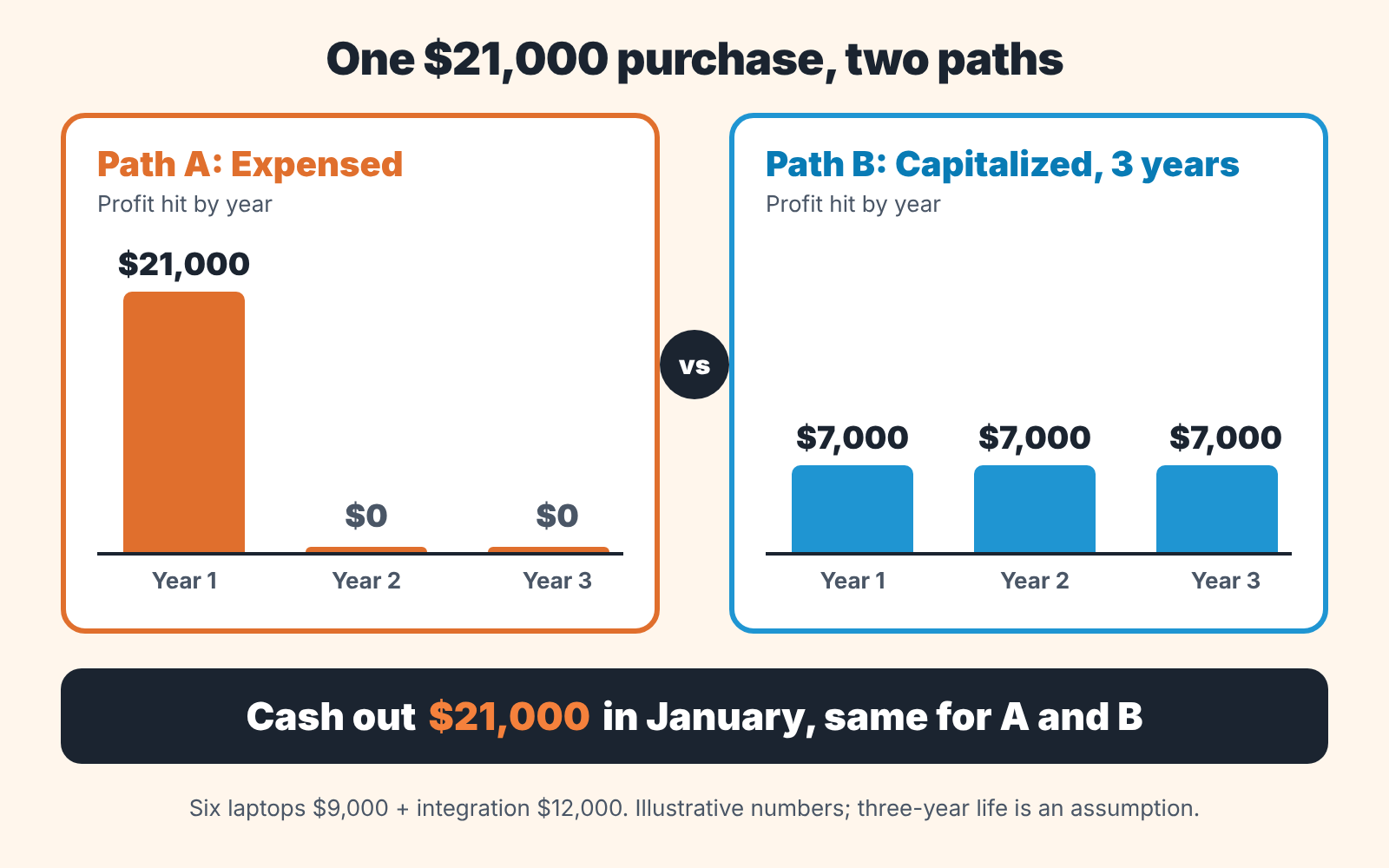
The two travel through your books differently. OpEx lands on the profit and loss statement in full, in the period you incur it. CapEx becomes an asset on the balance sheet first, and its cost reaches the P&L in slices over the years you use it. Those slices are called depreciation, and in the example below they come to $7,000 a year.
What usually counts as each, and where the rule bends
Open last month’s card statement for the sales team and you’ll mostly see OpEx (payroll aside, which is OpEx too): the CRM subscription, the dialer, lead lists, travel, the recruiter’s fee. Each of those is consumed in the month you pay for it.
The CapEx side of a sales team is short. Hardware bought outright, office furniture, a company car for field reps, and sometimes a large one-time project that builds something lasting.
Software is where owners get confused, and for a fair reason. The same Wikipedia entry notes that the cost of software for a business (development, software as a service, or licensing) might fall into either opex or capex, depending on whether it is business as usual or a fixed investment with a multiyear return. A CRM you rent by the seat is business as usual. A custom integration between your CRM and your billing system, built once and used for years, may qualify as an asset under your accounting policy, and that’s a judgment for your accountant.
Size bends the rule too. Nobody depreciates a $40 headset, even though it will outlive the fiscal year. For US taxes there’s a written version of this common sense: the IRS page on the tangible property regulations describes a de minimis safe harbor election that lets a business deduct tangible property up to $2,500 per invoice or item ($5,000 if it has an applicable financial statement), provided it expenses those amounts in its own books as well. Whether your company has made that election is a question for your accountant.
Capital expenditure examples: a six-rep company buys five things
A worked example helps. Say a company with six reps makes these purchases in January (prices are made up, and the three-year useful life is an assumption chosen to keep the arithmetic simple).
| Purchase | Cash out in year one | Usual treatment (general case) | Hits year-one profit as | Who decides |
|---|---|---|---|---|
| CRM subscription, 6 seats at $50 a month | $3,600 | OpEx | $3,600 | Owner approves the spend; treatment is routine |
| Six laptops at $1,500 each | $9,000 | CapEx, spread over useful life, or expensed if under your threshold | $3,000 (one of three years), or $9,000 if expensed | Accountant, by policy threshold |
| One-time CRM integration by a contractor | $12,000 | Depends: CapEx if it qualifies as an asset, otherwise OpEx | $4,000 if capitalized over three years, $12,000 if expensed | Accountant, after reading the contract |
| New rep, salary for the year | $70,000 | OpEx | $70,000 | Routine |
| Contractor for monthly CRM admin at $500 | $6,000 | OpEx | $6,000 | Routine |
Total cash out is $100,600. If the laptops and the integration are both capitalized, the year-one P&L shows $86,600 of cost. If both are expensed, it shows the full $100,600.
Same company, same purchases, a $14,000 difference in reported profit.
The rep hire deserves a second look, because owners often call it “an investment in growth.” In everyday language it is. In the books a salary is an operating expense, every month, for as long as the rep is on payroll. If you’re weighing that hire against a tool, the cost-benefit analysis of hiring a rep versus buying a tool covers the decision itself.
Same cash out, different profit
Look at the the bank account in that example. The $9,000 for laptops left in January under either treatment, and so did the $12,000 for the integration. Capitalizing only changed when the cost shows up in profit.
That gap runs in both directions over time. In year one, capitalizing makes profit look $14,000 higher than cash would suggest. In years two and three the P&L carries $7,000 a year of depreciation ($3,000 for laptops, $4,000 for the integration) with no matching payment, so profit looks worse than cash by that $7,000.
You can also work backward from the balance sheet. Corporate Finance Institute’s CapEx formula guide gives the indirect method as CapEx = PP&E at the end of the period − PP&E at the start + depreciation for the period. In our example, assuming the company owned no other equipment, fixed assets grow by $14,000 over year one (the $21,000 bought minus $7,000 of depreciation). Add that $7,000 back and you get $14,000 + $7,000 = $21,000, the cash that actually went into assets.
Profit and cash drift apart. An owner who reads only the P&L can be surprised by the bank balance in a heavy purchase month, and Wikipedia’s entry notes that capex is commonly found on the cash flow statement, in the investing activities section, so that’s the report to open when the two numbers disagree. Our piece on how closed-won revenue turns into spendable cash walks through the same gap from the revenue side, and the one on payment terms and open deals covers the cash you’re waiting on from customers.
Capitalized purchases also grow the asset base on your balance sheet, which feeds ratios such as return on assets. A sales-led company with few assets rarely worries about that, though a lender reading your statements might.
Now the common advice we disagree with. Every December someone tells owners to buy expensive equipment before year-end because “you’ll write it off.” A write-off lowers taxable profit by the amount the rules allow. The laptops still cost $9,000 in cash, and the saving is a fraction of that price. We’d reverse the order of questions. First ask whether the team needs the equipment and whether the cash can leave the account this month. Ask about tax treatment second, and ask your accountant.
On the tax side we’ll only point to the source. As of November 2026, IRS Topic no. 704 says you generally can’t deduct in one year the entire cost of property that is a capital expenditure, and that you generally must depreciate it instead. The same page describes the Section 179 election and the special depreciation allowance, which change that picture for qualifying property. Which of them apply to you is your accountant’s territory, and outside the US the rules are different again.
Who decides, and what to ask your accountant
You decide whether to buy. Your accountant decides how it’s recorded, following your accounting policy and local rules. Trouble starts when the second decision happens months after the first, at year-end, from a bank statement line that says “contractor, $12,000.”
So send the question before you sign. Four of them cover most sales-team purchases, and you can paste them into an email as they are.
“What’s our capitalization threshold, and is it written down?” Plenty of small companies have never set one. Your accountant can also tell you whether you use the IRS de minimis safe harbor mentioned above.
“We’re paying a contractor for a one-time CRM integration. Do you need the statement of work split into build and ongoing support?” Ask early. An invoice that lumps setup, training and monthly support into one line (“CRM services, $12,000”) is much harder to classify after the fact.
“If we buy the laptops outright versus leasing them, what changes in the books?”
“Which of this year’s planned purchases would change our reported profit by more than a few thousand dollars depending on treatment?” This one gets you a short list to discuss instead of a lecture.
Expensing an asset, capitalizing a subscription
Two mistakes show up at opposite ends.
The first is expensing something that should have been an asset. Say the six-rep company in the example books the $12,000 integration as a January expense without asking anyone. January looks like a terrible month, the owner cuts the lead budget in February to compensate, and the sales team loses budget over a purchase that will serve them for three years. The books may later be corrected. The February decision has already been made.
The second is the reverse. An owner hears that capitalizing “improves profit” and wants the annual CRM subscription, prepaid in one invoice, treated as an asset to be depreciated. Paying for the year up front moves the cash out earlier. You’re still renting the same seats for the same term, so ask your accountant how a prepaid plan is recorded before you count on any profit effect.
There’s a quieter third problem in sales teams specifically: nobody connects the spend to what it produced. Your accounting system knows the CRM costs $3,600 a year. It has no idea whether the deals inside it are moving. A CRM doesn’t track capital expenditure either. It holds the revenue side, in open and closed deals, and that’s the half you need when you ask whether the subscription or the new rep earns its keep. If you’d like an outside read of that half, SalesBond’s free CRM audit looks at the last 30 days of your connected CRM and sends a PDF report, then a second PDF seven days later showing what changed. Check your CRM with SalesBond.
FAQ
Is a high CapEx good or bad?
Neither by itself. High capital spending means cash is leaving now for benefits expected later, so the useful questions are what the money bought and whether the company can afford the gap. For a sales-led business with few physical assets, a sudden jump in CapEx is unusual enough to deserve a line-by-line look.
What is CapEx and OpEx in finance?
CapEx is spending on long-lived assets, recorded on the balance sheet and expensed gradually through depreciation. OpEx is the ongoing cost of operating, recorded on the P&L in the period it occurs.
Is a CRM subscription CapEx or OpEx?
A CRM rented by the seat, monthly or annually, is generally OpEx. One-time implementation or integration work around it may be treated differently, depending on your accounting policy and jurisdiction.
What is capital expenditure accounting?
It’s how a company records spending on long-lived assets. The purchase goes onto the balance sheet as an asset, and its cost moves to the P&L over its useful life through depreciation. Items below the company’s capitalization threshold are usually expensed right away, and a salary never goes through this route, however much a new hire feels like an investment.


