Free cash flow is the cash a business generates from operations after paying for the equipment and assets it needs to keep running. The formula is Free cash flow = Operating cash flow − Capital expenditures (TIKR: What is the free cash flow formula), where capital expenditures (capex) are the money spent on long-lasting assets such as vehicles, equipment or technology. A sales owner moves that number through three decisions made on the deal, long before finance sees an invoice: how long the customer gets to pay, whether there is a deposit, and how deep the discount goes.
Most of what ranks for this query is written for people who pick stocks, and it leaves out the person who signs the deals.
The free cash flow formula: operating cash flow minus capex
Operating cash flow is what customers actually paid you in the period, minus what you actually paid out to run the business: salaries, rent, suppliers, tax. Capex is the money spent on things that last, like a van, a machine, an office fit-out or a new server. Take the second away from the first and what is left is free cash flow, “the cash a company generates after accounting for capital expenditures” (TIKR).
Why call it free? Because nobody has a claim on it yet. Xero’s small-business glossary describes it as “how much money is actually available to reinvest, pay down debt, or save for the future” (Xero: Free cash flow). Hire, repay the loan, buy out a partner, take a dividend: this is the pot all of those come from.
For an owner of a company with a sales team, free cash flow is the money you can spend next quarter that did not come from a bank. Where the operating line itself comes from, section by section, is in our piece on the cash flow statement and where closed-won deals land in it.
Why a profitable year can still leave you short
A profitable year can leave you short because profit is booked when the deal is earned, and cash arrives when the customer pays. Those are two different dates. Sometimes two different quarters. The gap is the difference between cash vs accrual accounting, which also shows which of the two your closed-won report resembles.
Net income is “the profit a company earns after all expenses, taxes, and costs have been deducted from its revenue” (TIKR). It follows accounting rules, so a sale on 60-day terms counts as revenue the day you deliver, and the cost of last year’s van is spread over several years as depreciation. Free cash flow ignores both conventions and looks at the bank. That’s also why, as the same page notes, many investors consider FCF a better measure of profitability than net income.
The owner’s version of that gap looks like this. You close a strong fourth quarter, the P&L shows a healthy year, and in January you can’t make payroll without touching the credit line. Nothing is wrong with the accounting. The Q4 customers haven’t paid yet, and in December you also bought the two trucks you had been putting off. Profit went up and free cash flow went down in the same quarter.
Lenders test the same gap with the debt service coverage ratio, which asks whether cash covers the loan payments.
We think most owners of small sales-led companies manage the first number and get surprised by the second, because the first is the one the sales team talks about every week.
How sales can improve free cash flow: terms, deposits, discounts
Sales improves free cash flow by getting paid sooner and in full: shorter payment terms, a deposit on signing, and fewer discounts. Sales doesn’t control capex or rent, but these three are set on every deal, and they decide when and how much cash reaches the operating line.
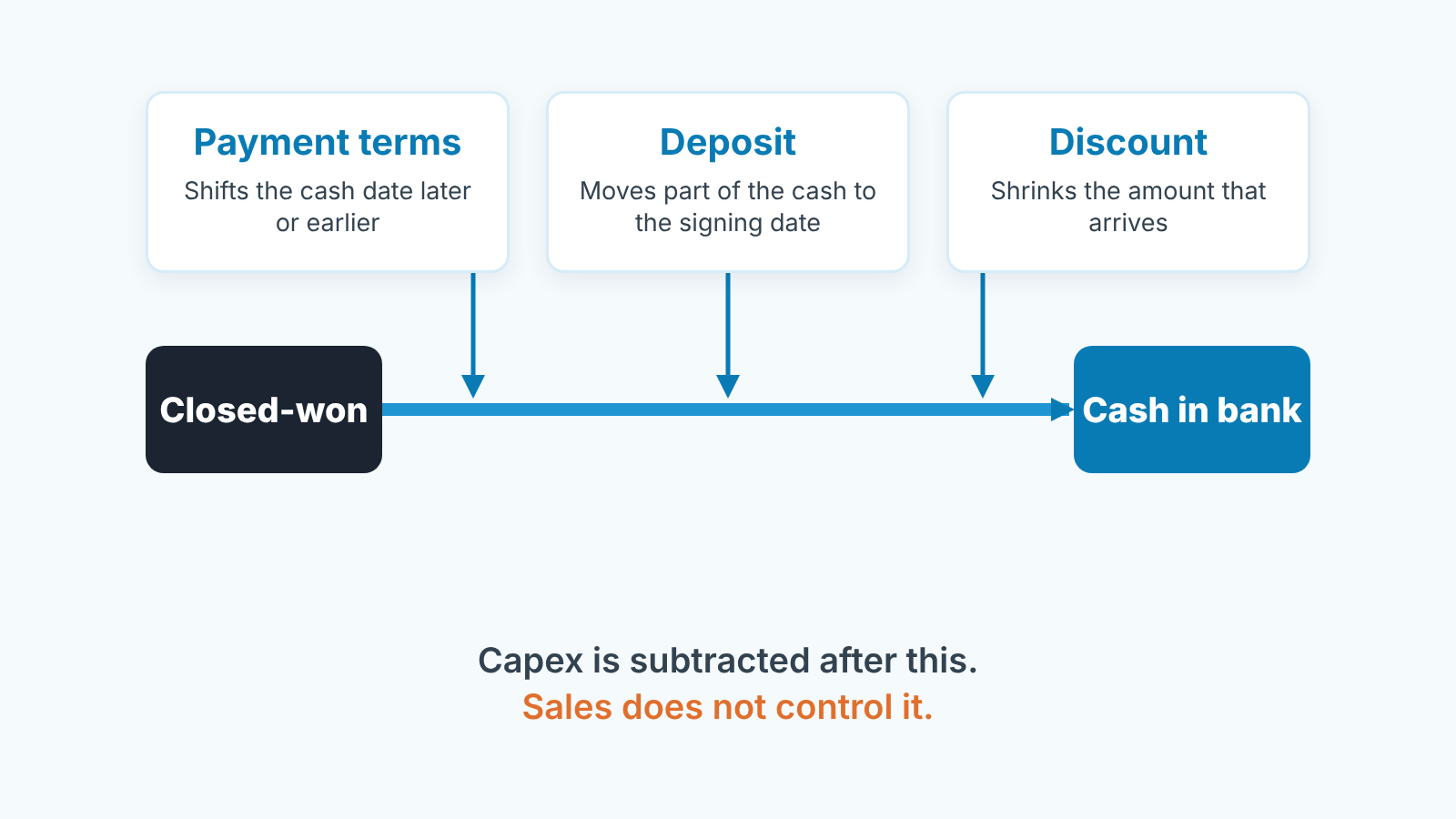
Start with payment terms, the lever that shows first when free cash flow sits next to revenue and profit in a monthly money review. Net 30 against net 60 does not change revenue or profit by a cent; it moves the cash date by a month. If your average deal is on 60-day terms, then for two months after a great quarter you are financing your customers with your own cash. The cheapest fix we know sits in the proposal template: make the short terms the default and let the rep ask for an exception when they need one. How those receivables build up and age is the subject of our article on accounts receivable: closed-won vs cash.
A deposit pulls part of the cash to the signing date. It also does something quieter: it tests whether the the buyer is real. A customer who won’t pay 20 percent up front on a project they say they urgently need is telling you something about the deal. Reps resist this lever most, because asking for money before delivery feels like it risks the close. In our experience it mostly risks the deals you didn’t want.
Discounts are different. They are the only lever of the three that cuts the amount itself. Ten percent off a deal is ten percent off teh cash that arrives, and every cost of delivering it stays the same. Discounting to pull a deal into this quarter is often a timing trade dressed up as a volume win: you got the signature in March, you get the cash in May either way, and you get less of it.
One more thought, and it is ours rather than a rule. If commission is paid on closed-won, the rep has every reason to accept net 60 and no deposit. Paying part of it when the customer pays lines the incentive up with the cash.
Returns and credit notes deserve a sentence too. They reverse cash that already arrived, so a team that oversells scope to hit a number books the deal as a plus when the customer pays and later as a minus when the customer asks for part of it back. The second entry rarely shows up in the sales report.
One quarter of deals, followed to the bank
The figures here are invented to show the mechanics. They are not from any customer and they are not a benchmark.
Picture one quarter, January to March, with five deals closed-won. The sales report adds them up at list price and says 100,000 won.
Deal A, 30,000, closed on January 10 on net 30 with no deposit and no discount. It was paid in February, so all 30,000 is in the bank by March 31. Deal B, 25,000, closed on February 3 on net 60; nothing arrives until April. Deal C, 20,000, closed on February 20 on net 60 too, but the rep asked for 20 percent on signing, so 4,000 lands in February and the remaining 16,000 in April. Deal D was quoted at 15,000, closed on March 15 with a 10 percent discount and net 60, so 13,500 arrives in May. Deal E, 10,000, closed on March 28 on net 30 with half paid on signing: 5,000 in March, 5,000 in April.
Add it up. By March 31 the bank has seen 39,000. By May 31 it has seen 98,500.
So the quarter “did” 100,000 and collected 39,000. That 61,000 gap isn’t a problem in itself; it is the shape of selling on terms. It becomes a problem when the owner spends as if the top line were cash.
Deal D gave away 1,500 and still paid nothing inside the quarter. The discount bought a signature date and left the cash date where it was.
And look at where the in-quarter cash came from apart from deal A, which simply closed early enough. Deals C and E got there the same way, with a deposit. Two reps asked for money on signing and between them put 9,000 in the bank in a quarter where the net-60 balances put in nothing.
Now subtract capex. If the business bought a 25,000 vehicle in February, the cash these deals bring in for the quarter, less the truck, is 39,000 minus 25,000, or 14,000, before a single salary or supplier bill, on a quarter the sales deck calls a 100,000 quarter. By the end of May, with the receivables mostly in, the same sum reads 98,500 minus 25,000, or 73,500, still before operating payments. Same deals, same truck, a very different number depending on which month you ask.
Sales set most of the operating line here through terms, deposits and discounts. Finance then subtracted a truck that sales never saw.
What the CRM can show, and what it can’t
Your CRM holds the inputs to the top half of this picture, if someone put them there.
A won deal normally carries a won date and an amount. Those two fields give you the “100,000 won” figure and nothing more. To get to “39,000 collected” you need three more things on the deal record: the payment terms agreed (net 30, net 60, something else), the deposit percentage or amount, and the discount against list. Most CRMs let you add these as custom fields on the deal; none of them fill the fields in for you. If terms live only in the signed PDF attached to the deal, the CRM can’t report on them, and your owner check turns into a reading exercise.
With those fields filled a saved filter of “won this quarter, grouped by payment terms” is a one-minute report that answers “when is this quarter’s revenue going to be cash?” Our guide to building a cash flow forecast from the CRM pipeline goes through which stages to include and at what weight. The free CRM audit from SalesBond reads the same deal records for the last 30 days and sends a PDF report on money at risk and what to fix, then a second PDF a week later showing what changed.
The other half is invisible to the CRM. It doesn’t know whether the invoice went out on the won date or two weeks later, because invoicing lives in accounting. It doesn’t know whether the customer paid on day 30 or day 55. It has no idea you bought a truck. Capex, payroll, rent and tax never touch a deal record, and they are what turns operating cash flow into free cash flow. A CRM that says “100,000 won, 39,000 expected inside the quarter” has done its whole job. The subtraction happens elsewhere.
This split matters for who you ask. Terms, deposits and discounts belong to the sales lead. Collections and capex belong to the accountant. Ask the sales lead why free cash flow is low and you get a shrug, and fair enough.
The monthly owner check
Once a month, on the day the accountant closes the books, sit the sales report next to the cash report and ask one question of each of the quarter’s won deals: has this one been paid, and if not, when were we told it would be?
In practice that is twenty minutes. Pull the won deals of the last ninety days with thier amount, terms, deposit and discount fields. Next to each, write the cash received so far, from the bank or the accounting system. The first column is what your team celebrated, the second is what you can spend. Then take the capex you approved in the same period and subtract it from the second total. If the result is negative, you have been funding growth out of the credit line or last year’s cash. That can be a fine decision, as long as it was a decision.
Two patterns are worth a conversation with the sales lead when they show up. One is a drift in average terms: if net 30 was the default a year ago and most new deals are on net 60 now, nobody chose that; it happened one exception at a time. The other is a quarter-end cluster of discounted deals with long terms, which is what pulling deals forward to make a number looks like. Neither is a rep problem by itself. Both are cheaper to fix on the proposal template than in a one-to-one . The wider version of this check is working capital for a sales owner: payment terms and open deals.
Free cash flow vs net income vs cash flow: quick answers
Is free cash flow the same as profit? No. Net income includes non-cash items like depreciation, while free cash flow is operating cash minus capital expenditures (TIKR). A growing company on long payment terms can show a profit and negative free cash flow in the same quarter; the profit side is in net income for a sales owner.
What is the difference between cash flow and free cash flow? Cash flow is all cash moving in and out of the business, financing and investing included. Free cash flow is only what is left from operations after capital expenditures (Xero).
What are FCFF and FCFE? Two valuation variants. Free cash flow to equity is the cash available to shareholders “after all expenses, debt repayments, and necessary reinvestments” (TIKR); free cash flow to the firm is the cash available to all investors, lenders included. An owner running the business week to week needs the plain version.
Can sales improve free cash flow without selling more? Yes, and it is usually the fastest route: shorter default terms, a deposit on signing, fewer timing discounts. None of them add a deal. All of them change when, and how much of, a won deal becomes cash you can spend.