
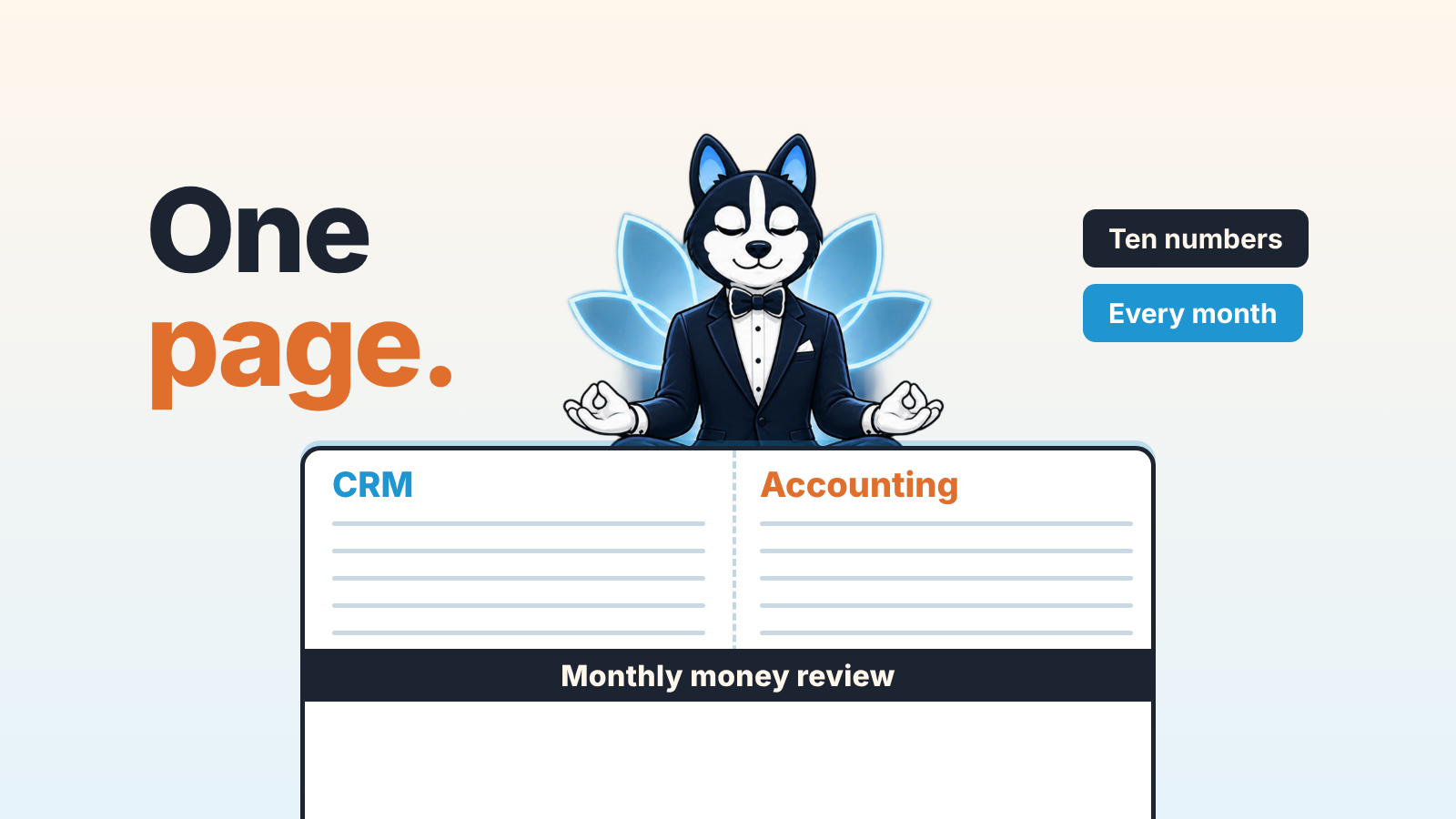
Financial management in a small business means regularly checking where money comes from and where it goes, then making decisions from what you find. Most owners already do some of it; they just don’t do it on a schedule. In a company that lives on its sales team, that check draws on two systems. The CRM shows what was closed and what is expected. Accounting shows what was collected, what was earned and what is owed. A monthly money review puts ten numbers from those two systems on one page.
What financial management means for a small business
QuickBooks defines financial management as “the process of planning and monitoring the use of a company’s financial resources” and lists six fundamentals, among them budgeting and forecasting, managing cash flow, and monitoring debt (QuickBooks: financial management, page as of November 2026). Xero’s glossary describes the small business version in plainer terms as keeping track of income and expenses and preparing accurate reports (Xero: what is financial management, as of November 2026).
Budgeting also means deciding in advance which purchases count as capital expenditure and which as running costs, which the CapEx vs OpEx guide walks through for a sales team.
Both definitions assume the numbers already sit in one place. In a sales-led company they don’t. The forecast half of “budgeting and forecasting” lives in the pipeline, while cash flow and debt live in the books, and the two halves are usually owned by different people who rarely sit in the same meeting.
That gap is also the plainest way to tell financial management from accounting. Accounting records invoices issued, payments on the bank statement and bills paid, so everything in it has already happened. Financial management uses those records together with what’s expected (open deals, the forecast, payment terms agreed on a call) to decide what to spend, whom to hire and which customer to chase.
So for an owner with a sales team, the practical job is narrower than the textbook one. Smaller, too. Once a month you get the sales numbers and the accounting numbers onto the same page, for the same period (calendar month in both, or the comparison falls apart), and you check whether they tell the same story.
The monthly money review: one page, ten numbers
How much should fit on the page? Ten numbers, each one answering a question you’d otherwise ask out loud in the meeting. Five come from the CRM and five from accounting.
| Question the owner asks | Number | Source |
|---|---|---|
| What did we sell this month? | Closed-won value | CRM |
| What could still close? | Open pipeline value | CRM |
| What do we expect to close next month? | Forecast for the next period | CRM |
| How long does a deal take? | Average sales cycle, in days | CRM |
| Which won deals are past their payment date? | Overdue payments, by deal | CRM, checked against invoices |
| Did we make money? | Net profit | Accounting, P&L |
| How much cash do we have? | Cash balance at month end | Accounting, bank |
| How much are customers holding? | Accounts receivable | Accounting |
| What do we owe, and when? | Liabilities due in the next 90 days | Accounting, balance sheet |
| What is left after the cost of delivering? | Gross margin | Accounting |
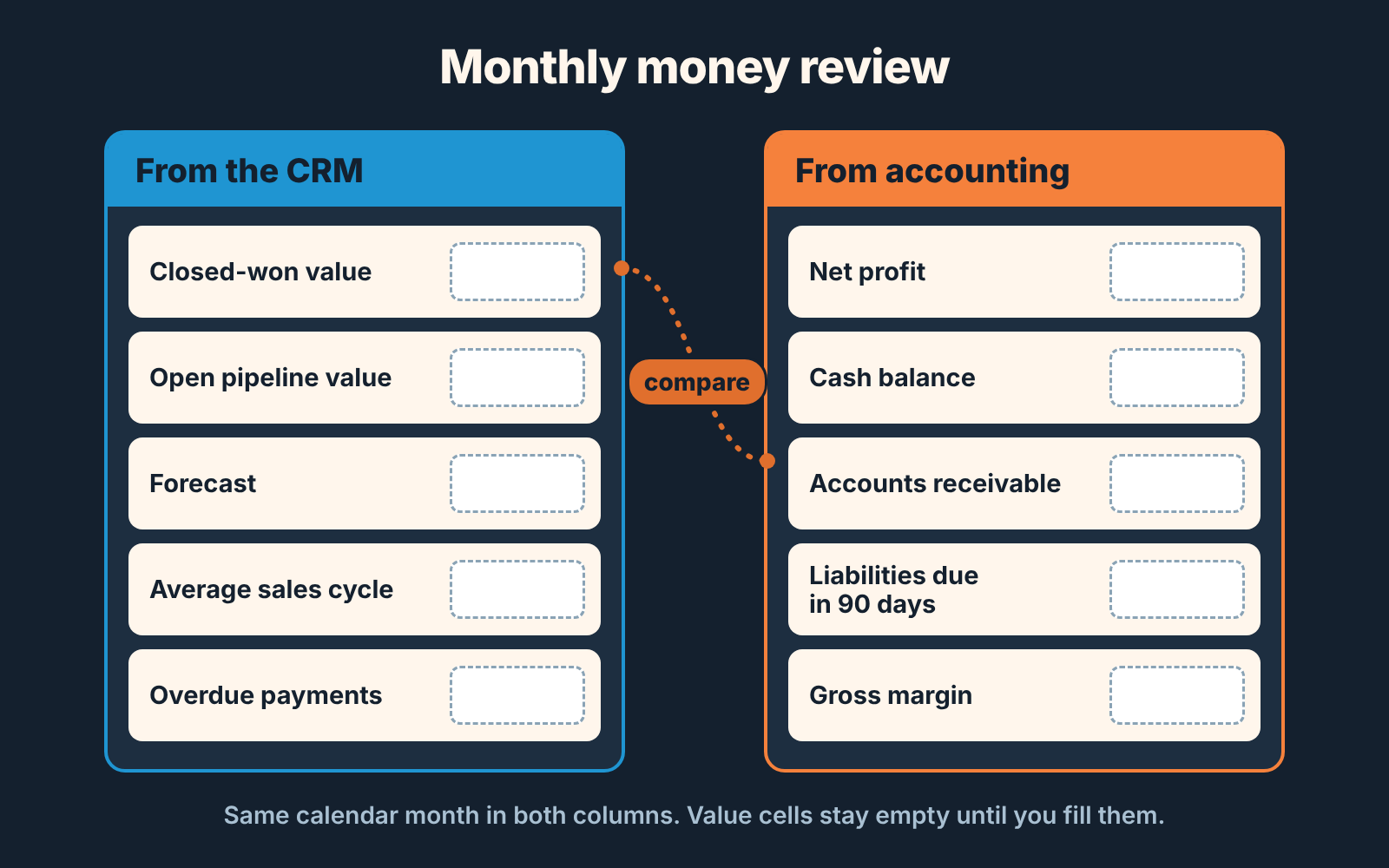
Our advice is to keep the page to these ten for the first three months. It’s tempting to add marketing metrics, headcount and call counts. Don’t, yet. They belong in a wider report, and if you need that one, the KPI report for a business owner covers what goes in it.
Five numbers that come from the CRM
Start with closed-won value for the calendar month, filtered by won date. It’s the number that gets quoted in every sales meeting, and it’s easy to mistake for income. What it records is a signed commitment. Revenue vs profit explains how far a CRM can take you toward each of those two figures.
Open pipeline value and the forecast for next month sit side by side on the page, and they answer different questions. Pipeline is everything still open. Forecast is the part you’d bet on, by expected close date and and stage. If your forecast has been above actual closed-won for three months in a row, write that gap on the page too (it tells your accountant how much to discount the next one).
Average sales cycle turns the forecast into a date. Take an illustrative business with a 45-day cycle and 30-day payment terms: a deal created today brings cash in roughly 75 days, which is next quarter’s money.
The fifth number is the awkward one. Overdue payments by deal means won deals whose agreed payment date has passed with no payment recorded. If your CRM has no payment-date field, it takes either an invoicing integration or a custom date field your team fills at close. We’d make the effort anyway, because the rep who closed the deal is often the person the customer will answer.
All five depend on the CRM being filled in honestly: close dates that aren’t stale, values that match the contract, deals that are closed when they’re closed. SalesBond’s free CRM audit covers that layer. It looks at the last 30 days of your connected CRM and sends a PDF report covering money at risk, deal health and the pipeline bottleneck, and a second PDF arrives seven days later showing what changed. It doesn’t do your accounting, so net profit and liabilities stay with your bookkeeper. Check your CRM with SalesBond before the first review, so the left-hand column of the page is one you can trust.
Five numbers that come from accounting
These arrive from your bookkeeper or accounting software, and each one has its own guide in this series, so here is only what to ask for.
- Net profit for the month, from the P&L. The profit and loss statement guide shows which of its lines your CRM feeds.
- How much cash was in the bank on the last day of the month, and how that compares with the month before? The cash flow statement explains where that change came from.
- Accounts receivable: invoices sent and still unpaid, with the overdue portion split out, as described in accounts receivable, closed-won vs cash. This overdue portion is a total across invoices, while the CRM’s overdue list names each deal and the rep who owns it.
- What falls due in the next 90 days, meaning payroll, taxes, supplier bills and loan payments. The 90-day window is our suggestion, long enough to catch a quarterly tax payment. The liabilities guide covers the sales-side ones, such as deposits and commissions owed.
- Gross margin, as a percentage. That’s revenue minus the direct costs of delivering what you sold, divided by revenue.
Receivables and short-term liabilities together tell you how much room you have and long payment terms eat that room quietly. The working capital guide walks through that with deal examples.
Who prepares which number and when
Who pulls the numbers? If the answer is the owner, the night before, the review tends to die quietly. The schedule below is the one we’d suggest; four dates and three people keep it alive.
- On the first working day, the head of sales (or the owner, in a team without one) exports the five CRM numbers for the month that just ended.
- By the fifth working day, the bookkeeper closes the month and sends the five accounting numbers.
- The same day, someone compares closed-won value with new invoices issued. Every won deal without an invoice gets a name next to it.
- In the second week, hold the review itself. We’d budget about 45 minutes, with the page printed or shared, and end with a list of who chases which overdue payment.
The usual advice to a small business owner is to hire a good accountant and let them handle the finances. We don’t recommend stopping there, because an accountant works from documents that already exist: invoices, bank lines, bills. That’s the past. They can’t see a deal that slipped from November to January, or a customer who negotiated 60-day terms on a call last week. That information reaches the books weeks later, and by then teh cash plan is already wrong.
So our suggestion is to bring the accountant into the review at least once a quarter. Fifteen minutes with the pipeline in front of them changes the questions they ask.
Mistakes: mixing booked and collected money
In this section, booked money means closed-won value in the CRM, and collected money means cash that has landed in the bank account. Take an illustrative six-rep company with a strong October and $120,000 booked.
| Line | Amount |
|---|---|
| Booked in October (closed-won, CRM) | $120,000 |
| Collected in October from October deals | $48,000 |
| Collected in October from earlier invoices | $30,000 |
| Total collected in October (bank) | $78,000 |
| Receivables at the start of October | $55,000 |
| Receivables at the end of October | $97,000 |
The owner who reads only the CRM sees $120,000 booked and approves a hire. The bank saw $78,000 collected. The gap of $42,000 went into receivables, which grew from $55,000 to $97,000, and November payroll is paid from the bank balance. Cash vs accrual accounting covers why the two systems legitimately disagree, and which one your books follow.
Other mix-ups hide on the same page. Once you know to look, each takes a minute to spot (and an awkward meeting to explain if you don’t). Adding open pipeline to booked money and calling the total “expected revenue” hides the fact that part of it may never close. Comparing a CRM month filtered by won date with an accounting month built on invoice dates produces a difference nobody can explain. And reading gross margin from deal values alone ignores delivery costs the CRM never sees.
What would last month’s page have shown you? Pull the ten numbers for the month that just closed, put booked next to collected, and take the difference into your next conversation with the person who sends the invoices.


