
A cash flow statement shows how much cash actually came into and left your business in a period, split into operating, investing and financing activities. A deal marked closed-won in your CRM is not cash yet: it becomes cash in the operating section only when the customer pays.
That sentence is the part every accounting glossary skips. They explain the three sections well. They do not explain where your March sales went, or why the P&L says you had a good month while the bank balance disagrees. The receivables side has its own piece, accounts receivable for a sales owner; here we stay on the statement itself and on the place one deal takes in it.
What a cash flow statement shows
It is one of the three core financial statements, next to the balance sheet and the income statement, and it reports only actual cash movements for a period. You will also see it called the statement of cash flows (Xero: what is a cash flow statement). The income statement works the other way: it is built on accrual accounting, so a sale is reported when the income is recognized, not when the money arrives (Financial Edge: cash flow statement). So is a cash flow statement a P&L? No. The P&L (income statement) reports revenue when it is earned, the cash flow statement only the cash that moved.
The three reports close into each other, since the cash flow statement ends by reconciling to the cash balance on the balance sheet (Financial Edge, same page). From the same statement you can trace closed-won revenue to the cash that is actually spendable, as shown in free cash flow for a sales owner.
For an owner with a sales team the difference is not academic. Your pipeline dashboard and your commission sheet run on the moment a deal is marked won, and the P&L follows close behind, as soon as the sale is recognized. The cash flow statement runs on the moment the bank balance moves. Xero puts the consequence plainly: the income statement might show a profit, but if customers have not paid their invoices yet you can still struggle to cover rent or payroll (Xero).
We think an owner should look at it monthly even when the accountant only prepares it quarterly. The reason is simple: the sales team’s decisions about payment terms and deposits show up in this report and in no other one.
The three sections, in plain words
Operating activities is cash from running the business: money received from customers, payments to suppliers, wages, rent, utilities, insurance, taxes (Xero). Investing activities is cash spent on or received from long-term assets: equipment, vehicles, property, software upgrades, the sale of a machine you no longer need (Xero). Financing activities is cash between the business and its owners or lenders: loan proceeds and repayments, owner contributions, dividends, owner withdrawals (Xero).
Add the three totals and you get the net change in cash for the period. Add that to the opening cash balance and you should land on the closing cash shown on the balance sheet (Xero).
Now the part that matters for you. Of all those lines, the sales team touches exactly one: cash received from customers, inside operating activities. The new laptop is investing. The bank loan and your own draw are financing. Everything a rep does with a quote, a discount or a payment term ends up in that single operating line, and nowhere else on the page.
Direct vs indirect method: what changes for you
Both methods reach the same operating cash flow; the indirect one starts from net income and adjusts it, the direct one lists every cash receipt and payment. The adjustments are for non-cash items and for changes in working capital (Xero). Most small businesses and their accountants prefer the indirect method because it comes out of standard accounting reports (Xero), and Financial Edge calls the direct method rare in practice (Financial Edge).
So you will almost certainly be reading an indirect statement and that changes where your sales show up. A direct statement would have a line called cash received from customers to set next to your closed-won total. An indirect one hides the same information in a line with a minus sign: increase in accounts receivable. Xero’s rule for that line is short. Increases in accounts receivable reduce cash; increases in accounts payable add cash; depreciation is added back (Xero).
Xero’s own example shows it in numbers. A small consulting business, one quarter, indirect method: net income $15,000, add back depreciation $1,500, increase in accounts receivable minus $3,000, increase in accounts payable $2,000, net cash from operating activities $15,500 (Xero). Read that minus $3,000 as a sales owner. It is revenue booked during the quarter that customers had not paid by the last day of it. The P&L counted it. The bank did not.
Our advice: ask the accountant for the cash received from customers figure even when the statement is indirect. It exists in thier system either way, and it is the only number you can honestly set beside closed-won.
A cash flow statement example: one deal, three reports
Take one deal and follow it. The numbers are made up to keep the arithmetic visible, and whether the deal lands in March or April depends on cash vs accrual accounting, which we compare against closed-won in a separate piece.
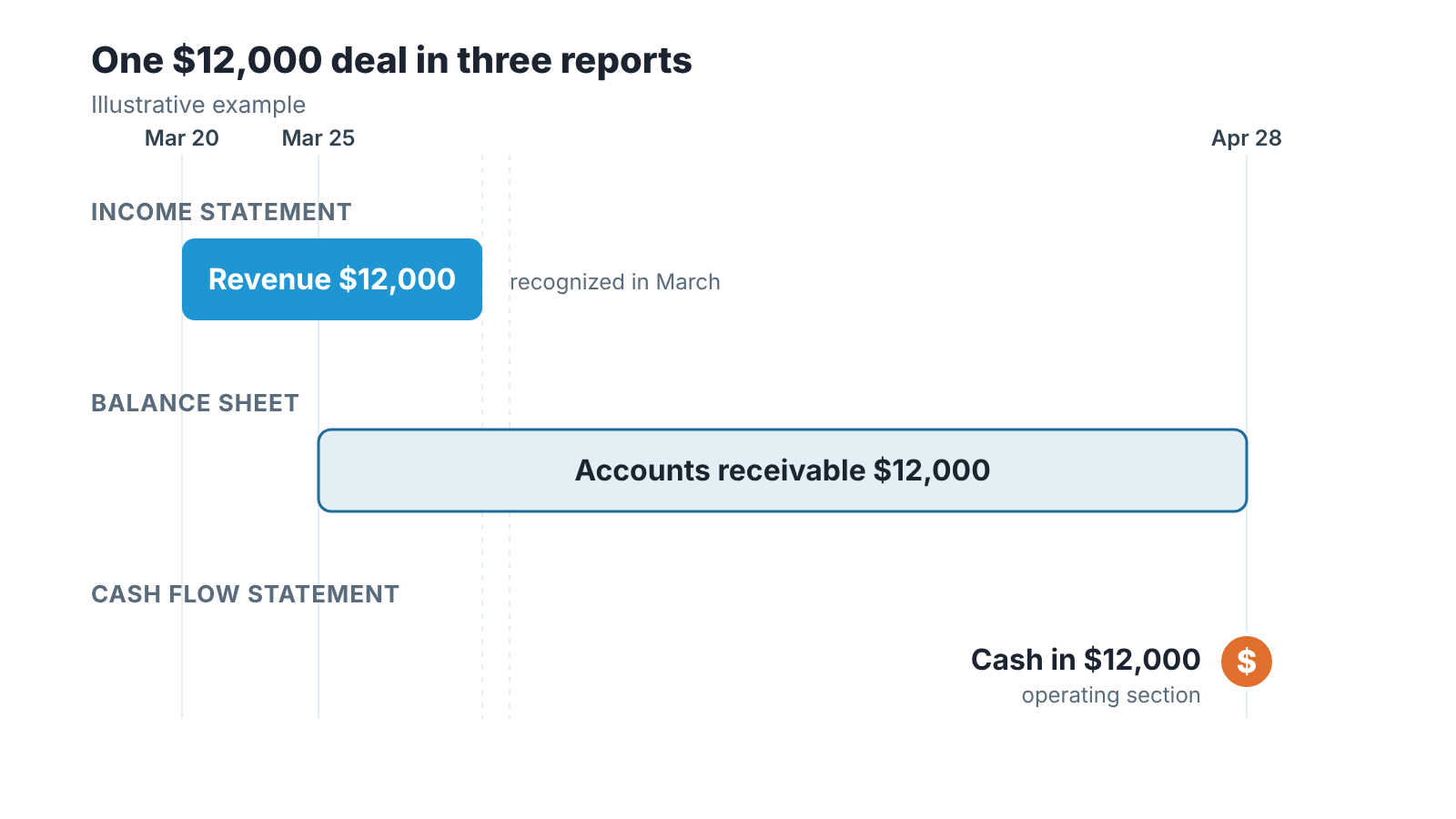
A rep wins a $12,000 deal on March 20. The work is delivered and the invoice goes out on March 25 with net 30 terms. The customer pays on April 28.
| Report | Where the deal appears | When |
|---|---|---|
| Income statement (P&L) | Revenue, $12,000 | March, when the sale is recognized |
| Balance sheet | Accounts receivable, $12,000 | From the invoice until payment; the March 31 snapshot shows it |
| Cash flow statement | Operating activities: cash received from customers (direct) or a decrease in accounts receivable (indirect) | April |
Two months for one deal. In March the $12,000 of revenue sits inside net income, and the indirect statement takes the same $12,000 back out as an increase in receivables, so the deal’s net cash effect in March is zero. In April the receivable falls by $12,000 and operating cash flow goes up by the same amount. The deal did not get better or worse between the two months. It just moved from one report to the the next.
This is why the gap between net income and operating cash flow is a named indicator in the glossaries. Xero lists it among the signals to watch: a big gap between profit and operating cash flow can mean you are earning revenue you have not collected yet (Xero). Financial Edge lists significant discrepancies between net income and cash from operations as a red flag (Financial Edge). For a sales owner that gap is made of deals already counted as won and not yet paid. If the income statement side is new to you, start with which P&L lines your CRM feeds, then revenue vs profit and net income, the line the indirect method starts from.
Three deal fields that predict the operating line
A CRM does not produce a cash flow statement and should not try. Accounting software and the accountant do that, from the bank and the ledger. What the CRM can do is tell you, weeks earlier, roughly what the cash received from customers line is going to look like, because the inputs to that line are decided on the deal before the invoice exists.
Three fields carry most of it.
Payment terms. Net 15, net 30, net 60, 50% deposit on signature. This is a sales decision with a finance consequence: a rep who offers net 60 to get the signature in March has moved that cash into May. Finance sees the result two months later. You can see it the day the deal closes, if the field is filled. Deposits work the other way round. A deposit is cash the day it lands, so it shows up in operating activities at once, while the accountant carries the part not yet delivered as a liability called unearned or deferred revenue, and it becomes revenue only on delivery (CFI: unearned revenue). How to set the field up and how it drives days sales outstanding is in DSO and the payment terms deal field.
Expected payment date. Invoice date plus terms, or the deposit date for a split payment. Sum this field by month across won deals and you have a draft of next month’s and the month after’s cash received from customers, before accounting has closed anything. We build the full version of that in cash flow forecast from the pipeline, so we will not repeat it here. One caution belongs in this article though. Xero’s Small Business Insights put US small businesses at an average of 7.8 days late on payments in Q4 2025 (Xero). Your own history may be better or worse. Whatever it is, the expected date should carry that buffer, or the draft will flatter you.
Invoice status. Not invoiced, invoiced, paid. Without it a won deal and a paid deal look identical in the CRM, and the won-but-not-paid problem is exactly the one this statement exposes a month late. Who fills the field, and when the deal passes from the rep to whoever invoices, is a handoff question, covered in quote-to-cash for a small sales team.
Three fields, filled at close. That is the whole CRM contribution to this report, and it is enough to change “we booked $90,000” into “we booked $90,000, and $60,000 of it is due before the 15th.” For an outside read of the deal data itself, SalesBond’s free CRM audit looks at the last 30 days of your CRM and sends a PDF report with money at risk and the top findings, then a second report a week later showing what changed.
What a cash flow statement leaves out
Anything that did not move cash: depreciation charged as an expense, and sales made on credit that the customer has not paid yet. The indirect method strips both out of net income for exactly that reason (Financial Edge).
It also leaves out the future. It covers a period that has already closed, so by the time it reaches you the slow payers have already been slow for weeks. Xero advises weekly or bi-weekly cash reviews rather than waiting for the quarter, which tells you how late the statement itself arrives (Xero). By the time the statement confirms a payment problem, the expected payment dates on those deals could have shown it weeks earlier.
It does not name anyone. The change in accounts receivable is one number. It will not tell you that two of the twelve open invoices are 80% of it, or that both belong to the same rep’s deals with net 60 terms. For that you need the invoice list and the deal list side by side.
It does not tell you whether you are profitable. That is the income statement’s job, and Financial Edge’s comparison table separates the two: the cash flow statement is about liquidity, the income statement about profitability (Financial Edge). A negative total is not automatically bad either. Xero’s example is a business that bought equipment heavily and showed negative overall cash flow while the investment had yet to pay off (Xero). Look at the sign of the operating section on its own, and at the reason behind it.
And it does not tell you whether a won deal was a good deal. A $12,000 sale at net 90 and a $12,000 sale with a 50% deposit produce the same revenue line and very different cash flow statements, and the statement shows the difference late.
The monthly check: closed-won against cash in
Fifteen minutes once the accountant has closed the month, to reconcile the sales team’s month against the statement. The weekly receivables routine is a separate job, covered in the accounts receivable piece.
- Ask the accountant for operating cash flow for the month and, if the statement is indirect, the change in accounts receivable line. Ask for cash received from customers as well; it exists even if it is not printed.
- Pull the closed-won total for the same month from the CRM, by won date.
- Set the two beside each other. The difference is revenue booked but not collected, the gap Xero and Financial Edge both flag. Watch it’s direction over three or four months; a single figure says little. Growing receivables without a matching rise in revenue is on Xero’s red flag list (Xero).
- Filter won deals whose expected payment date fell inside the month and whose invoice status is not paid. That is the same gap, now with customer names and the rep who set the terms.
- Bring one sentence to the sales meeting. “We booked $90,000 in March; $55,000 of it is in the bank; the rest sits on these four deals, three of them at net 60.” The numbers start the conversation. The terms are what you discuss.
The first time you do this the gap will probably be bigger than anyone expected. That is normal. Next month, if the three fields are being filled, you will see it coming before the accountant sends anything.


