
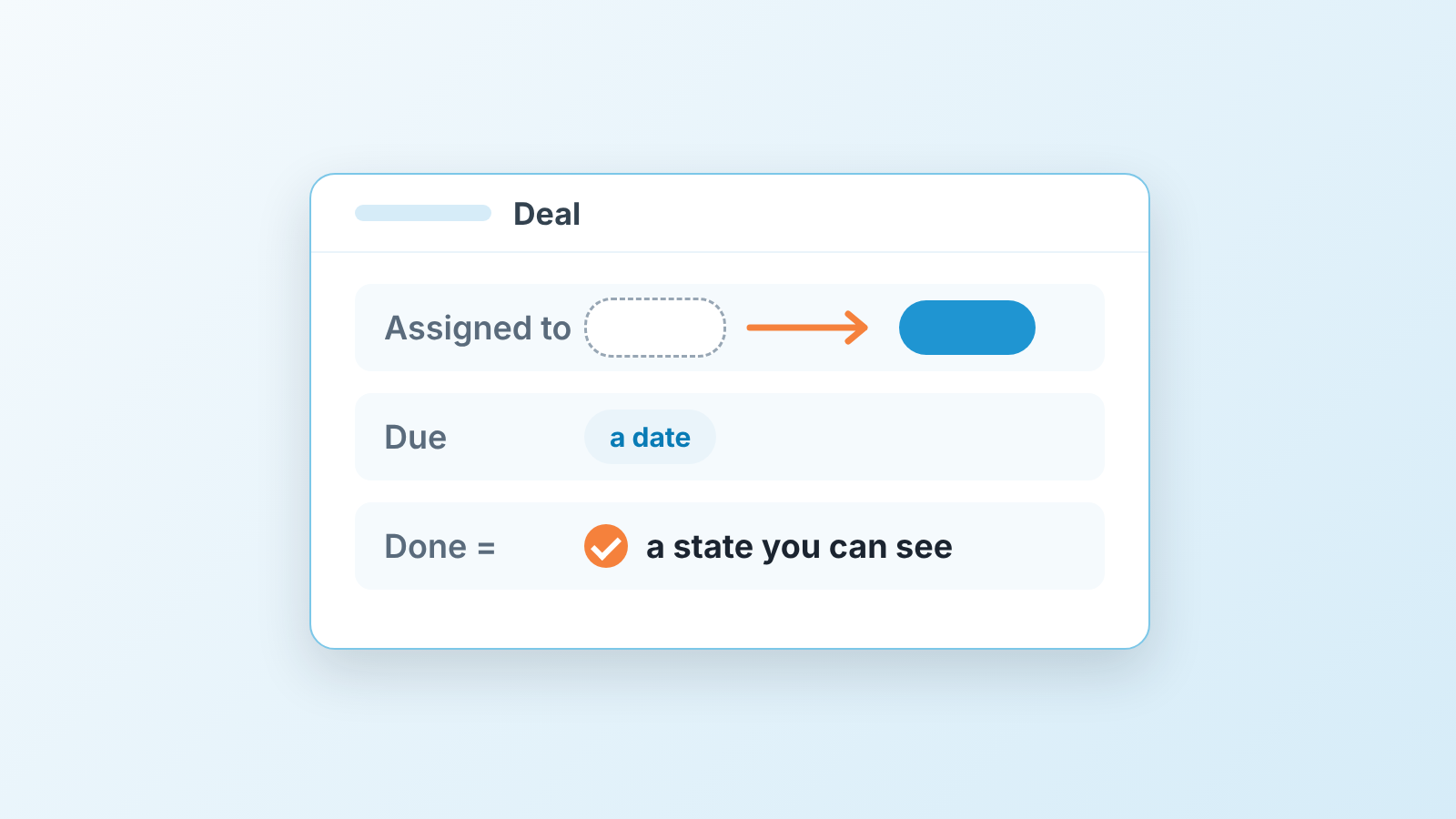
Delegation means handing a task to someone with a clear result and a deadline while you stay accountable for the outcome. In any small business it is how the owner gets back the hours only the owner can spend, and how the team learns to run while the owner is away. For a sales manager it works when each handed-off task has one owner and a due date written in your CRM, where you can check it.
What delegation means in management (and how it differs from abdication)
Abdication is handing off a task and walking away from it: no standard, no check, nobody accountable. The Batten Group’s guide to delegation in management draws the line where we would: once you have delegated, you still have to monitor the progress and quality of the work, and dumping the work on someone and leaving is abdication (The Art of Delegation).
In management terms a handoff moves responsibility, authority and accountability together, and the xMonks guide to delegation adds the condition: the authority delegated has to be proportionate to the responsibility assigned (What is Delegation?). A rep who owns lead review and still has to ask you before marking a lead unqualified has the responsibility and none of the authority; who answers for what afterwards is covered in how accountability works in a small sales team.
Abdication sounds like “can someone look at the inbound queue this week?” said on the way out of the Monday meeting. Delegating the same lead follow-up to a rep called Dana sounds different: “Dana owns inbound lead review until the end of the quarter. Every lead gets a qualified or unqualified decision within one working day, and on Monday I check the leads that are older than a day.” Same task, same rep. Only the second version has an owner, a standard, a due date and a place to check.
If you cannot say where you will check it, the task is still yours.
Why delegate, and why owners still keep the work
Ask the owner of a ten-person company what delegation buys them and the answer is time. The Batten Group puts it first: when you delegate, you free up your time to focus on the most important things. The guide adds two gains we see in sales teams too. Morale improves when people get to take on new challenges and learn new skills, and the leader stops carrying so much stress (The Art of Delegation). In a sales team that looks like this: the owner stops reading every inbound lead, the rep learns to qualify, and the pipeline keeps moving through the owner’s two weeks in August.
So why does the work stay on the owner’s desk? The same guide gives two reasons: managers don’t know how to do it effectively, or they fear losing control or quality. It also admits that trusting your team is hard when you are used to doing everything yourself. Underneath those sits the sentence every manager has said at least once: “it is quicker if I do it.” For one week that holds. By the fourth week you have built the report four times and taught nobody.
Sales adds a barrier of its own. The work a sales leader least wants to give up is the large deal, because closing is the part of the job they are good at and enjoy. Holding on to the deal feels like protecting revenue. It also means the team never learns to close one.
A rough test for letting go is the 70 percent rule. Prialto’s write-up boils it down to one question: “Can this person do it 70 percent as well as I would? If so, you should let go and delegate it” (Prialto on the 70 percent rule). For deals we would add: 70 percent as well, with a next step on the deal that you can see.
If handing a task over whole feels like too much, hand it over in stages. The levels further down are built for exactly that: a check before anything goes out, then a report after, then only the numbers.
Delegating tasks and deals: what to hand off and what to keep
Start from your own calendar: what did you do last week that a rep could have done to the same standard? In a team of five to ten reps, delegating tasks usually comes down to the same few things, each with a natural owner and a place in the CRM where you can see whether it happened.
The weekly pipeline report goes to your most organised rep, or rotates monthly; make it a saved filter the rep owns, and checking it means opening the filter. Inbound lead review goes to one rep for a fixed period; you check it by looking for leads with no owner, or no decision, that are older than one working day. Cleaning up open deals with a close date in the past stays with each rep for their own deals, and one view of those deals grouped by owner shows who has done it.
Deals are the bigger handoff. Deals below a value threshold you set go to the rep who sourced them, or to the rep with the thinnest pipeline. The check: the rep is the deal’s owner and a next activity is scheduled. Onboarding a new rep goes to a senior rep as a buddy, and by week two the new rep’s deals should each have a next activity and at least one stage change.
Keep for yourself: hiring and letting go, quota and territory splits, pricing exceptions above your limit, the forecast you report upward, escalations where the customer asked for you by name, and coaching itself. There, your judgement is the product.
We think most managers get the order wrong. They hand off the report because it feels like admin and keep the deals because deals feel like revenue. For a small team the opposite is better: a report a rep builds is still one you read every week, while a deal you keep is a deal you work, and your hours are the scarcest thing the team has. If you still carry a pipeline of your own, the player-coach article covers how to keep it from competing with the team’s.
How to delegate in six steps
The same six moves work for a report, a lead queue or a deal. The ones that get skipped are four and five.
- Pick the task. The section above lists the usual candidates in a sales team. For a wider sort of your whole week, the Eisenhower matrix for a business owner separates what to hand off from what to stop doing.
- Pick the person. Ask three things: do they have the skill, do they have room this month, and is this something they want to get better at? Inbound lead review often goes to the rep whose pipeline is thin, because they have the hours and the lead flow helps them most.
- Name the result and the date. “Every lead gets a decision within one working day, through 31 December” is a result. “Keep an eye on inbound” is a wish.
- Hand over the authority with the task. Say what the rep decides alone and what they bring to you. For small deals that might be: any terms inside the price list are theirs, anything below it comes to you before it is sent.
- Agree where and when you will check. Name the filter and the day: “overdue leads with no decision, Monday, nine o’clock.” A list in the CRM keeps checking form sliding into hovering; keeping an eye on a rep’s work without standing over it goes into the difference.
- Review the result and move the level. After the first month, look at the outcome together, say what was good, and raise the task one level of trust. If the work got thin, drop it back a level for a week and say that too.
The handoff note: task, owner, due date, what “done” looks like
Every handoff we have seen go well fits in four lines. The ones that went badly were missing one.
Task: the thing to do, in a verb. Owner: one name, never a team. Due: a calendar date. Done looks like: the state you can see when it is finished. Add the Monday check and you have steps three and five above, written where you will both see them.
Filled in for lead review: Review every new inbound lead. Owner: Dana. Due: one working day after the lead arrives, through 31 December. Done looks like: every lead has a qualified or unqualified decision and one line on why, and no lead older than a day is unowned.
Put the note where the the work lives. For a recurring task, create it as an activity or task in the CRM, assigned to the rep, with the due date on it and the “done looks like” line in the note. For a deal, change the deal’s owner and write the expected next step on the deal. A handoff that only exists in a chat message is gone by Thursday, and nobody can filter a chat thread on Monday.
Levels of delegation: three depths of handoff, with an example for each
The same task can be handed off at three depths. Most of the friction we see comes from the manager and the rep assuming different ones.
Level one is “do it and show me before it goes out”. Say Tom builds the first pipeline report on Friday and, for the first month, you send it back with notes before Monday. It is slow on purpose. You are teaching what “done” means to you.
Level two is “do it and tell me after”. Lead review gets here once Dana has shown she can qualify. She marks each lead with one line on why, and once a week you look at the pattern across her decisions.
Level three is “do it, and I will only see it in the numbers”. No check-in; the result shows up in won and lost by rep. Small deals should get here within a quarter.
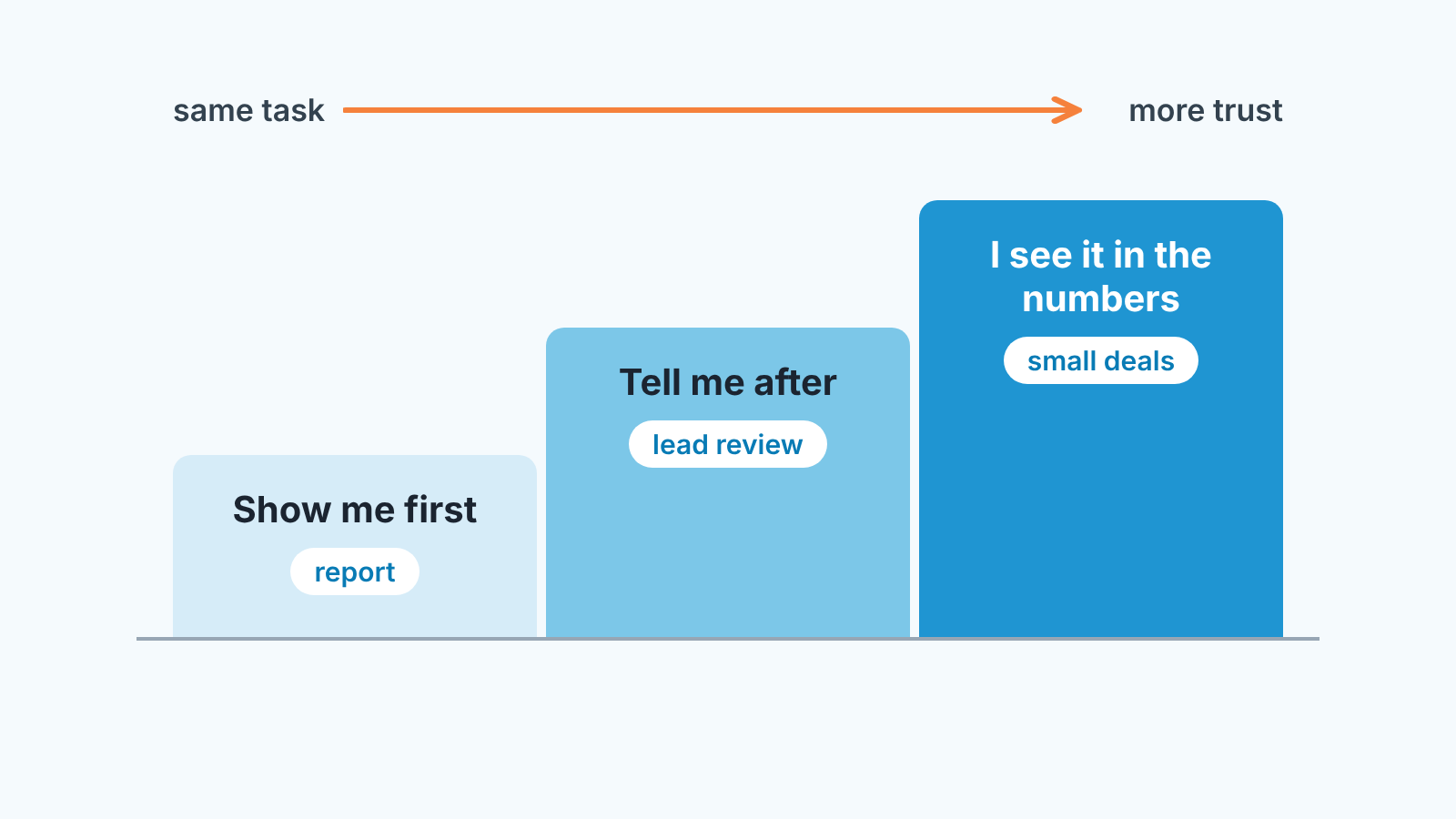
The level belongs to the task and the person together: the same rep can be at level three on lead review and at level one on a pricing reply. Say it when you hand off. “You own this, show me the first two” costs one sentence and saves a week where you both thought the other was checking.
Textbooks cut delegation along different lines. xMonks separates general delegation (a broad area of responsibility) from specific (a single task), and formal delegation (a structured process) from informal, often agreed verbally (What is Delegation?). Our three levels all sit in the specific and formal corner: one task each, written down in the CRM. The types describe what you handed over; the levels describe how closely you hold it afterwards, which is the part reps feel.
Checking delegated work in your CRM (owner field, tasks with due dates, next step)
You check delegated work in the CRM with three fields: the deal owner, tasks with a due date, and the next step. Every CRM we write for has them under some name.
The owner field. In Pipedrive every deal is assigned to one user, its owner; in HubSpot the property is called Deal owner. Save one filter: open deals where the owner is you. That number should fall across the quarter as you hand deals off. If it stays flat, you are delegating tasks and keeping deals, which is the slow version.
Tasks with a due date. A delegated task with an owner and a due date can be filtered as overdue by owner, and that view replaces most “how is it going?” conversations. The talk still happens, but it starts from a list. Who keeps those fields correct in a team with no ops person is it’s own question, and who owns CRM data quality covers the split.
Next step. For a handed-off deal: is a next activity scheduled, and is the date in the future? A rep who owns a deal and has scheduled nothing on it has not taken it yet, whatever the owner field says. Telling a real next step from a placeholder goes into what counts. All three checks fit inside the Monday routine from sales manager responsibilities and the weekly check for each: three filters, no new meeting.
A disclosure, since this is the check our product is built around: we build SalesBond, a sales management layer on top of the CRM a team already uses; we started with Pipedrive. Its Deal Health checks every deal in the connected CRM against more than 20 rules, Activity among their categories, and shows the problems per rep, which covers much of the Monday view without saving the filters yourself. Check your CRM with SalesBond.
When delegation goes back to you (signs in the data)
A handoff rarely fails loudly. Look for your name back in the Owner field, your own activities on a rep’s deals, and tasks reassigned from the rep to you.
A deal you handed to Tom that shows your name again has come back to you, whether or not anyone said so. Calls and notes you logged on a deal that is not yours mean you are doing the work under someone else’s name, and tasks that moved to you usually moved “because it was quicker”. A quieter sign: the rep’s deals have no next activity while every deal of yours has one. Your hours are going into your own deals while thier pipeline stands still.
Usually these signs point to a handoff note with a missing line, most often “done looks like”, so the rep did not know when to stop asking and you did not know when to stop answering. Rewrite the note before you reassign the person.
When you do have to take a deal back, write the reason on the deal and the date you will hand it back. Taking it back silently teaches the team that handoffs are temporary. If the real question is who decides and who does the work at each stage, that is a RACI question, and RACI chart for a sales team handles it.
Common mistakes
Handing off the task and keeping the standard in your head is the most common. It looks like good delegation for two weeks, then neither of you can say which line of the note was broken, because there was no note.
Next, delegating to the busiest rep because they are reliable. Rotate the report instead.
Checking by conversation alone is the third. “How is the lead queue?” gets “fine” every time. The filter for leads older than a day with no decision gets a number, and two people can look at a number together without anyone feeling accused.
So pick one handoff this week. Write the four lines, put the rep’s name in the owner field, and save the filter you will open next Monday. If you later need to step back in, say why and for how long: a rep moved from “tell me after” back to “show me first” without a word reads it as a demotion.