
A player-coach is a sales manager who carries their own deals, and often their own quota, while leading the team. A player-coach needs to decide two things in advance and write both down: how much of the week they sell, and which deals they take for themselves. Once those rules exist on paper, the team sees a rule instead of a rival, and the team’s reports in Pipedrive stop quietly absorbing the manager’s own wins and losses. Without them, the role runs on goodwill, and goodwill is what runs out first. This is for the manager of three to six reps who was promoted for selling well and never actually stopped.
“She takes the good ones”: what the rep sees
Picture the Monday pipeline review. Priya runs a team of four. She also owns eleven open deals, because when the inbound form fires with a recognizable logo, the lead usually ends up with her. She did not take it. It was routed, or the rep was on a call, or the client asked for “whoever is senior.” Each time there was a reason.
Marcus, two years on the team, sees it differently. From his seat, the three biggest deals of the quarter sit under his manager’s name and his own pipeline is the leftovers. When he asks for coaching on a stuck proposal, Priya has twenty minutes between her own calls, and the 1:1 slides to Thursday, then to next week. He does not say any of this out loud. He updates his resume on a Sunday.
That’s the mechanism to understand before you fix anything. The rep is not reacting to your intent. They react to the pattern they can observe, and they can observe exactly two things: whose name is on the large deals, and whether their coaching time holds.
You might not be cherry-picking. It does not matter if it looks like you are.
So the fix is not a speech about intent. It is two rules the team can check.
Write down the split, and put a date on it
The first rule is a number: what share of your working week is selling and what share is managing. Written where the team can read it, with a review date.
A Funded.club guide for founders hiring a player-coach VP of Sales suggests putting “60% selling, 40% leading” or an even 50/50 into the offer itself, reviewing it every quarter, and dropping the selling share by about ten points for every two new account executives. We treat 60/40 and 50/50 as examples, not a norm. Your number depends on your sales cycle and how far you are from target. What we insist on is that it is written and dated.
An unwritten split defaults to selling. Selling has a deadline this month; coaching has a deadline never. In any week where the two collide the quota wins, and after enough of those weeks the “40% managing” exists only in your head.
The date matters because the right split moves with headcount and nobody revisits it on their own. Put “manager’s selling share: still right?” on the quarterly agenda from your meeting cadence. If you are planning headcount anyway, the capacity-planning math for a small team should include your own hours as a line item, not as a rounding error.
And if you carry a quota, size it to the selling share, not to your old rep number. When you hire the next rep, interview them with one of your own closed deals rather than a hardest-deal story.
If you lead other managers rather than reps, what a sales director should check in the CRM each week is a different list.
Which deals are yours, by rule
The second rule is a definition: which deals the manager owns, and which the manager never owns. The test is whether a rep could predict the answer before the lead arrives.
For most teams this size the rule is short:
- You own a deal when the buyer is an existing key account whose relationship you already manage. That list of accounts is written down and does not grow mid-quarter.
- You own a deal when it needs a commitment nobody else can make (pricing outside policy, a custom contract term, a partnership angle), and you say so in the deal notes the moment you take it.
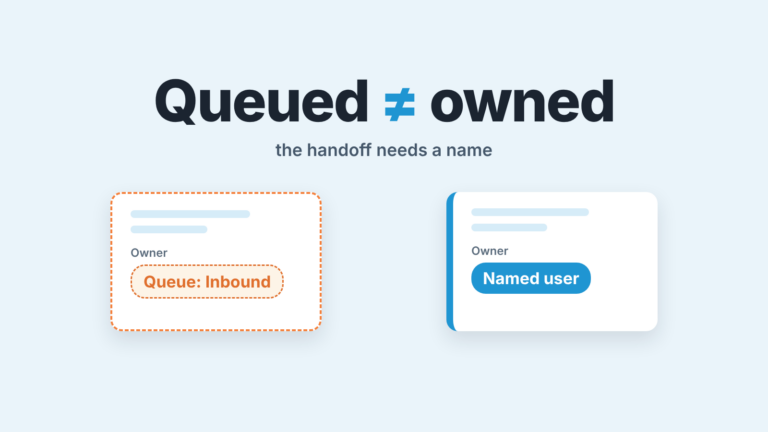
- You never own an inbound lead because it looks big. Big inbound goes through the same routing as small inbound.
- You never take over a deal a rep has already worked. The rep’s name stays on it. Joining a call on that deal is a different job from owning it, with its own rules.
The third line does most of the work. The Funded.club guide is blunt about it: “Don’t let them cherry-pick accounts,” and don’t let the leader “claim the best inbound leads” (Funded.club). The moment a recognizable logo is allowed to route to the manager, every rep knows the real rule, whatever the written one says.
When a deal is yours, write down which line of the rule applied. In Pipedrive that is one sentence in the deal’s notes, visible to anyone who opens the deal. It takes ten seconds, and Marcus can open your largest deal and read why it isn’t his.
Keeping your deals out of the team’s numbers in Pipedrive
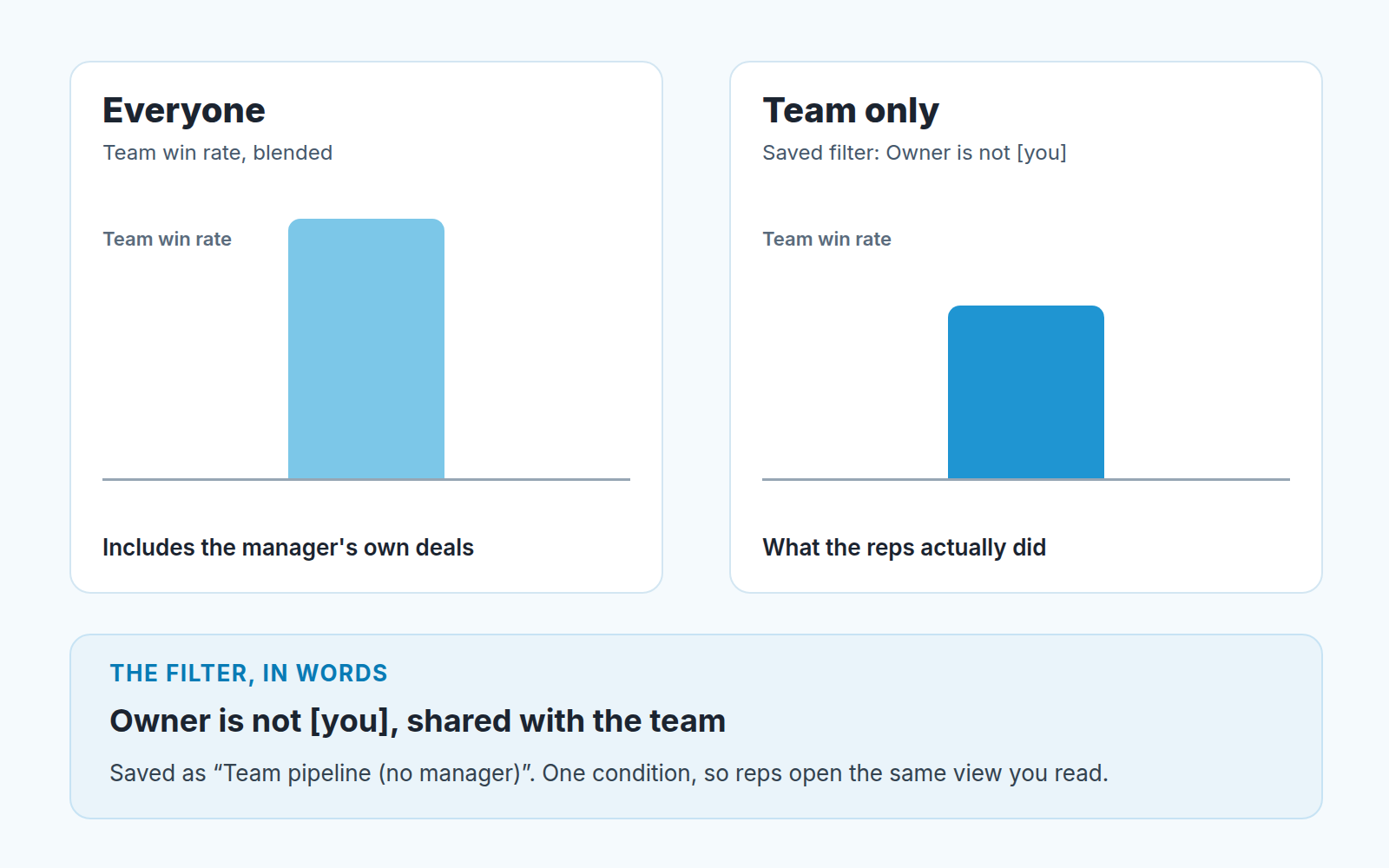
Exclude your own deals with a saved, shared filter, “Owner is not [you]”, and read the team through it.
Here’s why it matters even with a clean rule. Your deals sit in the same pipeline as the team’s, and every report that says “team win rate” or “average cycle” is quietly counting you. A manager who closes larger deals at a higher rate pulls the team’s averages up. The rep who is actually behind hides inside the blended number.
The setup, following the filter mechanics in Pipedrive’s help:
- Open the deals list or pipeline view. The filter dropdown sits in the top right, and advanced filters are available in the deals list, pipeline, forecast and archive views (Pipedrive: filtering).
- Create a new filter with one condition on the deal owner that excludes your user. Filters combine conditions as “ALL” (every condition must match) or “ANY” (at least one must); you need a single ALL condition.
- Save it under a name the team will recognize, such as “Team pipeline (no manager)”. A saved filter can be shared, visible to all users in the account, or private to its creator. Make this one shared so reps open the same view you read.
- Make a second filter with the opposite condition, owner is you, and keep it private if you like.
Reports take the same exclusion. In Insights, report filters combine deal, person and organization fields, and owner is a standard deal field (Pipedrive: deal conversion reports). The Win/loss conversion report already breaks win rate down by deal owner by default, which puts you and each rep side by side in one table. The plan limit on that page is about deal custom fields: only Premium and higher plans can use them “for filtering and building reports in the visual builder.” Owner is not a custom field. Dashboards can be shared with other users in the account (Pipedrive: Insights). If you keep a rep scorecard, apply the owner exclusion there too.
The habit matters more then the setup. When you open the pipeline review on Monday, open the team filter, not “Everyone.” Your deals are a separate conversation. If you have built a six-number manager dashboard, every one of those numbers should run on the team filter.
Your 1:1s are the one thing that doesn’t move
The written split only becomes real as blocks on a calendar. Jeb Blount’s advice to the player-coach about protecting selling time is “Put it on your calendar. Name it. Block it,” with no meetings allowed inside the block (Sales Gravy: the player-coach problem). We apply the same discipline to coaching time, and go one step further: decide in advance what gives first when a week collapses.
Most weeks something does. A prospect of yours asks to move the demo into your 1:1 slot. The quarter is tight and a deal in your own pipeline needs a proposal by Friday. If the order is unwritten the 1:1 gives every time, because the prospect has a deadline and the rep does not. Blount’s line fits here: when it’s leadership time, you set the selling hat down completely.
So write the order next to the split. Ours, for a manager at roughly half and half: your own prospecting block moves first, your own internal meetings move second, the team pipeline review moves third and only within the same day, and the 1:1s do not move at all. A rep whose 1:1 has held for twelve weeks straight stops believing you take the good deals, even if your name is on a few, because the thing they can observe says otherwise. If your 1:1s need a shape, the 1:1 agenda we use runs in thirty minutes.
Holding the slot is half of it. The other half is knowing which of the team’s deals deserve the time, and the answer shouldn’t be whoever talked loudest on Monday (we wrote about that problem in AI sales coaching for small teams). We build SalesBond, a sales management layer on top of the CRM a team already uses; we started with Pipedrive. Its Deal Health checks every deal in the connected CRM against more than 20 rules, shows the specific violations and explains what to do, so the 1:1 starts from a short list of deals and reasons rather than a feeling. If you want to see that list for your own pipeline, check your CRM with SalesBond.
Three signs the player-coach season is ending
Sales Gravy calls this role something that “can work for a season,” and the Funded.club guide puts the working range at two to six account executives and recommends a pure leader once the team reaches 8+ reps (Sales Gravy; Funded.club). We watch for three things that tend to show up before the eighth hire.
First, your quarterly review of the split keeps producing the same number while the team keeps growing. If you hired two reps and your selling share did not move, you did not review it. You re-approved it.
Second, your own deals start slipping in exactly the way you coach reps to avoid. Pushed close dates on your deals, no next activity on your deals. You are now the rep who needs the the 1:1, and nobody is holding it with you.
Third, and Marcus will not tell you this one: the win rate on the team filter and the win rate on “Everyone” have drifted apart, and the gap is you. When your personal results are what make the team look fine, you are carrying the team rather than managing it. If you are the founder rather than a hired manager, the founder-led sales handoff picks up from here.
None of these says stop selling tomorrow, they say the written number should move. As it moves, look at which sales manager responsibilities your CRM can show you.