Give the candidate one real closed deal from your Pipedrive, with the names and the money removed, and ask them to walk through it out loud: what they can see, what they can’t, and what they would do next. Forty-five minutes on a deal your team actually worked tells you more about how a salesperson thinks than an hour of “tell me about your biggest win”. It also tests the one thing the usual interview can’t: whether this person can sell the way your deals get sold.
This is how to interview a sales rep when you are the manager hiring a second or a fourth one and you are also the hiring team, the sales trainer and the top seller at the same time. If you are still deciding whether the headcount is justified, start with when a small team needs the next rep and come back here for the interview itself.
“Tell me about your hardest deal” tells you about their last employer
Every candidate has a hardest-deal story. It is rehearsed, it ends well, and the hard part happened at a company whose product, prices and buyers you have never seen. You can’t check it. You can’t even tell which parts were the candidate’s doing and which were a good manager standing behind them.
The common alternatives have the same gap. A cold-email task tests writing. A “sell me this pen” role play tests nerve and theatre. The written screen and the structured interview that most hiring guides recommend (the sequence shows up in the search results for hiring a sales rep, for example at Alpharun and Startup with Feras) are useful for filtering, and we use them too. What none of them show is the candidate reading a live situation with incomplete information, which is most of a sales job in a small company.
A closed deal from your own CRM flips the exercise. You know how it ended and why. The candidate doesn’t. Everything they say can be compared with what actually happened.
Think of it as a replacement for the sales role play interview. The candidate still has to think and talk like a seller, only the situation is one that really happened, so there is something to check them against. Before this round, a short set of sales interview questions about CRM habits tells you whom to invite.
Pick a deal that is ordinary, not a trophy
The best deal for the exercise closed three to six months ago. Older than that and you have forgotten the detail yourself, so you can’t judge the candidate’s reading of it. Younger than that and the rep who worked it is still emotionally attached, and you may still be onboarding the customer.
In Pipedrive, open the Deals list view, filter on won deals and add the won time column to find that window (Pipedrive: filtering for won, lost or deleted deals; Pipedrive: deal won time). Then pick with three rules:
- Not the cleanest deal of the quarter. A deal that moved through every stage in two weeks with no objections gives the candidate nothing to notice.
- Not a disaster either. A lost deal invites hindsight (“I would have asked about budget earlier”) and tells you little.
- Something in it should have gone sideways and recovered: a stage where it sat for a month, a change of contact, a value that went down, a close date that moved twice.
We also prefer a won deal over a lost one for a practical reason. A won deal lets you ask “what would have gone wrong here?” and then show the candidate where it did go wrong and how the rep fixed it. That second half of the the conversation is where you learn the most.
One more filter, and it decides the exercise more than the others: the record has to be readable. Open the deal detail view and look at the changelog tab, which records updates to stage, value, label, contact and expected close date, and the progress bar above it, which shows how many days the deal spent in each stage (Pipedrive: deal detail view). Then read the notes and the done activities under the history tabs. If you, who were there, can’t reconstruct what happened from the record alone, a stranger can’t either. More on that in the last section.
Strip the names and the money, keep the timeline
The candidate needs the shape of the deal, not its identity. What to remove and what to keep:
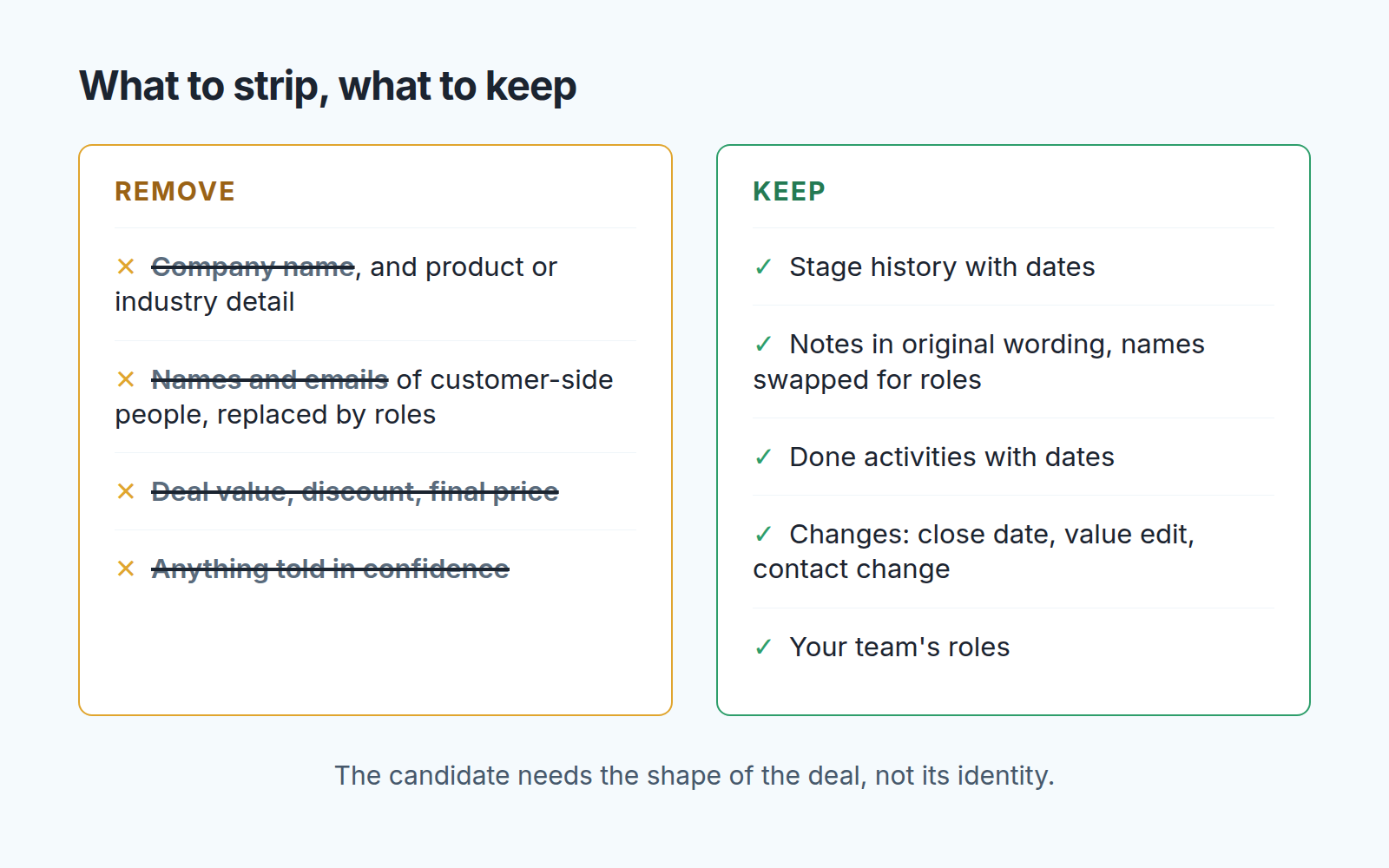
Remove:
- the company name, and any product or industry detail that would let the candidate identify it in a minute of searching;
- the names and email addresses of every person on the customer’s side, replaced by roles (“the ops lead”, “the owner”, “the finance person who joined late”);
- the deal value, the discount and the final price. Replace with “mid-sized for us” or leave it blank. The candidate’s job is to read the process, and a number pulls the conversation towards price;
- anything the customer told your rep in confidence.
Keep:
- the stage history with dates: when the deal entered and left each stage, and how long it sat;
- the notes, in their original wording, with names swapped for roles. The rep’s “they said the current tool is fine, just slow” is exactly the material you want the candidate to react to;
- the done activities: calls, meetings, emails sent, with dates;
- the changes: the expected close date moving, a value edit, a contact change;
- your own team’s roles (“the rep”, “me as the manager who joined the second call”).
The simplest way to produce this is to open the deal, use the “…” menu in the deal detail view and choose “Export as XLSX” for the deal fields, then copy the notes and activities out separately, since Pipedrive exports those apart from the deal itself (Pipedrive: exporting data). Paste the lot into one document, in date order, and do the replacement by hand. It takes less time than the interview will. Don’t delegate this to the rep who worked the deal; they will tidy it up, and the untidy version is the point.
Keep the stripped version. Once it exists it serves every interview for the next year, and it serves the first weeks of onboarding for whoever you hire.
The 45-minute closed-deal interview
Send the document the evening before, with one line: “Read this as if it were your deal. Tomorrow we’ll go through it together.” Some managers prefer to hand it over cold at the start of the meeting. We send it ahead. Preparing is part of the job, and you learn something from how much of the record the candidate actually read.
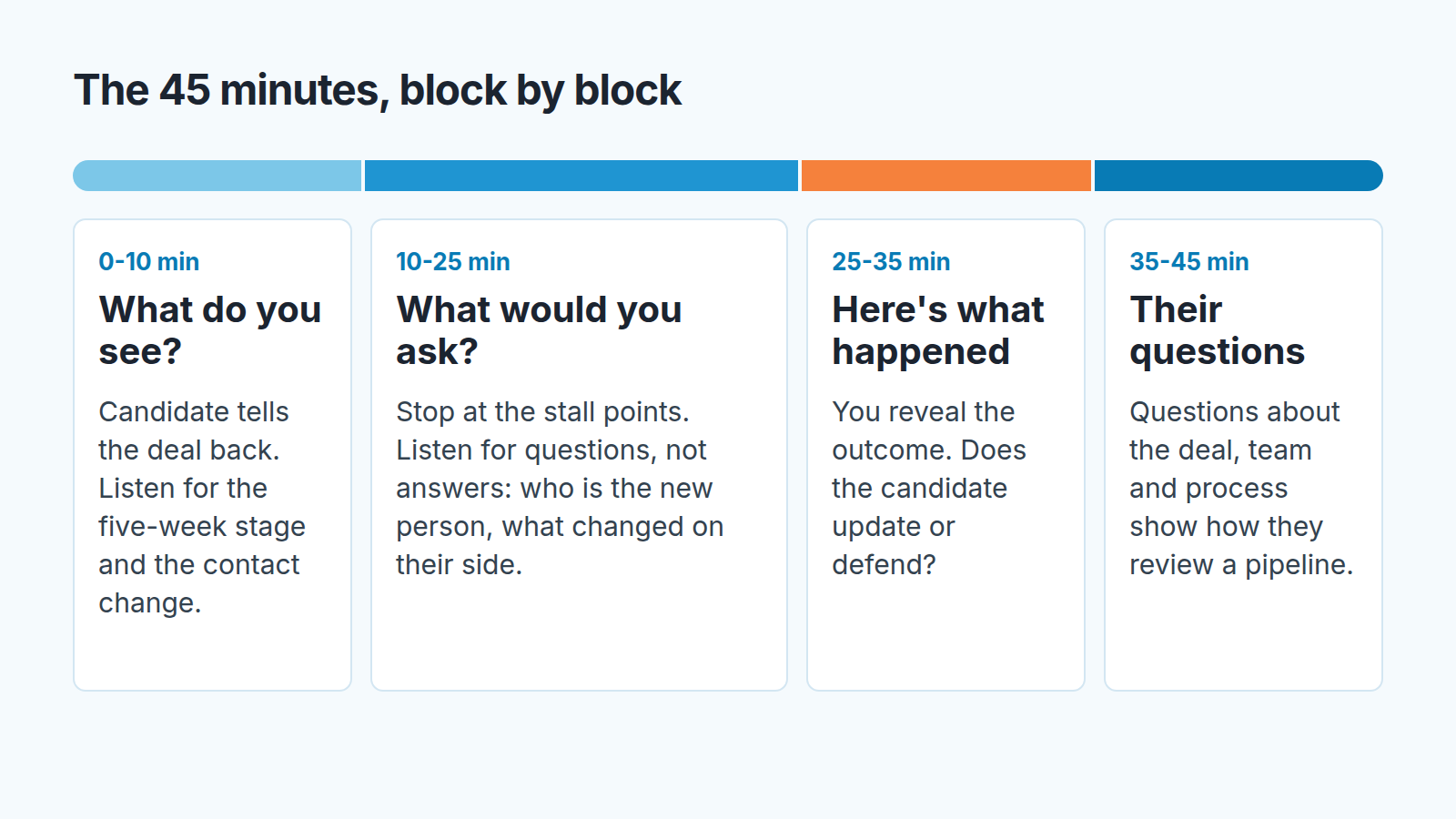
First ten minutes: what do you see. Ask the candidate to tell you the deal back. Not to evaluate it, just to narrate it: who the buyer was, what they wanted, how it moved. Listen for whether they noticed the stage that took five weeks and the contact change in week six, or whether they skipped straight to “and then it closed”. A rep who reads a record carefully will read your pipeline carefully.
Ten to twenty-five: what would you ask. Stop at the stall points. “The deal has been in Proposal Sent for a month. You’re the rep. What’s your next activity, and what do you want to find out?” Then move to the contact change. “A new person appears in the notes. What do you do about that?” You are listening for questions, not answers. Candidates who immediately propose a discount or a “check-in email” are telling you how they will handle your stuck deals. Candidates who ask who the new person reports to, or what changed on the customer’s side in week five, are telling you something else.
Twenty-five to thirty-five: what actually happened. Now tell them. Here’s what the rep did, here’s what the customer said, here’s why the close date moved. Watch the reaction. A good candidate updates: “OK, so the finance person was the real blocker; I’d have found that out later than your rep did.” A weaker one defends the original plan.
The last ten: their questions for you. Let them ask about the deal, the team, the process. A candidate who asks “why was there no activity for three weeks in stage two?” has just done a pipeline review of your team. That’s a hire signal, even if the question stings.
How not to turn it into an interrogation: one deal, not three. Say out loud at the start that there is no right answer and that your own rep got some of it wrong. Share your own mistake in the deal before the candidate has to admit one. And keep the stripped document in front of both of you, so the conversation stays on the record and not on the candidate’s memory.
How to judge it: three observations, not a score
We don’t score this exercise, and we’d argue against building a rubric for it. With one candidate a month and a four-person team, a rubric gives you false precision and a reason to argue about points instead of about the person. Write three observations instead, the same three for every candidate, in the hour after the interview while the detail is fresh.
The first observation is about reading. Did the candidate see the deal as a sequence of decisions, or as a list of events? The weak version sounds like “they had a call, then they sent a proposal, then it closed”. The strong version sounds like “after the proposal the deal went quiet, and the rep’s note from the second call suggests nobody had asked who signs”. Both candidates read the same page. Only one of them saw the pipeline problem on it.
The second is about the next step. At each stall point, was the proposed action specific, dated and aimed at a person? “Follow up” is not a next step. “Call the ops lead on Tuesday and ask whether the owner has seen the proposal” is one. This matters because it is what the candidate will type into your CRM, and it decides whether their deals can be managed or only hoped for. If your team already runs on a next-step rule in Pipedrive, you will hear within minutes whether this person will fit it.
The third is about honesty under correction. When you revealed what actually happened, did the candidate adjust their view, defend it, or go quiet? Reps who can say “I’d have missed that” in an interview can say it in a Monday pipeline review, and a small team lives on those admissions. Reps who can’t will manage your perception of their deals instead of the deals.
Three paragraphs per candidate, written the same day. After the third interview you will find you can compare them directly, which is all a score was ever going to give you. For the offer that follows a strong interview, the compensation side lives in how to set OTE for a first sales hire; this article stops at the handshake.
If you’re embarrassed to show the record, fix that first
Here is what happens when a manager tries this for the first time. They open a won deal from last spring, look at the changelog, and realise that the record says almost nothing. Three stage changes, two notes that read “good call, sending proposal” and “following up”, a close date moved twice with no reason, then Won. The deal was real, the rep did good work, and none of it got written down.
That is not a reason to skip the exercise. It is the exercise, pointed at your own team. If the record of a deal you won can’t be read by a stranger, it can’t be read by the rep you are about to hire either, and they will spend thier first month asking people what happened instead of reading it. Before the interview, open the deal you chose and read it as that stranger. Where you can’t tell what the next step was, or why the deal went quiet for three weeks, that is the gap to close with your current team, and five lines per call is usually enough to close it. The same gaps sit in your open deals right now, and there they cost money; we build Deal Health in SalesBond to check every deal against a set of rules (Activity, Progression and others) and show the specific violation and what to do about it.
Then pick the deal, strip it, and run the 45 minutes. The first time you do it you will learn as much about your own pipeline as about the candidate, and that is a fair trade for an afternoon.