
On-target earnings (OTE) is what a salesperson earns in a year if they hit 100% of quota: base salary plus target variable pay. It only means something if the quota behind it is realistic, so set quota first and derive OTE from it.
That order sounds obvious. Most small teams do the opposite. The founder picks a round number that sounds competitive for the job ad, splits it down the middle, and only later works out what quota would pay for it. By then the number is in an offer letter and nobody wants to touch it.
This guide is for the manager making a first or second sales hire without a comp team or a benchmark spreadsheet. We’ll build OTE from the revenue the seat has to bring in, pick a split based on how much of the result the rep actually controls, and deal with the awkward first months before any deals close.
What’s in OTE, and what isn’t
OTE has two parts. Base is the salary the rep gets no matter what. Variable is the commission or bonus they get for hitting quota, and it moves up or down when they land above or below it.
For how to pay out that variable part, see our guide to sales commission structures for a small team.
That makes the answer to a common candidate question short: OTE is not guaranteed pay. Only the base is.
So when you write “OTE $90,000” in an offer, you’re promising the whole package at exactly one point on the curve, 100% of quota. At 60% of quota the rep earns base plus a slice of variable. At 120% they may earn more than OTE, depending on how your plan pays above target.
Anything not tied to the sales result stays out. Health insurance, retirement contributions, equity, a phone allowance, a car: they’re part of what the job costs you and part of what the candidate weighs, but they aren’t “earnings” in the OTE sense. List them separately. A candidate comparing two offers will pull them apart anyway, and if you’ve mixed them in, your OTE looks inflated the moment they ask how it breaks down.
And OTE isn’t a forecast of what the rep will make. Its a target. If nobody on your team has ever hit the quota behind it, the OTE is a figure on paper, and experienced candidates spot that fast.
One-off SPIFFs sit outside OTE: a bonus for one result in a two-week window, not part of the pay you quote a candidate.
How to calculate OTE from your quota
Start from the number the seat has to produce, not from the salary you’d like to offer. Getting that number right is its own job, and we cover it in a separate guide on setting sales quotas. Here we’ll take the quota as given and turn it into pay.
A hypothetical example, with numbers that are made up but add up:
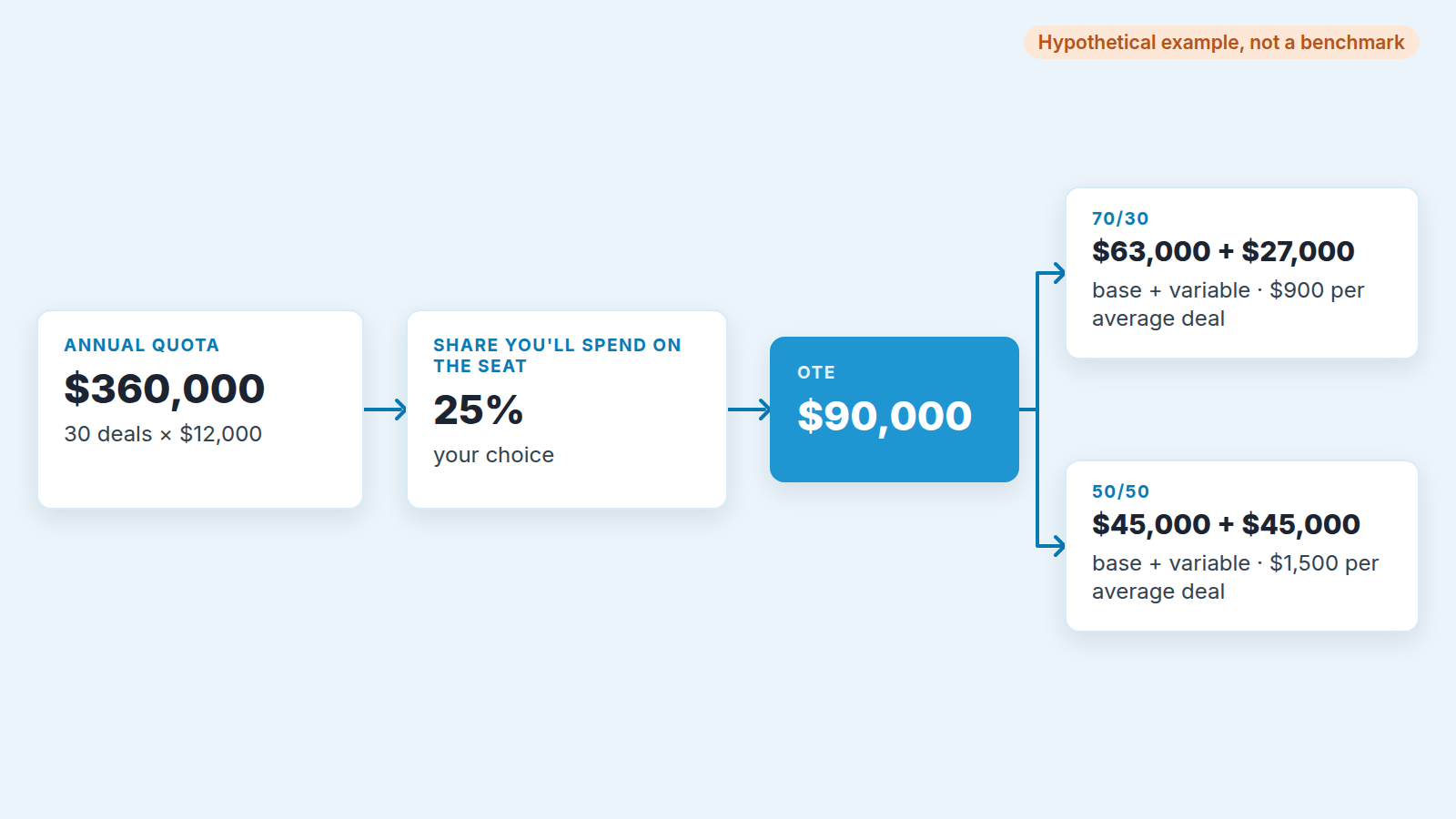
- The new rep’s full annual quota is $360,000 in new revenue.
- Your average won deal is $12,000, so the quota means about 30 won deals a year.
- You decide you can spend 25% of that new revenue on this seat’s cash pay. That share is your call, based on your margins and how fast the seat needs to pay for itself. It isn’t a benchmark.
25% of $360,000 gives an OTE of $90,000.
The split turns that into something the rep can check against their own deals. At 70/30, base is $63,000 and variable at quota is $27,000, which works out to 7.5% of revenue, or $900 per average deal (30 × $900 = $27,000). At 50/50, it’s $45,000 and $45,000: 12.5% of revenue, $1,500 per average deal (30 × $1,500 = $45,000).
Now the uncomfortable check. Can the business carry the base if the rep closes nothing for six months? Base is the part you pay regardless. If $63,000 a year of fixed cost would hurt, that tells you something about the split, or maybe about the timing of this hire.
The inputs already sit in your CRM. In Pipedrive, won deals per owner and their values over the last few quarters give you the average deal, and they show whether 30 wins a year is a normal year for your team or a heroic one.
Picking the split: who gets 70/30, who gets 50/50
Guides commonly treat 50/50 as the default for reps who close their own deals, and 70/30 or 80/20 for roles with less control over the close, such as SDRs.
We’d go further: for a first hire, the question isn’t the job title. It’s how much of the close this particular rep will control while you, the founder, are still in the room. How many of your deals already close without you is one of the numbers in the Pipedrive baseline to pull before your first sales hire.
If you still run most demos, set pricing and jump on every negotiation, the rep’s result depends heavily on you. Tying half their pay to it is asking them to bet on your calendar. A 70/30 split is fairer, and it’s more honest about what the job really is at this stage.
If the rep owns the deal from first call to signature, picks which leads to chase and sets their own pace, 50/50 makes sense. Their effort moves the number, so more of their pay should move with it.
Two other things push toward more base. Long sales cycles, because a rep on a big variable share waits months for the first commission and starts making short-term decisions to fix their cash flow. And an unproven quota: if you’ve never seen anyone hit it, a variable-heavy plan turns your guess into their pay cut.
You can move the split later. Shifting from 70/30 toward 50/50 at an annual review, once the quota has a track record, is an easy conversation. Going the other way, cutting variable because the rep “earns too much”, is a very hard one.
The first months, before anything closes
A new rep can’t earn commission on deals that don’t exist yet. If your sales cycle is two or three months, their first quarter of variable pay is close to zero through no fault of their own. There are three ways to handle it.
The first is a guarantee. You pay the target variable for the first few months as if they’d hit quota. In our 70/30 example that’s $27,000 ÷ 12 = $2,250 a month on top of base, so a three-month guarantee costs $6,750. It’s simple, and it takes pressure off while they learn your product. The catch: pay sends the rep no signal during the guarantee, so you have to watch activity and pipeline yourself.
The second is a reduced quota with the normal commission rate. The rep earns $900 per average deal from day one, but the quota for those first months is set low enough to be realistic. They feel the plan working immediately. The catch here is cash. If the first deals slip, the rep’s income dips right when they’re least sure the job was a good move.
The third is both, and it’s what we’d do for a first hire. Guarantee a share of variable in months one and two, let it step down, and pay normal commission on anything that closes in the meantime. The rep gets a floor and a reason to close early. Whatever you pick write down the exact date the guarantee ends. An end date that lives only in someone’s memory tends to become a negotiation.
What to say in the offer conversation
Say the OTE, then say the base right after it. Candidates who’ve been around know OTE alone doesn’t tell them much, and leading with base signals you’re not hiding anything.
Then show them the arithmetic from your side. “Quota is $360,000 for a full year. Average deal is about $12,000, so that’s roughly 30 deals. Each one pays you about $900.” A rep who can do that sum in their head on the call will trust the plan more than one squinting at a percentage in a PDF.
Tell them how the first months work, in dates. Tell them what happens above quota, even if the answer is “same rate, no cap.” And if nobody has hit this quota because nobody has held this job, say so. It’s a first hire; they already suspect it. Being straight now saves you a resignation in month five.
Every good candidate asks some version of “How many people hit quota last year?” For a first hire, the honest answer is: none yet, here’s how we set it, and here’s what we’ll do if it turns out wrong. Candidates who ask that deserve an interview that tests them back, and we keep a list of sales interview questions on CRM habits for it.
Mistakes that turn OTE into fiction
A few patterns make the the number on the offer letter meaningless. Most of them start with a good intention.
- Setting OTE to match a job ad you saw and backing into the quota afterwards. The quota becomes whatever makes the pay look right, not what the market can give.
- Promising “uncapped” commission while privately planning to revisit the plan if someone earns too much. Reps talk, and the first retroactive change costs you the trust the whole plan relies on.
- A quota nobody has hit in a year. Then your real OTE is base plus whatever people actually earn, and the candidate will find out in the first month.
- Variable-heavy splits on a cycle so long the rep can’t see a commission until month six.
- Leaving the ramp unwritten.
Try this before you send the offer: explain the OTE to yourself in three sentences (what the quota is, where it came from, what one average deal pays). If you can, the plan is probably sound. If you can’t, fix the quota before you fix the pay.