Before you hire a first salesperson, export what your own deals say about the motion: stage-to-stage conversion, cycle length, win rate by lead source, average deal size, and how many wins needed you personally on the call. Pull those five numbers from Pipedrive before the job post goes out. That baseline is what lets you tell, three months later, whether the hire is struggling or the process was never repeatable.
Founder-led sales is the stretch where the founder runs the deals personally, before anyone else is paid to sell. When to hand it off? Penny Mares, VP of Sales at Unusual Ventures, told Mercury that founders should often close at least 10 customers on their own before bringing on a salesperson, depending on the size and complexity of the deals (Mercury).
Most advice on the handoff then covers the documents (ICP, playbook, objection list) and the money. Both matter. What almost nobody says is that a new rep measured against the founder will lose every time. The founder had the product in their head, the investor’s warm intro, and “CEO” in the signature. We think the fair comparison is the hire against the process, and the process only exists as a number if you wrote it down before the hire started.
“Talk to your best customers” is a story with you in it
The same Mercury guide makes a second point that gets less attention: use data to tell whether the hire is struggling or the process is broken. Good advice. The trouble is what most founders do with it. They talk to their best customers, write up why those customers bought, and call that the process.
A conversation produces a story. The story has the founder in it.
Picture a founder who closed most of last year’s deals through warm introductions, joined every second call, and wrote every proposal. Ask the customers why they bought and you will hear “we trusted the team” and “the CEO really understood our problem”. True, and useless to a new rep. The CRM might tell a different story: deals that came in cold converted at a fraction of the warm ones, and the two deals a contractor ran without the founder died at the proposal stage. That second story is the one a hire inherits.
So the customer interviews are fine. Do them after the export, not instead of it.
Pull the baseline before the job post
Take the full history, not the last quarter. A founder’s pipeline is small and a single quarter is a handful of deals.
- Stage-to-stage conversion shows where deals leak, and how far a stranger gets without you. In Insights, create a deal conversion report of the “funnel conversion” type. Pipedrive won’t let you remove the pipeline filter on this one, and by default it only counts deals created this year that were marked won or lost, so widen the date range to the full history (Pipedrive: deal conversion report). Open deals stay out of it, which is what you want here.
- Cycle length tells you how long the rep has to survive before anyone can judge a result. The Insights route is in our guide to sales cycle length in Pipedrive; the fallback is an export of won deals and a spreadsheet column that subtracts the created date from the won date.
- Win rate by lead source shows which of your channels a non-founder can work. Same conversion report, “win/loss conversion” type, viewed by source channel. That is one of Pipedrive’s standard deal fields, not a custom one, so the plan restriction below does not apply to it. Switch the measure from number of deals to deal value as well. It’s often the more honest view of a founder’s pipeline, because founders tend to win the big ones themselves.
- Average deal size tells you whether the rep’s targets are even arithmetically possible. Total value of won deals divided by their count, plus the median, since one large deal distorts a small sample.
- Share of wins with you involved. This one doesn’t exist in Pipedrive yet. That’s the next section.
Stage conversion has its own walkthrough too: stage conversion rates in Pipedrive. We will not repeat the mechanics here.
Keep the export. A report dated the week before the hire started is the one nobody can argue with later.
The “Founder involved” field: tagging the last 20 or 30 deals honestly
Pipedrive will not tell you which deals you carried. You have to tag them. Open the account menu in the upper right corner, go to Personal preferences > Data fields, choose deals and click “+ Custom field” (Pipedrive: custom fields). Call it “Founder involved” and give it two fixed options rather than free text so you can filter on it later.
One plan detail before you spend the evening. Filtering the deals list by a custom field works on any plan. Slicing an Insights report by it does not: Pipedrive’s help says only Premium and higher plans can use deal custom fields for filtering and building reports in the visual builder. Below Premium you will count from the filtered list or an export instead. Annoying, not a blocker.
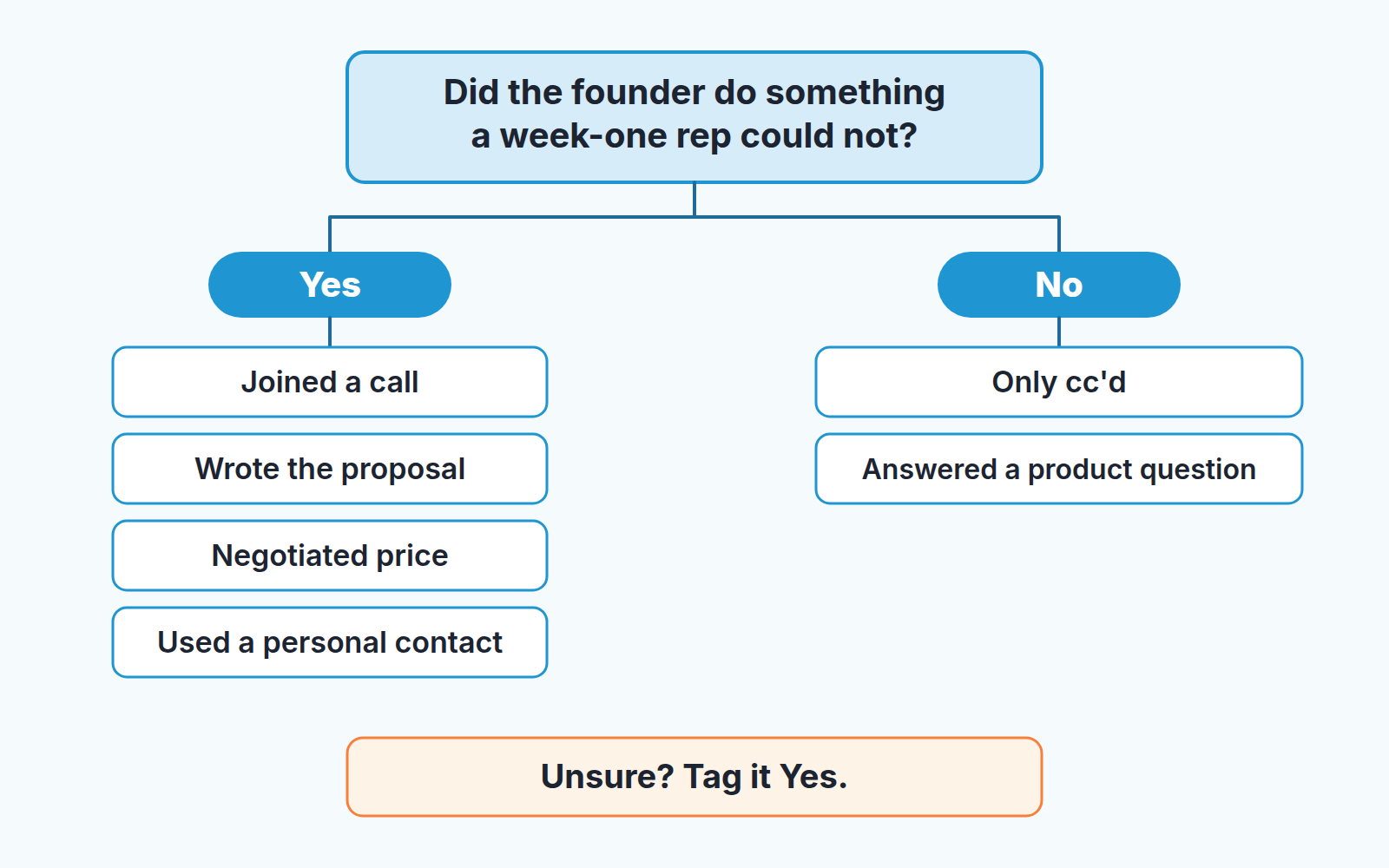
Then go through the last 20 or 30 closed deals, won and lost, and answer one question per deal: did you do something here that a new rep could not have done in week one?
- Joining a call counts. So does writing the proposal, negotiating price, or calling someone you have known for years.
- Being cc’d does not count, and neither does answering a product question in Slack. If that’s the whole of your involvement, the answer is “No”.
- Unsure means “Yes”. The point of the field is to find deals that closed without you, and a doubtful case is not one of those.
- Lost deals get the same care. A split that only covers wins tells you nothing.
This takes an evening. It is the most useful evening of the whole handover, and it can’t be done later, because in six months you will not remember who was on which call. The same closed deals make a good interview exercise later: hand a candidate one of them, names and money removed, and see what they notice.
Repeatable means it closed without you
Now split the wins. On Premium or higher, add Founder involved as a filter to the win/loss conversion report and run it twice, once for “No” and once for “Yes”. On a lower plan, filter the deals list by the field, then count won against lost for each value by hand or in an export. Either way you end up with two win rates, and the gap between them is the size of the the problem you are hiring into.
If nearly every win has you in it, you do not have a sales process yet. You have a founder.
That is not a failure. It’s the most important fact in the plan, because it changes the hire’s first job. The job is not “hit quota”. The job is to run deals you stay out of, and the measure for the first quarter is whether the “No” column grows and whether its conversion looks anything like the “Yes” column. The same rule works for any selling manager: keep your own deals out of the team numbers.
QuotaPath makes a related point about pay: compensate for what a non-founder reproduces, and audit deal size, cycle and win rate before you set the plan (QuotaPath). We would put it more bluntly. A target built on the founder’s win rate is a target the founder set for themselves and then handed to someone else.
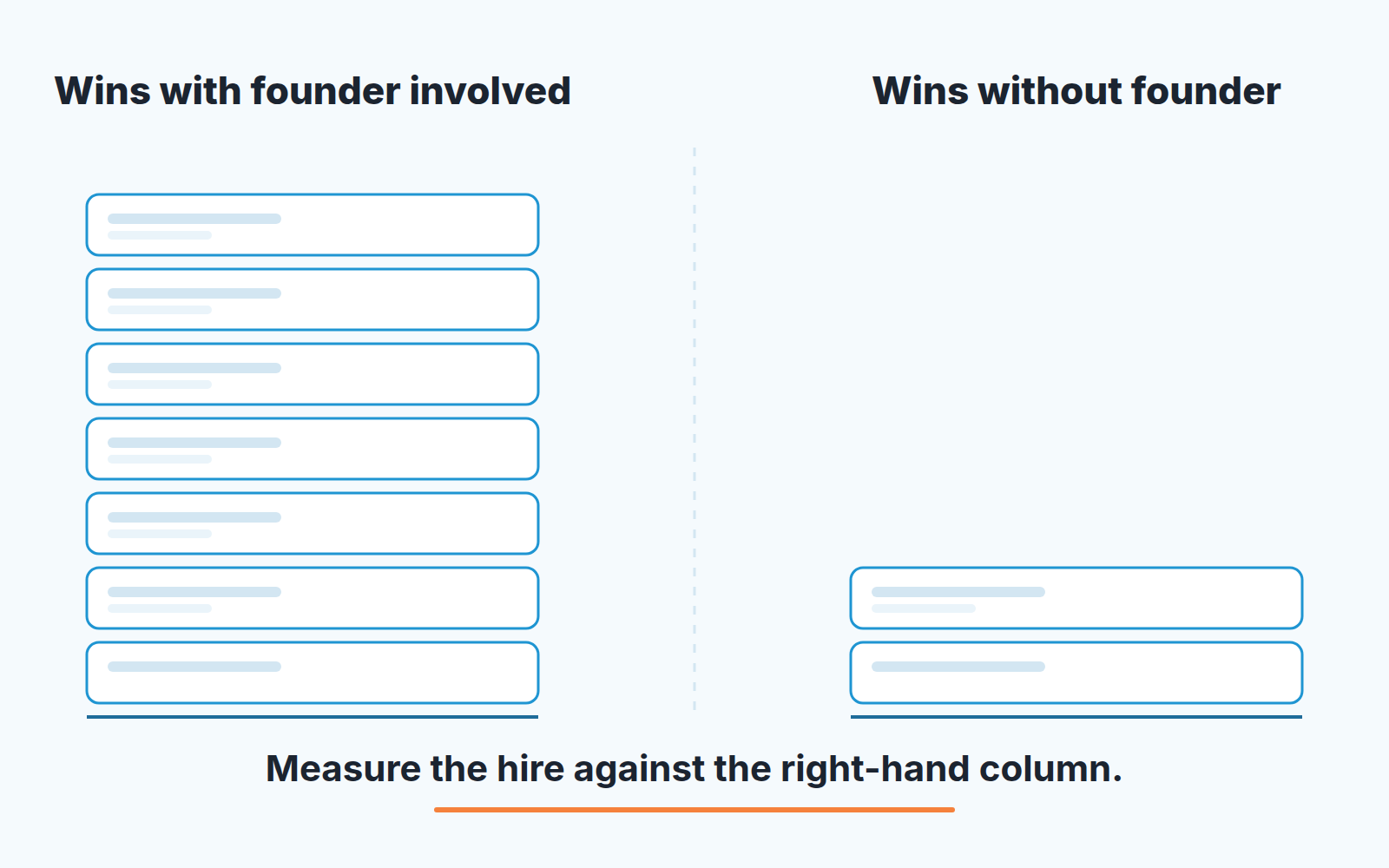
The “No” group may be five deals, so write it down as “two of five”, not as a percentage. Why a thin slice misleads is covered in our piece on win rate in Pipedrive.
Stage names are not a handover; definitions and next steps are
A founder’s pipeline stages are usually named, not defined. “Proposal” means whatever you meant the day you moved the deal there, and the new rep will mean something else. Before the handover, write one line under each stage saying what has to be true for a deal to enter it and what moves it out. Keep it short. This is not the moment to build a one-page sales playbook, though that comes next.
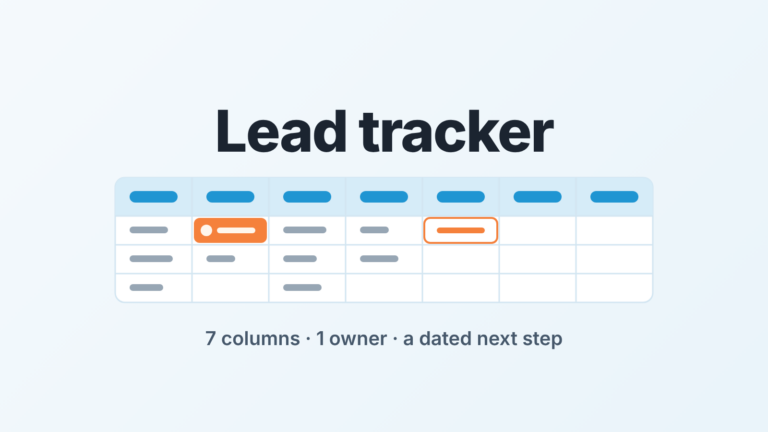
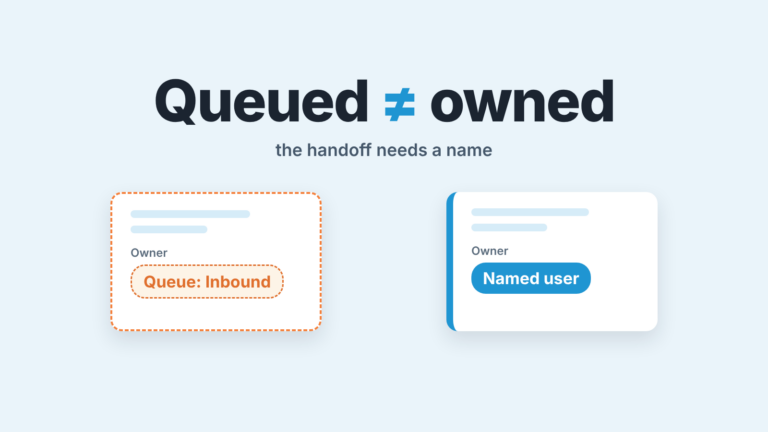
Then open every deal you are handing over and make sure it has a scheduled next activity with a date. A deal with no next activity is a deal only you know how to move, and the day it lands on the rep’s board it stops moving. Tedious, yes. It is also the only part of the handover the rep will feel on day one: they open Pipedrive and see either a list of things to do or a list of names. Which deals to hand over first is its own decision: give, keep or share.
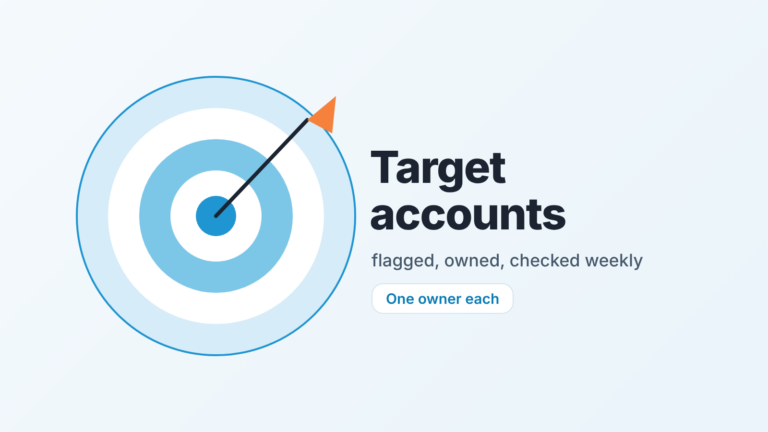
While you are in there, the deals tagged “Founder involved = Yes” that are still open need a decision. Either you stay on them through close and they don’t count toward the rep’s numbers, or you step off now and accept that some will die. Splitting the difference, where you drop in “just to help”, is how the baseline gets contaminated in month one. If you do join, agree a role and leave one note so the rep stays the owner.
What to compare at 30, 60 and 90 days (and what to leave alone)
The onboarding plan itself, what the rep does each week, is a separate article: 30-60-90 onboarding for a sales rep. Here we only care about which baseline numbers are ready to be compared, and when.
At thirty days, almost nothing is. If your cycle is longer than a month, no deal the rep opened has had time to close, so win rate and average deal size mean nothing yet. What you can compare is the top of the funnel: deals created, conversion from the first stage to the second, and whether every open deal still carries a next activity. Compare against the “Founder involved = No” baseline, not against your own numbers.
At sixty days mid-funnel conversion starts to mean something. You can see whether the rep’s deals stall in the same stage where your founder-free deals stalled. If they do, you have learned something about the process, not about the person. Cycle length is still half-baked, because the only closed deals are the fast ones, which makes the rep look quicker than they are.
At ninety days, compare win rate only if the rep has closed more than a handful of deals. Otherwise keep watching stage conversion and give win rate another quarter. Panicking at ninety days over four closed deals is the same mistake as never pulling the baseline at all.
When the numbers do diverge and you need to decide whether it’s the person or the pipeline, that diagnosis has its own guide: is it the rep or the pipeline? We left its tests out on purpose. Before the hire, the only job is the baseline. The money side, base against variable for a first rep, is in OTE for your first sales hire.
Where SalesBond fits, and where it doesn’t
A disclosure, since the handover above leans on next activities and stage discipline: we build SalesBond, a sales management layer on top of the CRM a team already uses, and we started with Pipedrive. Deal Health checks every deal in the connected CRM against the enabled rules, more than 20 of them, including activity, progression and data quality, and shows the specific violations with a recommended action. For a founder with one new rep, that means you see which of the rep’s deals have lost thier next step or sat in a stage too long, without opening each one. It will not tell you whether the rep is good on a call, and it will not pull the baseline for you. That evening of tagging is still yours. If you want to see what it flags in your pipeline, check your CRM with SalesBond.
The baseline is the part people skip, because it feels like homework and the hire feels like progress. Pull the five numbers anyway. In three months you will either be relieved that the rep is tracking the founder-free baseline, or you will know the process never worked without you. A report is a cheaper place to learn that than a resignation letter.