An underperforming sales rep is one who misses target while the team, working the same pipeline, does not. That is a diagnosis, not an observation, so check it before you act on it. Compare the rep with the rest of the team on four numbers you already have in Pipedrive: deals created, conversion between stages, deal age in each stage, and lost reasons. If every rep leaks at the same stage, the pipeline is broken and this rep is simply the one you noticed first. If one rep differs while their supply of deals looks like everyone else’s, you have a coaching or fit problem, and you now know which stage to coach.
It takes less time than the conversation it prepares you for. And it is far cheaper than a wrong hard conversation, which costs you a rep’s trust and sometimes the rep.
Why your first read of an underperforming rep is usually wrong
The number that starts the conversation is almost always an output: quota attainment, closed-won, revenue against plan. Outputs have inputs. How many deals reached the rep, how many survived each stage, how long each one took, why the lost ones were lost. Two reps can miss the same target for opposite reasons. One had plenty of deals and dropped them at Proposal. The other converted as well as anyone and never had enough to work. Different problems, different owners, and the second one is usually yours.
Most advice on underperforming reps already gets part of this right. Good activity with low conversion points at qualification or discovery; decent conversion with a thin pipeline points at prospecting. We agree with that logic as far as it goes. What it leaves out is the comparison. A low conversion at Proposal is a rep problem only if the other reps convert at Proposal. If nobody does, the problem is the proposal, the pricing or the way the stage is defined, and the rep in your office is just the one with the smallest cushion of deals.
There’s a second trap. A manager’s memory is built from the last two deals and the loudest voice in the room. The rep who lost a big one last week feels like a problem. The rep who quietly lost six small ones does not.
Numbers first, then the conversation.
Four numbers, rep against the team
Pick one window and one pipeline and use them for every number below. A quarter works for most teams; if your volumes are small, take two quarters and accept that the picture is a little older. Pull the team figure first, then the rep’s, and write them side by side. You are looking for the shape, not the decimals.
-
Deals created. Count the new deals each rep received or opened in the window. The deals list filtered by owner and creation date gives you the raw count. For the whole team on one chart, use the Insights deal performance report, which counts deals started, won and lost (its default filter is Deal created), and filter it by owner (Pipedrive: deal performance report). If this rep’s count sits far below the team and leads are routed rather than self-sourced, stop here. You have a supply problem, not a rep problem. If the rep hunts thier own deals, this number is partly an effort number, and the activity side is covered in the activity metrics worth tracking on a small team. The opposite case, a rep buried under too many open deals, has its own signature, which we walked through in how many deals one rep can carry.
-
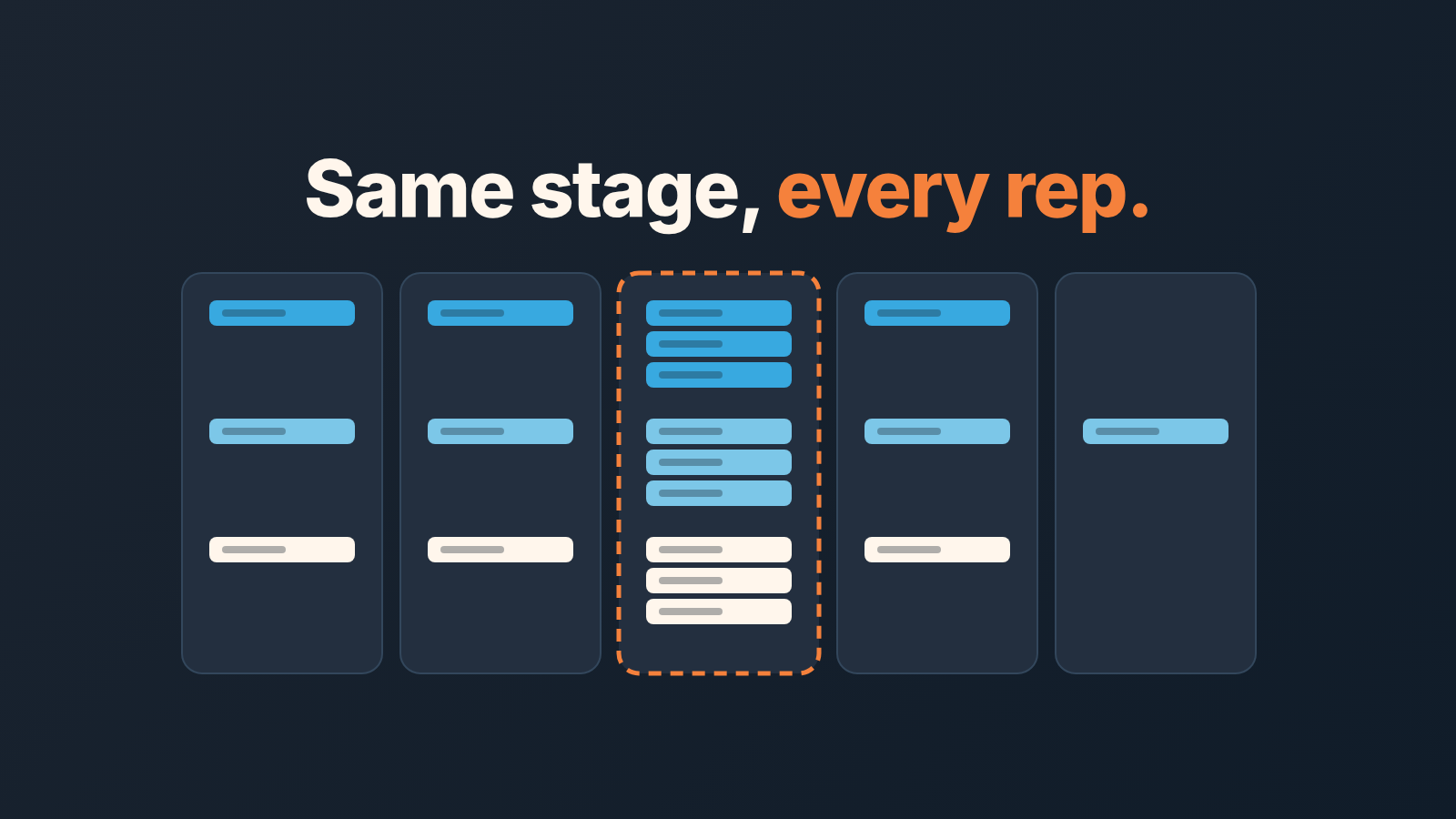
Conversion between stages. Open the deal conversion report in Insights and pick the funnel conversion type: each column is a pipeline stage and shows the percentage of deals that reached it (Pipedrive: deal conversion report). Run it once for the team, then once more filtered to the rep; the win/loss conversion type is handy here too, since it puts every owner in one chart. Lay the two funnels next to each other and find the step where the shapes part ways. Everyone drops at the same step? Pipeline. The rep drops at a step the team walks through? Rep, and you also know which skill. How to build the honest cohort version of this number, and the two Pipedrive traps that distort it, is in pipeline stage conversion rates in Pipedrive, so we won’t repeat it here.
If the rep’s totals don’t match what you see, check Insights visibility and the two Insights permissions first, because the two of you may not be looking at the same deals.
-
Deal age in each stage. The deal duration report shows the average time a deal takes to get through the pipeline, broken down by stage in days, with “Stage entered” as the default view; switch the view to a Users field and it splits by owner (Pipedrive: deal duration report). A rep whose deals sit in one stage far longer than the team’s is either not following up or not qualifying out. If deals age in that stage for everybody, the stage itself is the problem: no exit criterion, or an exit criterion the buyer controls and nobody chases.
-
Lost reasons. They live in the deal’s detail view once it is marked lost, and in Insights you reach them through a deal performance report with a filter for lost reasons (Pipedrive: lost reasons). Freeform reasons give you mush, so if that is what you have, cleaning up lost reasons in Pipedrive comes before this check. With a usable list, compare the mix. The team loses to price and to competitors in roughly the same proportions: that’s the market, and the pipeline. One rep loses to “no decision” or “went silent” far more often than the others: that is follow-up or qualification, and it belongs to the rep. Watch for the inverse too. A rep with very few lost deals and a fat open pipeline is not converting better. They are not closing deals as lost, and every rate you compute for them is inflated. How the definition of a win rate changes what you see is in sales win rate in Pipedrive.
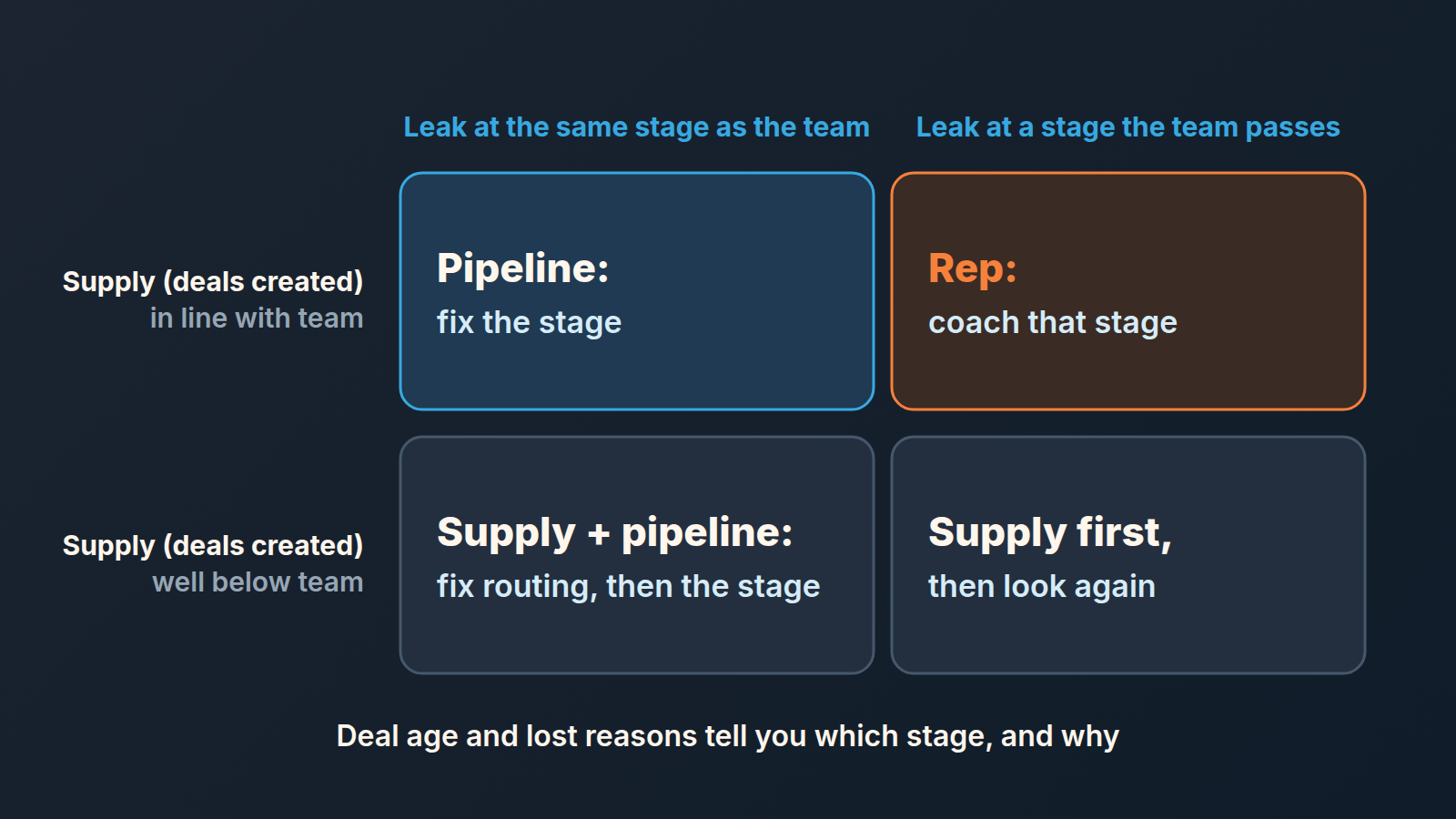
Read the four together, not one at a time. Supply fine, conversion fine, age fine, lost mix like everyone’s, and the number is still short? Then the target is wrong or the deals are smaller, and neither is a performance conversation. Supply fine and one stage leaking only for this rep, with deals ageing there and losses going silent? That is as clear a rep verdict as the data gives, and you can open the conversation with the stage, not with the quota.
Small teams: a few dozen deals is not a dataset
If you have three to eight reps and a few dozen closed deals a quarter, percentages will lie to you with a straight face. Say a rep converted two of seven at Proposal while the team converted about half. In a chart that looks like a disaster. The gap is a couple of deals, and a couple of deals is a conversation about those deals, not a conclusion about a person.
So count before you compute. Write the raw number next to every rate, and if it is small enough to read deal by deal, read deal by deal. On a small team you can go through one rep’s lost deals for a quarter in an afternoon, and that reading will tell you more than the the conversion chart. Widen the window before you sharpen the verdict: two quarters, or the trailing year. Then wait for the pattern to show up in two consecutive windows before you say it out loud. A stage that leaks for one rep in one quarter is noise until it leaks again. When the rest of the team is winning and one rep has stopped, the question is a different one: is the slump a streak or a decline?
We would also keep all of this away from any ranking. The moment the four numbers turn into a league table, reps start managing the numbers instead of the deals: deals get created later so the count looks lean, lost deals stay open so the funnel looks healthy. The checks work because they are a diagnosis you run quietly before a conversation, not a scoreboard on the wall. If you still want a board, rank each rep against their own goal and keep it apart from these checks.
How to manage the rep after each verdict
A pipeline verdict means you fix the stage and leave the rep alone. Say so at the next standup, in those words, because the rep whose numbers triggered the review has probably noticed the attention already. The fixes are the boring ones: write an exit criterion for the leaking stage that the seller controls, look at what gets sent at that stage (the proposal, the pricing page, the demo script) and check whether routing starves anyone. Re-run the four numbers next quarter and see if the shape changed.
A supply verdict is a routing or territory conversation if leads are assigned, and an activity conversation if the rep sources their own. Either way coaching conversion on a handful of deals is pointless. Fix supply first, because you can’t tell whether coaching worked on four deals.
To keep supply from running thin again, give each rep a weekly count of new deals to open.
A rep verdict is the one managers dread, and the data makes it smaller than it feels. You are no longer talking about “performance”. You are talking about one stage. Pull two recent calls from that stage and score them the way we laid out in a call review scorecard for a small team; the scorecard turns “your Proposal conversion is low” into “here is the question you didn’t ask on both calls”. Put the stage on the agenda of your next few one-to-ones (our 1:1 agenda for sales has a slot for exactly this), give it a window, and run the four checks again at the end of it. If the shape moves, it was a coaching problem and you fixed it. If it doesn’t move after honest coaching, you have a fit question, which is a different conversation and not the subject of this article.
The mixed verdict is the messiest. Supply a little thin, conversion a little weak, deals a little older than the team’s, and nothing screams. Resist the urge to file it under “attitude”. Take the supply problem first, since you can fix it without the rep changing anything, and look at conversion again once the rep has had a full quarter of normal supply.
Walk in with the team’s numbers beside the rep’s
The hard conversation gets easier when you bring the comparison with you. Something like: “Your deals sit in Proposal about twice as long as the team’s, and most of your losses this quarter went silent after the proposal. Let’s look at the last five together.” That opening has a stage, a pattern and an invitation, and none of it is about the person.
Often, once the four checks are done, there is no hard conversation at all, because the stage was leaking for everybody and the fix is yours. So before your next one-to-one with the rep who worries you, pull the deal conversion report for the team and for them, and put the two funnels side by side. Kept monthly, those numbers fit on a one-page scorecard per rep, so the conversation starts from the same sheet every time.