A sales slump is a stretch of weeks where a rep who normally closes stops closing. To tell a bad streak from a real decline, compare the rep with their own last six months, not with the team: if activity and new deals are steady and only the wins stopped, it is usually a streak; if the activity itself dropped, or deals now stall earlier in the funnel than they used to, something in the work changed. Decide which one before you talk to them, because the two conversations are different and the wrong one does lasting damage to a good rep.
Most of what’s written about a sales slump talks to the rep: fix your mindset, go back to basics, try these dozen tactics. The manager gets “catch it early, stay positive.” Neither helps on a Monday with the forecast open and a slumping rep on the list. Is it a bad month, or did the work change? On a team of three to eight, the rep’s own history answers that in one sitting.
Four weeks without a win, and what the numbers were doing meanwhile
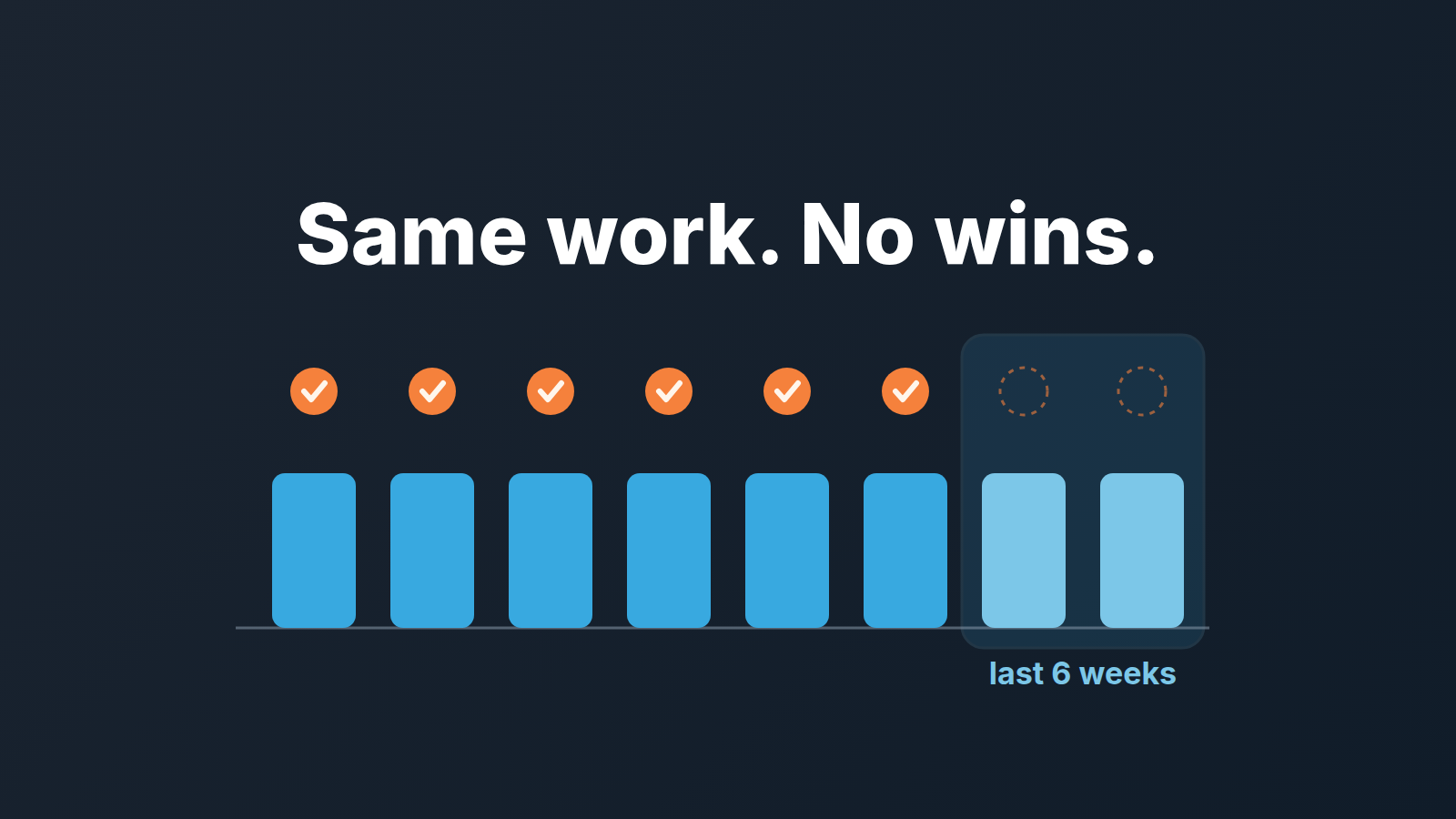
An illustration, with the rep and the shape of the numbers made up on purpose. Call him Pavel: team of five, normally the one you don’t worry about. A month passes with nothing in the won column, and the fifth week starts the same way.
Put his month next to his spring. Calls and meetings sit where they always sit, new deals open at his usual pace and deals still reach the proposal stage, with a couple waiting on a signature. Only the last column changed. That is a streak. The machine is running; the output has a gap in it.
Now the other version of the same four weeks. His completed calls have been sliding since midsummer, there are fewer new deals, and the ones he has stop at qualification instead of moving on to a proposal. Same empty column, different story, and the cause is weeks older than the empty column.
Two questions that separate a streak from a decline
Before either question, look at the rest of the team once. If nobody is winning, this is not a slump. It is the pipeline or the market, and the rep-or-pipeline check is the right tool, because it puts the rep next to the team. If the others are closing and this one rep is not, set the team aside. A slump is a good rep whose numbers moved, and the only honest reference for “moved” is where they were before.
The first question: did the activity change? Not “is it low” but “is it lower than this rep’s own normal”: completed calls, meetings and tasks over the last six weeks against their own monthly average for the half year before. A rep doing the same work they always did and not getting paid for it is in a streak until proven otherwise.
The second question: did the deals start stopping somewhere new? A rep whose deals always reached proposal and were sometimes lost there is losing late. In a streak, that keeps happening at the same stage and in roughly the same share as in their own last six months; the decisions at the far end just aren’t going their way for a while. Two patterns mean the work changed: deals now stop earlier than they used to, in qualification or after the first meeting, or the share that “went quiet after proposal” has grown against the rep’s own six months, which points at follow-up. Either one is a decline, even if the call count looks fine.
That gives four combinations, and only one is a streak: activity steady, deals stopping where and as often as they always did. Activity down is a decline in the week. Deals stopping earlier or going quiet more often is a decline in the deals or the follow-up. If both moved, start with the week.
Build the rep’s usual month from six months of Pipedrive
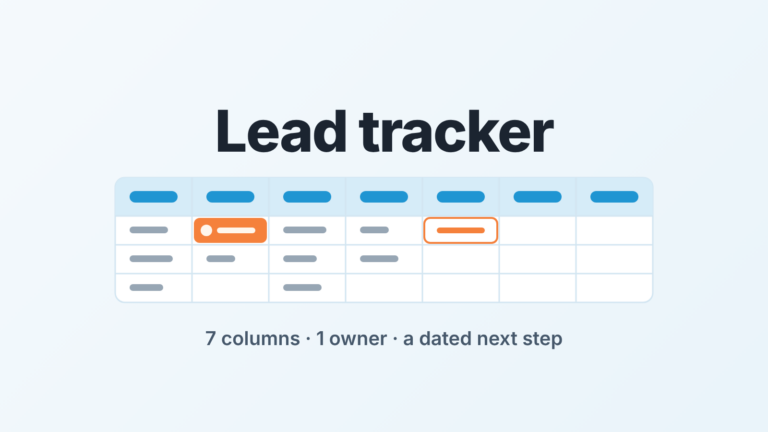
The rep’s baseline is their usual month: what an ordinary month of their work looked like, averaged over the last six. It goes in the first column of one sheet; the last six weeks go in the second. Four numbers build it, plus the won row you already know.
- Completed activities per month, by type. In Pipedrive, the Activities performance report in Insights shows calls, meetings and tasks completed by type, status and user. Its filter defaults to this month, and you can change it, for example to the whole year (Pipedrive: Activities performance report). Emails only appear if logged as activities, per the same page, so agree on that first with a rep who sells by email. More in sales activity metrics for a small team.
- New deals per month. The count of deals this rep opened in each of the six months. A monthly rep scorecard already has this row for every month; take the baseline from there.
- Where their deals stop. For the rep’s lost and stalled deals over the six months, the last stage each one reached. The method for reading this stage by stage is in pipeline stage conversion rates in Pipedrive. Lost reasons sharpen it: Pipedrive lets you pick a reason from a list or write one freely, saves the comment as a note on the deal, and the lost reason column can be added to the deals list and used as a filter in the Deal performance report (Pipedrive: lost reasons). If your reasons are free text, cleaning up lost reasons comes first, because “went quiet after proposal” and “didn’t qualify” are the two reasons this exercise turns on.
- Cycle length. Days from deal creation to won, for the deals the rep won in the period. A slump often stretches this number before it empties the won column.
For the second column, scale the six-week activity and new-deal counts to a month, and read stage and cycle deal by deal rather than as rates.
Then write the two columns side by side on paper. Not a dashboard, a sheet you can bring into a room.
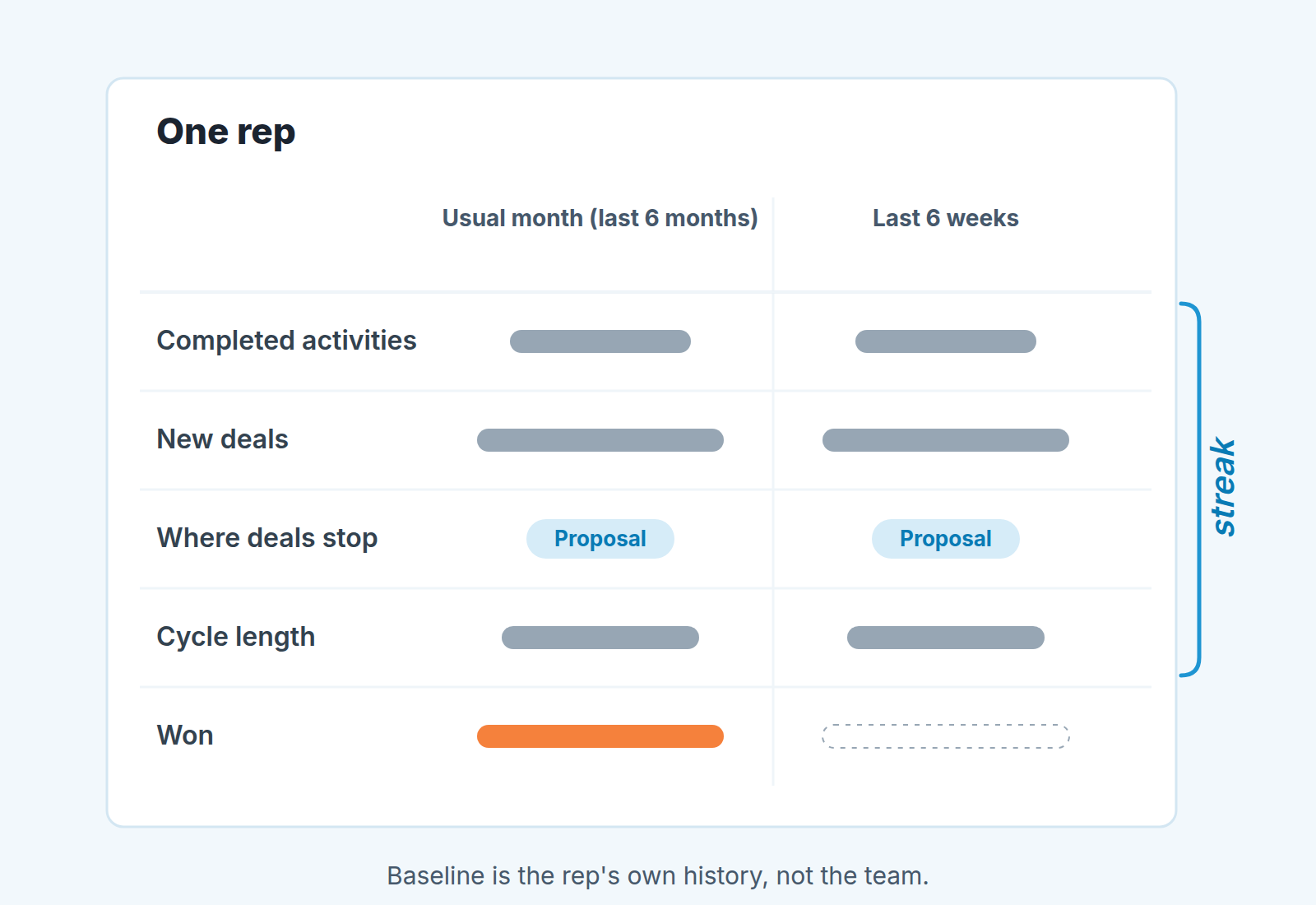
If the columns match and only the won row is empty, you are looking at a streak. If the activity row or the “where deals stop” row moved, that row is what you will talk about.
Ten to twenty deals a quarter: when “too early to say” is the honest verdict
When a rep closes somewhere between ten and twenty deals a quarter, six weeks of wins is a handful of decisions made by other people. We would not compute a win rate over that window; the rep-or-pipeline check explains why a few dozen deals is not a dataset.
What you can read on a small sample is movement. Did the deals open at the start of the window change stage? Does each of them have a next step booked? How many new deals got to a second conversation? Those happen daily and don’t need volume.
“Too early to say” is a legitimate verdict, and on a small team the most common one. The mistake is to treat it as permission to watch silently for another month. Say it out loud, with a date: “Your inputs look like your normal inputs. Let’s look again in two weeks.”
If it is a streak: what you do not do, and the one thing you do
A manager who does nothing feels negligent, so the urge is to act. Resist most of it.
- Do not change the sales plan or the target. Steady inputs mean the plan is working; moving the target teaches everyone that a bad month rewrites the numbers.
- Do not invent a contest. It tells a rep who is already working at their normal pace that you think they are not.
- Do not take thier deals. Joining a call is fine if they ask. Running the deal means that when it closes, it was your win, and the streak is still theirs.
- Do not add a daily check-in. Six weeks of steady activity is the evidence that they do not need one.
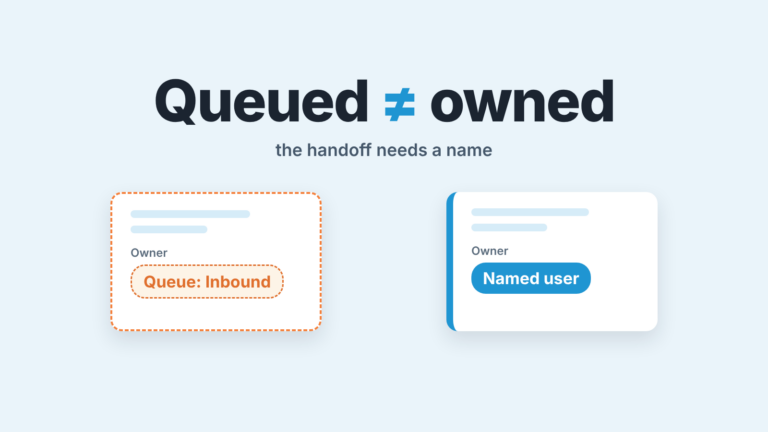
The one thing worth doing is a single activity goal for two weeks, set at the rep’s own usual level. Pipedrive Insights lets you set an activity goal on the number of activities added or completed, by activity type, for a week, month, quarter or year, and assign it to a user, a team or the whole company (Pipedrive: Insights goals). Make it weekly, for that one user, on the activity type that feeds the stage where their deals get won, for most reps meetings held. Set the number where their six-month column already sits, not above it. It is not a push, just a floor you both agreed on, so the the two weeks have a shape and nobody works harder on the wrong thing out of nerves.
How long will it last? Nobody can tell you that in advance, so don’t promise a date for the wins. Promise a date for the sheet. Two weeks later rebuild the second column and read it again. Streaks end quietly. If this one hasn’t, the rows will show you what moved.
If it is a decline: the first question, and when the plan starts
The first question is about the work, not the results: “What changed in how your week is spent?” Not “why aren’t you closing”, which they cannot answer and which the won column already asked for you.
Ask it openly and wait; the answers are usually things a manager can act on. A lead source dried up or the territory changed. One large account has been eating half the week. A new pipeline stage or a new tool changed what a qualified deal means. Something at home. Less often: they stopped believing in the product for a segment they used to sell to. Most of these are yours to fix, or at least acknowledge, before you expect anything of the rep.
If the “where deals stop” row moved and the activity row did not, the question shifts to the deals themselves: what is coming in now, and what happens in the first conversation. Open the lost deals from teh window together and read the reasons. A rep who marked them “no fit” six times in a row has already told you what changed. If the reasons need a proper conversation, run a 20-minute lost deal debrief with the rep.
Then set the same two-week activity goal as for a streak. The number is the rep’s own earlier level, so the goal is a return, not a stretch.
When does this become a performance plan? Not here. A good rep whose activity dropped for a reason you both understand needs the reason fixed, not exit criteria. The plan is for when two weeks pass, the reason is gone and the work still hasn’t come back; the 60-day improvement plan for a small team covers that case.
What to say when you sit down with the sheet
Put the sheet on the table before anyone says anything, both columns facing the rep. Then ask about a single deal: “Which loss from the last few weeks bothered you most?” A good rep in a slump has been replaying one deal, and which one tells you more than any row. After that, give your read of the sheet in two sentences, set the one goal, and name the day you will look again. Everything else in the weekly 1:1 stays as it was.
Three phrases are worth keeping out of the room. “What’s going on with you?” makes a question about numbers into one about the person, whom the sheet usually says is fine. “The team’s numbers are fine” is a ranking in disguise, against the wrong baseline: the rep was not slumping against the team, they were slumping against themselves. And “just get back to basics” insults a rep in a streak, whose activity row shows they never left, while in a decline it says nothing, because it does not name which basic.
What to say instead is mostly the sheet read aloud. “Your calls and meetings are where they were in March. Your deals still reach proposal like they always did. This is a streak, and I’m not changing anything. One goal for two weeks, and we look again on the twentieth.”
Where SalesBond fits
Full disclosure: SalesBond is our product, a sales management layer over the CRM your team already uses. The row that takes longest to build by hand is “where deals stop”, and that is the ground its Deal Health check covers. It scores every deal in the connected CRM against more than 20 rules, in categories that include Activity and Progression, and says in plain words what pulled a score down and what to do about it. Its per-rep view turns that into the early-funnel question answered deal by deal: which of this rep’s open deals lost movement and touches, and which look the way their deals always looked. Streak or decline is still your call, made from the six-month column. Check your CRM with SalesBond.