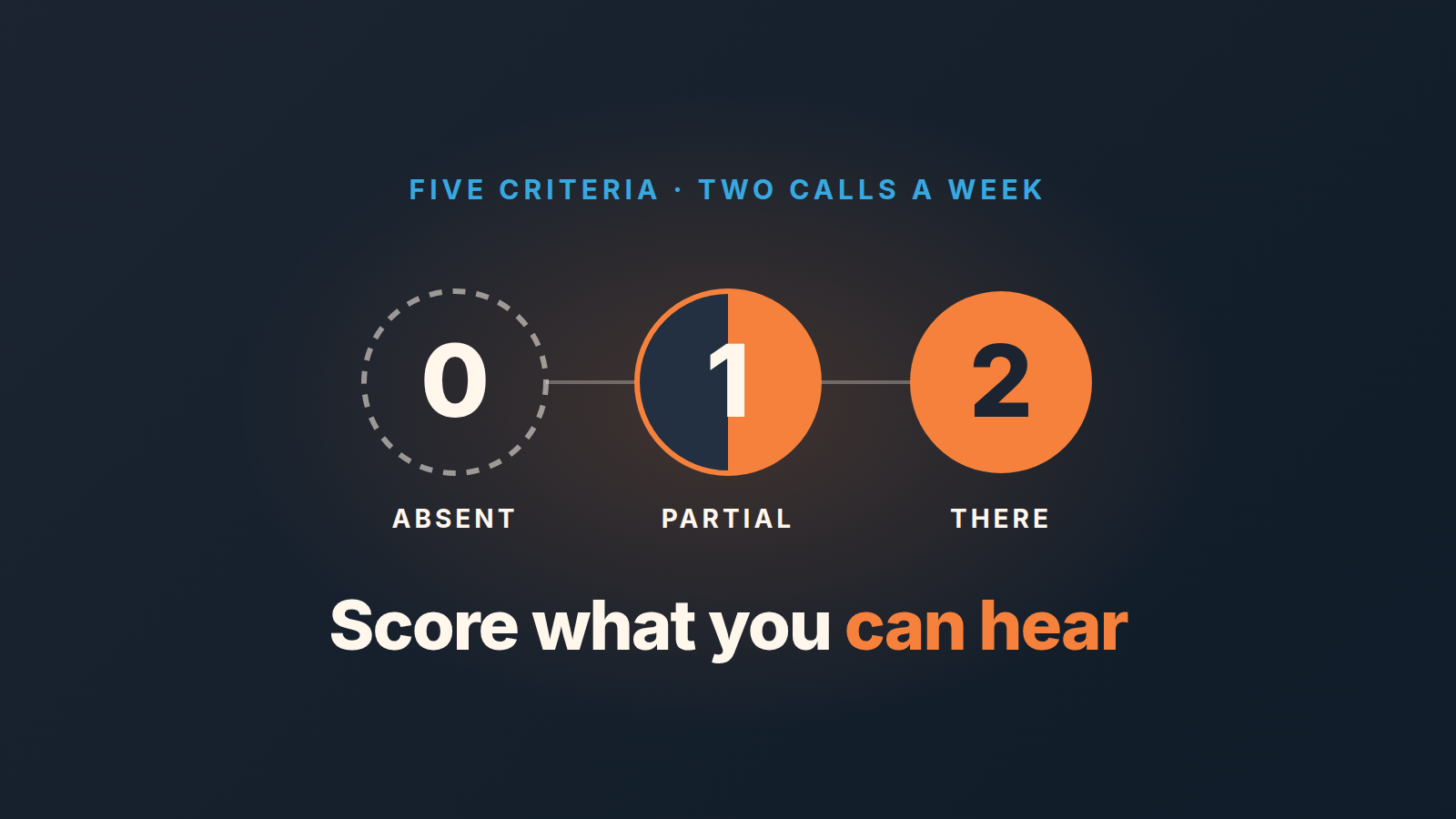
A sales call review scorecard is a short list of observable behaviors you score each call against. For a small team, five criteria on a 0-1-2 scale is enough: review two calls per rep per week and finish each review with one thing to work on, not a list.
That is the whole system. Most of what gets published on call scoring comes from vendors of call-intelligence software and assumes you want a dashboard at the end. A team of four to eight reps does not need one. It needs a manager with a recorder of any kind, a sheet with five rows on it, and the habit of scoring fewer things and then acting on the score. The score covers the techniques checked on a call, not in the CRM.
The five scorecard criteria, and what 0, 1 and 2 look like
Keep the rubric to things you can hear. “Built rapport” is an opinion. “Asked when they need this live” is on the recording or it isn’t. Each criterion gets a written anchor for every score, so that two people listening to the same call land on the same number. When the opening row keeps landing on 0, look at the words too: a sales pitch for a small team fits on one page.
| Criterion | 0 | 1 | 2 |
|---|---|---|---|
| Opening and agenda | Went straight into the pitch; the buyer was never told what the call was for | Stated the purpose, didn’t check whether it matched what the buyer wanted | Set the purpose, asked what the buyer wanted out of the call, adjusted |
| Discovery | Mostly yes/no questions, or none; demo started inside the first five minutes | Asked about the problem, never asked what it costs them or when it matters | Got the problem, its impact and a date out of the buyer, in the buyer’s words |
| Listening | Talked over the buyer; answered a different question than the one asked | Let the buyer finish, then moved on without reflecting anything back | Paraphrased the buyer’s point before answering, at least once |
| Objection handling | Argued, discounted on the spot, or changed the subject | Acknowledged and answered, didn’t check whether the answer landed | Acknowledged, asked a question to find the real concern, answered, checked |
| Next step | Call ended with “I’ll send some info over” | Proposed a next step, but no date or no commitment from the buyer | A specific action, a date, and the buyer said yes to it |
The table pastes straight into a doc or a sheet if you want a blank copy to print. The wording is ours, and you should rewrite it in your team’s language. What matters is the shape. Each level describes behavior a listener can point to with a timestamp. The 1 is a real middle: something happened, but not enough. And there are exactly five rows. Published rubrics tend to run five to ten criteria; we sit at the low end on purpose. A manager who also carries a quota will not fill in a twelve-row sheet twice a week for every rep. Five rows, ten points, done.
A word on the scale. A 1-5 scale invites a 3 for everything you aren’t sure about, and a sheet full of 3s tells nobody anything. With 0-1-2 there is no safe middle: the behavior was absent, partial or there. That is also why the anchors matter more than the numbers. Without them, “2” means “I liked it,” and that drifts with your mood.
You do not need conversation intelligence software to run this scorecard on two calls per rep a week, and our piece on whether a small team needs it explains when that changes.
Which two calls to pull
Two calls per rep per week. One picked at random, one from a deal that was just marked lost.
Random is the word that does the work. If you only review the calls a rep flags for you, you hear their best work and learn nothing you can coach. If you only review calls that went badly, the rep learns that a review means trouble, and recorders start getting switched off. Pick from the week’s calls before you have listened to any of them, and let the rep see that the pick is random. It is the fairest sample you can get, and reps accept it because it is the same for everyone. If you are pulling calls because a rep is in a slump, read the rep against their own history first.
The lost-deal call is the exception to random. When a deal is marked lost, go back to the last real conversation before it stalled and score that one. Often it is the demo: the call went well in the room and the buyer went quiet afterwards. That is a different problem from a bad call, and it has its own playbook in what to do when a prospect goes silent after the demo. On those calls the scorecard will usually show a 0 or 1 on next step, and that is the pattern you want to catch while the rep still remembers the conversation.
Advice on volume ranges from two to five calls per rep a week. We stop at two, because for a manager with their own number to hit, two is what survives a busy month. Skip anything under ten minutes; those are reschedules and voicemails. And skip calls where you were also on the line, because you already have an opinion about them.
From a score to one thing to coach
After every review, pick one behavior to coach. Not necessarily the lowest score: the one that would have changed that deal the most and that the rep can practice on the very next call. Tell the rep in one sentence, with the timestamp. Then listen for it on their next two calls, and for nothing else.
Without that rule, a sheet with 7/10 on it is a report card. The rep reads it, feels something about it, and changes nothing, because “do better on discovery” is not an instruction anyone can follow tomorrow morning.
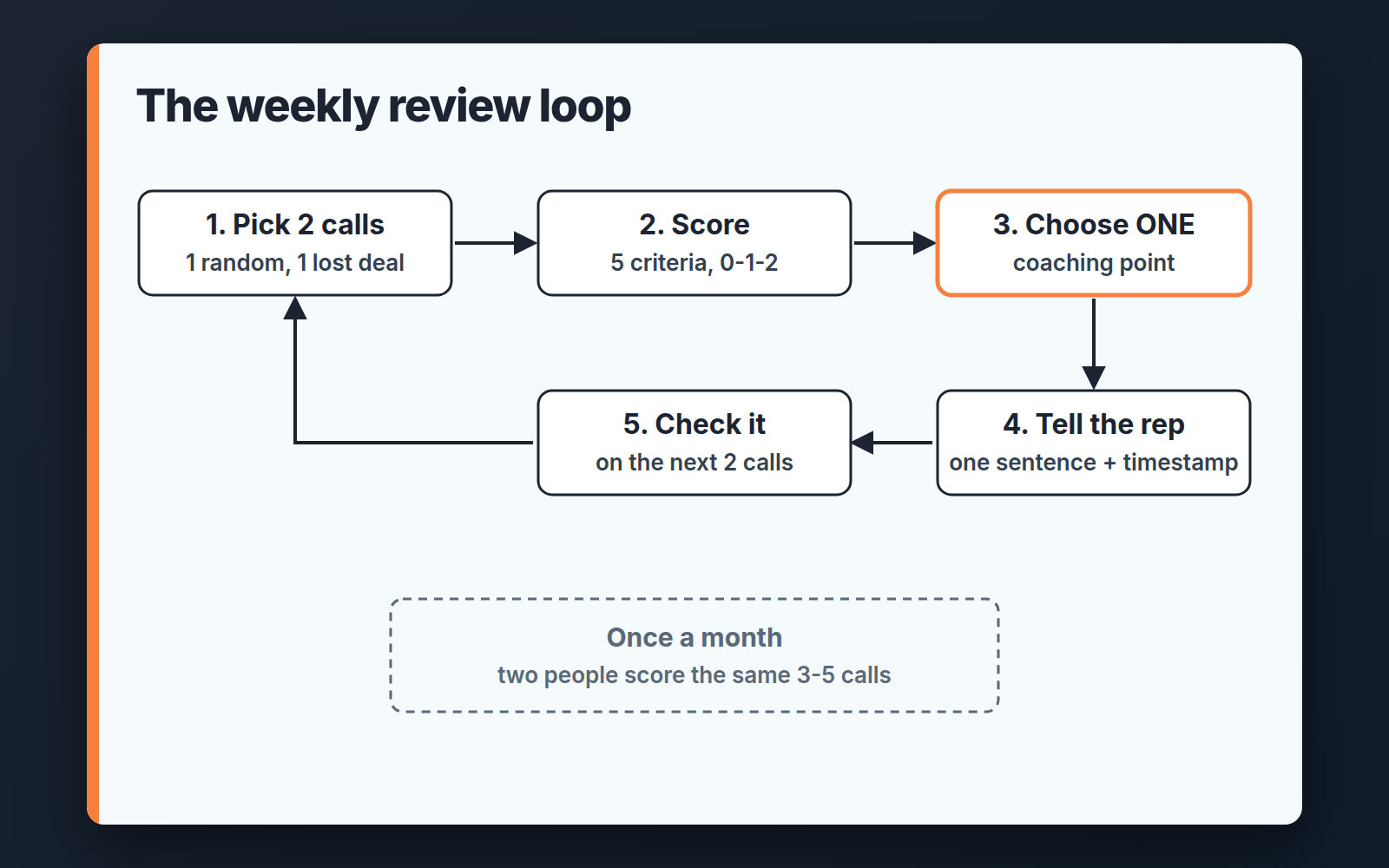
A hypothetical example. Dana’s random call for the week scores opening 2, discovery 1, listening 2, objection handling 1, next step 0. Two 1s and a 0, and the temptation is to send all three. Instead the message is one line:
“Dana, 14:30 on the Hartwell call. You proposed a follow-up, they said ‘sounds good’, and the call ended with no date. Next two calls: before you hang up, name a day and ask if it works. That is the only thing I’m listening for this week.”
Dana knows what to do and where it went wrong. She also knows nothing else is being graded right now. The following week, if next step is a 2 on both calls, you move to discovery. If it isn’t, same point again, maybe with the two of you listening to the call together. The other scores still get written down. They just don’t get discussed yet.
This is also what keeps the scorecard out of your 1-on-1. The weekly meeting is about the pipeline and the rep’s week, and the agenda for that lives in our 1-on-1 agenda for sales managers. The coaching point from a call review is a thirty-second message or a two-minute chat on the day you scored it. Mix the two and every 1-on-1 turns into a call autopsy, which is how reps come to dread both. Nothing here depends on software either. If you are weighing whether a recorder with an AI layer on top is worth paying for, AI sales coaching for small teams covers that question. The sheet above works the same on a phone recording as on a transcript.
Calibrate once a month, or the scores mean nothing
Scores drift. Yours get harsher in a bad month and softer when a rep is already having a hard time, and you will not notice either from the inside.
So once a month, two people score the same three to five calls separately, then compare row by row. Where you disagree by two points on a row, the anchor is broken: rewrite it until the behavior it describes is unambiguous. Where you disagree by one, talk it through, because one of you was being generous and it is useful to know which. Most published guides recommend a monthly calibration like this. The small-team twist is who the second scorer is. If there is no second manager, it is the rep. A rep scoring thier own call against the sheet is also the fastest way to teach them the sheet, which is why it belongs in a new hire’s first month (our 30-60-90 onboarding plan). Expect the rep’s numbers and yours to differ on a row or two; those gaps make a better conversation than any number on its own.
Calibration also tells you whether the sheet still measures anything. If every rep has been scoring 8 or above for three months, either the anchors have gone soft or the calls you are pulling are not as random as you think. Call scores stay on this sheet; the numbers the CRM already counts go on a separate monthly rep scorecard.
Where the score lives in Pipedrive
Not in a spreadsheet you will stop opening by November. On the deal.
After each review, add a note to the deal in Pipedrive: the date of the call, the five numbers, the one coaching point. One line is enough: “Call review Sep 24 · 2/1/2/1/0 · coaching: name a date before you hang up.” Start every such note with the same prefix so they stand out when you scroll a deal’s history months later. Now the score is attached to the record that will eventually be won or lost, and that is where it earns its keep. Three months on you can open any lost deal and read what the conversations looked like on the way down. No team average tells you that.
Keeping it on the deal pays off twice. When the objection row keeps coming back 0 or 1, the objection itself belongs in the team’s objection log in the buyer’s words, a separate setup described in logging objections in Pipedrive. The scorecard says the rep handled it poorly; the log says which objections the whole team keeps hearing. And when a deal with three reviews on it closes, the rep can see the trail from the 0 on next step to the 2. Of all the feedback they get, that is the piece that feels like progress rather than judgment.
The first month the scores will be noisy, and at least two of your anchors will turn out to be badly written. That’s fine. Rewrite them at the first calibration and keep going. A scorecard is one input; see what sales coaching is built on.
FAQ
How many sales calls should a manager review per rep each week?
Advice ranges from two to five. For a small team where the manager also sells, two a week (one random, one from a lost deal) is a pace you can keep, and keeping it matters more than the count.
Should a call scorecard use a 1-5 or a 0-2 scale?
A 1-5 scale lets reviewers park unsure calls at 3. A 0-1-2 scale forces a decision: the behavior was absent, partial, or there. Either way, each level needs a written anchor.
How many criteria should a sales call scorecard have?
Most published rubrics use five to ten. Five is enough when each one is a behavior you can hear on the recording. More rows mostly mean the sheet stops getting filled in.
Can AI score sales calls instead of a manager?
Call-intelligence tools can auto-score against a rubric, but the scorecard here works with any recorder. Whether that layer is worth paying for is covered in AI sales coaching for small teams.