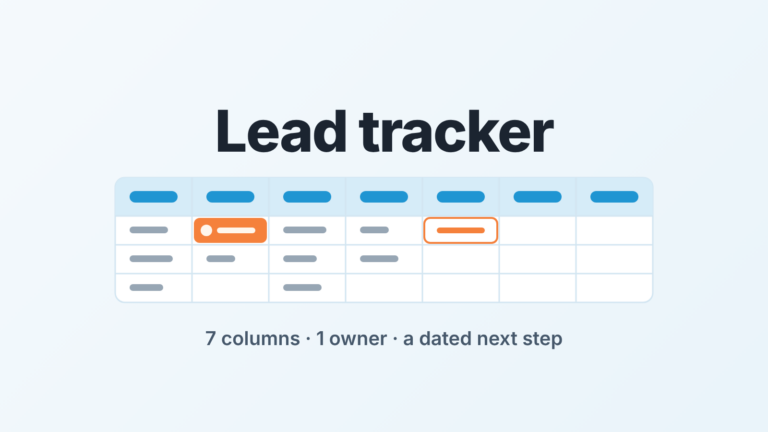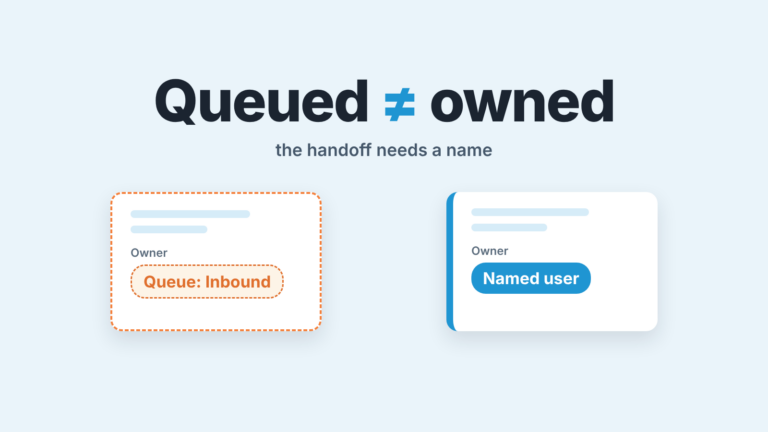
Sales techniques are the specific moves a rep makes inside a conversation: the diagnostic question, the summary before asking for the order, the follow-up that carries something useful. A methodology is the frame those moves sit in. Only some techniques leave a trace in the CRM, as a field, an activity or a stage change, and those are the ones a manager can check from the desk. The rest are checked on a call, or not at all.
The pages that rank for this query already list techniques well: Mailshake has twenty-five, Paperflite eighteen sorted by deal stage, Zendesk six. All of them are written for the rep. None of them answer the question a head of sales actually has on Monday: how do I know whether any of this happened last week? So we took the techniques that keep showing up across those lists and asked one thing of each. What should be left in the CRM if the rep used it? There are eight below: solution selling, value selling, question-based discovery, multi-stakeholder discovery, the next-step close, value-add follow-up, the Challenger reframe, and the rapport-and-tone group the CRM never records.
Sales techniques in one paragraph
A technique is small enough to use on one call and to notice on one call. “Ask what the problem costs them per month” is a technique. “Lead with an insight the buyer has not considered” is a technique. Solution selling, SPIN, Sandler, Challenger are methodologies: each one bundles a set of techniques with an order and a philosophy. The distinction matters for a manager because you coach techniques and you adopt methodologies. If your team has no methodology, you still have techniques, and they are still either visible in the CRM or not. If you are choosing a frame we wrote up how to pick a sales methodology for a small team; this post stays one level down, with the moves themselves.
Types of sales techniques by the trace they leave
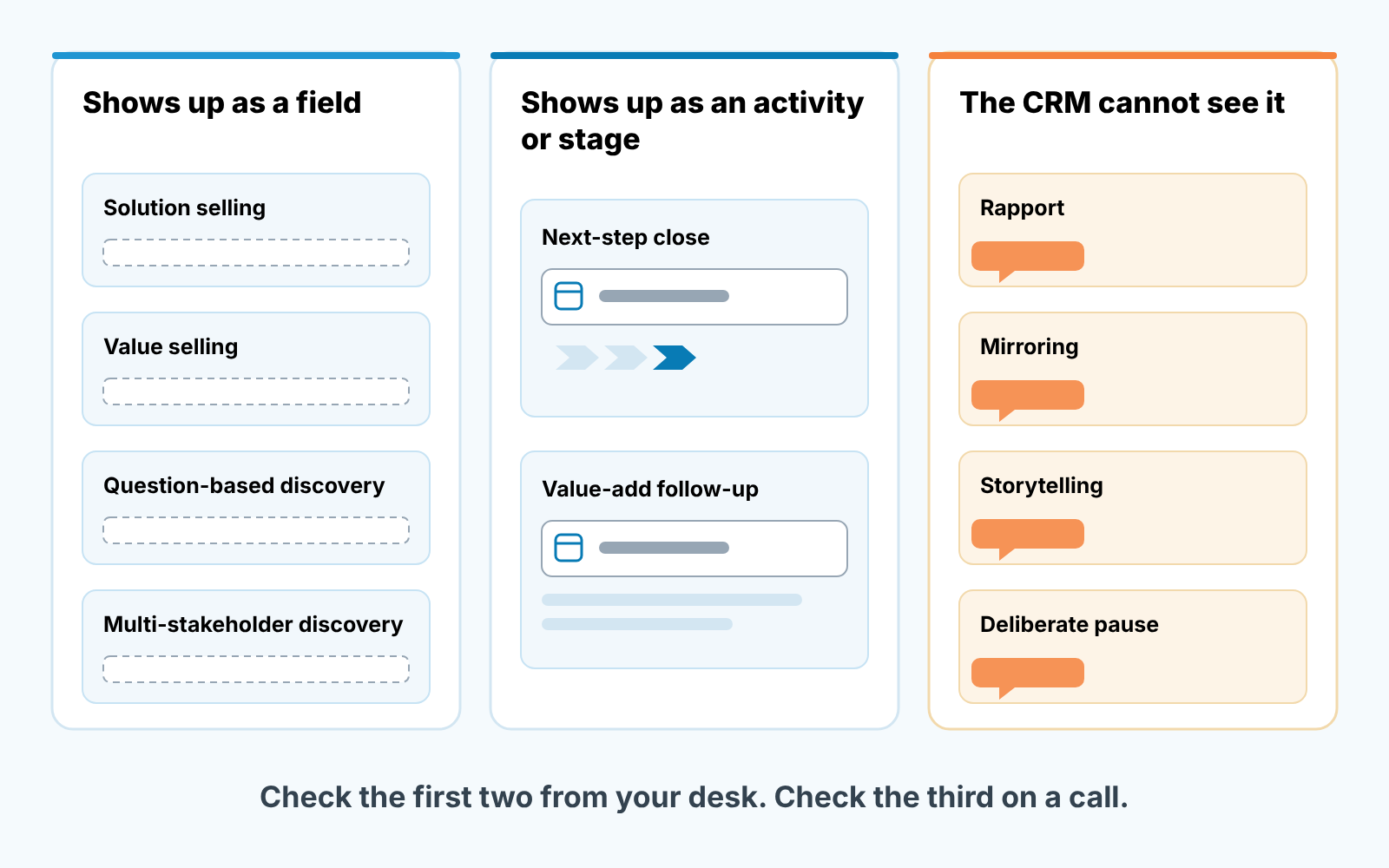
Field names below are generic. Every CRM we have worked with has a custom deal field, a contact linked to a deal, an activity with a note and a date, and a stage. The mechanics differ. The trace does not.
- Solution selling leaves a deal field. Look for the buyer’s problem in the buyer’s words and what it costs them; a blank field means no diagnosis. More in what to log at each stage.
- Value selling also lands in a deal field: a measurable effect with its unit, plus the name of the person on the buyer’s side who confirmed it. See the value case in deal fields.
- Question-based discovery (SPIN and its cousins) gets one field per question type, and the empty one is the next question to ask. See one deal field per question type.
- Multi-stakeholder discovery shows up in the contacts on the deal: more than one person attached, each with a role, not one champion and silence.
- The next-step close (with its summary and assumptive variants) is an activity, then a stage. You want a next activity with a date the buyer agreed to, and a stage that moves after that activity exists, not before. Our post on closing techniques and the one field that tells you which work has the detail.
- Value-add follow-up is a completed activity whose note says what was sent and why, instead of “checked in”.
- The Challenger-style reframe is visible only if you add a field for it: the insight the buyer accepted, in one line. Without the field it is a call-review item. See Challenger for small teams.
- Rapport, mirroring, storytelling and the deliberate pause leave nothing. Call review only; the CRM has no column for tone.
The techniques that become a field
Three of the most common techniques are, at heart, ways of getting the buyer to say something specific. Solution selling wants the problem and its cost. Value selling wants the effect in numbers and a name behind it. Question-based discovery wants an answer to each kind of question, in order. Each one produces a sentence the buyer said, and a sentence is exactly what a deal field is for.
That is why we treat the field as the test. If a rep says they ran discovery and the “Cost of the problem” field is blank, one of two things is true: the question was not asked, or it was asked and the answer did not make it out of the rep’s head. Both are coaching conversations, different ones. A notes box does not give you this test, because a notes box is never blank. It says “good call, sending deck” and the pipeline report looks the same either way.
We have gone through the field lists for these methods in their own posts, linked above, so we will not repeat them here. One rule is worth repeating, because it keeps the field honest: the field holds what the buyer said, not what the rep believes. “They need to cut admin time” is the rep’s belief. “Maria spends Friday afternoons re-keying the week’s orders” is the buyer’s sentence. Only the second one is evidence that the technique was used.
Multi-stakeholder discovery is the odd one in this group, because its trace is a list of people. Paperflite files it under discovery techniques, and the CRM check is simple: how many people are attached to the deal, and do they have roles? A deal in proposal with one contact is a deal where the technique was not used, whatever the rep remembers about the call.
Closing and follow-up: look for an activity, then a stage
Closing techniques are where the lists get longest and the CRM trace gets thinnest. Mailshake alone names six closes. Most of them are variations on one move: summarise, propose the next step, ask for agreement. Whether the rep used the summary close or the assumptive close, what should exist afterwards is the same object. A next activity, with a date, that the buyer agreed to on the call.
So forget which close they used. Ask whether there is a next activity, and whether its date came from the buyer or from the rep’s calendar. A follow-up set for “next Tuesday” because the rep likes Tuesdays is not a close. A follow-up set for the day the buyer said the finance review ends is one. Our closing techniques post goes one step further and proposes a single field at close to record how the deal was asked for, so that in a quarter you know which technique your buyers actually respond to. That is the only place we think the technique name itself belongs in the CRM.
The stage move is the second trace, and it should come second in time. A deal moved to Negotiation with no next activity on it is a stage move without a close. We would rather see it stay in Proposal with a dated activity than advance with nothing scheduled.
Value-add follow-up is number seventeen on Paperflite’s list, and most managers underrate it as a CRM check. The trace is a completed activity with a note, and the quality of the note is the whole test. “Followed up” is not a trace of the technique. “Sent the two-page comparison she asked for, flagged the integration question for their IT lead” is. You can read ten of these in five minutes and know which reps are carrying something to teh buyer and which are reminding the buyer they exist.
What the CRM will never see, and how to check it anyway
Rapport. Mirroring the buyer’s pace and vocabulary, which Zendesk puts fifth on its list. Selling with a story. The deliberate pause after a price, number six on Paperflite’s list. The “tell me more” redirect. These are real techniques, and some of them separate a good rep from an average one. None of them leaves anything in a deal record. There is no field for silence.
We think the honest thing is to say so, and then to check them where they live, which is the call. A manager with no call recording has ride-alongs and the occasional shared call. A manager with recordings can pick two calls a week and listen for one technique at a time , not for everything. Listening for everything produces feedback nobody can act on. Listening for one thing, say the pause after the price, produces a sentence you can say on Thursday: “You filled the silence twice; next time count to three.” If you want a structure for those two calls, our call review scorecard is the one we use.
Why keep these apart from the field techniques? They don’t matter less. Mixing the two up just produces bad management. A manager who tries to check rapport from the CRM ends up reading tone into notes that do not carry it. A manager who tries to check discovery from a call recording spends an hour confirming what a blank field would have told them in a second. Use the desk for what the desk can see, and the call for the rest.
One weekly question for each trace
We run deal reviews on Mondays, and the questions that come out of this split are short enough to say without notes.
For the field techniques the question is “which field is blank, and is that the next call?” Not “did you do discovery”, which has only one answer. Pick the deals that moved stage last week and read the fields, not the notes. A blank is a question to ask the buyer, not a mark against the rep, and saying that out loud is what keeps the fields from being filled with the rep’s guesses on Sunday night.
For the activity techniques: “what is the next activity on this deal, and whose date is it?” The second half is the the useful half. If the rep cannot say where the date came from, the close did not happen. We wrote more on deal review questions that ask what the buyer did.
For the invisible techniques the question is for the manager, not the rep: “which one call am I listening to this week, and for what?” One call, one technique. Write the technique name down before you press play, so you do not drift into a general review.
Three questions and together they take less of a Monday than reading the notes box across the pipeline would. They also make the CRM data better without a single lecture about CRM hygiene. The fields are now being read by someone, and reps fill in what gets read.
FAQ
What is the difference between a sales technique and a sales methodology?
A technique is one move in a conversation, like a type of question or a way to ask for the next step. A methodology such as SPIN, Sandler, Challenger or SNAP is a named system that tells you which moves to make and in what order. A team can run techniques without a methodology, but not the other way round; for the frames themselves, see Sandler for small teams and choosing a methodology.
What is solution selling?
Solution selling is a methodology where the rep diagnoses the buyer’s problem and what it costs before proposing anything. In the CRM it shows up as deal fields that hold the problem and its cost in the buyer’s own words. We list those fields stage by stage in solution selling: what to log at each stage.
What is the 70/30 rule in sales?
In a prospect meeting the prospect should be talking about 70% of the time, and the rep should spend the other 30% asking good questions (Sandler: the 70/30 rule for prospect meetings). No CRM field records who talked, so check it on a call; from the desk, the closest proxy is whether the discovery fields hold the buyer’s sentences.