The Challenger Sale is a B2B sales methodology from Matthew Dixon and Brent Adamson’s 2011 book: the rep leads the buyer with a point of view about their problem instead of waiting for requirements. A small team needs one commercial insight per deal type, one Pipedrive field and a check in the 1:1. If buyers just compare prices, skip it.
That’s the whole method at the size of a five-person team. What takes work is making it survive past the first month, and noticing when it’s the wrong tool.
What the Challenger model actually asks of a rep
The Challenger Sale is a book by Matthew Dixon and Brent Adamson. Their research sorted reps into five profiles: the Hard Worker, the Relationship Builder, the Lone Wolf, the Problem Solver and the Challenger (Pipedrive’s summary of the model). The Challenger is the one who understands the customer’s business well enough to disagree with them, and the book argues that this profile wins more often in complex sales than the one who invests mostly in rapport. In the research Pipedrive cites, over 50% of all-star performers in complex sales fit the Challenger profile.
Most write-ups stop at the three verbs: teach, tailor, take control. They sound like personality traits. They aren’t. Each one is a concrete thing a rep does in a conversation, and each one can be prepared in advance.
Teaching means bringing the buyer something about their own business they haven’t priced in yet. Not a feature. A problem, or a cost, or a trend that makes their current way of working more expensive than they think. Pipedrive’s write-up puts it well: the method relies on an insight about a problem or opportunity the customer doesn’t see yet, one the supplier is uniquely positioned to solve.
Tailoring means the same insight lands differently with the operations lead and with the finance person. The ops lead cares that the team loses two afternoons a week; finance cares what those afternoons cost. You don’t need a new insight for each person, you need a different first sentence.
Taking control is the part reps are most nervous about, and it’s the least dramatic. It means proposing the next step and the timeline yourself, and asking about budget and decision process when it’s relevant rather than when the buyer volunteers it. Pushy is not the goal. A rep who has taught the buyer something has earned the right to steer the next meeting.
Here’s the part that matters for a small team. None of this needs a training program. It needs one good insight, written down, and a habit of checking whether reps actually use it.
Does it fit a five-person team? A quick test
Challenger was built around complex, considered purchases. Before you change anything, look at your last ten won deals and answer honestly:
- Did the buyer’s idea of the problem change between the first call and the proposal?
- Were there at least two people on the buyer’s side with a say?
- Did the cycle take longer than a couple of weeks?
- Could you have lost to “do nothing” rather than to a competitor?
Three or four yes answers: Challenger fits, and the setup below will pay back quickly. One or two: use it only for your larger deal type and leave the fast ones alone. Zero: your buyers arrive knowing what they want, and teaching them will feel like a delay. Skip to the last section.
One insight per deal type: writing it down
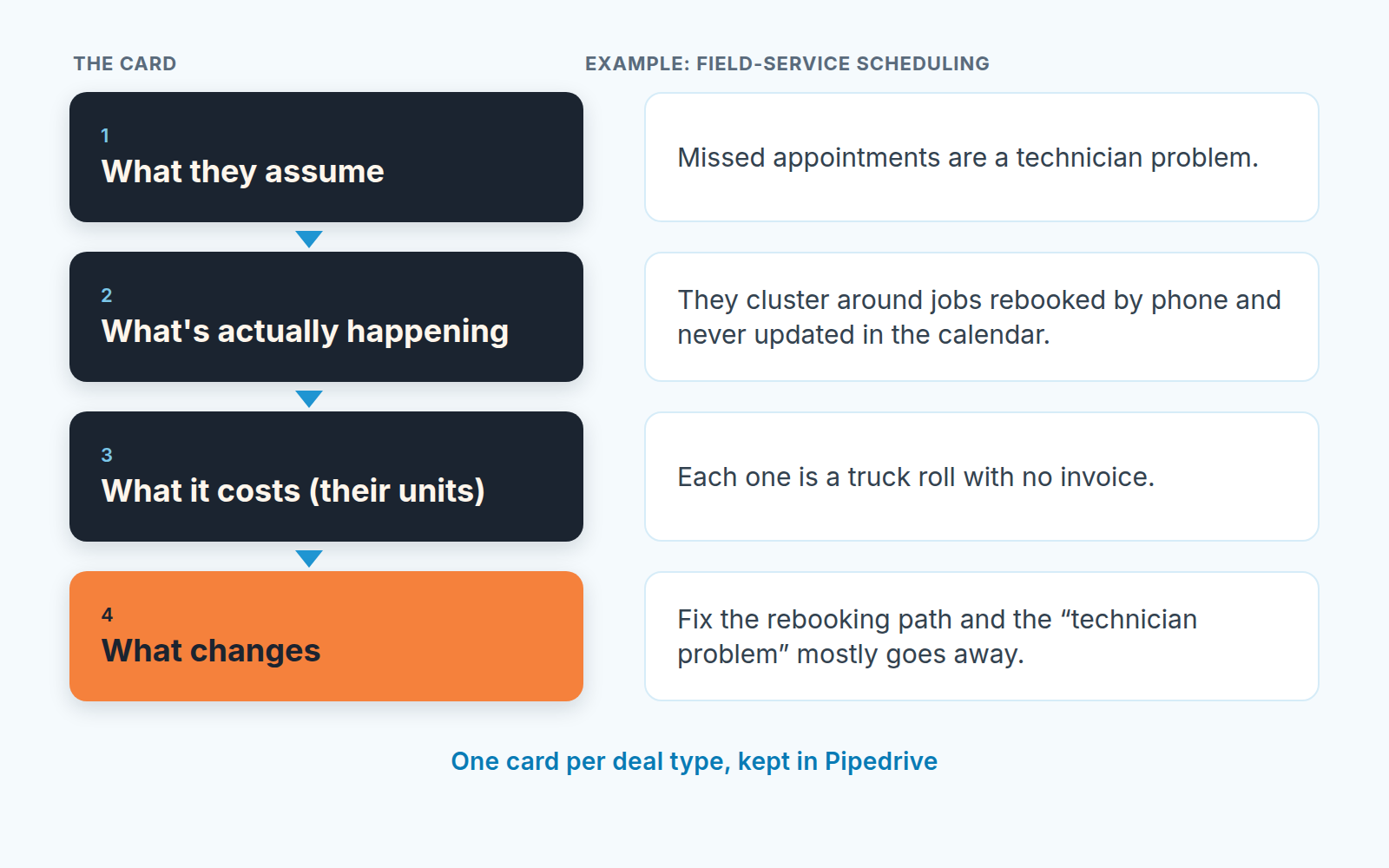
A commercial insight is a short argument, not a slogan. Ours have four parts. It starts with what the buyer usually assumes, then says what’s actually happening that they haven’t noticed. The third part is the cost, in their own units: hours, lost renewals, missed jobs. The last part is what changes if they fix it, pointing toward your product without naming it yet.
Say you sell scheduling software to field-service companies. A weak insight is “our scheduling is faster.” A usable one reads: most owners think missed appointments are a technician problem; in practice they cluster around jobs that were rebooked by phone and never updated in the calendar; each one is a truck roll with no invoice; fix the rebooking path and the “technician problem” mostly goes away.
Notice there’s no number in it that you haven’t measured. Put your own figures in line three once you have them from real customers. An invented statistic will get challenged by the one buyer who knows better, and then the whole conversation is about your credibility instead of their problem.
Write one per deal type, not one per rep. A team of five with three deal types needs three insights. The founder or sales lead drafts them, the team argues about them in one meeting, and the winner goes into the CRM. Rewrite an insight when reps stop getting a reaction to it. That usually happens after a quarter or two once competitors start saying something similar.
Where to keep it in Pipedrive
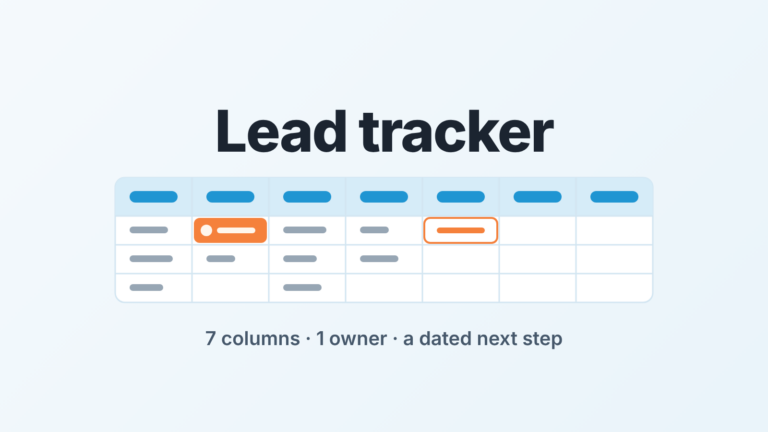
One field, one note. That’s enough, and anything more will be skipped by the second week. As we put it elsewhere, a book does not change the pipeline, a field does.
The field. Create a deal custom field called “Insight used”, type single option. The options are short names for your insights: “Rebooking leak”, “Renewal blind spot”, whatever your team calls them. Add “None yet” as an option too. The full text of each insight lives in your sales playbook doc; the field just says which one this deal is running on. A single-option field is filterable, and a free-text field turns into essays nobody reads.
The note. After the conversation where the rep teaches, they log a note on the deal with four lines:
Insight: <option name>
Their assumption: <what the buyer said before>
Reaction: <what the buyer said after, in their words>
Next step they agreed to: <date + what>
The “Reaction” line is the one that matters. If it’s empty or says “seemed interested,” the teaching didn’t happen, or it happened and didn’t land.
Timing: the field should be filled before a deal moves into your proposal stage. If you’ve written stage exit criteria (see how to define sales pipeline stages), add “Insight used is not None yet” to the exit from discovery. Then build a list-view filter: open deals past discovery where Insight used is “None yet” or empty. That filter is your coaching list.
Checking it in the 1:1 without listening to every call
You don’t have time to review call recordings for five reps. You also don’t need to.
Open the filter from the previous section before the 1:1. Pick two deals from it, or two deals that do have an insight logged, and do this:
Ask the rep to say the insight out loud as if you were the buyer. Thirty seconds, no slides. You’re listening for one thing: is it about the buyer’s business, or about your product? “Our tool does X” is pitching. “Most teams like yours lose Y because Z” is teaching. Reps slip into pitching under pressure, and the only way they notice is when someone plays the buyer back at them.
Then read the Reaction line from their note together. A real reaction has the buyer’s words in it (“we thought that was a dispatch issue”). A vague one tells you the rep delivered the the insight as a monologue and moved on.
Last, ask who else on the buyer’s side has heard it. Tailoring is where small teams fall down: the insight goes to the champion, the champion likes it, and nobody tells finance. If only one person has heard it, you have a single-threaded deal with a nice story attached. Agree with the rep on which second person gets the tailored version and by when.
That’s ten minutes. It fits into a normal sales 1:1 agenda as the deal review block, and after a few weeks reps start preparing thier answer before you ask.
When to drop the Challenger approach
Drop it for deals where the buyer has already done the thinking. If someone arrives with a spec, a shortlist and a deadline, they don’t want to be taught about their problem; they want a clear price, a quick demo and an easy contract. Reframing their problem at that point reads as stalling, and on a short transactional cycle you’ll lose to whoever answered first.
Existing customers are the other case. At renewal, or when you’re trying to grow an account, the customer has already bought into your view of their problem. A fresh provocative reframe can sound like you’re telling them that decision was wrong. Corporate Visions found that a challenging message at renewal or expansion backfires and raises the risk of losing the account to a competitor (their write-up on the model). Keep the insight card for new deals. With customers, start from what’s already working for them.
Drop it, or at least pause it, when the insight has gone stale. You’ll see this in the notes before you see it in the numbers: the Reaction lines get shorter and more polite. Rewrite the insight rather than pushing harder on the old one.
And watch your lost deals. If you track lost reasons in Pipedrive, add one called “Didn’t accept the problem” and look at it once a month. A few of those are normal; it means reps are challenging. A lot of them on one deal type means the insight is wrong for that buyer, or reps are delivering it as a lecture, and the 1:1 is where you find out which.
FAQ
What are the three parts of the Challenger Sale?
Teach, tailor and take control. The rep brings an insight about the buyer’s business, adapts it for each person on the buying side, and proposes the next step and timeline instead of waiting for the buyer to set them.
What are the five sales rep profiles in The Challenger Sale?
The Hard Worker, the Relationship Builder, the Lone Wolf, the Problem Solver and the Challenger. The book argues that the Challenger does best in complex sales.
Should you use the Challenger approach with existing customers?
Mostly no. A customer who already bought from you can hear a provocative reframe at renewal or expansion as a threat, and Corporate Visions’ research links that to a higher risk of losing the account. Keep the teaching for new deals.