SPIN selling is a discovery method built on four kinds of questions, in order: Situation, Problem, Implication, Need-payoff. In a small team, the part that pays off is the record more than the script. Write down the buyer’s problem, what it costs them, and what they said solving it would give them, and your deal review gets a lot less foggy.
Most SPIN guides stop at the question list. This one spends half its time on what happens after the call, because that’s where a three-rep team either gets something out of the method or quietly forgets it by the next quarter.
The four SPIN question types, one example each
The method comes from Neil Rackham’s 1988 book SPIN Selling. Pipedrive’s own summary puts the research behind it at more than 35,000 sales calls made by 10,000 salespeople in 23 countries over 12 years. The four question types are meant to be asked in sequence, each one building on the last (Zendesk walks through the same order).
Situation questions establish the facts. “How are appointments booked across your locations right now?” You need them. They’re also the least interesting thing you can ask a buyer, which is why we treat them as homework rather than conversation.
Problem questions go looking for friction. “Where does booking go wrong most often?” The buyer answers in their own words, and those words are worth more than your paraphrase of them.
Implication questions are the ones reps skip, and they’re where deals get won. “When a double booking happens, what does that cost you that week?” Or, one step further: “How many of the patients you bump ever rebook?” A problem the buyer can live with doesn’t get budget. A problem with a consequence attached to it sometimes does.
Need-payoff questions hand the pen to the buyer. “If rebooking took care of itself, what would your front desk do with that time?” Or: “What would it mean for the owner if Monday looked like any other day?” The buyer says the value out loud, so you’re not the one making the pitch.
That’s the whole method. Using it without turning calls into interrogations is the hard part. For buyers with no time for a long discovery call, a lighter option is SNAP selling in Pipedrive.
Where reps get SPIN wrong
The most common failure is a call that’s two-thirds situation questions. The rep asks how many people are on teh team, which tools they use, who reports to whom, how long they’ve been doing it that way. All of that is visible on LinkedIn, the company website, or the notes from the last call. The buyer spends twenty minutes being a data source and hangs up with nothing new to think about.
Fix it before the call. Whatever you can look up, look up, and put it in the deal notes so the next person on the deal doesn’t ask again. Keep one or two situation questions to confirm what you found, then move on.
Ten minutes with the deal before the call is usually enough.
The second failure is stopping at the problem. A rep hears “our booking is a mess,” gets excited, and starts demoing. There’s no implication on record, so the buyer never connected the mess to anything they care about, and the deal stalls at proposal with a polite “we’ll revisit next quarter.”
The third is subtler: reps ask good implication questions and then don’t write the answer down. The manager sees a deal at “Demo done” with a value and a close date and no idea why this buyer would move now.
What to capture in Pipedrive from each type
You don’t need a field per letter. Situation answers belong in the notes or in the fields you already have (company size, current tool). Three answers earn a dedicated custom deal field, because a manager can’t reconstruct them later.
The first is the problem, in the buyer’s words and in quotes if you can manage it: “We lose Mondays to rebooking.”
The second is the implication. That’s what the problem costs them or what it causes, written as a consequence someone could check. Front desk overtime is one. Patients going to another clinic after a missed slot is another.
The third is the need-payoff, meaning what the buyer said solving it would give them. “Our front desk could do intake calls instead.”
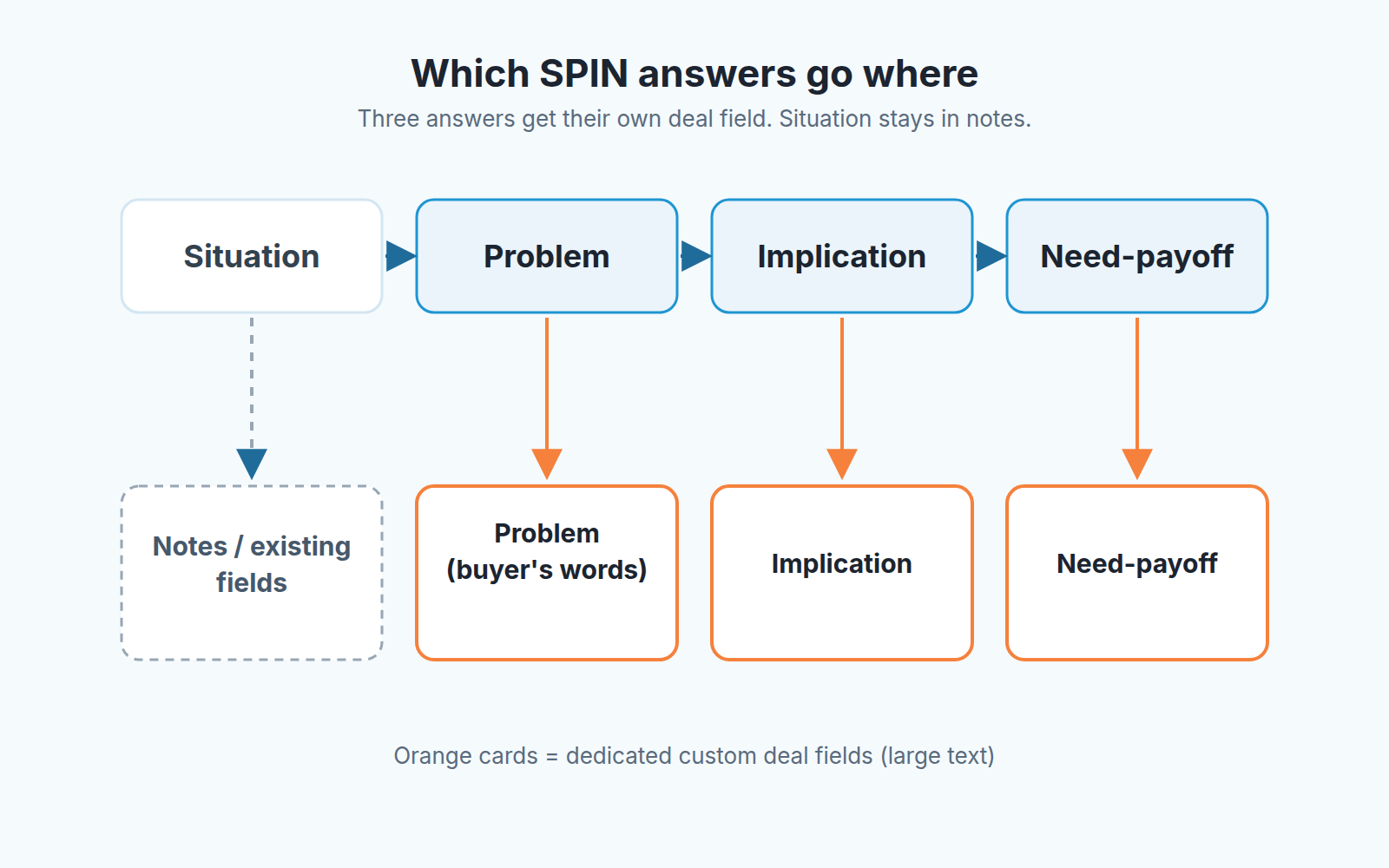
Use large text fields. A dropdown for “problem” turns into “Other” within a month.
Custom fields in Pipedrive can carry a description that your team sees behind the info icon next to the field, so put the question prompt there (“What does this problem cost them? Their words, not ours.”). If you want the fields filled before a deal moves to the proposal stage, Pipedrive can make fields required per stage, with one caveat: the rule doesn’t apply to deals moved by import or the API. Stage-gate setup is a topic of its own. Here we only need the fields.
One opinion we hold firmly: write the problem in the buyer’s words, not yours. “Needs better scheduling” is a rep’s summary. “We lose Mondays to rebooking” is something you can quote back in the proposal, and its something a manager reading the deal can actually picture.
A made-up deal, before and after
This deal is invented to show the difference. A rep is working a regional physio clinic group that books patients by phone and a shared calendar.
Before. The deal sits at “Demo done.” Notes say: “Good call. Booking is chaotic, they’re interested. Send proposal.” Value and close date are filled in. The manager asks in pipeline review why they’d buy this quarter, and the rep says “they really liked the demo.”
There’s nothing wrong with the rep’s instincts here. There’s just nothing on record.
After. Same call, but the rep asked two implication questions and one need-payoff question and wrote the answers into the three fields:
- Problem: “Mondays are lost to rebooking everyone the weekend messed up.”
- Implication: the clinic manager said the front desk works late most Mondays, and that some patients who get bumped don’t come back.
- Need-payoff: “If that went away, the front desk could run intake calls for new patients.”
Now the manager has something to test. Is the late-Monday cost big enough for the clinic manager to take it to the owner? Does the owner care about lost patients more than overtime? The next step writes itself: get the owner on a call and ask the implication question again, to them.
How a manager uses this in a pipeline review
The review question is short. For every deal past the demo stage: is there an implication written down?
No implication, no reason to buy this quarter. That isn’t a verdict on the deal. It tells you the next activity should be another discovery call, and the proposal can wait. We’d rather see a rep go back and ask one more question than send a quote into silence. If the buyer still cannot give a reason this quarter, the honest record is that the deal is paused, with a date and a reason, not a quote in a drawer.
If you want that cost written down as a number, see our gap selling fields in Pipedrive.
In a 15-minute weekly pipeline review you won’t have time to read every note. Filter to deals in late stages with the Implication field empty and start there. What to look for:
- implication is empty, or it just restates the problem (“booking is chaotic” twice);
- the problem field has no quote marks and reads like the rep’s summary;
- the need-payoff sounds like your marketing copy rather than something a person said;
- the implication came from one contact only, which usually means the deal is single-threaded and the person who pays hasn’t heard it yet.
The same fields make a decent input for a deal health score: an empty implication field on a late-stage deal is a risk signal you can see without opening the deal. And if one rep keeps showing up with problems and no implications, that’s a coaching topic for the next 1:1. The pipeline is fine.
When SPIN is overkill
Is SPIN selling still relevant almost forty years on? For deals with several people involved and a price someone has to defend, yes. For small, one-call deals, use a cut-down version.
Rackham’s research was about large sales, and it’s worth taking that seriously. Pipedrive’s summary of it notes that closing techniques can help with low-priced products but reduce the chance of a sale when the deal is large. The reverse also holds in practice: a full SPIN sequence on a small, fast deal is more process than the deal can carry. If your buyer decides in one call and the price fits on a company card, four rounds of questions will feel like a consultant’s intake form.
For those deals we keep it to two questions. One problem question, one implication question, both written down. Skip the need-payoff, skip the fields gate, and let the notes do the job. If the average deal in a pipeline closes inside a couple of weeks making reps fill three large text fields before proposal will mostly teach them to type “n/a.”
Where SPIN earns its keep is the deal with more than one person involved, a price someone has to justify upward, and a buyer who isn’t sure yet that the problem is worth solving. That’s most mid-market deals a small team works. Start with your late-stage deals this week: open each one, and if the Implication field is empty, the next activity is a call, not a quote.
SPIN is one way to run discovery; if you want the wider habit it belongs to, our guide to consultative selling in Pipedrive shows what to ask and what to log when the deal has no sales engineer behind it.