
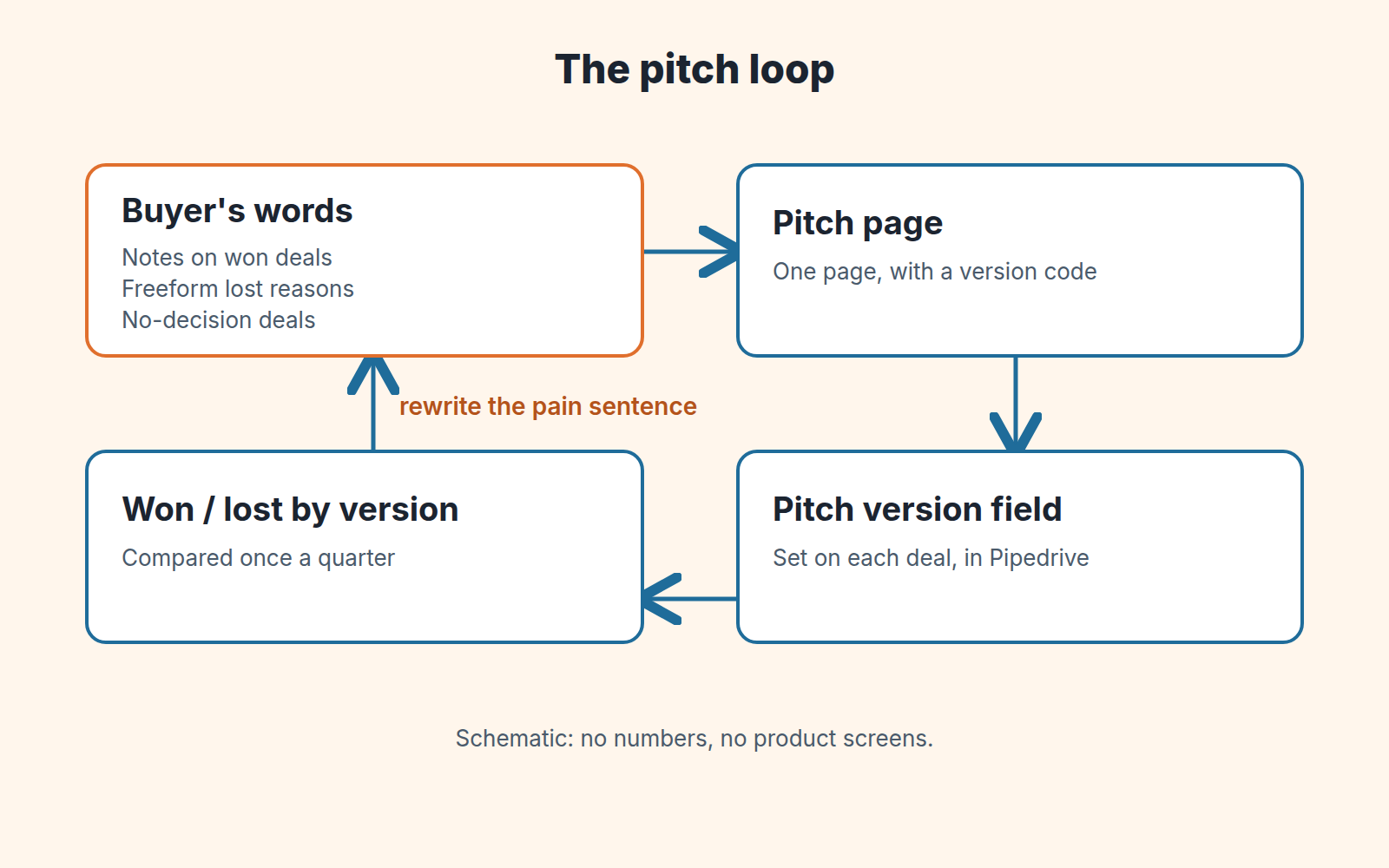
A sales pitch is the short opening that tells a buyer why to keep talking to you; a good one starts with their pain, not your product. For a small team the workable version of that advice is mechanical: take the wording of the pain from deals you have already closed, won and lost, write the pitch in those words, record which version of the pitch each deal heard in a field on the deal, and once a quarter compare win rate by version. The pitch stops being something your best rep carries in their head and becomes something the team can change on purpose and then find out whether the change helped.
What counts as a sales pitch here
Salesmate’s guide lists pitch types by channel: elevator, email, phone, deck, social, video (Salesmate: sales pitch). Useful as a catalogue. For what follows we need something narrower, because you can only version a thing that has a fixed shape.
Our definition: the pitch is the first two minutes of a first conversation, where you say why this buyer should keep talking to you. On a call it is what you say after the pleasantries. In a cold email it is the opening three sentences. In a demo it is the slide before the product appears. The core stays put across channels; only the length changes.
The pitch is not the demo, not the proposal and not the answer to “why are you more expensive”. If “the pitch” means everything a rep says in forty minutes, no two deals heard the same one, and the comparison later in this article has nothing to compare. For those later moments, such as the price question, keep a short talk track.
Pain and change first, features last
Pipedrive’s own piece on this makes the point we would make: open with the customer’s problem rather than the product, and name the change in their situation that makes the problem urgent now (Pipedrive: how to write a sales pitch). Zendesk puts it as making the customer the hero of the pitch and personalising the solution to their needs (Zendesk: sales pitch examples).
Small teams get this wrong in a specific way. On a five-person team the person pitching often helped build the product, or sits next to the person who did. They know the features too well and the buyer’s Tuesday too little. So the pitch drifts toward what is interesting to say instead of what is painful to hear.
The shape that holds up for us has three sentences before any feature. What the buyer is doing by hand or with a workaround. What changed that makes that cost more than it used to (a new hire, a second location, a price rise from the old vendor). What teams in their position do instead. Features come after the buyer nods at the first three.
The hard part is not the shape. It is the the words in the first sentence. Reps invent them, and invented pain sounds like marketing.
Your CRM already holds the real wording.
The buyer’s words are already in your CRM
Three places, in order of how often we go there.
Notes on won deals. Somewhere in the discovery notes of the last twenty deals you won is the sentence the buyer used to describe their problem when they still had it. Not your summary of it; their phrase. Here is the kind of sentence you’ll find: “We find out about a late shipment when the customer calls.” Or: “My Friday is reconciling two spreadsheets.” Copy those sentences, with the deal they came from, into one document. An hour of reading does this. The phrases that repeat across several won deals are your opening line, and they will sound nothing like your website. If your reps write one sentence about the buyer’s problem after each call, as in our minimum for sales call notes, this hour gets a lot shorter.
Lost reasons. Pipedrive records a reason when a deal is marked lost, as a freeform note or from a predefined list, and the point of the field is to see trends (Pipedrive: lost reasons). For the pitch we want the freeform text more than the category. The category tells you the bucket; the note tells you what the buyer thought the problem was. How to set the list up and run a monthly review is in our piece on lost reasons in Pipedrive, so we won’t repeat it here. Read the notes for wording, not for counts.
The no-decision pile. Deals lost because the buyer went quiet are the ones your pitch did not move. The buyer agreed the problem existed, heard your answer and decided it was not worth a second meeting. Whatever they said in the first call about why they took it is the pain your pitch failed to connect to the change. These are the most useful twenty minutes of the whole exercise, and the least comfortable.
Two things we leave out on purpose. Objections are not pitch material: an objection arrives after the pitch, and the log and coaching routine for it is a different piece (objection handling in Pipedrive). And a lost reason is still the rep’s account, not the buyer’s. To get the buyer’s version you have to call them, which is the whole of our win-loss analysis for a small team. For the pitch, the rep’s notes and the freeform reasons are enough to get the words right; the calls refine them later.
A Pitch version field that nobody resents
Create a custom field on the deal and call it Pitch version. Pipedrive lets you add custom fields to deals and filter deals by them (Pipedrive: custom fields), which is all the loop needs. Make it a Single option field rather than free text, or reps will type the same version five different ways. Pick the type deliberately the first time: Pipedrive doesn’t let you change a custom field’s type once it has been created.
Values are short codes with a date in them: v3-2026Q4. The date matters more than the number. A year from now nobody remembers whether v3 came before the price change.
Three rules keep it from becoming paperwork.
Set the field once, when the deal moves into the stage where the pitch is actually delivered. Not at creation (the deal may never get a call) and not at close (nobody remembers). A blank at that stage is a reminder, not an offence.
Run at most two versions at the same time. A small team closes few deals; split them across four versions and none of the slices will ever say anything. Want to try a third idea? Retire the weaker of the two first.
A new version code only when the pain sentence or the change sentence changes. Swapping an adjective or reordering the proof is not a version. Keep a one-line changelog at the top of the pitch page so the team can see what v3 changed against v2.
One more thing we learned the hard way: do not go back and tag old deals from memory. A rep guessing which version a March deal heard will guess the version that makes them look right. Leave the history blank and start counting from today.
Comparing versions by win rate, honestly
Once a quarter filter the Deals list to won and lost deals with each Pitch version value and count. Won divided by won plus lost is the win rate for that version. It takes ten minutes.
The honesty part is about the sample. Say, as a hypothetical, that v2 was heard by fourteen decided deals and won six, and v3 by nine and won five. That is 43% against 56%, and the room will want to declare v3 the winner. One more loss on v3 and it is 50%; two and it is 45%. A single deal moves the number by about six points, which is half the 13-point gap. Two more losses and the gap is nearly gone.
We don’t apply a statistical test to this, and we are suspicious of articles that quote a threshold for how many deals make it significant. The rule we use is arithmetic, and we spelled it out in how to read a small-team win rate: we don’t read a slice until one more win would move it by less than three points, which at a 30% win rate takes roughly twenty-five decided deals. For most small teams that means a version needs two quarters, not one, before the win rate says anything. Until then the number is a hint, and the honest sentence at the meeting is “v3 is not losing”.
There is a faster signal that doesn’t need the sample. Look at where the lost deals died, by version. If v2 deals mostly went quiet after the first call and v3 deals mostly got to a proposal before losing on price, the pitch is doing it’s job in v3 and the problem has moved downstream. The pitch only has to earn the second meeting. A drop in no-decision losses shows up long before the win rate settles, and it is the metric a pitch should be judged on.
Two traps. Don’t compare an old version against a new one across different quarters; season, a price change or a new rep will confound it. Run both versions in the same period, split by rep or by lead source, so each rep carries both. And don’t let the rep who wrote v3 be the only one who delivers it.
One sales pitch page, five blocks
Zendesk structures a pitch as problem, solution, value proposition, social proof, then a question and a call to action (Zendesk). Salesmate’s script runs audience, hook, solution, pre-empted objections, call to action (Salesmate). Both are fine. Ours is arranged so the page can be versioned and fed from the CRM, which is the only reason it differs.
- The pain, in the buyer’s words. One quoted sentence from your notes, with the deal it came from in brackets. If you cannot point at a deal that said it, it does not go on the page.
- The change. One sentence on what shifted in the buyer’s world that makes the pain cost more now.
- What you do about it. One sentence. No feature list, no adjectives you would not say out loud.
- One proof. A specific thing that happened for a specific customer, taken from a won deal. If you cannot source a number, say what happened without the number.
- The question. End on a question that gets the buyer talking about their own version of block one, not on a request for a meeting.
At the top of the page: the version code, the date it went live, and one line on what changed from the previous version. At the bottom: which deals it was tested on, filled in from the field at the quarterly count. One page, so a new rep can read it before their first call and the rest of the team can argue about a sentence rather than a document.
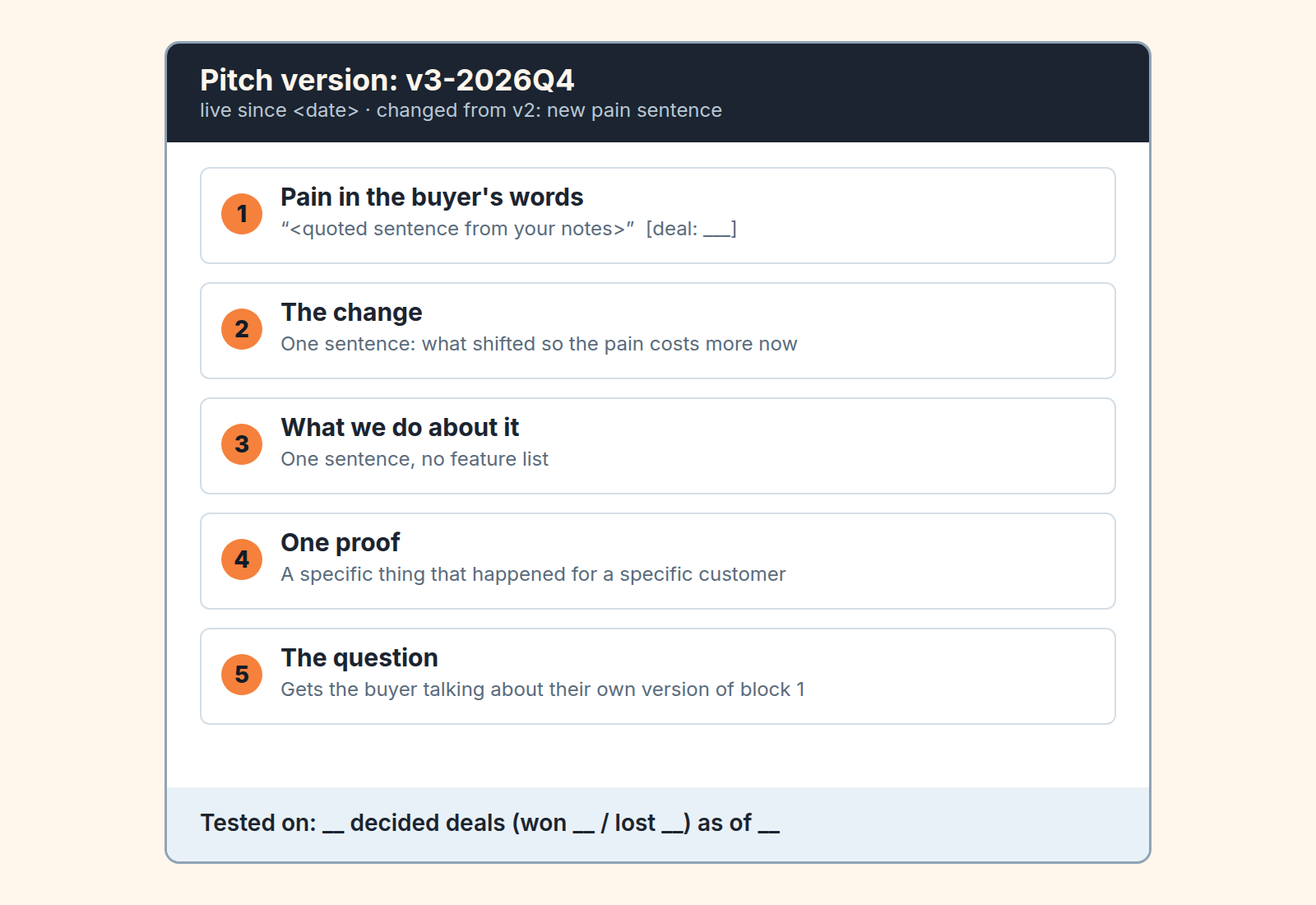
Here is what a filled page might look like. This one is hypothetical: a small team selling shipment tracking to wholesale distributors.
v3-2026Q4, live since the start of the quarter. Changed from v2: new pain sentence.
“We find out about a late shipment when the customer calls.” [deal #1042, hypothetical]
Since you added a second warehouse, the same order can ship from either one, and nobody owns the tracking.
We put every open shipment in one list with its promised date and flag the ones slipping before the customer notices.
A distributor about your size stopped hearing about delays from their customers first.
When a shipment runs late today, who on your team finds out first?
Notice what is missing. No product name until the buyer asks, no feature list, and the last line hands the conversation back to them.
Is it worth a few hours?
The whole loop, from reading twenty deals’ notes to the first quarterly count, costs a small team a few hours. The comparison itself stays a quarterly hour with a filter and a spreadsheet, and we think that is the right place for it: deciding whether a pitch works is a judgement, and it should be a person’s.
The part that pays is not the field or the count. It is that the first sentence of your pitch becomes a sentence a buyer actually said, and when you change it, you will know a quarter or two later whether you should have. Start with this week’s won deals and copy out the first sentence.