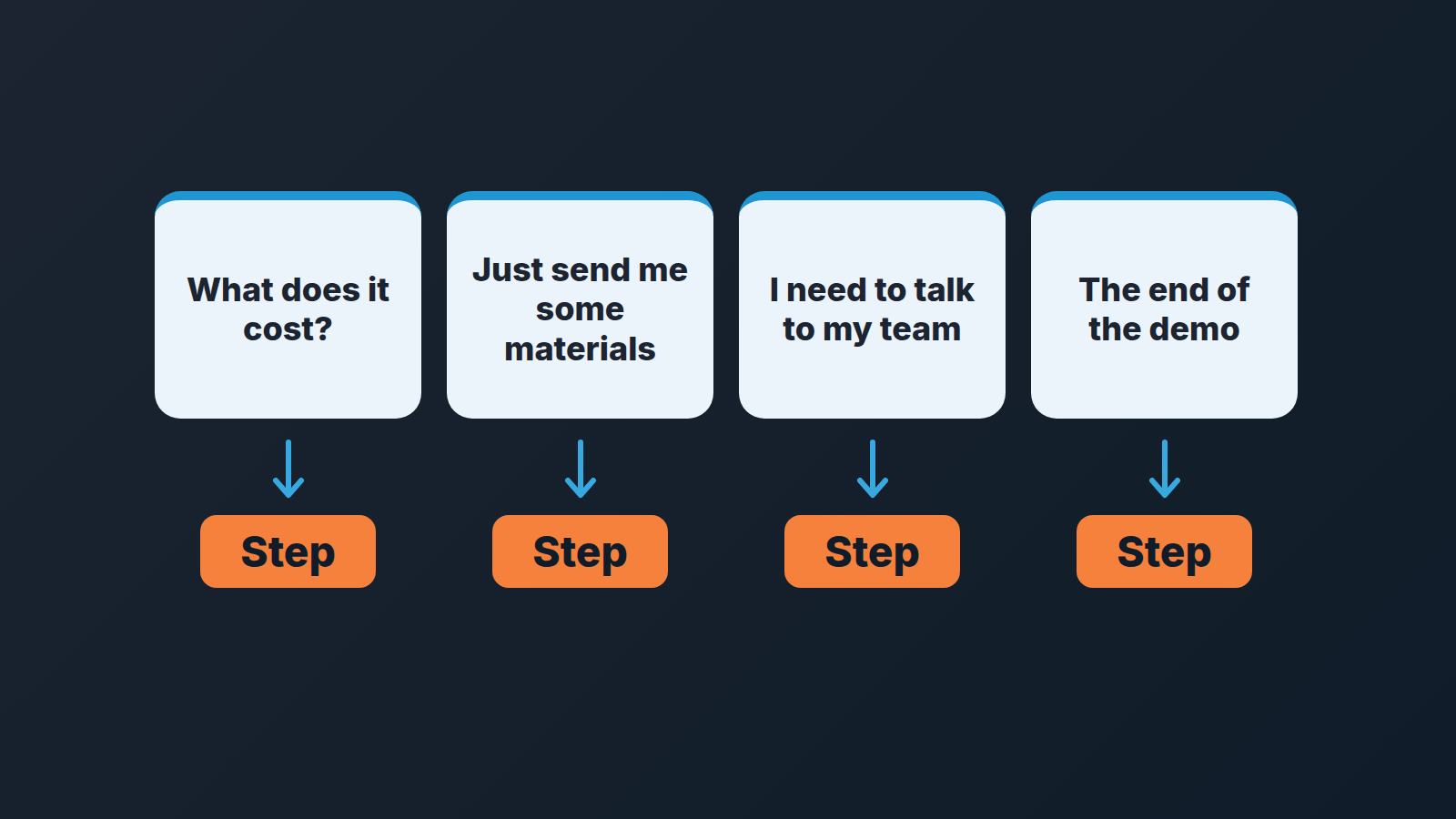
A sales talk track is two or three tested lines for one specific moment in a call, not a script for the whole conversation. A small team needs four of them at most: the early price question, “send me some materials”, “I need to run it by my team”, and the end of a demo or follow-up call, where the next step is agreed or quietly isn’t. Every line ends with a request for a concrete step, and the sign that a line is failing is a deal that comes off the call with no next activity scheduled in Pipedrive.
A talk track is not a script, and it is not your pitch
Close describes talk tracks as “short, strategic phrases” that help reps explain complex ideas simply and handle objections. Grain draws the line against scripts: a script gives “specific lines for each ‘character’” in the conversation, while a talk track is a flexible framework the rep fills in on the call (Close: talk tracks, Grain: sales talk tracks). So a talk track is not a sales script template with a gap for the buyer’s name. We would go one step further. In a team of three to eight reps, a talk track that covers the whole call is a script with a friendlier name, and nobody opens it after the second week.
So we keep the word for something smaller. A talk track is the sentence or two you say at a moment where improvising goes badly, plus the step you ask for right after. It is not the pitch, the pitch is the opening that earns the conversation, and it has its own article. It is not the structure of the first call either: how we run a discovery call covers that. The talk track is what you say when the call has already left the plan.
Why these moments and not others? Because this is where a rep in a small team has had the fewest repetitions. A founder who sells handles the price question twice a week. The new hire handles it twice a month, and nobody improvises well at twice a month. Writing down what you say at those moments belongs on the list of things to pull together before the first hire.
Four moments where a small team improvises worst
Listen to ten calls from a small team and the pattern is hard to miss. The call runs well while the buyer is describing their problem. It wobbles at the same four places, and the wobble sounds the same every time: a pause, a “sure, no problem”, and a call that ends with “I’ll follow up”. Below are the four, each in the shape we write them: what the buyer said, what the rep says, and which step the rep asks for. Change the words to your product. Keep the shape.
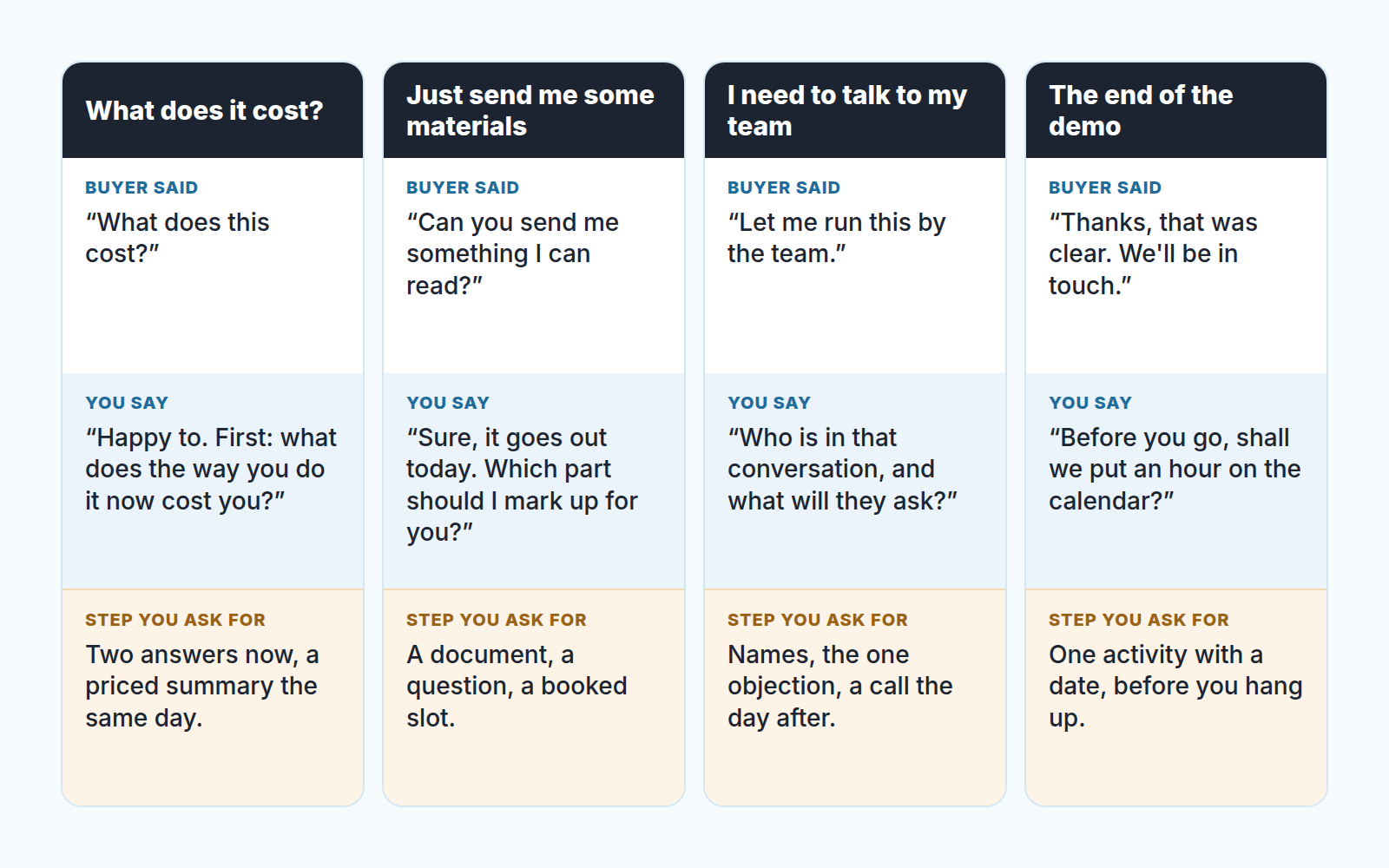
“What does it cost?” in the first ten minutes
Buyer said: “Before we go any further, what does this cost?”
You say: “Happy to. It depends on how many people would use it and whether you need the integration. And on one thing I’d like to understand first: what the way you do it now costs you, in hours or in lost deals. Give me those and you’ll have a number before we hang up.”
Step you ask for: the two answers now, one sentence on what the current workaround costs, and permission to send a priced summary the same day.
A price question this early usually means the value isn’t on the table yet. That is a discovery problem, not a pricing one, which is what we found when we counted objections in Pipedrive. So the line does two jobs. The buyer gets a real promise with a time on it, and the rep gets the cost of the status quo said out loud before any number is. What we never do is say “it depends” and stop. Buyers hear that as a dodge, because it is one.
“Just send me some materials”
Buyer said: “This is interesting. Can you send me something I can read?”
You say: “Sure, the two-pager goes out today. Which part should I mark up for you, the setup or the pricing? And can we put fifteen minutes on Thursday so I hear what landed?”
Step you ask for: a specific document, a specific question answered in it, and a calendar slot booked before the call ends.
Materials sent without a follow-up call are the most common way a deal dies politely. This line turns a brush-off into a booked activity. If the buyer refuses the fifteen minutes, that is information too, and it belongs in the deal notes rather than in the rep’s memory.
“I need to talk to my team”
Buyer said: “Let me run this by the team and get back to you.”
You say: “Of course. Who is in that conversation, and what will they ask that you can’t answer yet? I’d rather give you the answer now than have it block you next week.”
Step you ask for: the names of the other people, the one objection they will raise, the date of the buyer’s internal conversation, and a call the day after it.
Small teams lose more weeks here than anywhere else. We treat “talk to my team” as a question about the buying group, not as a delay to be accepted. The objection the buyer expects from their colleague is usually the the real one, and if the same objection shows up across deals it is worth logging it as a field so the team sees the pattern instead of each rep meeting it alone.
The end of the demo
How a first call ends is part of discovery, and we covered it in the discovery call article. This moment comes later: the second or third call, usually a demo, where the buyer liked what they saw and is about to leave without anything on the calendar.
Buyer said: “Thanks, that was clear. We’ll be in touch.”
You say: “Glad it landed. Before you go, the questions you asked were mostly about setup. Shall we put an hour on Wednesday morning with whoever runs your Pipedrive account and set up a trial on your own data? Or does something need to happen on your side first?”
Step you ask for: one activity with a date, created in Pipedrive before the rep hangs up.
The end of a good demo is not a moment where the rep has nothing to say. It is the moment where saying nothing is easiest, because the buyer is pleased and “we’ll be in touch” sounds like a plan to everyone on the call. The line ties the step to something the buyer did in the demo, which makes it hard to wave off, and it forces a date.
Writing a line: the buyer’s sentence, your sentence, the step
Three parts, in this order.
The buyer’s sentence first, written exactly as a buyer says it. “Price objection” is a category; “before we go any further, what does this cost?” is a moment the rep will recognise with their ears. If nobody on the team can quote a buyer saying it the moment is not real yet and does not need a line.
Then your sentence. Under thirty words, said aloud three times before anyone writes it down, because a line that reads well and speaks badly is worse than no line. Write it in the voice of the person who will say it. A founder can open with “I built this because”; the hire who joined in March cannot, and should not try. If two reps handle the same moment differently and both walk away with the step, keep both lines and note who says which. That is two people with two voices, and nobody needs to pick a winner.
The step last, and it has to be something Pipedrive can hold as an activity: a call with a date, an email with a date, a meeting with a date. “They’ll get back to us” is not a step. “I’ll think about it” is not a step. If the ask at the end of your line cannot be typed into an activity, rewrite the ask.
Where the lines live, and why not in a field
A talk track lives where the rep can see it with Pipedrive open in the other window, and nowhere Pipedrive has to be told about it.
Not on the playbook page, though. Our one-page sales playbook holds exit criteria per stage and a handful of plays, with no scripts, and it should stay that way. Each play there already has it’s own “Say” line, but a play starts from a trigger in the deal: a competitor named in the notes, a deal that has sat in Qualified too long. A talk track starts from a sentence the buyer says on the call, whatever state the deal is in. So the four lines go on a separate card, kept next to the playbook page and short enough to read in the second before you answer.
We do not add a custom field for “talk track used”. The question here is whether the call ended with a step, and Pipedrive already records the answer as the deal’s next activity, so a second field would record the same fact worse. There is also a human reason. A field means the rep stops after a hard call to type which line they said, and the honest answer after a hard call is often “I don’t remember”. A field full of guesses is worse than no field.
Five minutes, out loud
The lines get practised in five minutes that sit right after the weekly pipeline review, not inside it. The review has one decision and two filters for an agenda, as we argued in which meetings a small team keeps, and a drill does not belong on that list. It just uses the fact that everyone is still in the room.
It goes like this. The manager names one of the four moments. One rep plays the buyer and says the buyer’s sentence, the one written on the card. Another rep answers with the line, out loud, without reading. Then the only coaching question that matters: what step did you just ask for? If the rep cannot name it, the line did not end in a step, no matter how smoothly it was delivered. Four moments, four weeks, then back to the first one. A new hire listens in their first week and answers in their second.
The point is not a perfect performance. It is that the line has been said aloud recently enough to come out under pressure on Wednesday, when a buyer who is about to go quiet asks for materials. The drill also shows which lines are dead. When a rep cannot say a line without looking at the card, it is not their line; rewrite it in thier words, there and then, and move on. Five minutes is the limit, because a drill that grows to twenty is the first thing the team will cancel, and they will be right to.
The sign a line is failing: a call that ended with nothing on the calendar
Not conversion. With four reps and a few dozen deals a month there is not enough data to attribute a stage change to one sentence, and we have written about how slowly stage conversion rates settle in a small pipeline. Waiting a quarter to learn that a line is bad is too slow for a team that can fix it next week.
What a small team does have, the same day, is whether the deal came off the call with a next activity. Pipedrive puts an activity icon on each deal card in the pipeline view, which opens the deal’s upcoming activities and lets you schedule a new one, and by default it orders the cards by next activity (Pipedrive: pipeline view). We wrote about what that default order does and does not tell a manager. At the end of the day the manager opens the deals that had a call today and checks what is scheduled behind the icon. A deal with nothing there is a call where a line was either not used or did not land.
Then one question to the rep, not an accusation: which moment did the call die at? One deal is a deal. The same moment three times across the team in a month means the line for that moment is the problem, not the three reps who said it, and it gets rewritten at the next five minutes.
A disclosure, since this is the part that is tedious by hand: we build SalesBond, a sales management layer on top of the CRM a team already uses; we started with Pipedrive. Deal Health checks every deal in the connected CRM against the enabled rules, more than 20 of them, with Activity as one of the rule categories, and shows each violation with the reason and a recommended action. It cannot tell you which line the rep said or which moment the call died at. That part is still a question you ask a person. If you want to see what it flags on your own pipeline, check your CRM with SalesBond.
Start with the one moment that cost you a deal last month. Write down the buyer’s sentence exactly as they said it, write the line you wish the rep had said, and say it aloud at the next five minutes. The other three moments can wait until the first one stops hurting.