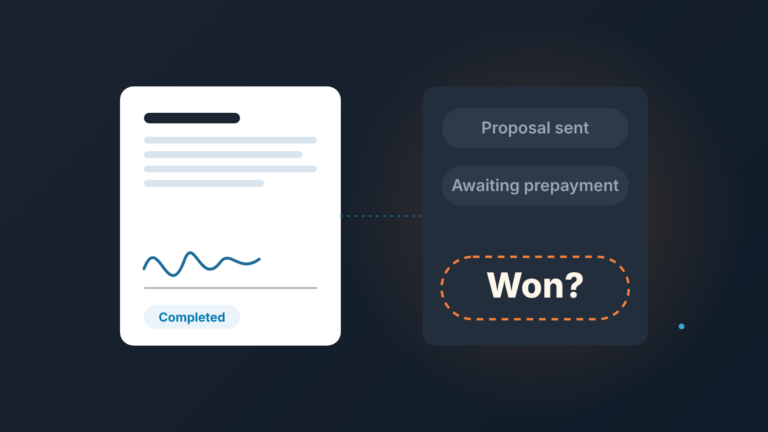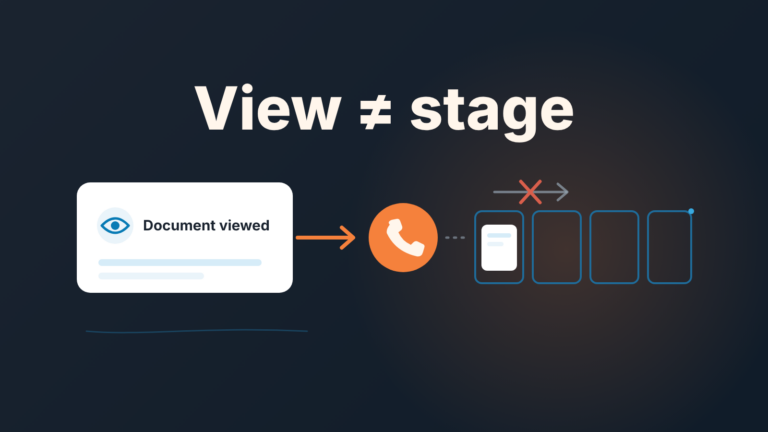
Sales negotiation is the part of a deal where buyer and seller settle price and terms. In a small team it comes down to one rule: any concession (price, payment terms, start date, scope) is given only in exchange for something the buyer commits to, and the exchange is written into the deal, not kept in the rep’s head.
Everything else here hangs off that rule. The trade list tells the rep what they can give. The “if… then” sentence makes the trade conditional out loud. And the short note after the call makes it visible to the manager, and to the rep who picks the deal up next week and has forgotten half of it.
We are not going to teach negotiation psychology. Red Bear and the training companies cover the tactics well. What they don’t cover is the part a five-person team on Pipedrive actually struggles with: keeping the trades honest from one call to the next, and letting the manager see where the margin went before the discount shows up in the won deal.
A concession is anything the buyer wanted and you moved on
Most reps hear “concession” and think “discount”. That is the expensive version.
A concession is any move on a term the buyer cares about, and the list runs well past price (Red Bear: sales concession strategy). In our own deals the ones that come up most are when the invoices land, how many seats are included, how fast onboarding starts, who the buyer gets to call when something breaks, and what happens at renewal.
What matters in practice is the difference between a trade and a giveaway. A trade is movement on one term in return for movement on another. A giveaway is movement with nothing coming back. Red Bear makes a point we agree with from experience: an unconditional price drop tells the buyer the first number had air in it, and that makes your next number harder to believe (same source).
Here is the version we say on Monday planning: if you moved and did not ask for anything, that was a gift, and gifts go on the list of things we talk about.
Why a rule and not good intentions? Because small concessions don’t feel like money. Starting the onboarding two weeks early, a free extra seat “for the admin”, quarterly invoicing when the price list says upfront. None of these touch the deal value in Pipedrive. All of them cost you something, and none of them is recorded anywhere unless you decide to to record them.
The trade list: what we can give, what we ask back
Build the list once, as a team, before anyone needs it on a call. Score each item on two things: what it costs us to give and how much the buyer wants it (same source). Cheap for us and valuable to them goes at the top. Price goes at the bottom.
Ours looks roughly like this. Yours will differ, which is the point.
- Quarterly invoicing instead of payment upfront, for a 12-month term instead of six months. Cheap for us, and often the buyer’s real blocker.
- A named contact for the first 90 days, in return for an intro to the second team that was “maybe later”.
- Payment due 45 days after the invoice instead of 30, if the signature lands before the end of the month rather than “once legal has looked”. If procurement asks for more, treat a net 60 request the same way.
- Onboarding starting the week they sign instead of the standard queue, if the kickoff is booked with their decision-maker in the room.
- Price, last. Below the threshold in our one-page discount rule the rep can move alone, but still only as a trade; above it, the manager says yes before the quote goes out. That article has the details, we won’t repeat them here.
Two notes on the list. First, keep it short enough that a rep can hold it in their head during a call. Six to eight lines is plenty; a page is a document nobody opens mid-conversation. Second the “ask back” column is where most teams go wrong. Reps write what they can give in great detail and leave the other side vague. If the ask-back is not a specific, checkable commitment (a date, a signature, a named person), it is not a trade.
One Pipedrive detail helps with pricing the list. If you sell through Products, each product can carry a Cost per unit next to its price, and the product itself has a billing frequency (Pipedrive: products). If your team fills in Cost, the cost behind a payment-term or seat concession sits right next to the price, and whoever builds the trade list can look it up instead of guessing. If your subscription terms are messy there, we wrote about recurring products versus installments separately.
“If you can… then we can”: the sentence that runs a sales negotiation
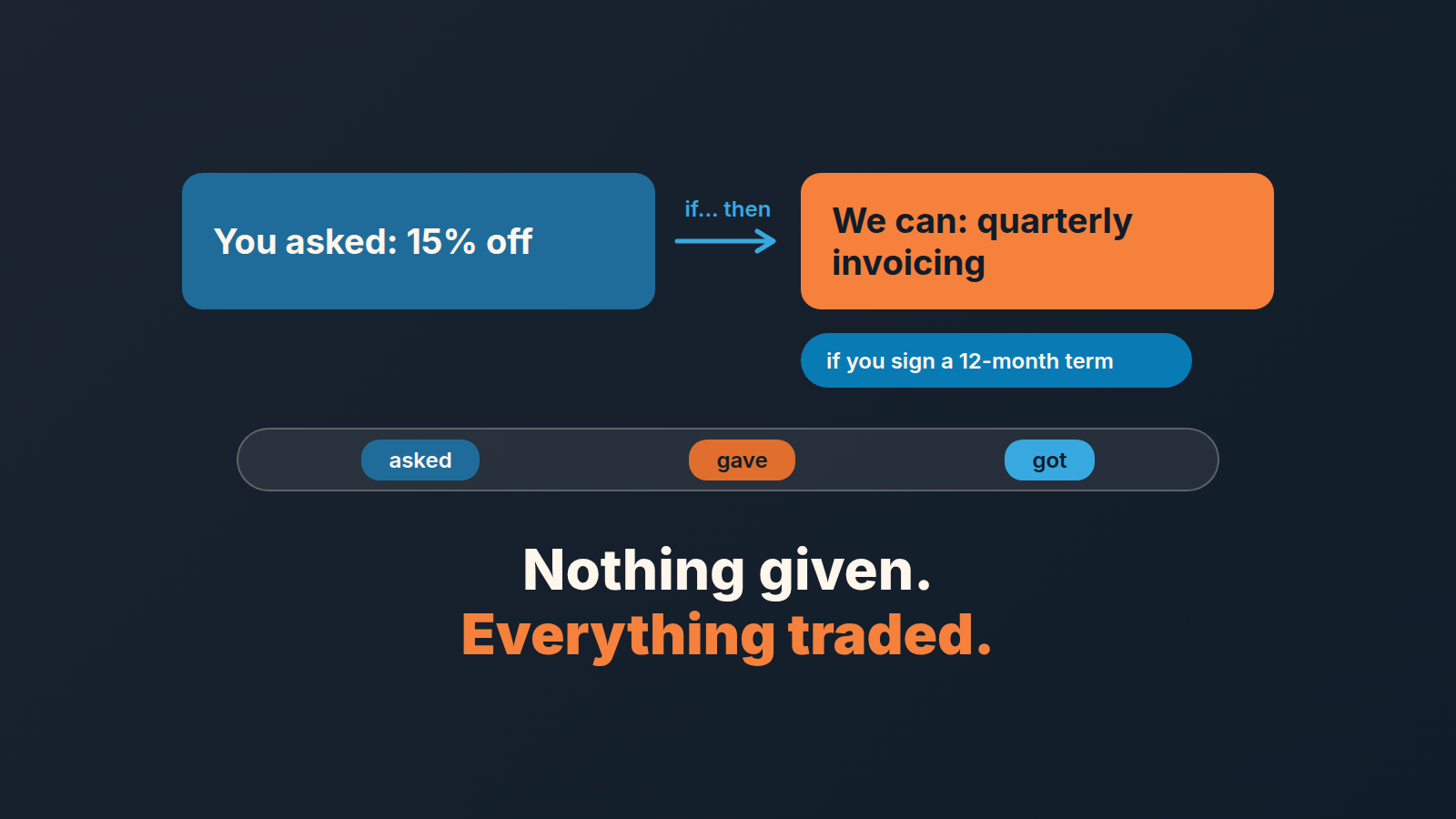
The order of the words is the whole technique. Condition first, concession second, a point Red Bear makes as well (same source). In the call further down it sounds like this: “If you can sign for 12 months, then we can invoice quarterly.” Flip it (“We can invoice quarterly. Could you do 12 months?”) and the concession has left your hands before the buyer has agreed to anything.
Two more ideas from the same source have held up in our deals. Let each move be smaller than the last: if there is room, the first step is the biggest, and the shrinking steps tell the buyer where your floor is so you never have to say it. And keep concessions back until the buyer has already put real work into the process. A discount request in the first discovery call is not a negotiation; it is a question, and the answer is “let’s see what you need first”.
For a small team the practical version is: nobody concedes anything on a first call, and nobody concedes anything without the word “if” in the sentence. If a rep can’t think of an ask-back on the spot, the right move is “let me check what I can do and come back to you tomorrow”. That is not weakness. It buys a day to look at the list and talk to the the manager.
What this sounds like on a Thursday call
A made-up deal, but the shape is real. Mid-sized buyer, 20 seats. They floated a six-month contract, so the proposal that went out a week ago is six months, paid upfront, as our price list says. The buyer’s operations lead calls.
Buyer: We like it. Finance wants 15 percent off before they’ll sign.
Rep: Understood. Before I go to price, tell me what finance is actually solving for: is it the total, or the cash leaving in one quarter?
Buyer: Honestly, it’s the upfront payment. Q4 budget is tight.
Rep: Okay, that I can work with. If you can sign on a 12-month term rather than the six you asked about, then we can invoice quarterly instead of upfront. Your Q4 invoice covers three months instead of six.
Buyer: That might do it. And the discount?
Rep: I’d rather not move the price for a six-month deal. If the 12 months works and the second team you mentioned comes in at the start, then we’re talking about a bigger deal, and I can look at price for that one.
Buyer: Let me take the quarterly option to finance.
What happened there: the rep found the real variable (cash timing, not price), traded a cheap item (the invoice schedule) for a valuable one (double the term), and kept price back for a bigger ask (more seats). Nothing was given away. If finance comes back and still wants 15 percent, the rep checks it against the discount rule: within the rep’s threshold it’s a trade the rep can make alone, above it the manager signs off before the quote goes out. Improvising is not one of the options.
When to hold the line yourself, and when to bring the manager in
A rep should be able to run the whole trade list without asking anyone. That is why the list exists. The manager comes in for three situations, and we would rather be explicit about them than have reps guess.
The buyer asks for something that is not on the list. New request, new cost nobody has priced. The rep says “let me come back to you” and does.
The buyer has refused two ask-backs in a row. At that point either the buyer is not ready to commit, or the rep is misreading what they value. Either way a second pair of eyes is cheaper than a third concession.
Price beyond the rep’s threshold. Under it, the rep trades price like anything else on the list. Over it, the manager says yes first, in our team and in the discount rule. Not because reps can’t be trusted, but because price is the one concession you cannot take back, and the rep is the person in the room with the most pressure to say yes.
One pattern worth naming: the request that arrives from procurement after the business side has agreed. That is a different negotiation with a different counterparty. The rules above still apply but the timeline risk is bigger. We covered it in deals stuck in legal and procurement.
After the call: asked, gave, got
This is the part nobody teaches, and it is the part that saves the next call.
Right after the call, the rep writes a note on the deal: what the buyer asked for, what we gave, what we got in return. Three parts, one line each if needed, in plain words:
Asked: 15% off. Gave: quarterly invoicing (if 12-month term). Got: taking it to finance, answer by Tuesday.
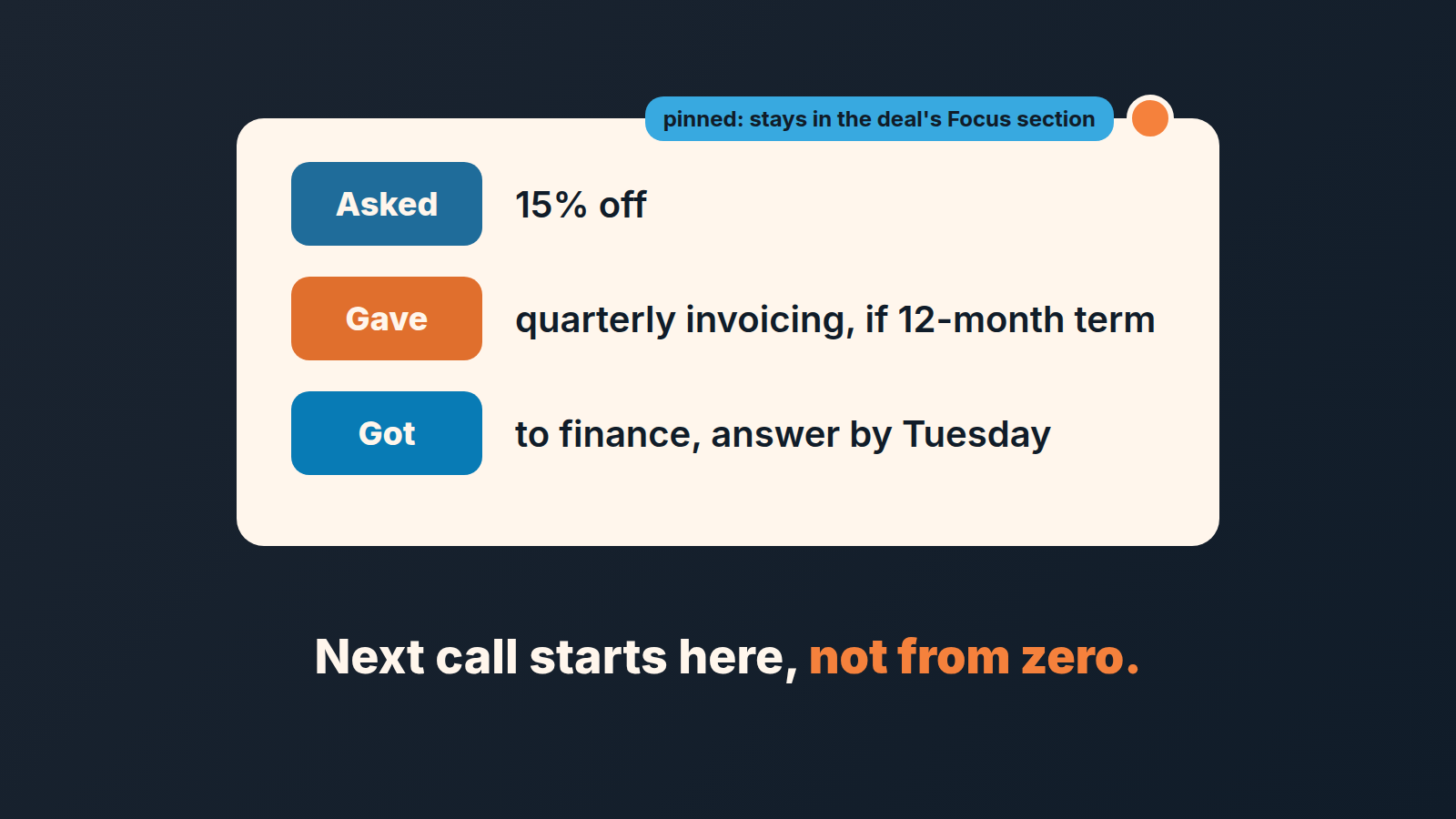
Pin it. In Pipedrive’s deal detail view, pinned notes sit in the Focus section together with upcoming activities and email drafts (Pipedrive: deal detail view), so whoever opens the deal next, including the manager before a pipeline review, finds the open trade right there.
We did consider a custom field for this, the way we track discounts and objections, and decided against it. A discount is a number and belongs in a field, which is what the discount article sets up. An objection is one of six values, which is why logging objections works as a field. A trade is a sentence with a condition in it, and a condition does not fit in a dropdown. The note loses filterability; it keeps the “if”, which is the whole content.
What the note changes in practice: the follow-up call does not start with “remind me where we got to”. The rep who covers for a colleague on holiday can see the open condition. And when a deal is marked won with a 10 percent discount in it, the manager can read back through teh notes and see whether that discount was traded or given. In our deals the pattern showed up quickly, once there were a few notes to read side by side. If the trade turns into a third revised quote with no stage move, stop recalculating and ask what blocks the decision.
If the buyer goes quiet after a trade is on the table, that is a follow-up problem with a known shape; we wrote the sequence down in follow-up after the proposal.
When the trade is logged and the deal still sits there
The trade list and the note fix the conversation and the memory of it. They do not, on their own, tell a manager which of the twelve deals in the final stage has an open condition nobody has chased for two weeks. Reading every pinned note on a Friday afternoon is possible for a team of three and stops being possible at a team of eight.
A disclosure, since this is where we come in: we build SalesBond, a sales management layer on top of the CRM a team already uses; we started with Pipedrive. Deal Health finds and explains problems in deals: it checks every deal against more than 20 rules and shows the reason and a recommended action, so the manager can spend Friday on the deals that need it rather than reading all of them. If that sounds like your Friday, check your CRM with SalesBond.
Whatever you decide about software, the first step is a meeting, not a tool. Sit down with the team this week, write the trade list (five or six lines, price at the bottom) and agree that every pricing call ends with an asked, gave, got note on the deal.