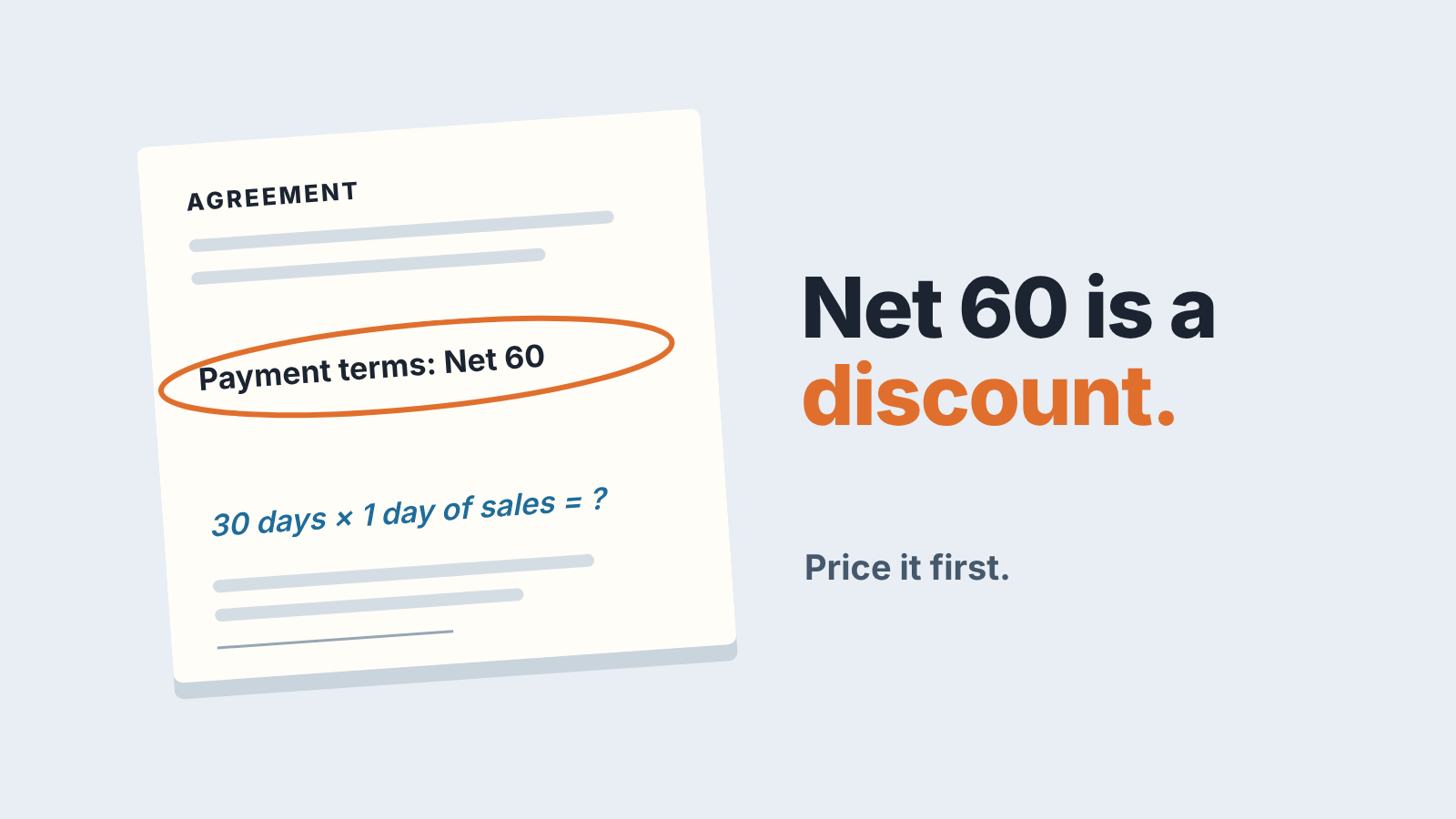
When negotiating payment terms with customers, treat a request for net 60 as a request for a discount. Price it first: moving a customer from net 30 to net 60 means you fund thirty extra days of their business for as long as they stay a customer. Then trade for it instead of giving it away: a payment mandate, a longer term, part of the amount up front. Only then say yes, and write the agreed terms into the deal before anyone signs. Here is how we do it on a Pipedrive team, and when we skip it.
Procurement writes back on signing day
Dagny had the contract ready in the second week of September 2026. The buyer’s sponsor had said yes twice. Then an email arrived from Radek in the buyer’s procurement team, two lines long: “Our standard supplier terms are net 60. Please update the agreement and resend.”
She forwarded it to Florin, her manager, with one word: “Fine?”
To sales it feels like paperwork, and procurement knows it. (A deal stuck in procurement for weeks is a different problem.) Our rule is that Florin does not answer “fine” to that email. He answers with a number.
Net 30 vs net 60: thirty days of someone else’s sales
Net 60 means the invoice is due 60 days after it is issued; net 30, 30 days. The gap sounds like a calendar detail. It isn’t.
Monk, writing from the finance side, puts it plainly: stretching a customer from net 30 to net 60 “ties up thirty extra days of that customer’s sales, permanently, for as long as the relationship lasts” (Monk: Net 30 vs Net 60 vs Net 90). The arithmetic fits on one line: what the customer pays you in a year, divided by 365, times the extra days. The same terms decide when an open deal turns into cash, which is what expected cash dates for open deals are built from.
An illustration with invented numbers. A customer worth $36,500 a year is $100 a day. Net 60 instead of net 30 means $3,000 of your money sitting in their bank at any given time, until the contract ends. If Dagny had been asked for a $3,000 discount on signing day, she would have gone to Florin with a case and not with “fine?”.
LeadHaste’s playbook gives the example of a $36K deal billed quarterly on net 60: the first payment lands around day 150 (LeadHaste: payment terms negotiation playbook). Five months of delivery before the first dollar, the gap you see when you compare bookings against billings at quarter end.
Don’t give it away, trade it
Monk’s line is that “terms are a form of financing, so trade them for something” (Monk). LeadHaste says to handle a net-60 ask “exactly like discount asks: acknowledge, state the cost, propose the trade” (LeadHaste). The general method is in how we trade concessions; these four trades are specific to payment terms.
- A payment mandate. Net 60 on direct debit is a different animal from net 60 on “we’ll process it when it reaches the top of the pile”. Monk lists a direct debit mandate among the things worth trading terms for.
- A longer contract. Thirty days of financing is easier to carry over two years than over one year with a renewal cliff.
- Part of the amount up front. A deposit on signature and the rest on net 60, so less money is actually financed. If the buyer wants the deposit amount in writing first, a pro forma invoice does that without raising a real invoice. (A deal marked Won while the invoice is still unpaid is a separate problem, covered in Won but not paid.)
- A price that reflects the terms. Two numbers on the quote, one for net 30 and one for net 60. Monk describes the same ladder: “Net 30 at list, Net 60 at a stated uplift and Net 90 for a committed volume.” Choosing is what procurement is for.
What we never trade for is nothing. Net 60 given away for free becomes the customer’s permanent terms, and their procurement team will quote it back to you at renewal.
Negotiating payment terms with procurement: three sentences
Dagny’s reply to Radek needed three sentences, in this order.
The first is policy, not preference. Karl Sakas (Sakas & Company) advises citing policy: “Our agency’s policy is that payments are due Net 15” is more persuasive than “I’d like you to pay Net 15” (Sakas & Company: negotiating payment terms). So: “Our standard terms are net 30, and that is what the quote was priced on.”
The second is the cost, said calmly: “Net 60 means we finance an extra thirty days for the length of the contract, so we treat it the way we treat a price change.”
The third is a choice between two things you can live with, never a flat no: “We can do net 60 with a direct debit mandate and a two-year term, or we keep net 30 and the current price. Which works on your side?”
Does it work when the buyer calls net 60 standard? Sakas’s example starts with “A client recently shared a success story from his agency”: one of Sakas’s clients, an agency owner whose usual terms were net 15, faced a buyer’s net 60 and settled on net 20 with no discount (Sakas & Company). The buyer’s “standard” had room in it, they just didn’t volunteer it.
What goes in the deal before anyone signs
This is where teams lose the trade they just won. Dagny agrees net 60 with a mandate by email, the contract is signed, and three weeks later the person raising the invoice has never heard of a mandate and sends a plain net 60 invoice.
We keep three things on the deal, in fields, not in a note nobody filters on.
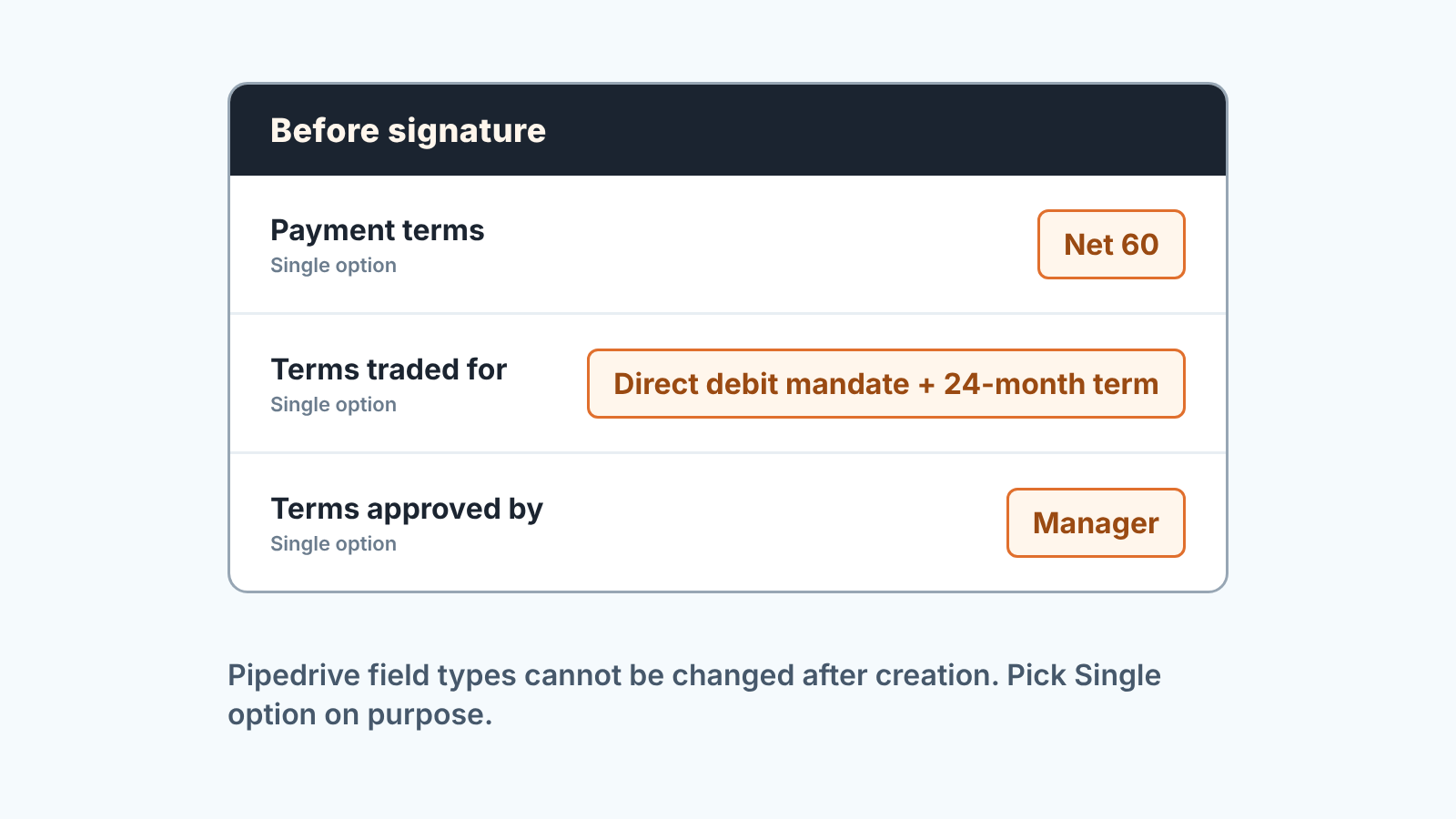
Payment terms, a Single option field: Net 15, Net 30, Net 45, Net 60. Not a text field, because “net 60”, “N60” and “60 days” are three different values to a filter. Pipedrive offers sixteen custom field types (Pipedrive: custom field types), and the type can’t be changed once the field has been created (Pipedrive: custom fields). Decide before you create it.
Terms traded for, also Single option: Mandate, Longer term, Deposit, Price, Nothing. The “Nothing” option is deliberate. It makes a free giveaway visible in a report instead of invisible in an email thread.
Terms approved by: Standard, Manager, Owner. Whoever raises the invoice sees at a glance whether net 60 was an exception and who signed off. Ask at the same time whether the invoice needs a purchase order number, since a missing one can hold up payment too. The person who raises the invoice also needs to know who the invoice goes to, which is often not the person who signed.
Beyond those three, resist. Every extra field is one more to defend in the next custom fields cleanup. And put the terms the price was based on into the quote itself, next to its validity date. “Priced on net 30” hands Dagny her first sentence before the net 60 email even arrives.
When to just say yes, and who decides
Sometimes the right answer is “fine”. Two cases.
The first is a small deal. If thirty days of financing come to less money than an hour of Florin’s time, the trade isn’t worth running. Use the line your discount policy already draws, the amount a rep can give away without asking. One threshold, not two approval processes.
The second is the customer whose procurement does not negotiate. Monk reports that across the receivables Monk manages, 92% of enterprise invoices must be submitted through a vendor portal or network (Monk). A buyer with a portal often has it’s terms built into it. Accepting net 60 on a large account is a decision about financing the company, so it belongs with Florin or the owner, not with Dagny on signing day. The fields make that escalation fast: “Payment terms: Net 60, Terms traded for: Nothing, Approved by: ?” is a question a manager answers in a minute.
Dagny’s deal closed in late September 2026 on net 45 with a direct debit mandate, and the three fields were filled in before the signature. This week, open the quote template your team sends most often and add one line under the price: the payment terms it was priced on. The next net 60 email will find the first sentence of thier answer already written.