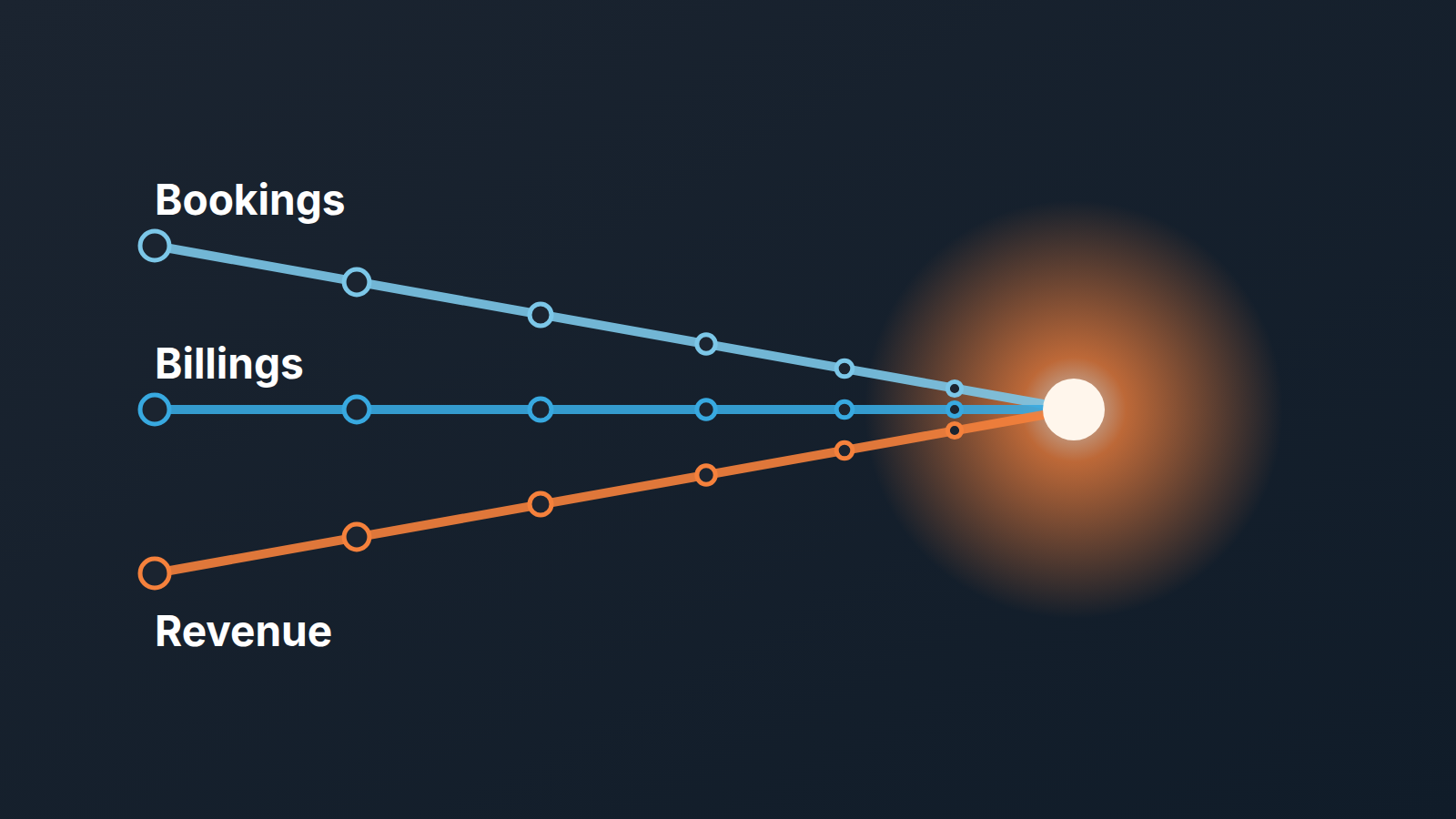
Pipedrive holds bookings: the value a deal carried when it was marked Won, placed in the month it was won. Billings (what you have invoiced) and revenue (what the accountant has recognized) live in the finance system, and none of the three has to match the others in any given month. When someone outside sales asks for “revenue” and gets the Won total, they get the right number for the wrong question.
The cash plan built on the Won column
A scene we have watched more than once. A company hires a part-time finance director. In her first week she asks the head of sales for “revenue for Q3”, because she is building a cash plan for the next two quarters. He opens the Forecast view, adds up the Won columns for July, August and September, and sends one line: 96,000.
She takes it at face value. Why wouldn’t she? Pipedrive’s own column header calls it revenue. Her plan assumes something close to 32,000 a month coming in, and she pencils in a hire for January on that basis.
Then the invoices don’t arrive at that pace. Half of the Q3 deals start service in October or later, a few bill quarterly, one bills in three parts. The money is real, it is just spread over the next year. Nobody lied and nothing was lost. One number was what customers committed to, and the plan needed a different one: what gets invoiced and when.
The cost is not one awkward meeting. It is that the next time sales sends a number to finance, finance quietly re-checks it. So, vocabulary first. Three words, each with one owner.
Bookings vs billings vs revenue, one sentence each
Bookings are the total value of contracts customers have signed, recorded in full at signing no matter how payment is spread (Orb: SaaS bookings, billings and revenue). Rework says the same thing in sales language: bookings are “recorded the moment the deal closes, regardless of when the customer pays”, and “bookings lives in the CRM and the sales comp plan” (Rework: bookings vs revenue). This one belongs to sales.
Billings are what you invoiced over a period, monthly, quarterly or annually depending on the contract (Orb, same page). Finance owns this number. It drives collections and cash, and it says nothing about whether the service has been delivered. A deal can also be won but not invoiceable for weeks while the PO number from the buyer is missing, and that gap sits between bookings and billings. How fast billings turn into cash is days sales outstanding: finance computes it, but payment terms set at the sale stretch it.
Revenue is what the company earns as it delivers the service over time (Orb again). For a subscription or a retainer that means a slice per month across the service period: Rework’s example is a three-year 360,000 contract that books once and recognises 10,000 a month for 36 months. The accountant owns revenue, and it is the only one of the three that belongs in a P&L. If your team is on HubSpot, MRR and ARR on a HubSpot deal are another pair of numbers again, calculated from recurring line items.
Can revenue be higher than billings in a month? Yes, whenever you deliver in a month you don’t invoice; the example further down has two such months.
A one-time sale delivered on the day collapses all three into one figure, which is why a team selling boxes never has this conversation. Sell anything delivered over time, or invoiced in parts, and the three come apart.
What is actually in Pipedrive
Pipedrive stores the first one. The Forecast view places won deals by their won date and open deals by their expected close date, and each column header totals the open value, the won value, and “a projection of combined revenue should you win them all” (Pipedrive: the Forecast view). The view is only on Professional and higher plans. You can point it at a custom date field instead of expected close date (Pipedrive’s own example is a delivery date), which moves deals in time but doesn’t change the amount.
Look at the word Pipedrive uses for that projection: revenue. It’s a reasonable word for a CRM to pick and the wrong word for the finance meeting. Nothing in that column knows whether an invoice went out or whether the service has started. Won value by won date is bookings. Payment terms do not change that number either: a net 60 payment terms request moves when the money arrives, not what Pipedrive shows as Won.
There is no billings or revenue in Pipedrive unless you build them, and we would not. A custom field for “first invoice sent” or “service start” works for a handful of deals. At a hundred deals a quarter it becomes a second set of books kept by people whose job is selling, and it will disagree with the real set within a month. The accounting system already has those numbers. Ask for them.
One deal, three numbers, six months
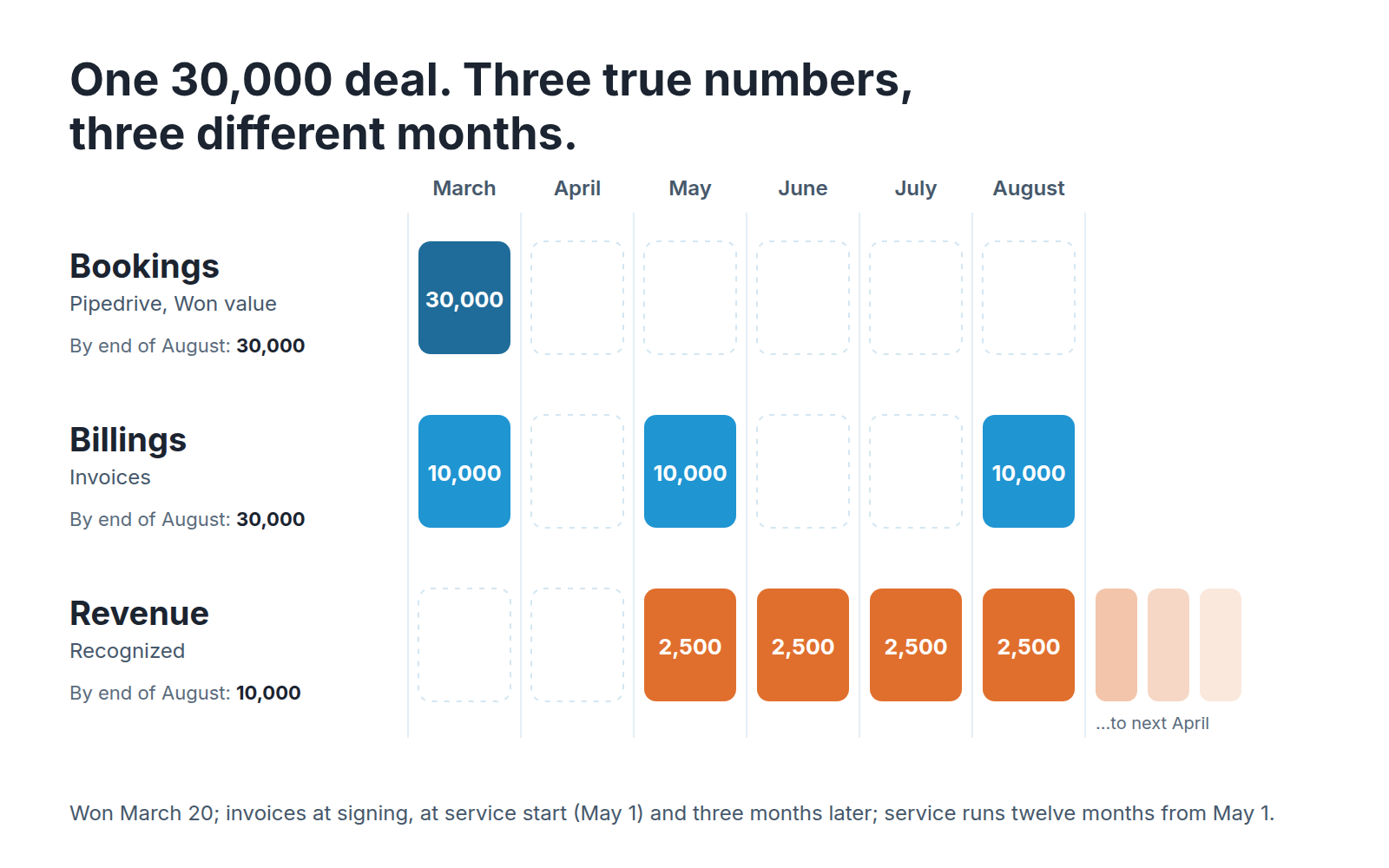
Take one deal. A 30,000 annual service contract, signed and marked Won on March 20. Paid in three invoices of 10,000: at signing, when the service starts, and three months after that. Onboarding takes a while, so the service starts on May 1 and runs twelve months.
| Month | Bookings (Pipedrive, Won) | Billings (invoices) | Revenue (recognized) |
|---|---|---|---|
| March | 30,000 | 10,000 | 0 |
| April | 0 | 0 | 0 |
| May | 0 | 10,000 | 2,500 |
| June | 0 | 0 | 2,500 |
| July | 0 | 0 | 2,500 |
| August | 0 | 10,000 | 2,500 |
By the end of August the three columns add up to 30,000, 30,000 and 10,000. All three are right. Pipedrive’s Forecast view shows 30,000 in March and nothing after. Finance shows 2,500 a month until next April. If the owner asks in April “what did we make from that customer”, sales says 30,000, the bookkeeper says nothing yet, and both are answering a different question than the one asked.
Now multiply by forty deals signed in a quarter, each with its own start date and payment schedule. The quarter’s bookings and the quarter’s revenue will differ, and the difference has two parts: this quarter’s contracts not yet delivered, minus the revenue still arriving from contracts signed earlier. In a growing company the first part is usually bigger. That is a healthy gap to have, as long as everyone knows what it is.
Which number to say in which room
Our rule, and we hold to it even when the bookings figure looks better: sales reports bookings and forecasts bookings; finance reports billings and revenue; nobody reports a number they do not own.
In the sales plan, the target is bookings: Won value against target, by won date. The team can move it, and it lands the month they do the work. A revenue target for a sales team is a target for events that happen months after the the selling, so a rep would be rewarded in October for a March deal. Feedback that slow teaches nothing.
The forecast is expected bookings: open deals by expected close date, weighted or not. That is exactly what the Pipedrive Forecast view is. Call it “expected bookings” or “forecast won value” in the room, whatever the column header says. If finance hears “revenue forecast” from sales and then sees a different revenue figure in the books, you are back to the cash plan from the first section.
For finance, the bank or investors, ask finance for billings and revenue and attach bookings as the leading indicator, labelled. The sentence that ends the argument sounds like this: “Bookings for Q3 were 96,000. Recognized revenue is finance’s number. They differ because revenue still includes slices of contracts signed earlier and leaves out the part of this quarter’s contracts we haven’t delivered yet.” Three numbers, three labels. If you are building a one-page manager report, bookings is one of the six numbers we put on a sales manager dashboard, and it sits there under its own name.
A disclosure, since we are on the subject of plans. We build SalesBond, a sales management layer on top of the CRM a team already uses; we started with Pipedrive. Its Sales Plan measures attainment on the Won value from the CRM, so plan, pipeline and the Monday meeting all use the same unit. If you want to see how your Won total lines up against target month by month, check your CRM with SalesBond.
When the Won value itself is off
Calling the Won column bookings only helps if each Won value is a real booking. It isn’t when the Value field mixes three-year totals with annual contracts, when installments or recurring products are chosen inconsistently across deals, or when several currencies are summed in one view. And if your rule is to mark Won when the prepayment lands rather than at signature, your Won column runs behind signed bookings by however long customers take to pay. Each of those is its own fix.
A fifteen-minute reconciliation, once a month
We do this on the first working day of the month, before anyone has a chance to argue about it.
- Pull Won value by won date for the closed month from the Forecast view. Write it down and label it “bookings”. If anyone edited a won date after month end, the figure moves, so check who changed won time before it leaves the building.
- Ask finance for the same month’s invoiced total and recognized revenue. Don’t compute them yourself.
- Explain the gap in one line: contracted but not yet invoiced, or invoiced but not yet delivered. A piece of the gap that fits neither bucket is the real finding, usually a deal marked Won that the customer never signed or a signed contract nobody put in Pipedrive.
- Put the three numbers side by side in the monthly report, each with it’s label.
Start with last month. Pull the Won total today, send finance a two-line email asking for invoiced and recognized for the same month, and put the three figures in one row of your next report.