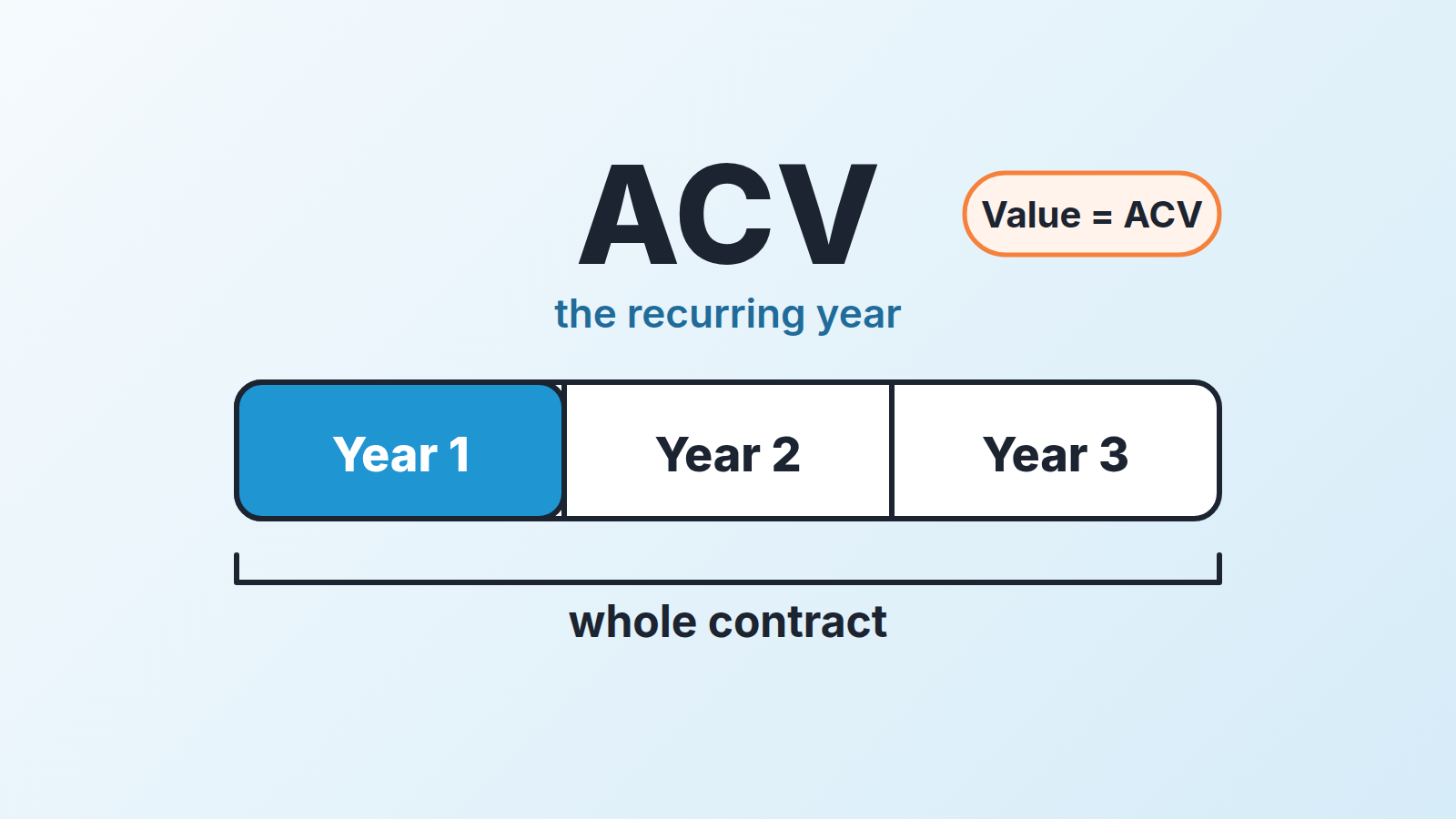
ACV, annual contract value, is the recurring revenue a contract brings in per year, without one-time fees: (total contract value minus one-time fees) ÷ years in the contract. In Pipedrive, that is the number for the standard Value field, and one-time fees and the contract total get fields of their own. Mix them in Value and the forecast inflates quietly: a three-year subscription entered at its full sum counts three times what it brings in this year, a $12,000 onboarding fee looks like revenue that repeats, and every report built on Value, from the weighted pipeline to average deal size, inherits the error.
The quarter that looked nearly three times bigger than it was
Henrik runs a twelve-person software company and goes through the quarter with his two reps the week after it closes. The Won filter in Pipedrive showed $186,000. His bookkeeper could not find $186,000 anywhere in the year ahead. Both were right; the gap was about what had been typed into Value. Deals in more than one currency open a gap of their own, a separate reason why the Pipedrive total never matches the bank.
The three won deals looked like this (the numbers are made up, the pattern is not):
- Keiko closed a 36-month subscription at $3,000 a month. She entered the contract total, $108,000.
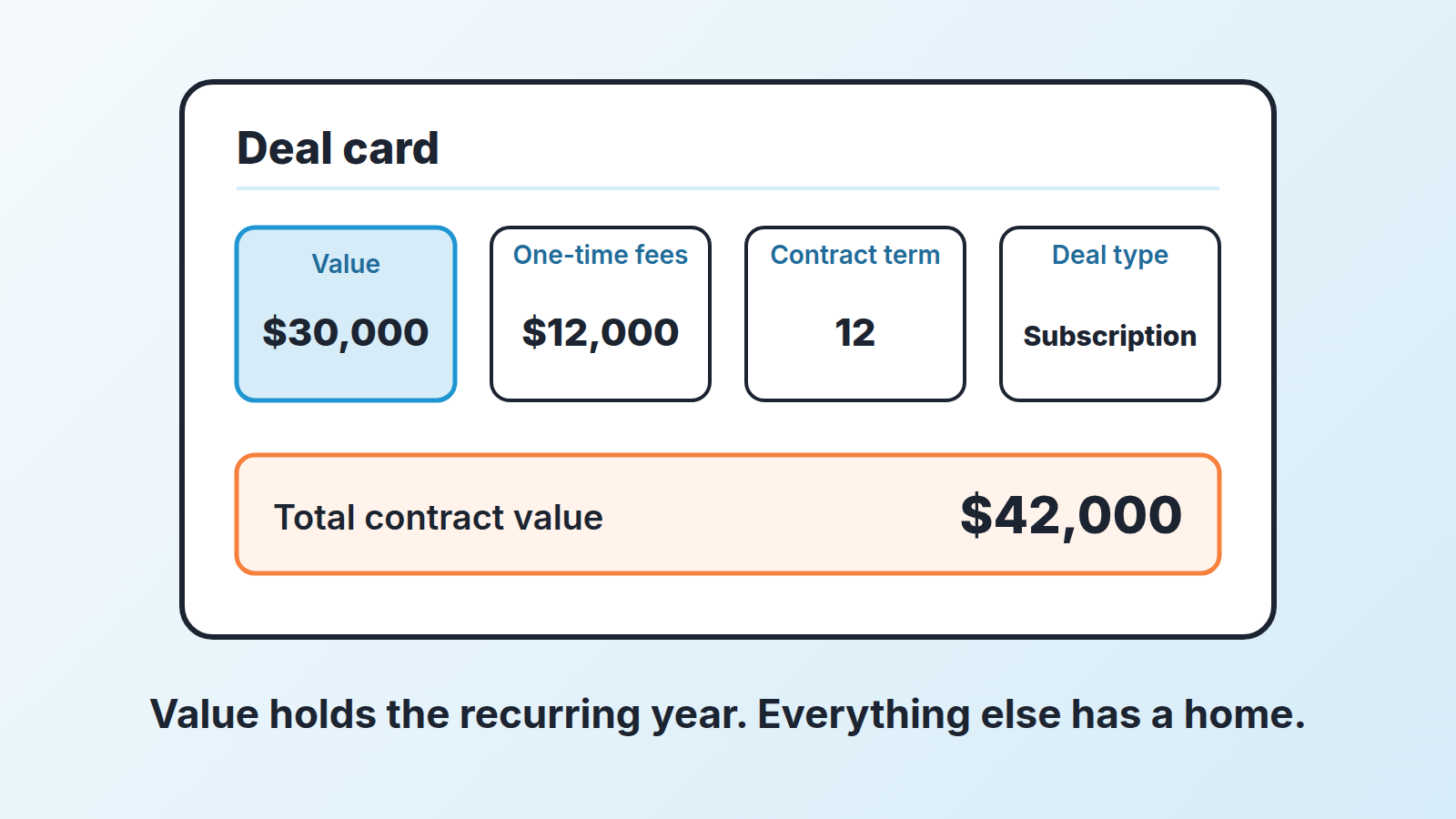
- Her colleague closed a 12-month subscription at $2,500 a month with a $12,000 onboarding fee. He entered $42,000, the two added together.
- A one-off consulting project at $36,000 was entered at $36,000, which is fine.
Count the recurring revenue those deals produce in a year and you get $36,000 plus $30,000: $66,000. Count the one-time money and you get $12,000 plus $36,000: $48,000. The $186,000 in the Won column is neither. It is three kinds of number added together, and the biggest piece, Keiko’s $108,000, is exactly three times what her deal is worth per year.
For anyone in finance there is a second question behind this one: what the Won total actually measures, and why it is bookings rather than billings or revenue.
Nobody did anything wrong by their own definition. That is the problem. Keiko’s Value meant “the contract”, her colleague’s “everything the customer signed for”, the project rep’s “the invoice”. Pipedrive accepted all three: $108,000 is a valid amount.
Deal value, TCV, ACV: three numbers, one field
A deal with any recurring component has at least three honest sizes, and they answer different questions.
| Number | What it is | Keiko’s deal | Question it answers |
|---|---|---|---|
| ACV, annual contract value | recurring revenue per year, excluding one-time fees | $3,000 × 12 = $36,000 | What does this customer add to next year’s revenue? |
| TCV, total contract value | everything the contract commits to over its full term, one-time fees included | $3,000 × 36 = $108,000 | What is the whole agreement worth if it runs to the end? |
| One-time fees | setup, implementation, hardware, training: paid once | $0 | What lands in cash this quarter and never again? |
The deal value in a CRM is not a fourth concept. It is whichever of the three you decided to type in, and if you never decided, it is a mixture. The formula is the easy part: ACV = (TCV − one-time fees) ÷ years, so Keiko’s deal is ($108,000 − $0) ÷ 3 = $36,000. The hard part is that Pipedrive gives you one field and a team of people who each resolve the ambiguity their own way. If a proposal offers three packages, Value is the one you discussed, not the one you hope for.
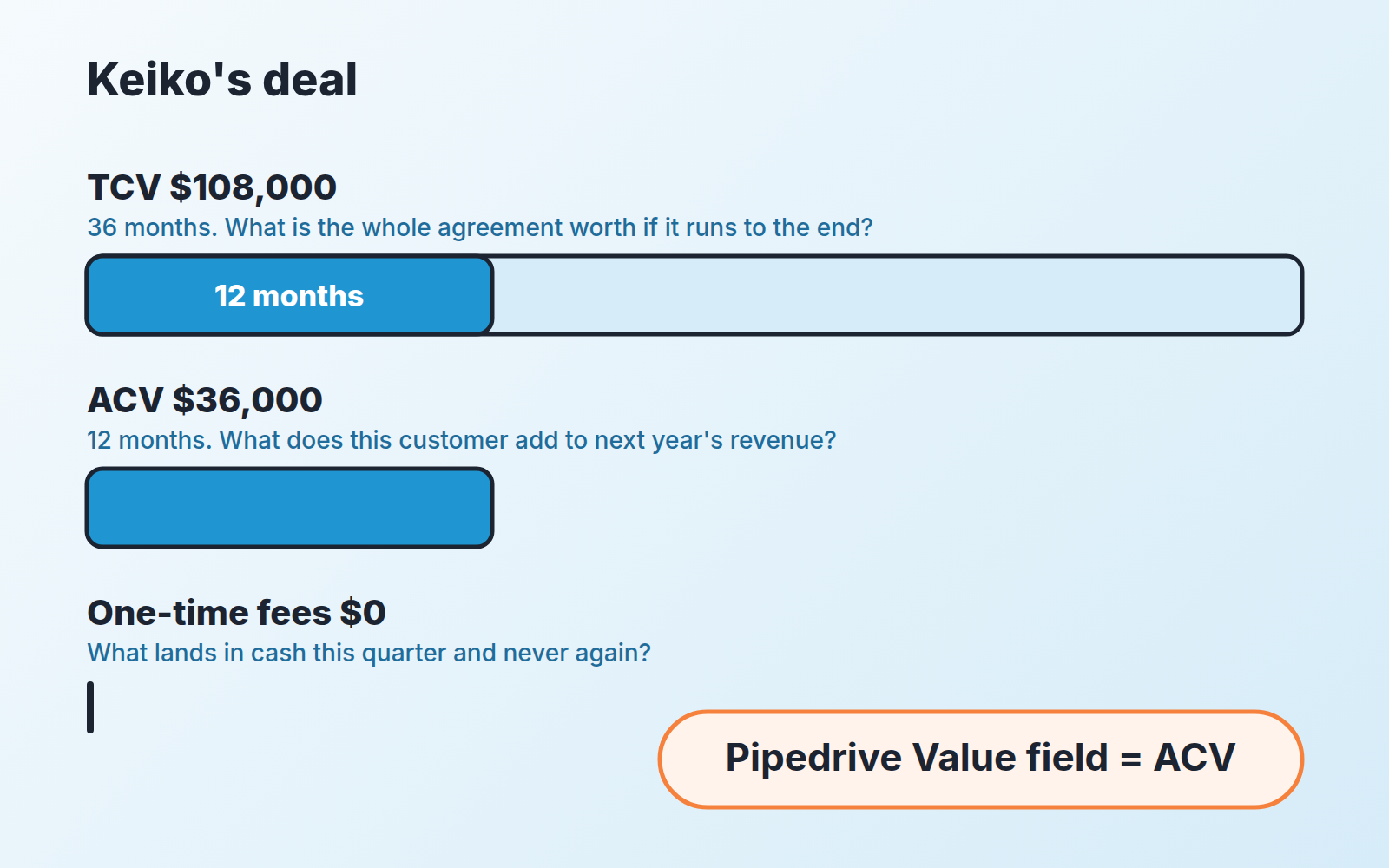
For a 12-month contract with no setup fee all three numbers coincide and nobody notices the question. Sell a three-year term or an implementation package and they split apart. Then whoever sells the longest contracts “wins” the leaderboard on a number that is not revenue. For the three-year case, we cover what to track after a multi-year deal is signed separately.
A simple rule for the Value field in Pipedrive
Value holds the annual recurring amount. That is the rule, and it has three parts:
- Subscription deal: Value = monthly price × 12 (or the yearly price as quoted). Keiko’s deal is $36,000, whether the term is one year or three.
- Deal with a subscription plus a one-time fee: Value = the recurring part only. The onboarding deal is $30,000 in Value; the $12,000 goes to its own field (next section).
- Pure one-off deal, no recurring part: Value = the one-time amount, and the deal is marked as one-off in a type field so reports can separate it. The $36,000 project stays $36,000.
Why ACV and not TCV? Because almost every decision you make from the pipeline is an annual one: this year’s target, hiring, the forecast. TCV in Value answers a question you ask once a year and corrupts the ones you ask every week.
We would rather see a one-off deal in Value at its full amount than at zero, because a zero-value deal vanishes from every pipeline total and from the rep’s attention. The type field keeps it out of the subscription averages. If you sell through Pipedrive products, the choice of recurring products vs installments adds calculated ACV and TCV figures of its own, which are not the same as the recurring-only ACV here.
One-time fees get their own custom field
The field setup is short. Open the account menu, go to Personal preferences > Data fields, choose Deal, and click “+ Custom field” (Pipedrive: custom fields). Create these:
- One-time fees, type Monetary. Setup, implementation, hardware, training. Empty on most subscription deals, and that is fine.
- Contract term (months), type Numerical. 12, 24, 36. It lets you reconstruct TCV later.
- Deal type, a single-option field: Subscription / One-off.
- Optional, on the Premium plan and up: Total contract value as a formula field. You enable “Apply formula to deals” and write the calculation from other deal fields (Pipedrive: data fields). Ours is Value × Contract term ÷ 12 + One-time fees: $108,000 for Keiko’s deal, $42,000 for the onboarding deal, typed by nobody. A formula field can calculate margin on the deal card the same way, from a cost field you add.
Write the rule into the fields themselves, not into a Slack message the next hire never sees. From the Growth plan, custom deal fields can carry a description that reps see behind the info icon. Ours, on One-time fees: “Setup, implementation, training. The recurring yearly amount goes in Value, never here.” On Deal type: “Subscription: Value = yearly recurring amount. One-off: Value = the invoice.”
Pick the field type carefully the first time. Pipedrive does not let you change a custom field’s type after it is created, so a “One-time fees” field created as Text has to be deleted and rebuilt. If you do have to rebuild one, copy the values out first: a deleted field takes its data with it.
Should any of these be required? Contract term, yes, at the proposal stage: the rep knows it by then. One-time fees, no. Empty correctly means “none”, and a required field that is usually empty teaches reps to type 0 to get past the gate. Pipedrive’s quality rules can block saving a deal until a required field is filled (Premium plan), or merely highlight an important field without blocking (Growth plan). The test for which to use is the one in our piece on required fields in Pipedrive: will someone make a decision from this field, at this stage?
What it does to forecast, average deal size and win rate
Once Value means one thing, everything downstream gets quieter. Not evenly, though.
Start with the weighted pipeline. Pipedrive multiplies each open deal’s Value by it’s stage probability and sums the result, and we have written before about why that number is a description of pipeline shape, not a forecast. Mixed values make it worse in a specific way: the error is concentrated in the longest contracts. A $108,000 TCV deal in a 60% stage contributes $64,800 of “expected” pipeline; the same deal at ACV contributes $21,600. A rough stage probability applied to a number three times too large gives a forecast whose biggest line items are the least trustworthy, and those are exactly the deals the owner asks about.
Average deal size moves next. In Henrik’s quarter, the Won filter gives an average of $62,000 across three deals. On ACV it is $36,000 and $30,000 for the two subscriptions, an average of $33,000, with the $36,000 project reported separately as a one-off. That second set is the one you can plan with: it does not swing from $33,000 to $69,000 the quarter one rep happens to enter a three-year term at its full sum. If someone asks how ACV differs from average deal size: ACV belongs to one deal, average deal size is the mean of Value across won deals, so it is only as clean as the field. Average deal value is also an input to sales velocity, so a TCV-inflated average inflates the velocity figure by the same ratio: a team that quietly started selling longer terms looks faster while closing exactly as much per year.
Once ACV lives in its own field, Insights can average that custom field directly.
Win rate is the one place the fix cuts both ways. A win rate counted in deals ignores Value, which is one reason we prefer counting deals over counting dollars for most teams. A value-weighted win rate, though, is hostage to the field: lose one three-year deal entered at TCV and the quarter’s weighted win rate drops as if you had lost three one-year deals. Reps notice and learn to enter big deals small and safe deals big. When Value means whatever the rep decides, the leaderboard rewards the definition, not the sale.
Cleaning up old deals without a spreadsheet marathon
Do not try to fix history. Fix the deals that still feed a decision.
That means two sets: every open deal, and the won deals from the last twelve months, because those are the ones in your average deal size and your win-rate denominators. Lost deals and anything older can keep their old Value; note the cutoff date in the Deal type field’s description so nobody later wonders why 2024 looks different.
If the ACV figures already sit in a billing sheet, you can update them from a spreadsheet instead of typing them deal by deal.
For open deals, the list view is usually enough. Add One-time fees, Contract term and Deal type as columns through the gear icon, filter to open deals, and edit the values inline, or bulk-edit a whole filtered set to Deal type = Subscription (Pipedrive: list view). Sort by Value descending and start at the top. The ten largest open deals are where the TCV entries live; a $4,000 deal entered wrong is not worth the same minute.
Try a bulk edit on five deals first and check whether it runs your automations, since the change can’t be undone.
Each rep cleans thier own deals. They know the terms, and “monthly price, term, one-time fee?” takes them seconds per deal. Give them the rule and a week, then go through the top twenty together in the next pipeline review.
Only reach for a spreadsheet if the won-deal set is large. Export the filtered list as XLS or CSV from the list view (Pipedrive: exporting data), fill the new columns, and bring it back through import. The deal ID shows up among the system fields in the import mapping, so the file can update the the existing records instead of creating duplicates (importing: mapping your fields). Keep the export file. If a report looks strange a month later, you want the before picture.
A disclosure, since the next question is usually “and how do I know it stays clean”: we build SalesBond, a sales management layer on top of the CRM a team already uses; we started with Pipedrive. It watches every deal and explains the risks it finds, with the reason next to each one. If you want a second pair of eyes on the pipeline you just cleaned, check your CRM with SalesBond. The rule itself needs no software, though. It needs one sentence in a field description and a review where someone asks Keiko what the monthly price was.
Henrik’s quarter, restated: $66,000 of new annual recurring revenue, $48,000 of one-time work, and a 36-month commitment from one customer that will be worth telling the bank about. Smaller than $186,000. Also true, which the other number never was.