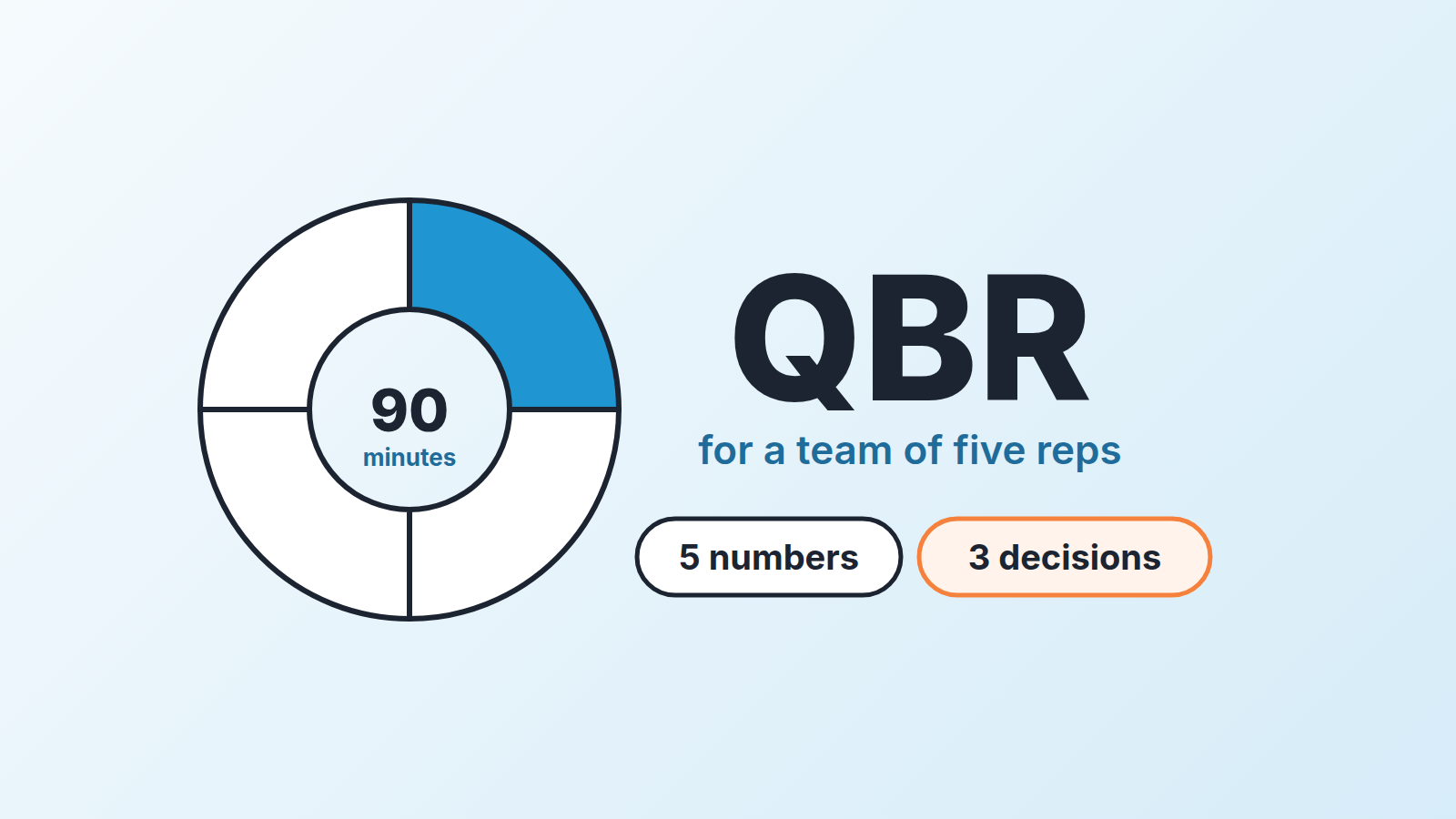
A sales QBR for a small team is a 90-minute meeting once a quarter where you take five numbers from your CRM, answer three questions with them (what happened, where can we win, what do we change) and leave with three decisions, each with an owner and a date. That is the whole format. No deck, no RevOps analyst, no BI export. The meeting is the first block of the quarterly reset from our sales meeting cadence post: the QBR reads the quarter that just ended, and the rest of the half day sets quota, territories and stage definitions for the one that starts.
We keep the two apart on purpose. Quota arguments go badly until the room agrees on what actually happened. So the review comes first, with a hard stop, and planning starts after a break.
A sales QBR is not a bigger weekly review
The weekly pipeline review is about this week’s deals and what each one needs before Friday. The QBR asks about the quarter, and a quarter is not a list of deals. It is a pattern that only shows up once ninety days of them are stacked together: the segment that kept winning without anyone pushing it, the deal size where the cycle quietly got longer.
So open with the quarter’s totals, not the pipeline view. Start with the pipeline and by minute forty the team is arguing about one deal; start with the totals and that deal becomes an example, not the topic.
Salesloft frames the meeting around three questions, “What happened? Can we win? How will we win?” (Salesloft: 3 questions to ask in your QBR). We use the same three, in that order: the room finishes looking backwards before anyone proposes a fix. Aviso splits the metrics by time instead: win rate and attainment for the past, cycle length for the present, coverage and commit for the future (Aviso: sales quarterly business review). Both maps work. Both also assume someone will produce the numbers, and on a team of five reps that someone is you, the night before, with Pipedrive open.
Five numbers to bring, all from Pipedrive
Each number has its own page on this blog, so this is the shopping list, not the method. Pull all five for the quarter that ended and for the one before it. One quarter is a snapshot; two side by side are a direction.
Win rate. Won deals divided by won plus lost, for deals closed in the quarter. The Insights deal performance report counts deals started, won and lost, and you can add filters to narrow it down (Pipedrive: deal performance report). The traps, and there are several, are in how to read win rate in Pipedrive.
Cycle length. The deal duration report shows the average time deals spend in each stage, in days; it is a mean, not a median, and it ignores time in stages you have since deleted (Pipedrive: deal duration report). By default it looks at deals created this year, so switch the period to the quarter before you copy the number down. If the pipeline was rebuilt mid-quarter, say so before someone celebrates a shorter sales cycle.
Stage-to-stage conversion. In the deal conversion report, the funnel conversion type shows the share of deals that reached each stage (Pipedrive: deal conversion report). This is the number that answers “where did deals die this quarter”, and the QBR templates we read leave it out. How to read it is in pipeline stage conversion rates in Pipedrive.
Coverage on day one of the new quarter. Open pipeline with an expected close date inside the coming quarter, against the target for that quarter. A saved filter on open deals by expected close date gives the first half (Pipedrive: filtering); the pipeline coverage ratio page gives the second, and what to do when the quarter starts empty is the page you hope not to need.
Activity per rep. Done activities per week, by type, for each rep across the quarter. Pipedrive stores each activity’s type and the time it was marked done (Pipedrive: activities), so this is a filter on done activities, run once per rep. Which types are worth counting is on the activity metrics page.
Budget about an hour for all five the week before and put them in one shared doc, last quarter’s figure next to each. It is not a dashboard. It does not need to be.
The 90-minute agenda, with the clock running
Ninety minutes is not a rule we found in a study. It fits three questions and three decisions without a second coffee, and leaves the rest of teh half day for planning. Everyone has read the five numbers and each rep’s page before they walk in; nobody presents.
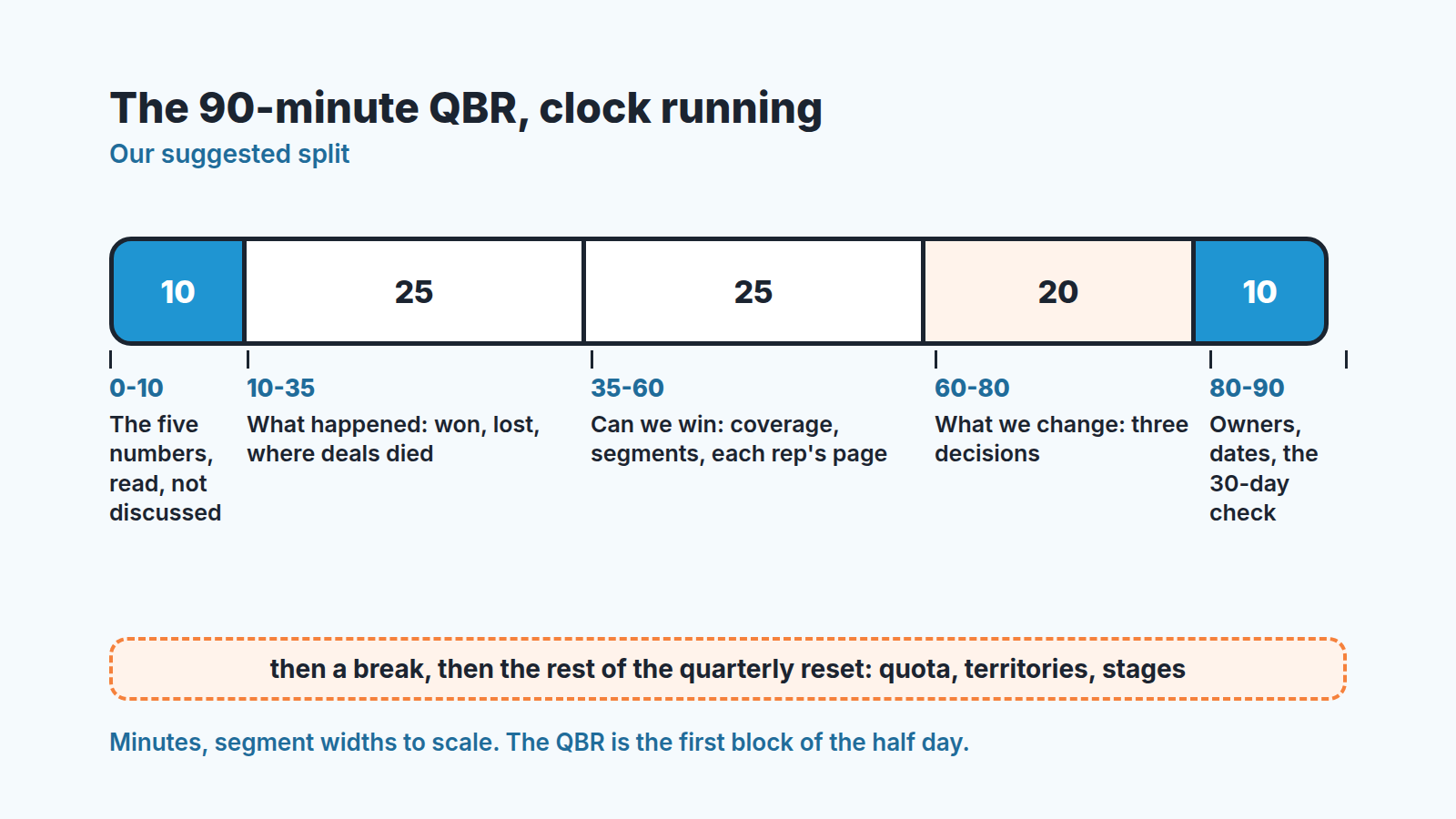
- Minutes 0 to 10: the five numbers, this quarter next to last quarter. The manager reads them out. Questions of fact only (“is that won time or close date?”). Opinions come next, and better for it.
- Minutes 10 to 35: what happened. Won deals by segment, lost deals by grouped lost reason, and the stage where conversion fell against the previous quarter. Your monthly review flagged dips as they happened; the question here is which of them held for all ninety days. A win-loss review of the quarter’s three biggest losses fits here if you did one. Add the share of revenue by customer while you have the won list open.
- Minutes 35 to 60: can we win. Day-one coverage against the new target, which segments are over-represented in the won column and thin in the open one, and each rep’s page, two minutes per rep, rep talking.
- Minutes 60 to 80: what we change. Three decisions, described below. Anything that cannot be settled in twenty minutes becomes one-week homework, not a forty-minute debate.
- Minutes 80 to 90: owners, dates and the number each decision should move. Book the 30-day check before anyone leaves the room.
Then a break. After it the half day moves on to what needed the review first: next quarter’s quota, who covers which territory or segment, and whether the capacity is there for the target. Those pages carry the arithmetic; the QBR only has to hand them inputs nobody is still arguing about. None of that is a kickoff: a kickoff looks forward to one behavior to rehearse on live deals. Once the quota is agreed, put it into Insights as monthly goals so the number follows your season.
If someone will be away for part of the quarter, settle how to adjust quota for vacation and leave in the same session.
Three decisions, not twenty slides
The output of a QBR is three sentences. Three, because a five-rep team can carry three changes through a quarter and will quietly drop the fourth, and because stopping at three forces a choice about what matters most.
The first decision is where effort moves. A segment, a deal size, the inbound-versus-outbound balance, a product line. It comes from the won-by-segment view and from coverage. Say twelve of your fifteen wins were companies under 50 seats: “next quarter, outbound targets only companies under 50 seats” is a decision. “Focus on quality leads” is not.
The second is about support: who gets what help, and from whom. It comes from the rep pages and the activity numbers. Sometimes that is coaching on a stage one rep keeps losing at, sometimes it is the manager joining every late-stage call for a month, sometimes it is admitting a territory cannot produce it’s number and fixing the territory in the planning session that follows. The rep or pipeline problem test tells those apart before the conversation gets personal.
The third is about process: one rule changes. One. A new required field at your qualification stage, two stages merged into one, a discount that now needs a second signature. It comes from the stage where conversion fell or deals slowed. Say deals sat in your demo stage much longer than last quarter, and most of the slow ones had no next activity scheduled: the rule might be that no deal stays there without a dated next activity. The monthly review spots that slide; the QBR decides it is the one rule worth changing for ninety days.
Each decision gets an owner, a date, and the one of the five numbers that will show whether it worked. A decision without a number is a wish, and the 30-day check has nothing to look at.
Reps prepare too: one page each
The rep’s side of the QBR is a single page, due a week before the meeting, written by the rep about their own quarter. One page, because the manager reads five of them, and because fitting a quarter on one page makes the rep do the thinking before the meeting instead of during it.
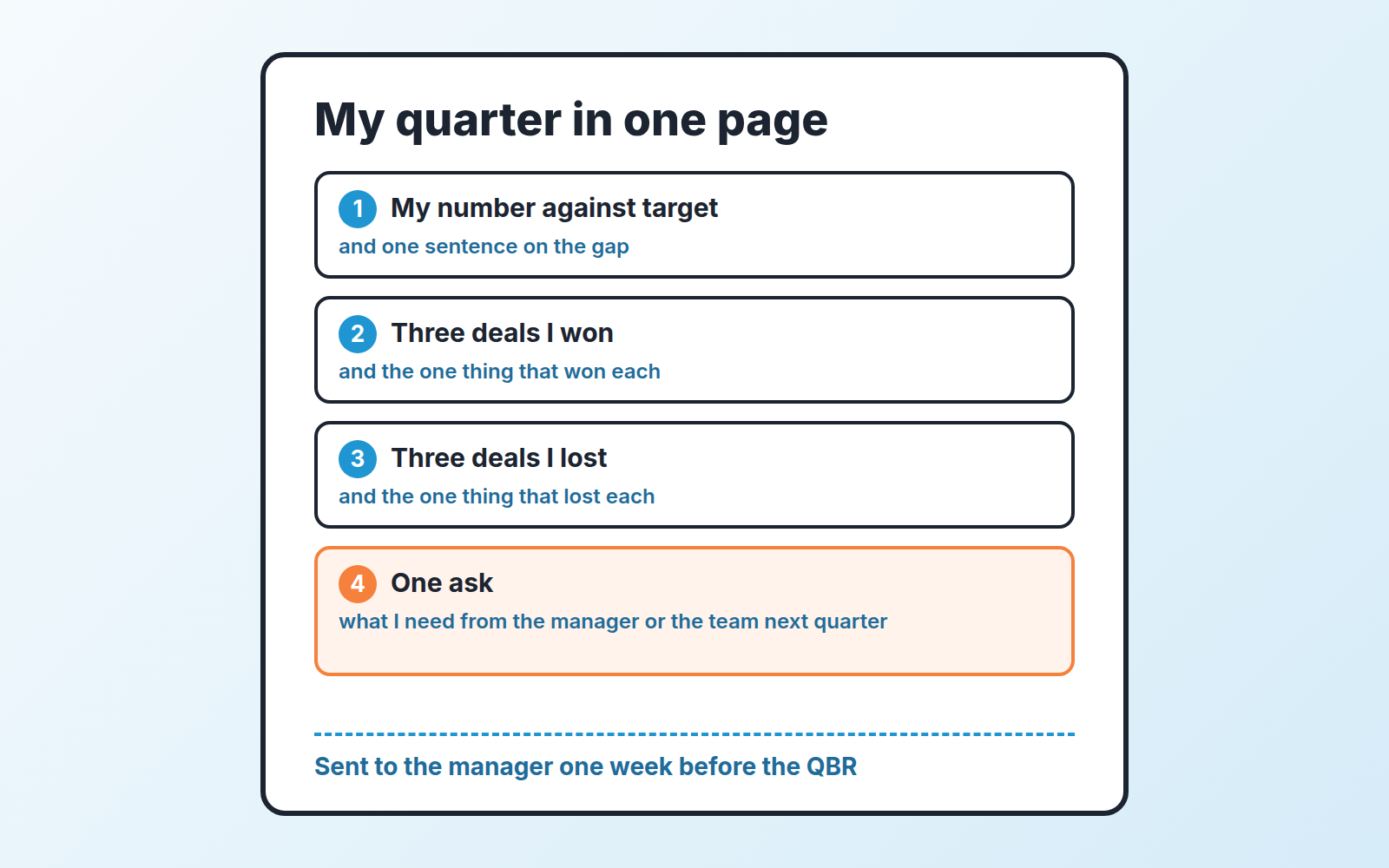
- Their number against target, and one honest sentence about the gap, either way.
- Three deals won and, for each, the one thing that won it. Not the story, the thing.
- Three deals lost and the one thing that lost each. The lost reason field in Pipedrive is the prompt; the page is where the rep says what the field cannot.
- One ask. What they need from the manager or the team next quarter that they do not have now.
In the meeting the page is the rep’s two minutes under “can we win”, so the rep talks about their quarter instead of being talked about. Afterwards the pages feed the support decision, and the “one ask” line across all five often points to the process decision too. When four reps ask for the same thing independently, you already know which rule changes.
If your top customers are on the agenda too, bring the key account plan for each of them instead of a fresh slide: one page per customer, reviewed for twenty minutes.
What happens to the notes
The notes from a QBR fit on one page too: the five numbers for both quarters, the three decisions with owner, date and metric, and the date of the 30-day check. That page lives wherever the the team’s weekly report lives, and the next QBR opens by reading it. Nothing is more useful at a quarterly review than last quarter’s decisions with a tick or a cross next to each.
The 30-day check is fifteen minutes added to the end of a weekly pipeline review, a month after the QBR. Three questions, one per decision: has the owner done the thing, has the number moved, and if not, is it too early or was it the wrong call. Reversing a decision at the 30-day check is fine. Nobody having looked is not.
We build SalesBond, a sales management layer on top of the CRM a team already uses; we started with Pipedrive. The part of this process it shortens is the hour the week before: plan attainment and forecast sit on the Sales Dashboard’s Business Impact tab and each rep’s execution on Team Performance, so the 30-day check is a glance and the next QBR starts from numbers you did not have to rebuild from filters. Check your CRM with SalesBond if that hour is the reason your QBR keeps slipping into the second week of the quarter.
Your first QBR run this way will overrun, because “what happened” turns up three things nobody knew. Let it. Push the planning half to the following week instead: planning is only as good as the review, and the review gets good once the team learns it can say, in ninety minutes and with five numbers, what the quarter was actually about.