
To set sales quotas, start from each rep’s own CRM history: qualified deals per quarter, how many they win, and the average won deal. A good quota is one the rep believes they can hit if they work well, and would miss if they coasted. Add a stretch, check the total against the company target, and review it monthly.
What a sales quota actually does for a team
A quick test for your next one-on-ones: ask each rep to name their quota and where they stand against it without opening the CRM. If they can’t, the quota isn’t doing it’s job.
A sales quota is the revenue, or number of deals, a rep is expected to close in a set period. It turns “sell more” into a number a rep can plan a week around. The rep knows what a good quarter looks like instead of guessing what the manager expects. A rep far behind at the halfway point shows up in week six, not in the last week. The sales plan gets tied to hiring, cash, and how many leads marketing has to bring in. And coaching gets specific: “You’re $30,000 behind and your open deals cover half of that” is a conversation. “Push harder” isn’t.
Revenue is the default quota, and the one used in this article, but not the only kind. When one large deal would distort a revenue number, count won deals instead. New hires often start on activity targets, such as qualified deals created, calls, or meetings, before a revenue number makes sense, and an activity number belongs next to any revenue quota anyway. If reps set their own discounts and could buy revenue with margin, a margin quota closes that door. As for the period, follow your sales cycle: the shorter the cycle, the shorter the period. The examples below use a quarterly revenue quota.
Whatever the quota type, a discount policy small teams follow keeps those decisions consistent.
What happens when a sales quota is too high or too low
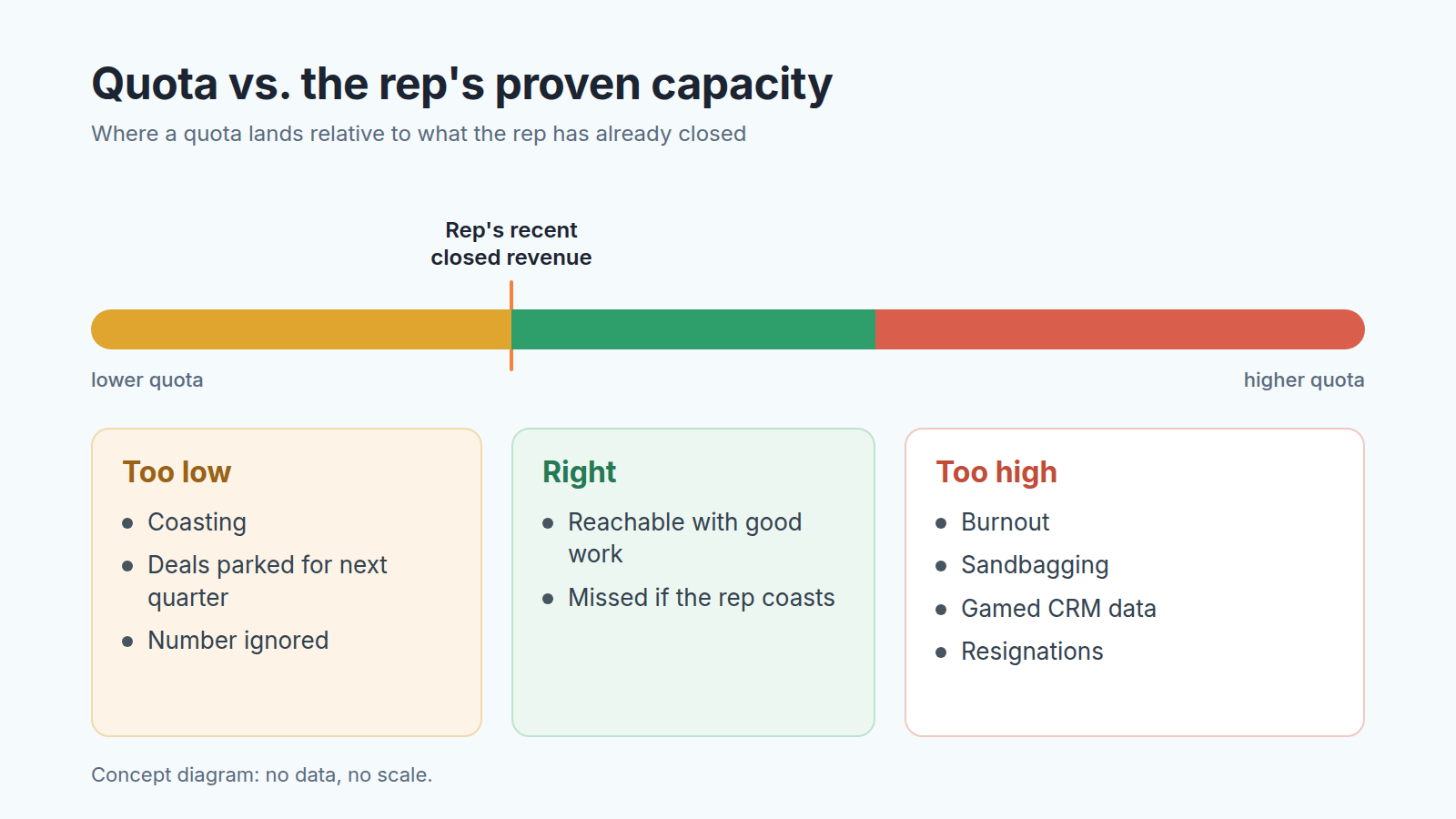
Too high a quota makes reps give up and game the CRM; too low a quota makes them coast. Only the first one looks like a problem on the dashboard.
A rep who knows by week two that the number is out of reach stops planning to hit it. What follows is predictable:
- Burnout. Long days that don’t move the number start to feel pointless.
- Sandbagging: holding back deals that could close now so they land next quarter, when they count.
- Gaming the CRM. Close dates slide, deals jump stages without a real next step, activities get logged to look busy. Your forecast turns into fiction.
- People quit, often the good ones first, because they have options.
We wrote separately about how to tell sandbagging from happy ears in a rep forecast.
The last one costs the most: every replacement starts with an empty pipeline and needs months to sell at full pace.
A quota that’s too low fails more quietly. Everyone hits the number, the dashboard is green and nobody asks questions. A rep who reaches quota in week eight has little reason to push for the rest of the quarter, and some start parking deals for next quarter to begin it with a cushion. The quota stops meaning anything, and so does hitting it.
“We’re too small for quotas”
Plenty of small teams skip quotas on purpose. The owner knows everyone, and a target feels like bureaucracy. What you give up is a shared definition of a good quarter and an early warning when a quarter goes wrong, and that cost is harder to see than the saving.
Without a number, each rep works to their own standard. A slow month looks like any other until the quarter’s revenue is already short. Pay and promotion get subjective, and the most visible rep tends to beat the most productive one. Planning turns into guesswork, because hiring or spending more on marketing depends on knowing what the current team will bring in.
If that’s your team, start small. Pull each rep’s closed revenue for the last two quarters from your CRM and use it as next quarter’s starting number. It’s crude. It’s also a baseline you can discuss with the team, which is more than you have now.
The “paper quota”: when the number stops meaning anything
Take a hypothetical rep with a quarterly quota of $100,000. For several quarters she has been closing around $200,000, steadily. The quota was set when she joined, and nobody has touched it since.
That’s a paper quota: a number that no longer describes what the rep actually sells. On a dashboard it looks like success, which is why it’s easy to miss.
It does nothing. She passes it mid-quarter, and after that nobody, including her, looks at it again. The team plan still counts her as a $100,000 rep, so the forecast is wrong. Meanwhile, the same $100,000 applies to a recent hire who closes a fraction of it, and nobody has sat down with him to work out how to close the the gap.
The strong rep isn’t stretched. The weak one isn’t supported.
Raising everyone’s number won’t fix it. Revisiting each number will. Her next quota should start at the $200,000 she has proven and add a stretch, and the same conversation should cover what she needs to get there: a larger segment, more inbound leads, or less admin work.
To find paper quotas on your team, put each rep’s closed revenue for the last two quarters next to their quota. Anyone who beat or missed it by a wide margin both times has one. Treat that as a quota problem before you treat it as a people problem.
Check every rep’s quota against actuals at the quarterly review, not once a year. To read that check correctly, see what quota attainment counts in Zoho CRM and what the percentage hides.
Why one quota for everyone is a mistake
One quota for everyone overloads new hires and under-stretches senior reps, because reps don’t start from the same place. A single number still feels fair, since nobody can accuse the manager of playing favorites.
Look at a new hire. They have to learn the product, build a pipeline, and see the first deals through a full sales cycle. With a two-month cycle, someone hired on day one of the quarter can only close what they opened in their first few weeks. The longer the cycle, the more this quarter’s revenue depends on last quarter’s work.
Skills differ too. One rep is strong in discovery and weak at closing, another is the reverse, and their win rate (the share of qualified deals a rep wins) and deal size show it. A rep on larger accounts closes fewer, bigger deals than one on small businesses, so the same revenue number means very different workloads. Inherited pipeline matters as well: taking over a colleague’s open deals puts a rep ahead, taking over an empty territory puts them at zero.
So newcomers need a ramp, a quota that starts at zero and rises over their first quarters. Senior reps need a stretch, a target above what they’ve already proven, with a clear idea of where the extra comes from. One number for everyone gives neither.
How to set individual sales quotas: a 7-step method
The method is bottom-up from each rep’s history, with a top-down check against the company target. You need your CRM, a spreadsheet and an afternoon. The figures below describe a hypothetical three-person team.
If the check shows a gap, how to read the top-down target against a bottom-up forecast walks through it rep by rep.
Step 1: pull each rep’s history
In Pipedrive, or any CRM that tracks deals by owner and stage, filter deals by owner for the last two or three quarters. For each rep, note how many qualified deals they had per quarter, how many of those they won, the average value of a won deal, and how long a deal usually takes from creation to won.
“Qualified” means deals that reached the stage where you treat a lead as real, not every contact. Count all deals and the rep who logs every cold contact looks like a poor closer.
Step 2: calculate a baseline
The baseline is what the rep’s recent history says they can do:
Baseline = qualified deals per quarter × win rate × average won deal
If your sales are seasonal, base it on the same quarter last year rather than on the quarter just gone.
| Rep | Tenure | Qualified deals per quarter | Win rate | Average won deal | Baseline |
|---|---|---|---|---|---|
| Dana | 4 years | 40 | 1 in 4 | $20,000 | $200,000 |
| Sam | 1 year | 30 | 1 in 5 | $15,000 | $90,000 |
| Lee | new hire | no history yet | no history yet | no history yet | ramp (step 4) |
Dana is the rep from the paper quota example. Her history says $200,000, so a $100,000 quota tells her nothing.
Step 3: add a stretch the rep can picture
Express the stretch in deals, not in an abstract figure. Ask: what would one more won deal this quarter take?
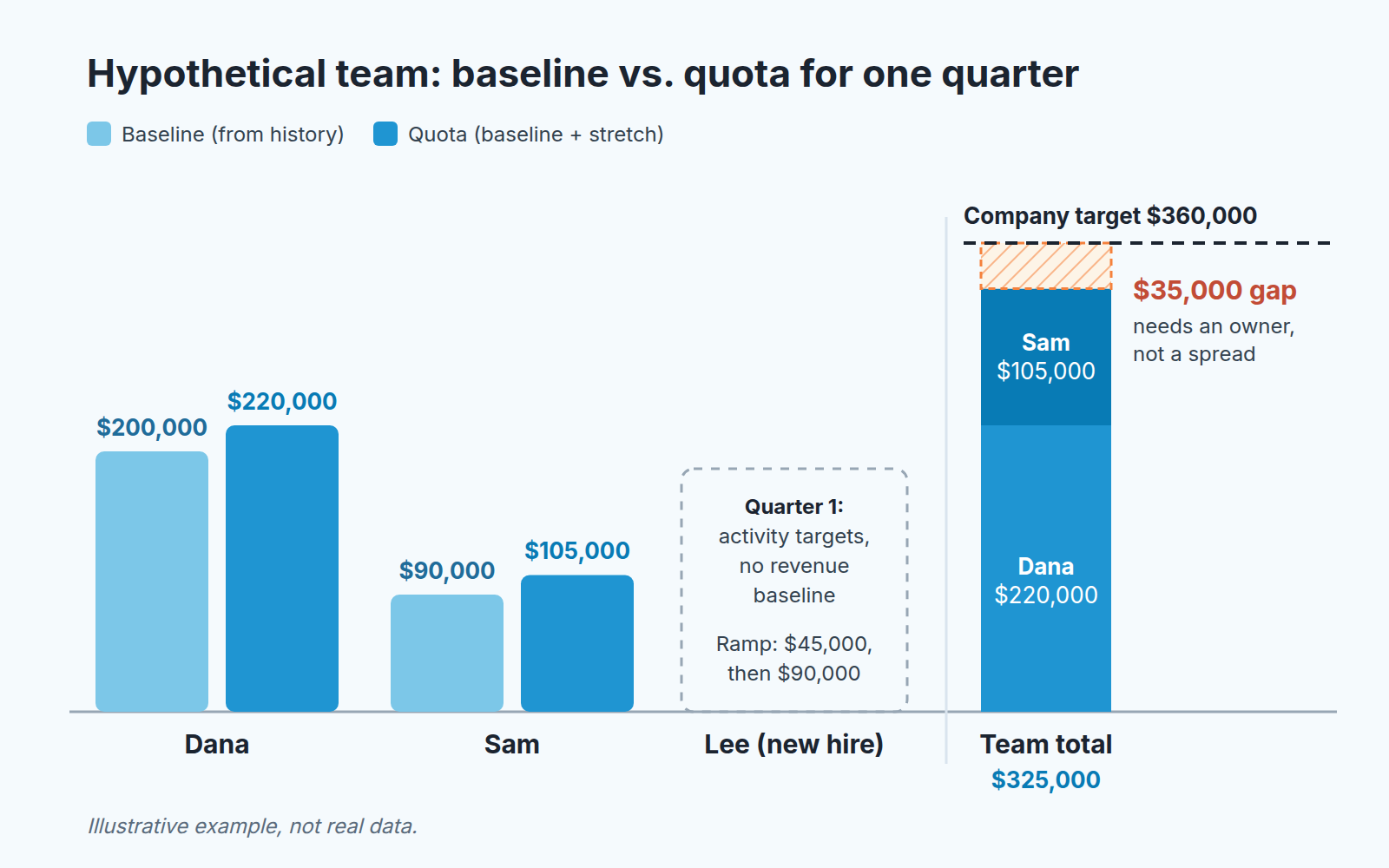
For Dana, one more average deal puts her quota at $220,000. At her win rate of one in four, that means about four more qualified deals over the quarter. For Sam, one more deal gives $105,000, and at one in five he needs about five more qualified deals.
Both reps can see where the extra number comes from. That’s the difference between a stretch and a wish. Go bigger only where there’s real room to grow, like a new segment or more inbound leads.
Step 4: give new hires a ramp
Lee has no history, so a revenue quota in the first quarter would be a guess. A ramp could look like this:
- Quarter 1: no revenue quota. Activity targets instead, for example 20 qualified deals created and a set number of discovery calls.
- Quarter 2: half of a mid-level baseline for the segment, so $45,000.
- Quarter 3: the full $90,000, then recalculated from Lee’s own numbers.
For pay during those quarters, we wrote about how to pay commission on a ramped quota.
The longer it takes a new rep’s first deals to close, the longer the ramp should be. Whatever the ramp, reconcile commission against closed-won data in the CRM every month.
Step 5: check the total against the company target
Add the quotas up: $220,000 for Dana, $105,000 for Sam, $0 in revenue for Lee. The team total is $325,000.
Now suppose the business plan needs $360,000 from this team. There’s a $35,000 gap.
The easy move is to spread the gap across the reps. Resist it: that is exactly how inflated quotas and paper quotas are born. Decide how the gap closes instead: more pipeline from marketing or the owner’s network, some deals closed by the manager, an earlier hire, or a lower plan with spending adjusted to match. Write the gap down as its own line in the plan, with a name next to it.
Step 6: pair the number with activities
Dana’s $220,000 quota rests on about 44 qualified deals a quarter: the 40 behind her baseline plus four for the stretch. That’s roughly 15 a month, or three to four a week.
That weekly number is the part she controls on a Monday morning. Track it in the CRM as deals reaching the qualified stage. If she’s behind on it in week four, you know revenue will be short while there’s still time to act.
Step 7: set a review cadence
Once a month, look at each rep’s won revenue plus open pipeline against thier quota. That’s where coaching happens. If the quota lives in Pipedrive as a goal, give it a number for each month instead of a flat twelfth of the year. Once a quarter, recalculate the baseline from the latest history and reset the quota. In between, change a quota only for real events, like a territory change, a long leave, or a large account moving to another rep. Never because someone is behind.
Before the numbers go out
Try explaining each rep’s quota to them in two sentences: what their last quarters say, and which extra deals the stretch asks for. If you can’t, the number isn’t ready. Look again at anyone who beat or missed their quota by a wide margin two quarters running, and at any new hire without a written ramp. Make sure the team total matches the company target, or that the gap has a name next to it, and put the first monthly review in the calendar before anyone sees their number.
A quota the team believes in is worth more a week late than one that arrives on time and gets ignored.