Quota relief is a cut to a rep’s target in proportion to the working days they are away, and it applies only when the absence is longer than a threshold you wrote down before anyone booked a flight. A common threshold is two weeks, and that is where we put it. Below it, the quota stays and you move close dates and cover the deals instead. Between two and four weeks, you prorate by working days. For a leave of months, you close the plan and start a fresh one when the person is back.
The exact number matters less than the fact that the rule exists in advance, because a rule you negotiate after the vacation is a precedent, and in a team of seven everyone will remember it.
The vacation in the last week of the quarter
Nadia runs a team of seven on Pipedrive. In the second week of the quarter Oren tells her he is taking three weeks in the middle of it, booked a year ago, non-refundable. Nobody objects. Then the quarter ends, Oren is at 71% of his $90,000 quota, and the Monday review turns into a negotiation. Oren says the number should have been lowered. Nadia agrees in principle, but how much? She prorates on the spot, lands on something that feels fair, and Oren’s quarter is quietly rewritten to a pass.
Two months later Kofi takes nine days off and asks for the same treatment. Nadia says nine days is not three weeks. Kofi asks where that line is written. It isn’t. Now she has two problems: a line she has to invent under pressure, and a team that has learned the quota is negotiable after the fact. (Example; the names and numbers are made up.)
Fairness in the abstract is not what makes the case for a policy. The Monday after the quarter closes is. The policy is three sentences long, written before anyone is away: when the quota moves, how it is calculated, and who looks after the deals in the meantime. What follows is our version of those three sentences, with the arithmetic shown.
Three thresholds: leave it, prorate it, reset it
The length of the absence decides what happens, and we split it at two weeks and four weeks. The two-week line is not only ours. Asked by Founders Circle in February 2024 about quota relief for SDRs and inside sales, two Alexander Group principals gave “Must be absent for 2+ weeks or must be absent for 20%+ of month or quarter” as an example of the qualifier most companies set. For jobs on short performance periods, they suggested closing out the plan and starting the rep on a new one when they return (Alexander Group: SDR quota relief for PTO and LOA). The four-week line is our own call for a small team.
- Up to two weeks (10 working days): the quota does not change. Close dates that fall inside the absence move to the first week back, and the deals that cannot wait get a cover person.
- Two to four weeks: prorate by working days for the period the quota covers, with the same cover setup written into each deal before the rep leaves.
- Longer than four weeks, which in practice means parental leave or a long sick leave, closes out the current quota period. A new goal starts on the return date, and open deals change owner for good, in bulk, with a note in each one.
The two-week floor is the part managers resist. It feels generous to relieve every day. It isn’t. A quarterly quota already assumes people take some time off, and a rep who is away for a week should expect a slightly harder quarter, not a recalculation. The Alexander Group names this as one of the reasons many companies do not adjust quotas: they are set on an expected 200 to 220 available days a year. We think that holds for an annual number and breaks for a monthly one, so we relieve the monthly or quarterly goal and leave the annual alone.
How to prorate a quota: count working days, not calendar days
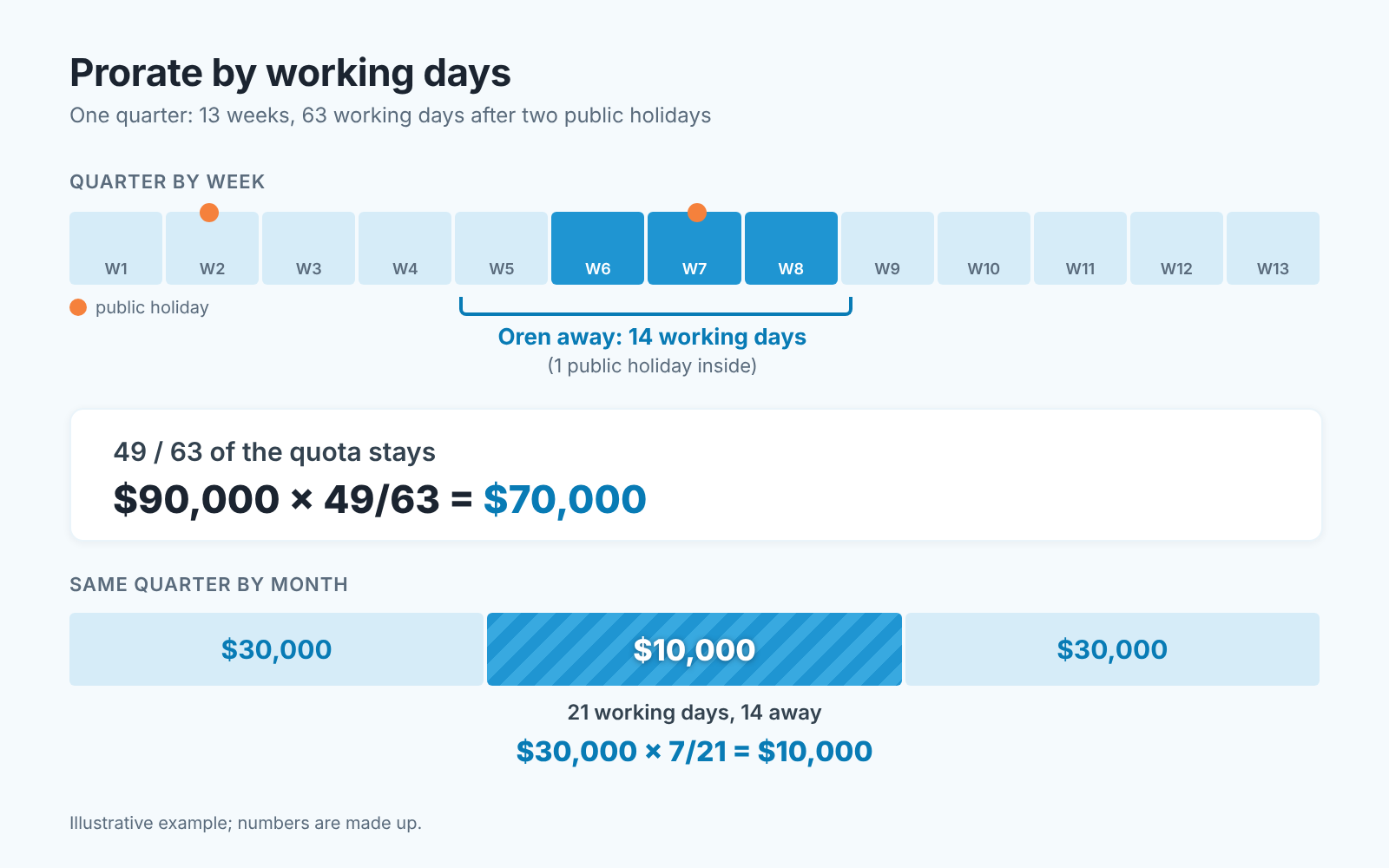
Prorating a quota means cutting it by the share of working days the rep is away. In practice that is one fraction: the working days the rep is present, over the working days in the period. Quota times that fraction. Use working days, because calendar days overstate the loss when the absence spans weekends and understate it when a public holiday sits inside it, and a three-line policy cannot afford a rounding argument.
Here is Oren’s case worked through (example; the numbers are made up). The quarter has 13 weeks, so 65 weekdays, minus two public holidays, 63 working days. Oren is away three weeks, and one of those public holidays falls inside his trip, so he misses 14 working days, not 15. He is present for 49.
$90,000 × 49 / 63 = $70,000.
That is his quarterly quota for the period. If the team tracks a monthly goal as well, do the same fraction for the month: the middle month has 21 working days, Oren is away for 14 of them, so the month’s goal is $30,000 × 7 / 21 = $10,000, and the other two months stay at $30,000. The three months add up to $70,000, which is the check that you did it right.
Compare that with a formula that does not prorate. Qualia’s policy, as Built In describes it, gives each rep two units of relief a year. One unit covers up to nine days off and cuts the quarterly quota by 8.5%, so $100,000 becomes $91,500; a rep who takes more than ten days uses a second unit, 17% in total, and the quota drops to $83,000 (Built In: quota relief). Nine days out of a 63-day quarter is nearer 14% than 8.5%, so Qualia relieves less than the calendar would and pays a higher commission rate on deals closed against the reduced quota. That works when there is a comp plan behind it. For a team of seven on a simple commission structure, the plain fraction is easier to explain and nobody has to remember what a unit is .
Round to the nearest hundred and say so because $69,230.77 invites a debate about decimals. And do the arithmetic in the same message in which you approve the leave, so the number exists before the quarter starts.
The deals that will close while the rep is away
A lowered quota does nothing for the three deals Oren was going to close in week two of his trip. Those are the real cost of an absence, and a separate decision from the number. For each open deal with a close date inside the absence there are three honest options, and “the rep will check email from the beach” is not one of them.
- Move it. If the buyer can wait, change the expected close date to the first week back and tell the buyer that is the plan. In Pipedrive this is a bulk edit from the deals list view: filter on owner and expected close date, select, and “expected close date” is one of the fields the panel lets you edit for many deals at once (Pipedrive: list view, filter and bulk edit).
- Cover it. If the buyer cannot wait, a named colleague takes the conversation while Oren keeps the deal. How to set that up with followers, notifications and a note in the deal is its own article: Pipedrive followers when a rep is out of office. The one rule we would repeat from it: whoever closes the deal owns it, and the owner field is not changed “temporarily”.
- Hand it over. For a leave of months, the deal changes owner for good. Owner is in the same bulk edit panel, and the list view warns an admin when the change will fire automations, with the option to run or skip them (Pipedrive: list view, filter and bulk edit). Same mechanics as reassigning deals when a rep leaves, minus the deactivation.
Sort the deals before the rep leaves, with the rep in the room. Ten minutes per deal is enough. The decision goes in the deal itself, so the cover person and the manager read the the same line two weeks later. Whichever option you pick also decides what counts toward quota attainment for the period.
Coming back is not starting over
The rep who returns from a long leave does not need a new-hire ramp, and giving them one is the second most common way to create a precedent. QuotaPath’s guide draws the line we use: a returning rep’s ramp is shorter than a new hire’s, because they already know the company and its buyers (QuotaPath: quota relief). The same guide describes the parental-leave pattern many comp plans follow, 60% of OTE while away and a ramp on return. The new-hire ramp itself is in how to set sales quotas, step 4; a returning rep gets something shorter, not a copy.
Our version for a small team: the first two weeks back carry no quota and a pipeline target instead, measured in meetings held with buyers who went quiet. From week three the normal monthly goal applies. After a two-to-four-week vacation there is no ramp at all; the person comes back to thier own sorted pipeline.
Where this lives in Pipedrive
Pipedrive does not calculate quota relief. Nothing on its goals page mentions absences, and we would not want it to guess. What it gives you is a goal per period that can be set unevenly, and that is enough.
Goals are created under Insights, “+ Create”, then “Goal”. A goal has an assignee (a user, a team or the whole company), one or more pipelines, a frequency of weekly, monthly, quarterly or yearly, and a start and end date (Pipedrive: Insights goals). The relief lives in Oren’s personal goal. If you also run team goals, managers can create team goals for the teams they manage (Pipedrive: goals for teams).
The feature that carries the relief is goal seasonality. For a deal goal with a defined end date, tick “Specify individual period goals” and the goal takes a different target for each period inside its duration (Pipedrive: Insights goals). So Oren’s monthly won-deals goal for the quarter is set as $30,000, $10,000, $30,000, and the goal report shows him against the right number in the month he was away instead of a red column. The basics of setting up a monthly goal are in Pipedrive goals for monthly targets.
What if the goal already exists? The help page names the title and the filters as editable after saving and says nothing about changing per-period values later, so the safe route is to end the current goal the day before the absence and create a new one with seasonality from the first day of leave, with the reason in the title: “Oren · Q3 · 3 weeks relief approved 12 May”. The title is the audit trail. Six months on, when someone asks why Oren’s goal was lower, the answer is in the goal list and nobody has to remember.
Do not lower the team goal as well. The team goal is the company’s number; the relief is between the manager and the rep. If the team misses by exactly the relieved amount, that is a planning conversation, and its input is capacity planning for a small team, not the vacation policy.
Two things not to do
Do not grant relief after the fact. Qualia requires reps to lock in vacation days before the next quarter starts, so leadership can forecast with the adjusted quotas, and it allows no relief at all in the fourth quarter because company holidays are already in the number (Built In: quota relief). A team of seven does not need the Q4 rule, but it needs the lock-in: relief is approved when the leave is approved, with the fraction in the same message. A request that arrives after the quarter has ended gets the quota the rep had, and a conversation about next time.
And do not say “we’ll see how it goes”. It sounds kind. What the rep hears is that the quota is open to argument if the quarter goes badly, and the quarter will go badly for someone. The three-line policy exists so that the answer to “can I have relief?” is something you look up. Nobody has to weigh the person asking.
While the rep is away, watch the deals. A deal whose owner is on a plane and whose cover person is busy drifts without anyone meaning it to. We build SalesBond, a sales management layer on top of the CRM a team already uses; we started with Pipedrive. Deal Health runs more than 20 rules over every open deal, on stage, activity and data, and the manager’s view lists the deals that have stopped moving, whoever owns them. For the three weeks a rep is out, that list is the cover plan’s check. Check your CRM with SalesBond.
Write the three lines this week, before the next holiday request: the threshold, the fraction, and who covers. Put them where the team can read them. The next time someone books three weeks in the middle of a quarter, the only question left is which deals move.