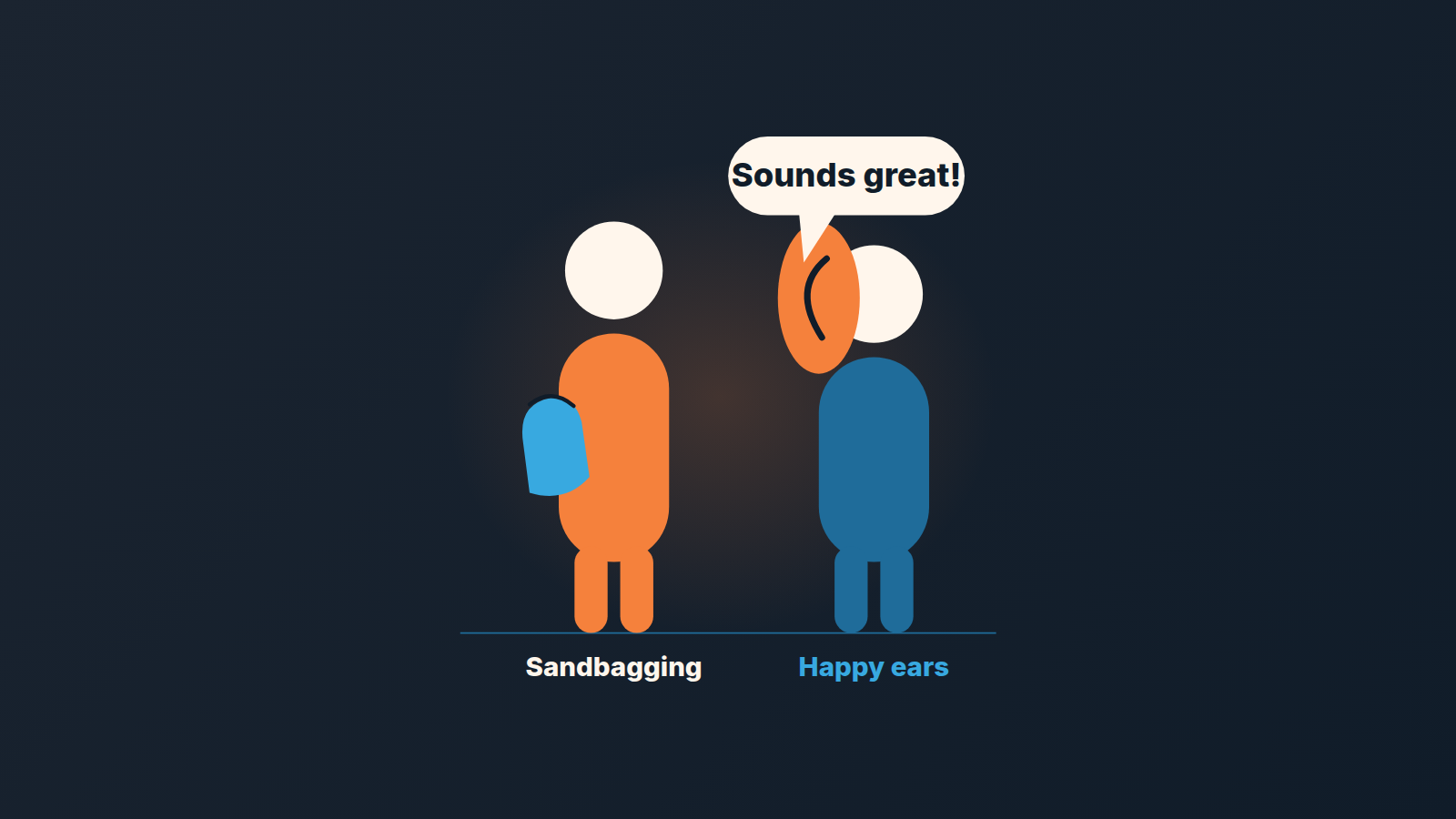
Sandbagging is a rep understating what will close to leave room; happy ears is a rep hearing a yes the buyer never gave. The first is usually deliberate, the second is sincere belief. One forecast comes in low and beats itself every quarter, the other comes in high and slips. The fix differs, so the first job is telling them apart.
That matters more than it sounds. After a miss, most managers have one reflex for everyone: push for a bigger number. With a sandbagger, pushing surfaces deals that were already there. With a rep who has happy ears, pushing gets you a bigger number that is even less true than the last one. Same move, opposite result, and that’s the practical reason to treat these two kinds of sales forecast bias separately.
Neither one is a reason to put a rep on trial. Sandbagging is usually a conscious choice, but a rational one: the rep is answering the incentives you set. Happy ears is a rep who honestly believes the deal is further along than it is. Treat both as problems with the process and the conversation stays useful.
A model trained on your deal history will not fix either habit on its own; we looked at what an AI forecast can and cannot correct.
Two reps, same quarter
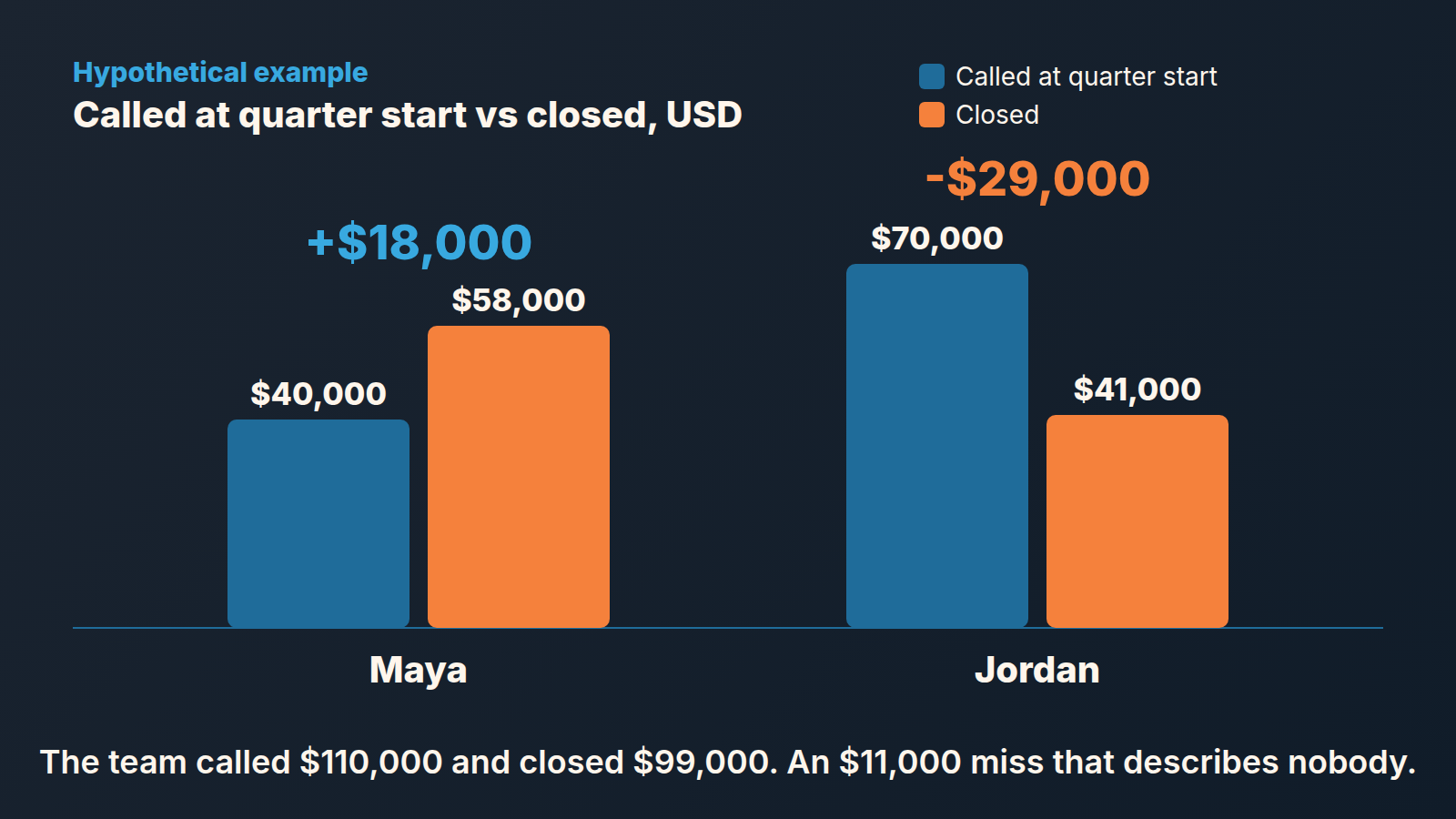
A hypothetical, so the arithmetic is easy to follow. Maya and Jordan sell the same product on a team of six. Each gives a call at the start of the quarter: the number they commit to closing. We’ll use “call” for that number from here on.
Maya calls $40,000. She closes $58,000. Two deals account for the extra $18,000: one for $10,000 and one for $8,000. Neither was in her call. Both sat in an early stage for weeks and then went to won within a few days.
Jordan calls $70,000 and closes $41,000. The missing $29,000 is three deals, $12,000, $9,000 and $8,000, all parked in a late stage when the quarter began. None of them had a dated next step. Two of them had one contact on the buyer’s side.
Add them up and the team called $110,000 and closed $99,000. An $11,000 miss that describes nobody. It’s the number the manager sees on the dashboard, yet Maya was $18,000 under her own call and Jordan $29,000 over his. A team total averages two opposite errors into one small, misleading one.
One quarter proves nothing about either of them, and we’ll come back to that. But it shows why you have to look rep by rep.
Sandbagging vs happy ears, side by side
Pedowitz Group describes sandbagging as intentional understatement that shows up as consistent over-performance against commit, usually in a culture that rewards beating the number. Winsabove defines happy ears as reading buyer signals as commitment. Here’s how the two compare from a manager’s chair.
| Sandbagging | Happy ears | |
|---|---|---|
| What the rep believes | “If I call it low, I can’t miss.” | “They loved the demo, it’s happening.” |
| What the call looks like | Low at quarter start, beaten again and again | High at quarter start, slips again and again |
| What the CRM shows | Deals that sit early, then jump to won with little recorded movement in between | Late-stage deals with no dated next step and one contact on the buyer side |
| What to ask | “What would have to be true for this to close this quarter?” | “What did the buyer say or do that tells you it’s this quarter?” |
| What pressure does | Brings hidden deals into the call | Inflates the call further |
The last row is the one to remember.
What to check in Pipedrive before you decide
Start with the only comparison that matters: what each rep called at the start of a quarter against what they actually closed. You don’t need a forecasting tool for this. If you already write down each rep’s number in a weekly review or a shared sheet, you have the first column. The second column is a won-deals report filtered by owner and close date, which any CRM gives you. Put two or three quarters side by side, per rep. A rep who lands above their call every time is a different case from a rep who lands below it every time, and a rep who bounces around is a third case entirely.
Then open the deals themselves. For the rep who keeps beating their number, look at the deals that closed but were never in their call. In Pipedrive, the Changelog under History in the deal’s detail view lists stage, value and expected close date changes by date, and the progress bar shows how many days the deal spent in each stage. See how it it got to won. If it sat in qualification for a month and then went straight to won in a week, with nothing logged in between, that deal was probably further along than the CRM said. One such deal is a fast buyer. The same shape across several deals and quarters starts to look like a rep keeping deals in their pocket.
While you’re in the Changelog, check the close dates too. Sandbagging also works on timing: a deal that looks ready, has its expected close date pushed past the end of the quarter, and then closes in the first days of the next one. Once is a buyer’s calendar. Every quarter is a pattern. If you have not done it before, here is what to read in the Changelog and what it will not tell you.
Short incentives move timing too: a SPIFF can shift timing by pulling a deal into its window, so compare the weeks after it as well.
For the rep who keeps missing, go to the late stages at the start of the quarter and look at each deal’s next activity. Is there one scheduled, with a date, that involves the buyer? Then look at teh people on the deal. A late-stage deal with a single contact and no scheduled activity is a deal the rep believes in and the buyer has not yet acted on. We wrote about why deals held up by one contact are so fragile; this is the same pattern seen from the forecast side. If you’ve built a deal health score, the happy-ears rep’s call will usually be full of low scores that the rep rates highly anyway.
One more check applies to both. A weighted pipeline forecast gives you a stage-math number that nobody’s gut touched. Put it next to each rep’s own call. The sandbagger’s call tends to sit below their weighted number, the happy-ears rep’s above it. That doesn’t prove anything by itself, since stage percentages have their own flaws, but a gap that stays on the same side quarter after quarter is worth a question.
The same comparison, run against the team target instead of the weighted number, is top-down vs bottom-up forecasting.
What to say to each of them
Talk about the deals. The person will follow.
Start with why a rep sandbags at all, because it’s rarely mysterious. Avoma describes the trap: a rep who hits quota early gets a higher target next quarter, and a deal held until the first week of the new quarter means starting it with a win on the board. HubSpot lists carrying momentum into the next quarter among the reasons too. If your team also celebrates the rep who “crushed” a low forecast, you are paying for the behaviour twice.
Part of the fix sits in the target itself; we wrote about how to set quotas that do not invite sandbagging.
So the goal with the rep who sandbags is to make an honest call feel safe. Say it plainly: “I’d rather have a number that’s right than a number you beat. Missing by a little on an honest call is fine with me.” Then go deal by deal on the early-stage ones and ask what would have to be true for each to close this quarter. Often the answer is “it already is,” and the deal moves up in the call without anyone saying the word sandbagging. Over time praise accuracy out loud. A rep whose call came close to what they closed deserves the mention more than one who beat a low call by a mile.
The pay plan plays a part as well; for a first hire, we explain how to split base and variable.
With the rep who has happy ears, anchor the call in what the buyer did. A warm meeting is not evidence. Winsabove’s counter is documented buyer statements and call review, and that works on a small team too. Ask for the evidence: “What did they say, and who said it? What’s the next meeting, and is it on their calendar?” If there’s no dated next step, the deal comes out of this quarter’s call until there is one. The rule applies to everyone, so nobody has to feel singled out, and it quietly fixes the rep’s number without a lecture. Listening to one recorded call together, if you record calls, is often enough for the rep to hear the gap between “this is interesting” and “we’ll sign this month” on their own.
Don’t lead either talk with the label. Nobody improves after being told they have happy ears.
When it’s neither
Before you decide a rep has a habit, rule out the boring explanations. On a team of 5 to 20, each rep closes a handful of deals a quarter, so the numbers are thin and one deal can flip the whole read.
- One big deal. A single large deal that closed early or slipped a week makes a rep look like a sandbagger or an optimist for that quarter alone. Take it out and look at what’s left.
- A buyer that slipped for its own reasons. Budget freezes, a reorg, a champion who left. If the record shows dated steps and several contacts right up to the slip, the rep read the deal fine.
- Plain luck, both ways.
This is why we’d want at least three quarters of the same pattern before calling it anything. Two quarters of beating the number could be a strong pipeline. Two quarters of missing could be a bad territory or a thin one, and that’s a pipeline coverage problem rather than a forecasting one.
So this week, open a sheet with one row per rep and two columns, call and closed, and fill in last quarter. Add a row every quarter. By the third, the pattern will be telling you more than the last month did.