AI sales forecasting predicts which deals close and when, using your deal history. For a small sales team it only helps when close dates, stages and amounts are kept honest; on messy data it produces a confident number with nothing behind it. So before you compare tools, look at what your CRM would actually feed them.
That is the whole argument of this piece. The rest is how to check it on your own pipeline, and what to do with the answer.
What data AI sales forecasting actually reads
An AI sales forecast reads deal amounts, close dates and how often they moved, stage history, won/lost outcomes with reasons, and activity on each deal. Strip away the dashboards and that’s most of it. In Pipedrive terms, it’s the deals themselves and everything that happened to them: an amount that shrank along the way, a close date a rep pushed three times, a deal that sat in Proposal for most of a quarter, the calls and emails and the silence between them.
A model learns patterns from closed deals and applies them to open ones. If deals that stall in Proposal for a long stretch usually end up lost on your team, teh model notices and discounts similar open deals. If a certain kind of deal tends to close late, it shifts the date.
Notice what is missing from that list. The model does not know that your biggest prospect just hired a new CFO, or that a rep is holding deals back from the forecast to look good next quarter. It only knows what was typed into the CRM. For a team of five to twenty people, that is the part worth worrying about, because a handful of sloppy records makes up a large share of the history.
A data check you can run this week
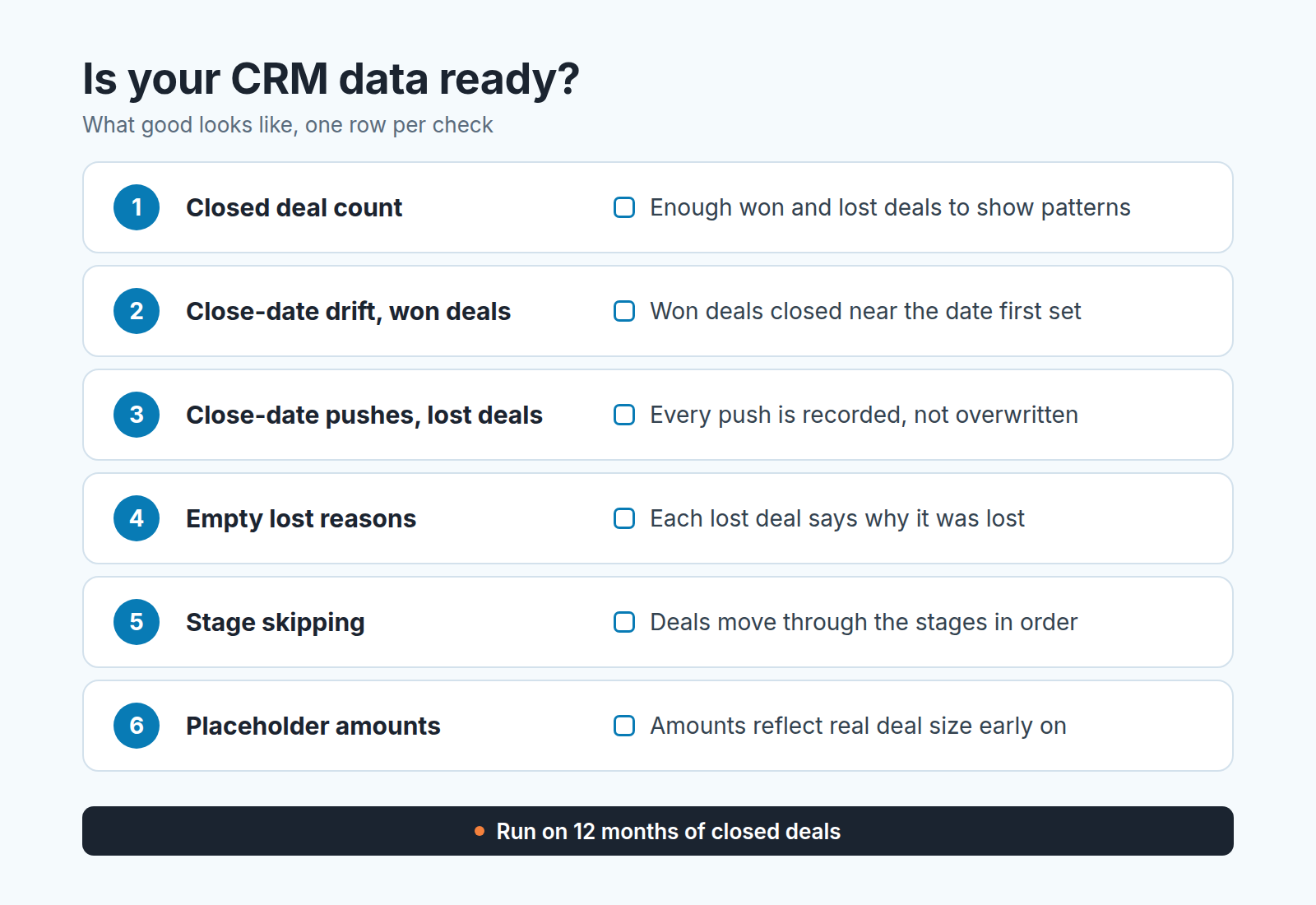
You don’t need a vendor to tell you if your data is ready. An afternoon with an export will do it. Pull every deal closed (won or lost) in the last 12 months and go through these steps.
- Count the closed deals. Vendors quote minimum deal counts for their models; ask for their basis rather than taking the number on faith. Your own count tells you if you are anywhere near it.
- Look at expected close dates on won deals. Compare the date set when the deal was created with the date it actually closed. If most won deals closed well after the first date, your close dates are wishes, and any forecast built on them inherits the wish.
- Check how often close dates were moved on deals that were eventually lost. Deals that get pushed again and again before dying are a signal a model can learn from, but only if the pushes were recorded instead of the date being quietly overwritten at the end.
- Scan lost deals for an empty or “Other” lost reason. A model can’t learn why you lose if half the answers say nothing.
- Pick ten won deals at random and read their stage history. Did they move through stages in order, or jump from first contact to Won on the day the contract was signed?
- Check amounts. Placeholder values and deals that sat at zero until the last day tell the model nothing about deal size.
We wrote separately about how to read a pushed close date in Pipedrive.
Here is how this looks on a hypothetical team. Eight reps close 260 deals in a year, 110 won and 150 lost. The check finds that 70 of the lost deals have no lost reason, and about a third of the won deals skipped straight from the first stage to Won. That team has enough volume to try something. It does not yet have enough clean history for a model to learn from, and a month of fixing lost reasons and stage discipline would do more for its forecast than any tool.
Honestly, a weighted pipeline is often enough
A weighted pipeline multiplies each open deal by a probability tied to its stage and adds the results. Say, hypothetically, your stages carry 20% at Qualified, 50% at Proposal and 80% at Negotiation, and you have $100,000 sitting in Qualified, $60,000 in Proposal and $25,000 in Negotiation. The weighted forecast is $20,000 plus $30,000 plus $20,000, or $70,000. Anyone on the team can recompute that on a napkin, and that is it’s main strength.
It has real weaknesses. The stage percentages are usually guesses set once and never revisited, and they treat a deal that entered Proposal yesterday the same as one that has been rotting there since spring. Still, on a small team the manager often knows most of the deals by name. If you have a few dozen open deals and a weekly pipeline review where each one gets a sentence, a weighted number plus that conversation will get you close enough to plan hiring and cash.
We’d stay with a weighted pipeline if your data check came back rough, if you close only a few deals a month, or if one or two large deals make up most of the quarter. In that last case no model helps much, because the forecast is really a bet on two conversations. Where we’d start looking past it is when the pipeline gets too big for the manager to hold in their head, or when the stage percentages keep being wrong in the same direction quarter after quarter and nobody has time to recalibrate them.
With very few closed deals, even a weighted number can be more than the data supports; which sales forecasting method fits your count is laid out step by step.
Where AI sales forecasting helps a small team, and where it doesn’t
AI sales forecasting helps a small team mostly by reviewing every open deal every week and recalibrating stage probabilities. It helps least when closed history is thin or the quarter hinges on one deal. That’s a narrower case than the vendor pages make, but it is real.
It helps with the things humans are bad at doing every week. A model can look at every open deal, every time, and flag the ones whose pattern looks like past losses: long silence after a proposal, a close date pushed for the third time, an amount that dropped. A manager reviewing the whole pipeline on a Monday morning will skim. The model won’t. It can also recalibrate the probabilities that a weighted pipeline keeps frozen, using what actually happened to deals at each stage on your team.
It helps least where the data is thin or the deals are unusual. A new product line with no closed history, a market you just entered, a quarter that hinges on one enterprise deal: the model has nothing comparable to learn from, and it will still give you a number. That’s the danger. A forecast from a tool looks more authoritative than one from a spreadsheet, even when it is built on the same shaky close dates.
And it can’t fix behavior. If reps set close dates to the the end of the month by default, the model learns that close dates mean nothing, which is true, and useless.
What stays with the manager
Some calls never leave the person running the team.
Commit is one of them: the deals a manager promises will close this period. A model can say a deal looks like past wins; only the manager can decide to put it in the number they give the founder. The same goes for anything that lives outside the CRM: a champion leaving, a budget freeze mentioned on a call but never logged, a competitor’s price cut. Those are exactly the things that swing a small team’s quarter.
We wrote separately about how to split commit from best case on a small team.
The manager also owns the inputs. The data check above only stays passed if someone insists that lost reasons get filled in and close dates get moved when reality moves. We’d argue that habit is worth more than the choice of tool and it costs nothing to start.
Questions to ask a vendor before a trial
Start with accuracy, since every vendor page leads with it. An accuracy figure only means something against a baseline, and the baseline that matters is your own weighted forecast, checked on your own closed deals. A percentage measured on someone else’s customers tells you how the model did on their pipeline, and nothing about yours.
If the data check looks reasonable and you still want to try a tool, go into the demo with these:
- How many closed deals does your model need before its forecast is meaningful, and what is that number based on?
- Which CRM fields do you read? Do you use stage history and close-date changes, or only current values?
- What happens when my data has gaps, like empty lost reasons? Do you tell me, or quietly work around them?
- Can I see why a specific deal got its score or date, in words a rep would accept?
- If you quote an accuracy figure, measured on whose data, over what period, and against what baseline?
- Can I run the trial on my own historical deals and compare your forecast with what actually closed?
A vendor who answers the last question with a yes and a date is worth an afternoon. One who answers with a percentage from someone else’s customers is asking you to trust the model before you’ve seen it read your pipeline.