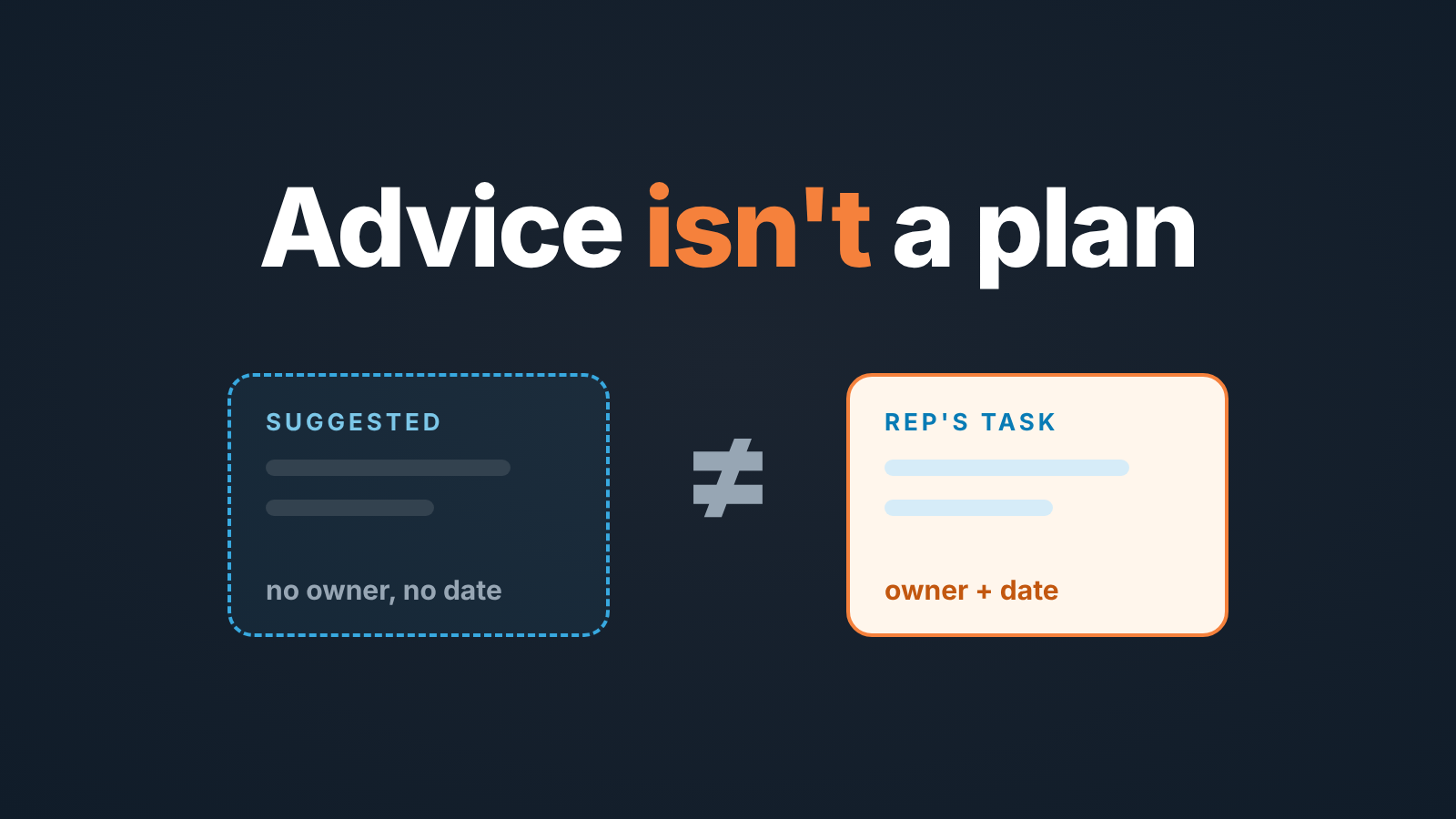
Salesforce Next Best Action shows a suggested action on a record, but it is a prompt, not a commitment: the next step that counts is the task a rep writes, with an owner and a date. Review five open deals a week and compare what the system suggested with what is actually scheduled. If the suggestion is there and the task is not, the deal has advice and no plan.
That is the whole article in two sentences. The rest is why the distinction matters on a team of three to ten, who gets to decide what the system suggests, and a check that takes less time than reading this page.
What Next Best Action shows on a record (and what it does not)
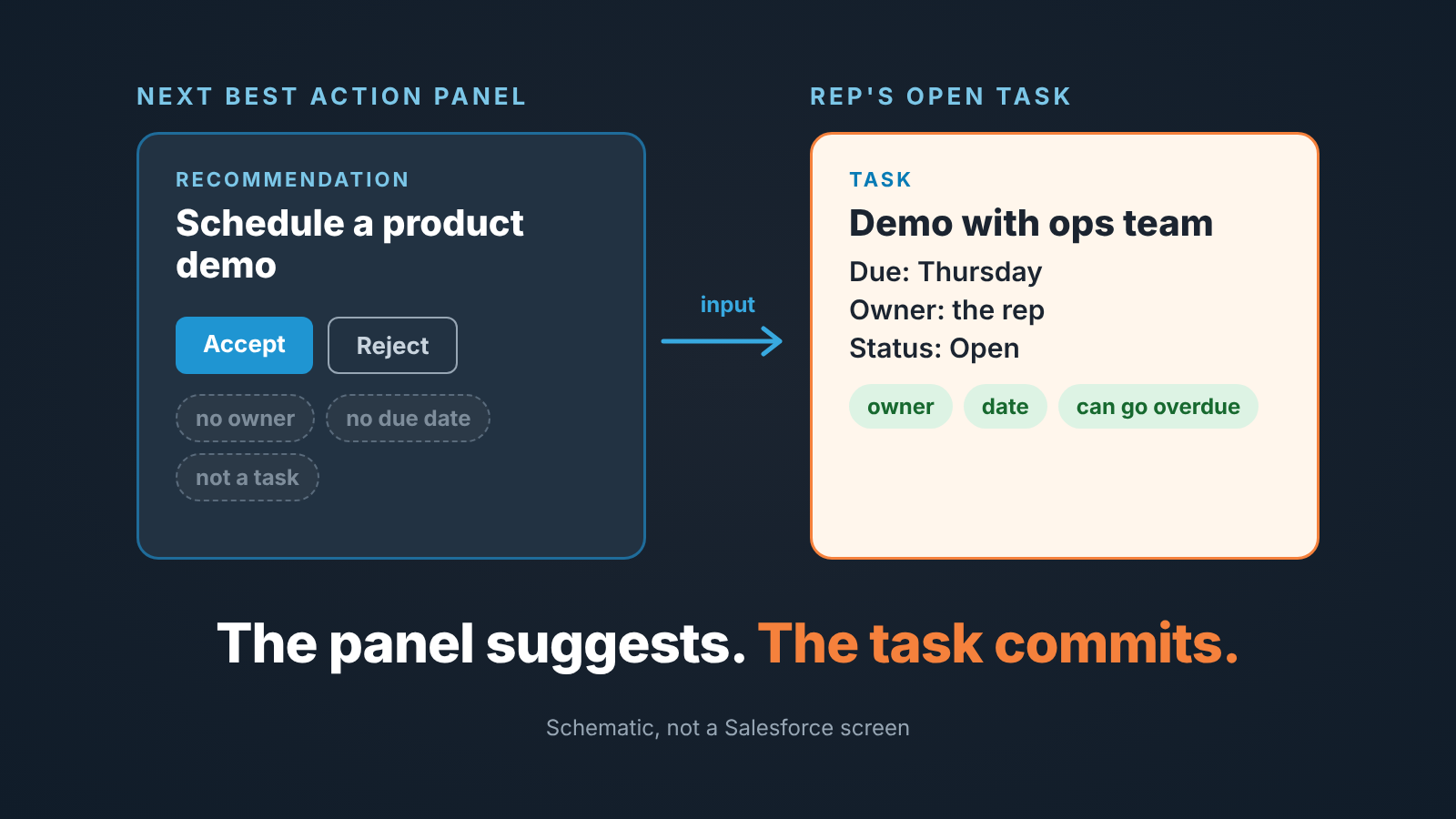
Open an opportunity in Salesforce with Next Best Action set up and you see a panel on the record page: one or more recommendations, each with a short title, a line of explanation and two buttons, Accept and Reject. Einstein Next Best Action is two pieces underneath: recommendations, which are ordinary records in your org, and a strategy, built as a flow, that picks which of them to show on which record.
The panel, then, is a message from whoever built the recommendation to the person looking at the record, delivered at the moment they look. Accepting runs the flow behind the recommendation. Rejecting sends it away. Salesforce logs both reactions, and an admin can report on them.
What the panel is not: a task. A recommendation has no due date and no owner, and it never goes overdue. The report will tell you a rep clicked Accept on “Schedule a product demo”. It will not tell you the demo has a date, because whether it does depends on what the accept flow does and on what the rep typed afterwards. A click is a reaction. It is not an agreement with a customer.
Recommendation versus the rep’s own next step
Consider two opportunities. On the first, the panel says “Schedule a product demo” and the rep has an open task, “Demo with ops team”, due Thursday, assigned to himself. On the second, the panel says the same thing, the rep saw it, nodded, and moved on. Nothing else on the record.
From the panel alone the two records are identical. From the task list they could not be more different.
Our position is plain: the next step a manager can rely on has three properties. Someone wrote it. It has a date. It has an owner. A recommendation has none of the three, however good the logic that produced it, because the person who wrote it did not talk to the customer. The rep’s task carries a promise, and promises are what a pipeline review is actually checking.
So the rule we put in front of teams that switch Next Best Action on is three lines long:
- The recommendation is visible. Nobody hides it, and nobody rejects everything to make the panel quiet.
- The next step is written by the rep, as a task, in the rep’s words. Accepting a recommendation is not the same as writing the step; if accepting creates the task, the rep still edits the subject and the date so it says what was agreed.
- Every open opportunity has exactly one open task with a due date and an owner, recommendation or not.
Line three is the rule from one open Salesforce task per opportunity, and it does not change when Einstein arrives. The panel is extra input into that task, never a substitute for it.
Who decides what the system suggests
Not Einstein, mostly. Despite the name, the recommendations a rep sees are records someone in your org created, and the logic that picks which one to show on which record is a strategy an admin built. (If you are still deciding which Einstein features a small team can actually switch on, start there.) The strategy loads candidate recommendations, filters them against the record and passes on what is left; Salesforce’s Next Best Action examples show the pattern. On a small team that admin is often the manager, or the one rep who likes clicking around Setup.
This matters for two reasons. A recommendation is only as good as the rule behind it, and the rule was written on a Tuesday afternoon by a person with a theory. “Offer a discount when the deal has sat in Negotiation too long” is a theory. It might be right for the deals the admin had in mind and wrong for the one on the rep’s screen; the rep closest to the customer knows which. That is why line two says the rep writes the step: the strategy knows the fields, the rep knows the conversation.
And when you know a person wrote the recommendation you can ask them to change it. If the panel keeps telling reps to schedule demos on deals that already had one, the fix is not “ignore the panel”. It is a ten-minute conversation with whoever owns the strategy about which field should switch that recommendation off. Keep a short list of who owns which recommendation. Three or four that reflect how you actually sell, maintained by someone, beat a dozen that reps learn to reject by reflex.
A weekly check: five deals, recommendation against task
The reaction reports answer a different question: what reps clicked. The question here is whether a dated step exists next to the suggestion, and the quickest way to answer it is to open the record. So the check is manual, and it is short.
Pick five open opportunities. Not the five biggest, not the the five you are worried about: five from different reps and stages, chosen before you open any of them. Open each record and look at two things side by side: what the Next Best Action panel suggests, and what the open task says.
Each deal lands in one of four boxes.
Suggestion and a matching task: the panel says demo, the task says demo on Thursday. Good. Move on.
Suggestion and a different task: the panel says discount, the task says “send revised scope by Friday”. This is the interesting box, and usually the healthy one. The rep knows something the strategy does not. Ask what, briefly, and write it down if it comes up twice; it may be a recommendation that needs a new filter.
Suggestion and no task: the rep saw advice and scheduled nothing. This is the box the check exists for. The conversation is not “why didn’t you accept the recommendation”. It is “what is the next step and when”, and the task gets created while you are on the call.
No suggestion and no task: the strategy had nothing to say and neither did the rep. Same conversation, minus teh panel.
Five deals, four boxes, fifteen minutes at the most. Keep a tally for a month. If the third box is empty three weeks running, the team has learned the rule and you can drop to five deals a fortnight. If the second box fills up with the same recommendation every week, the strategy is wrong about something and the admin should hear it.
This check slots into the Monday routine from the parts of Sales Cloud a manager opens every week as one more item, not a separate meeting.
When to switch it off
The panel earns its place when reps read it and then write their own step. We would turn it off in three situations rather than let it decay.
The reject button has become a reflex. Watch a rep open three records. If the hand moves to Reject before the eyes reach the text, the recommendations are noise, and noise next to the fields people need teaches them to skim the whole page. Switch it off, fix the strategy, bring it back when it says fewer and better things.
Nobody owns the strategy. The admin who built it left, or Setup became someone else’s problem. A recommendation with no owner cannot be corrected, so it cannot be trusted.
The third box stays full. If reps keep treating the suggestion as the step after five weeks of conversations, the panel is doing harm: it gives the record the appearance of a plan. Go back to the task rule on its own, without a panel competing for the rep’s attention.
A disclosure, since we are on the subject of catching a deal with advice but no plan: we build SalesBond, a sales management layer on top of the CRM a team already uses, and Deal Health flags open deals with no scheduled next step without anybody opening five records by hand. Check your CRM with SalesBond if you would rather the third box found you. The three-line rule above needs no tool at all.
Back to the two demo opportunities, which are a composite rather than one team. The manager, Priya, found both in the same Monday check. The first rep had a Thursday task and the demo happened Thursday. The second, Daniel, had a panel he agreed with and nothing scheduled; the demo got booked during the call for the following week, as a task with his name and a date, and he updated the Next Step field to match. The recommendation had been right both times. Only one of the deals had a next step, and the panel could not tell you which.