
In sales, your ideal customer profile (ICP) is a description of the accounts that buy from you fastest, stay, and cost the least effort to win. For a small team, the quickest honest way to build one is from your own closed-won and closed-lost deals in the CRM. A template won’t know your customers. Export the deals, group them by a few fields you actually track, and look at which groups win more often, close faster, and pay more. What you get is a working hypothesis you can turn into a qualification rule next week.
That’s the whole method. The rest of this article is about doing it with the messy data a five-to-fifteen person team really has, and about not fooling yourself with it.
ICP or persona? Keep them apart
An ICP describes a company. A persona describes a person inside it.
“Accounting firms with 10 to 50 staff that came to us through a referral” is an ICP. “The managing partner who hates chasing clients for documents” is a persona. You need the first to decide which deals deserve your time and the second to decide what to say on the call. Mix them up and you get a profile nobody can use, something like “growth-minded leaders at innovative companies”. It fits every lead, so it filters none of them.
This article is about the company-level profile. Personas come later, once you know whose companies you are talking to.
Pull the data you already have
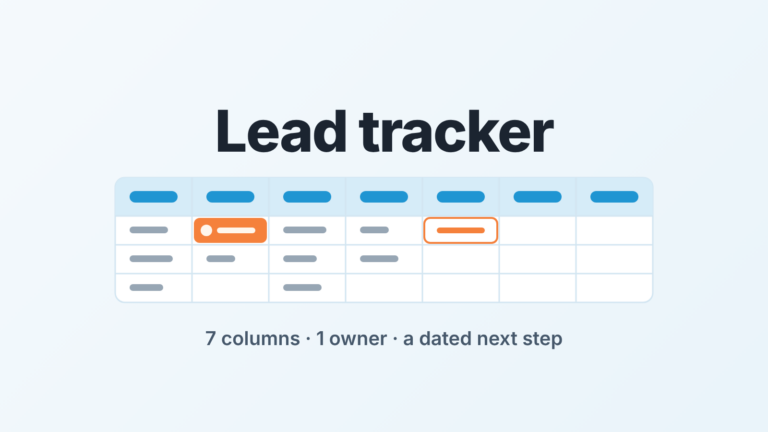
Start with an export of every deal marked won or lost over the last twelve months or so. In Pipedrive that means your won and lost deals, with their values and dates. You want one row per deal and these columns:
- status (won or lost) and the close date
- the date the deal was created, so you can work out cycle length
- deal value
- lead source, if anyone records it
- lost reason, if your team records one
- company size and industry
Be ready for the last three to be half empty. Value and stage usually get filled in, because the pipeline puts them in front of everyone every day. The other fields often don’t. That’s normal, and for this exercise it’s fixable: you only need the gaps filled for closed deals. If you have 24 won deals, open each one, check the company’s website or your notes, and type the size and industry in by hand. It’s a boring hour. It’s also the hour that makes the analysis possible.
There are fields you almost certainly won’t have, and that’s fine too. Nobody on a small team logs “the real reason they bought” or the buyer’s budget cycle. Don’t invent columns you can’t fill for most rows, a column that is mostly guesses will produce a confident, wrong answer.
Then add one calculated column: cycle length in days, close date minus created date.
Reading the export: cycle, size, source, and who signed
Now group the deals. One or two dimensions at a time, never all of them at once. Lead source crossed with company size is a good first cut because both tend to be filled in and both are things you can act on.
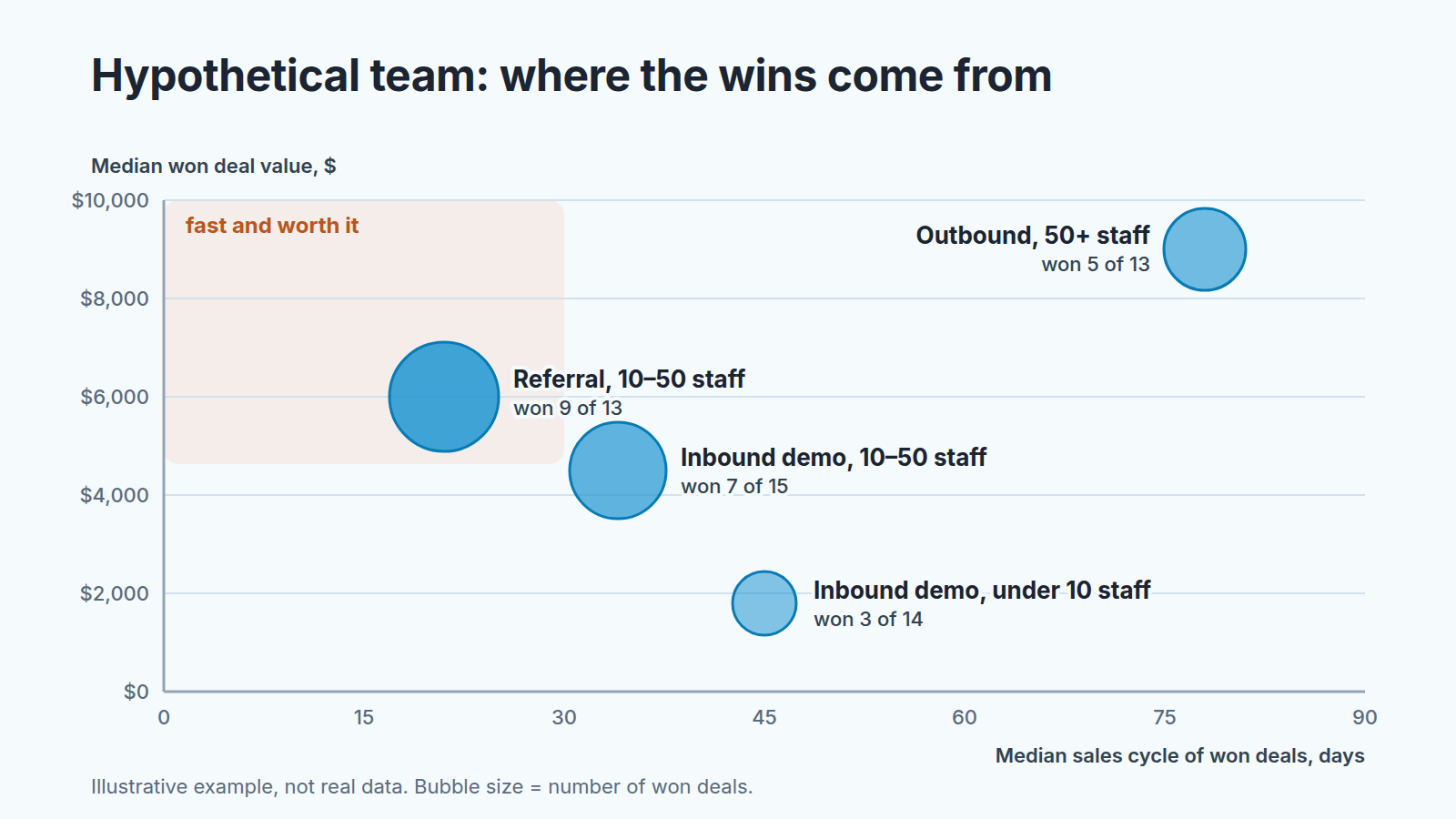
Here is what that looks like for a hypothetical team with 24 won and 31 lost deals over a year. The numbers are made up for illustration; the way of reading them is the point.
| Segment (hypothetical) | Won of closed | Median won deal | Median cycle, won deals |
|---|---|---|---|
| Referral, 10–50 staff | 9 of 13 | $6,000 | 21 days |
| Inbound demo request, 10–50 staff | 7 of 15 | $4,500 | 34 days |
| Inbound demo request, under 10 staff | 3 of 14 | $1,800 | 45 days |
| Outbound, 50+ staff | 5 of 13 | $9,000 | 78 days |
Read it row by row and ask three questions of each.
Do we win here more often than not? Referrals from 10–50 person firms close 9 times out of 13. Nothing else comes close.
Is the money worth the wait? Outbound to bigger companies brings the largest deals, $9,000 at the median, but they take 78 days. That’s more than three times as long as a referral deal, and your reps are working those deals the whole time. A $6,000 deal that closes in three weeks usually beats a $9,000 deal that eats a quarter.
Does the segment cost us more than it pays? Small companies from the demo form close 3 times out of 14, at $1,800, and they still take 45 days. That row gets its own section below. If you keep selling to it, set a minimum deal size so those deals get a shorter path.
Then look at who signed. The CRM rarely has a clean field for it, so open the won deals in your best segment and read the the contacts and notes. In our example, say 7 of the 9 referral wins were signed by the founder or managing partner directly, with no procurement step. You would never see that in a template. It’s also the most useful line in the whole profile, because it tells your reps who to get on the first call.
Written out, this team’s first ICP draft reads: service firms with 10 to 50 staff, arriving through a referral or a demo request, where the owner is in the conversation from the start. Once the profile says referrals, the next step is to ask your best-fit customers for referrals on purpose.
For the demo-request part of that profile, see our note on speed to lead for inbound requests.
If you want it as a fill-in line for your own team: [type of company] with [size], arriving through [source], where [who] is in the conversation.
Negative ICP: what your lost deals say
Everyone builds the “who to chase” list. Fewer teams write down who to stop chasing, and that list saves more time.
A negative ICP comes from the lost deals, the lost reasons and the segments where the win count is low even though the pipeline is full of them. In the example, the under-10 demo requests are 14 closed deals with only 3 wins. They look like opportunities on the board. They get the same discovery call and follow-up sequence as everyone else, and most of them go quiet after the demo.
So the negative profile might read: companies under 10 people with no one who owns the sales process, arriving through the demo form.
Two things to watch here. First, “negative” doesn’t mean “reject”. It means a lighter path: a recorded demo instead of a live one, one follow-up instead of five, no custom proposal. Second, check the lost reasons before you trust the pattern. If most of those losses say “chose a competitor on price”, you may be looking at a pricing problem. Fix that first, and the segment might deserve another look.
How many deals do you need for an ICP?
Honestly, fewer than you’d like and more than you have.
There is no safe minimum. A couple of dozen won deals is enough for a hypothesis you go and test, and too few for a rule you stop questioning.
With that many deals you are not doing statistics. You are looking for a pattern strong enough that you would bet a quarter of your team’s time on it, and you should hold it that loosely. A useful test is to move a single deal and see if the story changes. In the example, if one more referral deal had been lost, that row would read 9 of 14 instead of 9 of 13, still clearly the best. If one more small-company demo had closed, it would be 4 of 14, still clearly the worst. Those conclusions survive a nudge. The outbound row is different: 5 wins is thin, and two big deals that happened to land in the same month could be doing all the work. Treat that one as an open question.
Another check is to take out your single largest deal and look again. If the “best segment” stops being the best, you were looking at one good customer.
And write the date on the profile. The pattern from the last twelve months describes the company you were, with the reps and teh offer you had then. Run the same export each quarter, add the new closed deals, and see if the rows hold.
Make it a qualification rule, not a poster
An ICP that lives in a slide deck changes nothing. It needs to show up at the moment a rep decides how much time a new deal gets.
The simplest version is two or three questions asked on the first call, taken straight from the profile. For the example team: how many people work at the company, how they heard about you, and whether the owner will be part of the decision.
A deal that matches on all three gets the full process and the rep’s best hours. A deal that matches the negative profile goes down the lighter path. Anything in between is the rep’s call, and that’s fine, because the rule only sets the default.
Put the answers where the team can see them. If the questions live only in a doc, nobody records the answers, and next quarter’s export has the same empty columns as this one. Make the fields visible on the deal, keep them few, and look at them in the pipeline review. “This one’s outside the profile, why are we still on it?” is a fair question to ask on Monday. The same profile also gives you a short list of companies to go after, which is where target account selling starts.
FAQ
What does ICP stand for in sales?
ICP stands for ideal customer profile: a description of the kind of company that fits what you sell best. It describes companies, not people. The people inside those companies are what buyer personas are for.
What is a negative ICP?
A negative ICP describes accounts that look like opportunities but rarely close, or cost more effort than they bring in. You build it from lost deals and their lost reasons. Use it to give those deals a lighter sales process; if one of them still wants to buy, you still sell to it.
Can you have more than one ideal customer profile?
Yes, if your won deals split into two separate groups that both win often and close at a reasonable pace. A small team usually does better with one main profile and a clear negative profile than with several that nobody really uses.
How often should you update your ICP?
Re-run the won and lost export once a quarter and check whether your strongest segments still hold. If they have shifted, update the profile and tell the team what changed and why.