Take the average hours your team spends per won deal, price them at what an hour of a rep costs you, and compare the result with your average deal size. Where the time costs more than the deal returns, set a floor and give the deals under it a shorter path: a template offer, one call, no custom demo. A minimum deal size is not a refusal; it decides which deals get the full treatment.
The Tuesday spent on a 400-dollar deal
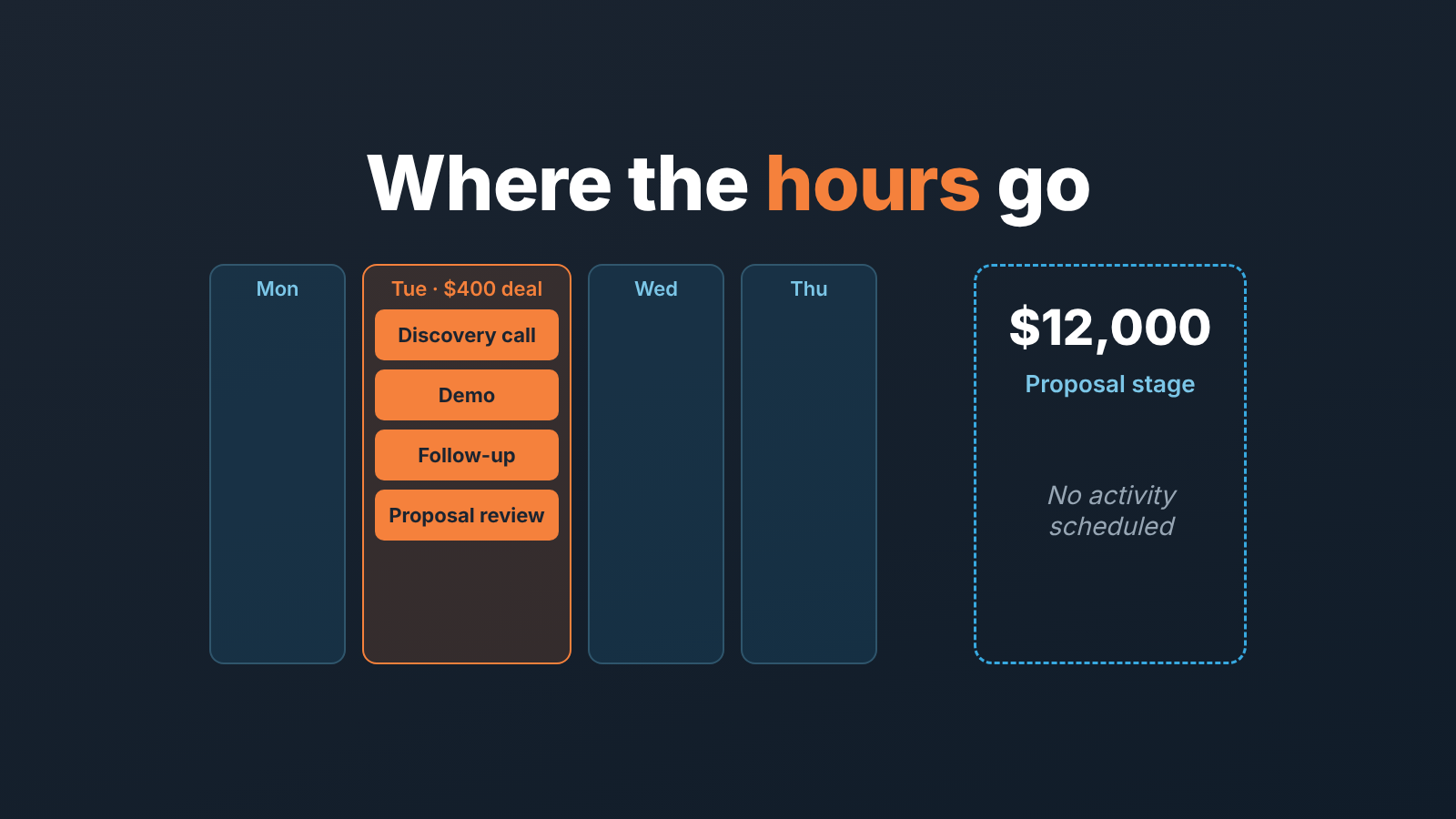
Henrike runs sales at a three-person software company. One Tuesday she looked at Casimir’s calendar: a discovery call, a demo, a follow-up and a proposal review, all for one deal worth $400. The same week his $12,000 deal sat in the proposal stage with no activity scheduled.
Nobody did anything wrong. The $400 buyer asked for a demo, so he got one. He asked for a custom proposal, so he got one. A process written for the deals you want gets applied to every deal that arrives, and it has no idea what any of them is worth.
Count the hours behind a minimum deal size
Everyone on a small team has a feeling about which deals are too small. We don’t trust it, because it is usually about the buyer’s manners rather than the money. Count instead.
The count has three parts. First, the hours per won deal: the activities your team completed on deals it won in the last 90 days, divided by the number of deals won, turned into hours. Second, the cost of an hour: what a rep costs you fully loaded, divided by the hours in a working month. Multiply the two and you have what a won deal costs you in selling time.
Third, what the deal returns. For subscriptions use the annual value, not the headline contract sum, as in ACV vs deal value in Pipedrive. If the selling cost eats a large share of what a deal of that size brings in a year, that size sits below your floor. The floor, then, is the smallest deal size that still earns the full sales process. If one big deal inflates the average, compare against the median deal size instead.
Bain described the same exercise at an IT services company: once fully loaded sales and marketing costs were counted, small deals were mostly unprofitable, the company rejected deals below a size threshold, and sales productivity improved quickly (Bain, Let’s Make a (Larger) Deal). That is one firm’s result, and the threshold was never published. Yours comes from your own hours, and it moves. A team that gets faster at the standard path lowers its floor without deciding to.
Where to find it in Pipedrive
The activity side lives in Insights: click “+ Create”, then Report, Activity, Activities performance. Supported fields include Number of activities, Duration (minutes), Type of activity, Deal and Marked as done time (Pipedrive: activities performance report). The default filter is Add time, this month; change it to Marked as done time, last 90 days.
Then narrow it to won deals. The report can filter activities by fields of the deal they’re linked to, which Pipedrive calls combined data (Pipedrive: combined data in Insights), so add a deal filter for status won. Divide the total by the deals won in that period, from a deals report. Duration only counts if your reps fill it in and most small teams don’t. If it’s empty, count activities by type and multiply by what a call or a demo really takes you.
The deal side is a custom field. Under Personal preferences, Data fields, pick Deal and click “+ Custom field” (Pipedrive: custom fields). Call it Size tier, single option, three values, filled when the deal is created from the Value field, not from the conversation. Using custom fields in Insights filters and the visual builder needs Premium or higher; the table view takes them on any plan (Pipedrive: Insights reports, goals and dashboards).
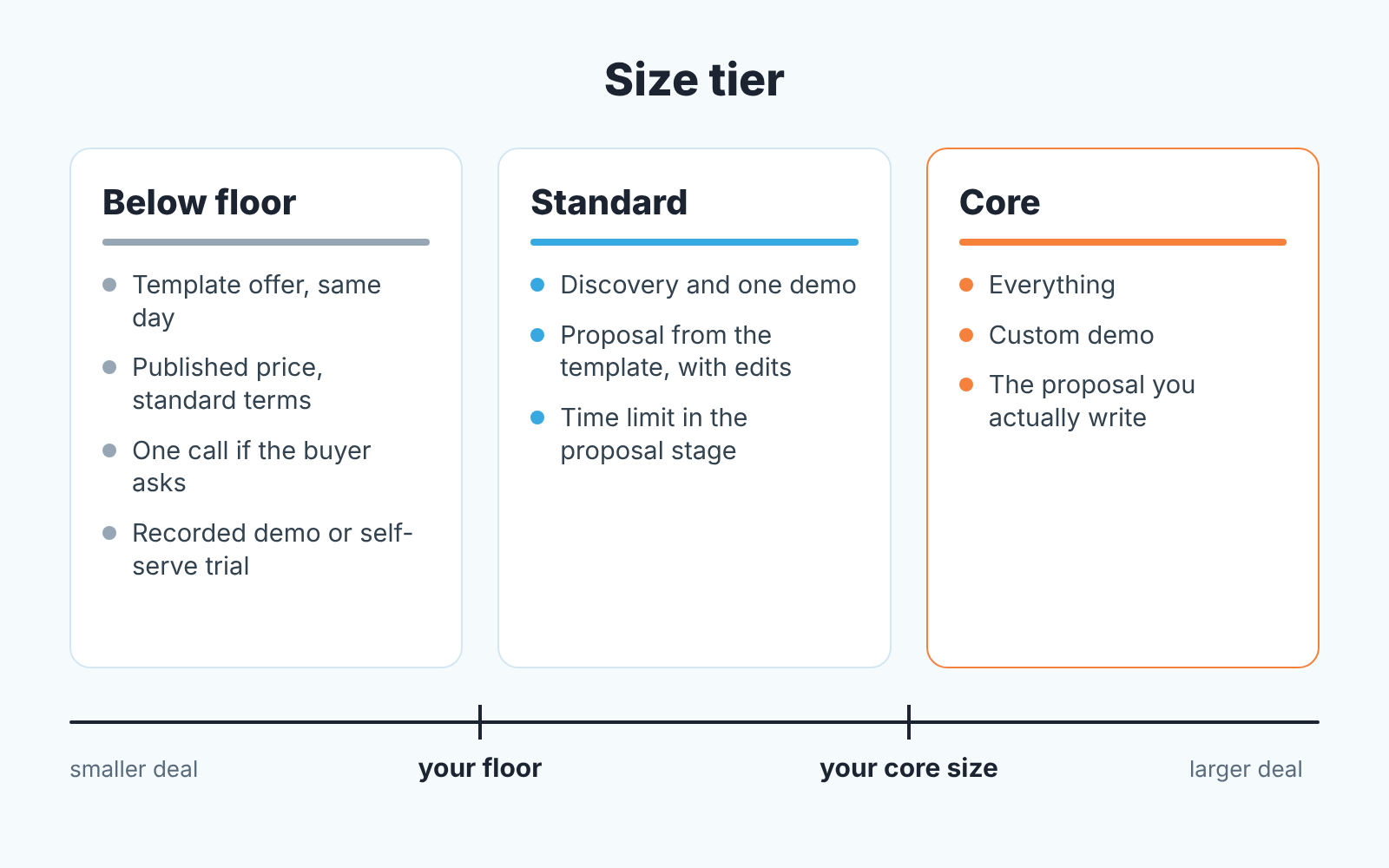
Three tiers and what each gets
Why three? Two creates an argument at the line, and four nobody remembers.
- Below floor: a template offer sent the same day, at the published price, standard terms. One call if the buyer asks. No custom demo: a recorded one or the self-serve trial instead. No discount conversation, no custom proposal. If you have partners or resellers, this is their tier. One rep owns it for the week.
- Standard: discovery, one demo, a proposal built from the template with edits. A time limit in the proposal stage, after which the deal is closed out instead of nursed.
- Core: everything, including the custom demo and the proposal you actually write.
The bottom tier still closes. The $400 buyer gets an answer on Tuesday instead of a demo on Thursday, and often prefers it. What changes is Casimir’s week: the hours go to the $12,000 proposal.
The exceptions you write down
Every floor has exceptions. Fine, as long as they are written down. Two reasons count. A strategic account: a logo that opens a market, or a customer whose other departments are the real deal. Expected growth: a small first order with a written reason to expect a larger next one, and a date by which you will know.
Our rule: an exception is a note on the deal with the reason and who approved it, and the Size tier field stays at the real value. Nobody changes the field to make a deal eligible for a demo. Once a quarter, filter won deals below floor, read the the exception notes, and check whether any grew. If none did, the exception list is a wish list. For who approves, the deal desk article has the five-line version.
A floor is not a lead quality filter. A large deal can be a tire-kicker and a small one can be a serious buyer. Size tells you how much process a deal can afford. Whether the buyer is real is a different question.
Saying it to a small customer
The conversation people dread is shorter than they expect, because the small customer rarely wanted the demo; they wanted to know whether the thing works and what it costs. So say that: “For your size, the standard package is the right fit. Here is the offer at the price on the site; you can start as soon as you sign. If you ever need a custom setup, that is our larger plan.” The same plain answer works for answering the price question on the first call.
You never say “you are too small”. You are offering the faster route and it has to be faster. If the template offer takes three days to arrive, the buyer will ask for the demo again.
A three-person team has a fixed number of selling hours a month (sales capacity planning for a small team), and the cheapest way to get more is to stop spending them on the wrong deals. We build SalesBond, a sales management layer on top of the CRM a team already uses, and one thing it watches for is a large deal with no next activity while small ones collect calls; check your CRM with SalesBond to see whether yours has one this week.