
A tire kicker is a prospect who asks questions, takes your time and never buys, because they have no budget, no authority or no real need. You can usually see it in the CRM before the third call: no next step, no second contact, no date, and a deal that sits in the same stage while the messages keep coming.
The three missing pieces map onto BANT fields in Pipedrive, where a manager can filter for them.
The name comes from car dealerships: the shopper who kicks the tires on a few cars to look interested, then leaves without buying one.
In sales, what it costs you is rep time that could have gone to a deal that closes. Most advice on tire kickers stops at personality red flags. We’d rather go one layer lower, to what you can check in the pipeline itself, and to a rule for deciding fast.
Why they end up in your pipeline at all
Nobody creates a deal thinking “this one is a tire kicker.” They get in because the front door is wide open and the first conversation feels good.
A demo request form asks for a name and an email, so anyone curious can book thirty minutes of a rep’s calendar. A lot of pipelines create a deal automatically from that form, which means the deal exists before anyone has asked a single qualifying question. The same goes for sample requests that never turn into orders: the box ships before anyone knows who will test it. Then the first call goes well. The prospect is friendly and full of questions, and that feels exactly like buying interest. It isn’t always. A friendly call is not a result, though: a discovery call should end in one of three outcomes, and friendly is not one of them. A free-trial signup is the same trap one step earlier, which is why our rule for trial signups in Pipedrive logs it as a lead, not a deal.
There’s also a quieter reason. Reps are measured on pipeline, and a deal in the “Qualified” stage looks better on the Monday report than an empty row does. So a deal that should have been a lead, or nothing at all, gets promoted and stays there. Nobody is lying. The pipeline just drifts toward optimism, one friendly prospect at a time.
Some tire kickers are honest people researching a project that has no budget yet. Others are students, competitors, consultants gathering material for a client, or a junior employee asked to “look at a few options.” None of them are bad people. They’re just not buyers, and they won’t be this quarter.
What a tire-kicker deal looks like in the CRM
Personality red flags are hard to coach and easy to argue about. Deal data isn’t. When a manager asks “is this real?”, here is what you can check in Pipedrive, or in any CRM where deals, stages and activities live, without listening to a single call recording:
| Signal | Tire kicker | Real buyer |
|---|---|---|
| Next activity | None, or “follow up” with no agenda | A dated call or meeting on the calendar |
| People on the deal | One contact; nobody else has been on a call or copied on an email | A second name shows up, often the boss or whoever owns the budget |
| Expected close date | Empty, or pushed out more than once | Set, and tied to something on their side |
| Budget, timeline, decision process | Not written anywhere, not in fields or notes | At least rough answers in the deal |
| Stage | Same stage since the week the deal was created | Moves, even if slowly |
| Direction of activity | Almost all inbound: they ask, you answer | They start giving things back |
The last row is the one that fools people. An active tire kicker produces a busy-looking activity history, so the deal doesn’t look neglected. It looks hot. But read the direction of the arrows: every exchange is them asking and you giving. Real buyers start giving back fairly early (a meeting with their boss, a call with the person who owns the budget, a date they need to be live by).
On the discovery call itself, SPIN questions that surface real need help you find out sooner which kind of buyer you have.
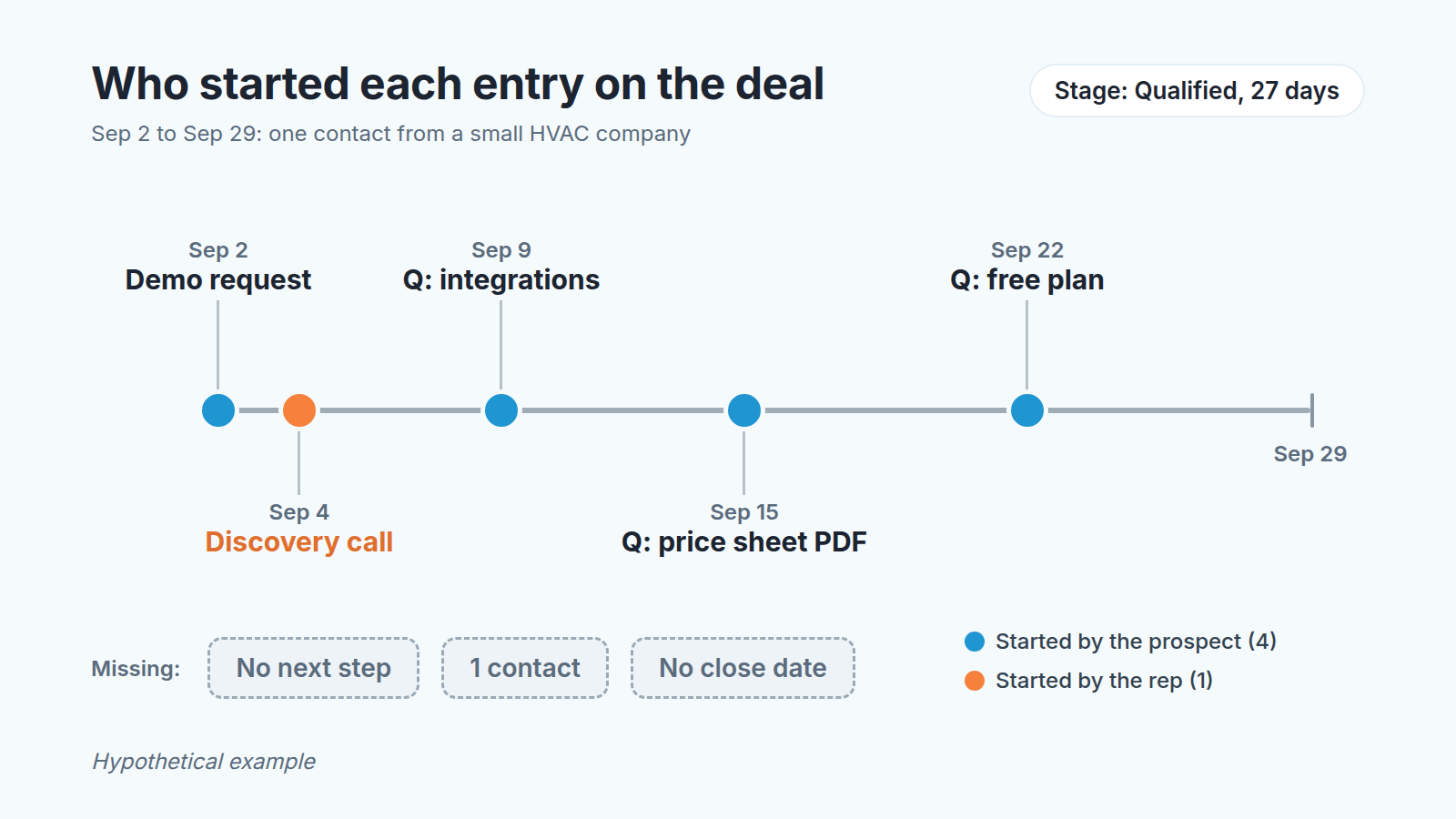
A hypothetical example. A rep sells scheduling software to service businesses, and on September 2 a deal is created from a demo request sent by the office manager of a small HVAC company.
- Sep 2: demo request comes in, deal created in “Qualified”, value $4,800 per year, one contact.
- Sep 4: discovery call, 30 minutes. Notes say “very interested, lots of questions about the mobile app.” No next activity scheduled.
- Sep 9: inbound email asking which accounting tools it integrates with.
- Sep 15: inbound email asking for a PDF price sheet “to share internally.”
- Sep 22: inbound email asking whether there is a free plan.
On September 29 the deal is 27 days old, still in “Qualified,” with one contact, no close date and no budget noted. Five entries on the timeline; four came from the prospect (the demo request and three emails), and the only thing the rep started was the discovery call. On a pipeline report it shows up as an engaged deal. Read entry by entry, it’s a curious person with no path to a signature.
None of these signals on its own proves anything. A deal with one contact can be a founder who signs everything. Three or more together, on a deal that hasn’t moved stage, is a pattern worth acting on. A tire kicker is at least a real conversation; padded deals are not, and they leave a different trail in the deal list.
Questions that expose a tire kicker on the first call
Deal data shows a tire kicker after the fact; the first call is where you can find out on purpose. Ask questions that need the prospect to give something back instead of only taking answers.
Keep them conversational. You’re not running an interrogation, you want the prospect to tell you how they’d actually buy.
- “What’s happening in the business that made you look at this now?”
- “If this worked, who else would need to see it before you could start?”
- “Is there a date you’d need this running by?”
- “Have you set aside a budget for it, or would that be a separate conversation?”
- “What are you using today, and what happens if you just keep using it?”
A buyer answers most of these without much trouble, even if some answers are “I don’t know yet, let me check.” A tire kicker gets vague on all of them at once, or steers back to features. Write the answers into the the deal while you’re still on the call. Whatever stays blank is your signal. It’s also what your manager will ask about.
The most useful move of the whole call comes at the end: put a specific next step on the calendar before you hang up, ideally a second call with the person who owns the budget. People who intend to buy usually agree. People who are only browsing tend to say “I’ll get back to you.”
When a buyer does agree, a shared plan for the next steps helps keep the deal moving after the call.
Ten minutes, not ten days
Our rule: after the first real conversation, spend ten minutes with the deal record and decide. Compare what’s written down with the table above. A scheduled next step with a second person from their side means keep going. If there isn’t one the deal gets one honest attempt to set it, and if that doesn’t produce a date, it leaves the active pipeline.
Ten minutes is enough because you are not trying to predict the future. You’re checking whether the prospect has done anything a buyer would do. That’s a short list, and it’s visible.
Why be this strict? Because the expensive part of a tire kicker isn’t the first call. It’s the three weeks after it, when the rep answers every email promptly because the deal might be real, and nobody makes a decision.
Every inbound question gets answered, since answering feels like selling. Put a limit on it: one reply with the useful answer and a link to documentation, plus one invitation to a call with a date. The custom PDF and the second demo wait until there’s a next step on the calendar.
Managers, this part is yours. In the weekly pipeline review, sort by days in stage and ask about every deal with no next activity. You’ll find the tire kickers in about the time it takes to read the list.
Closing them out without burning the bridge
Closing a deal as lost feels harsh when the person has been nice to you. It doesn’t have to be. You’re not rejecting them, just being honest that now is not the time.
Agreeing an upfront contract early in the deal makes this kind of ending easier for both sides.
Send one short message that makes the decision easy and leaves the door open:
Thanks for all the questions over the last few weeks. It sounds like the project isn’t budgeted yet, so I’m going to stop sending follow-ups for now. If that changes, or someone else on your team wants to take a look, reply here and I’ll set up a call. The docs link below answers most of what we covered.
Then close the deal as lost in the CRM with a reason you’ll be able to read later, something like “No budget / research only” instead of “Other.” If the conversation suggested a real project down the road, add a follow-up activity a few months out. If it didn’t, don’t.
We wrote down how to keep a lost reason you can read later, with a short list instead of free text.
Two things to avoid. Don’t leave the deal open “just in case”: it inflates the pipeline and your forecast carries it. And don’t move it back to a lead status without a note, because six months from now nobody will remember why it was there.
Some will even be relieved. They knew they weren’t buying and didn’t know how to say so.
Can a tire kicker turn into a customer?
Sometimes, yes. The office manager researching options today may get a budget next year, or move to a company that already has one. Someone who was treated with respect while browsing tends to remember who was straight with them.
But that happens on their timeline, not yours, and more follow-ups won’t speed it up. The honest play is to close the deal cleanly, leave a note that explains what you learned and let them come back when something on thier side has changed. If they do come back, it will be as a new deal with a reason behind it, and it will look very different in the CRM: a date, a second name and a next step they asked for.