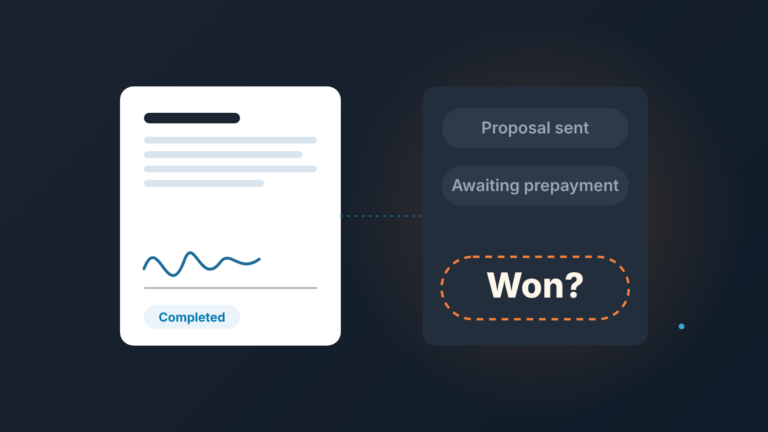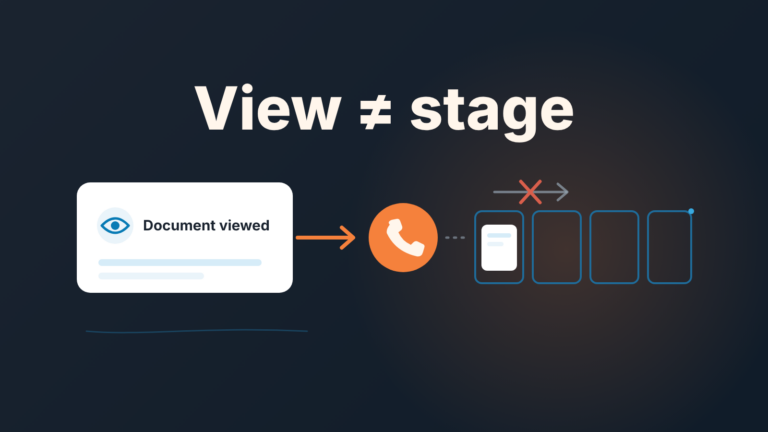
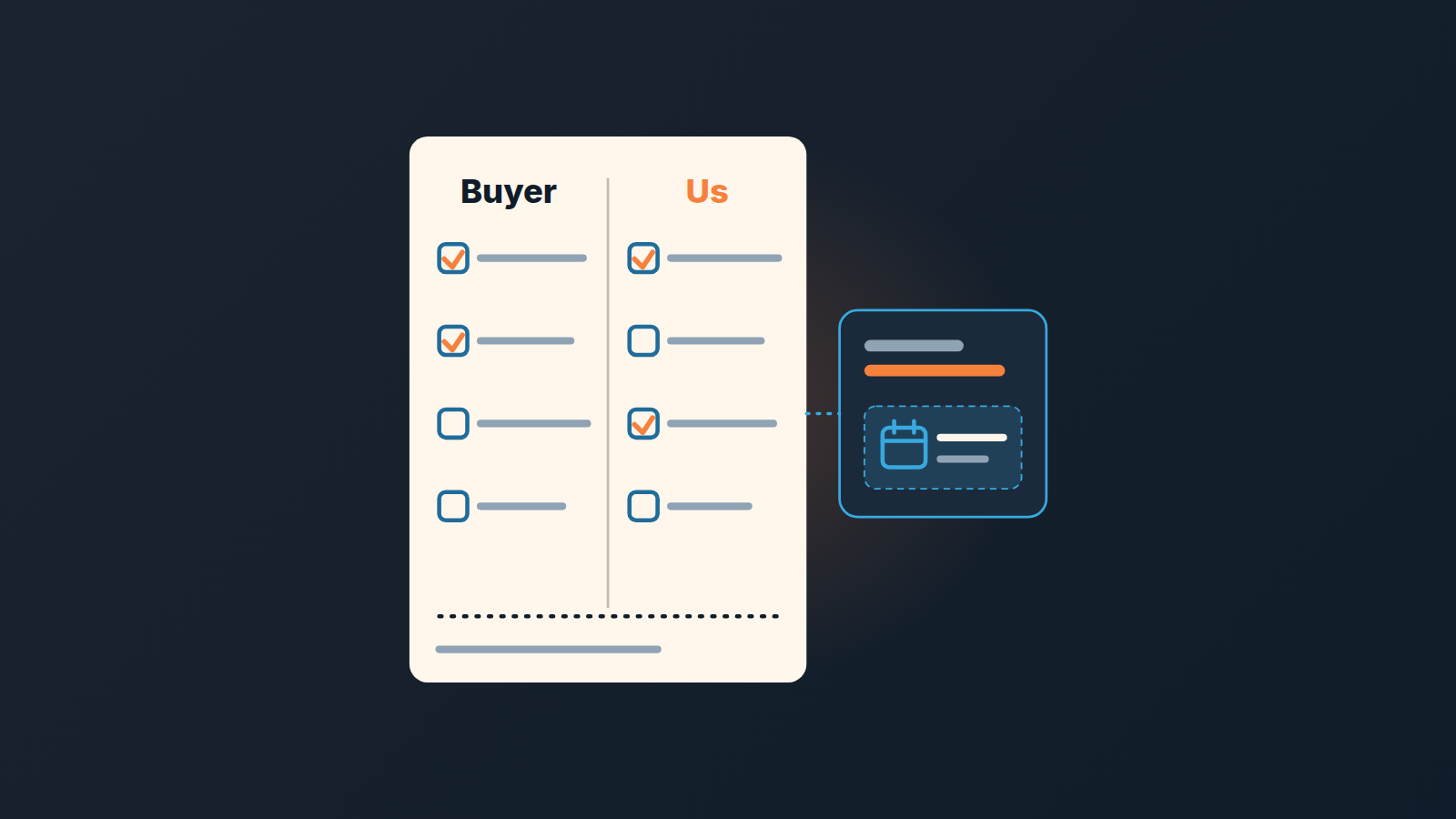
A mutual action plan (MAP) is a short shared list of what the buyer and you each do, by which date, to get from now to signed and live. For a small team the useful version fits on one page, is agreed with the buyer, and shows up in the CRM as a next step with a date.
Most of what you’ll find under “mutual action plan template” is a spreadsheet with a dozen columns. That’s fine for an enterprise account team with a deal desk. A team of five doesn’t need more columns. It needs to know which deals deserve a plan at all, how to get the buyer to write on it, and how a manager can tell on a Monday morning whether the plan is real.
Which deals need a mutual action plan
Not every deal. Our rule, offered as a starting point rather than a law: write a mutual action plan when a deal has more than one person on the buyer’s side who has to say yes, or when the buyer has a date they can’t move, like a contract renewal, a season, or a board meeting. If neither is true, the plan is overhead.
The first condition matters because a deal with several approvers fails in places you can’t see. Your champion is keen, but finance hasn’t heard of you and IT will want a security questionnaire the week before signature. A plan forces those people onto paper early. If you can’t name them yet, that is its own finding, and the single-threaded deals piece covers what to do about it.
If legal is the step that keeps slipping, track it separately, with the questions to ask the buyer.
The second condition matters because a fixed date gives the plan something to count back from. “We need this live before the new sales year starts” turns into a sequence almost by itself: contract signed by X, onboarding call by Y, data import by Z. Without a real date the dates on the plan are ones you invented, and the buyer knows it. If the work itself needs defining first, add a statement of work as its own step.
One more filter: the size of the deal relative to your usual one. A plan costs you some drafting time and part of a call to agree. For a deal that’s much bigger than your average, that’s cheap insurance. For a deal that looks like the rest of your pipeline, it probably isn’t.
The one-page version
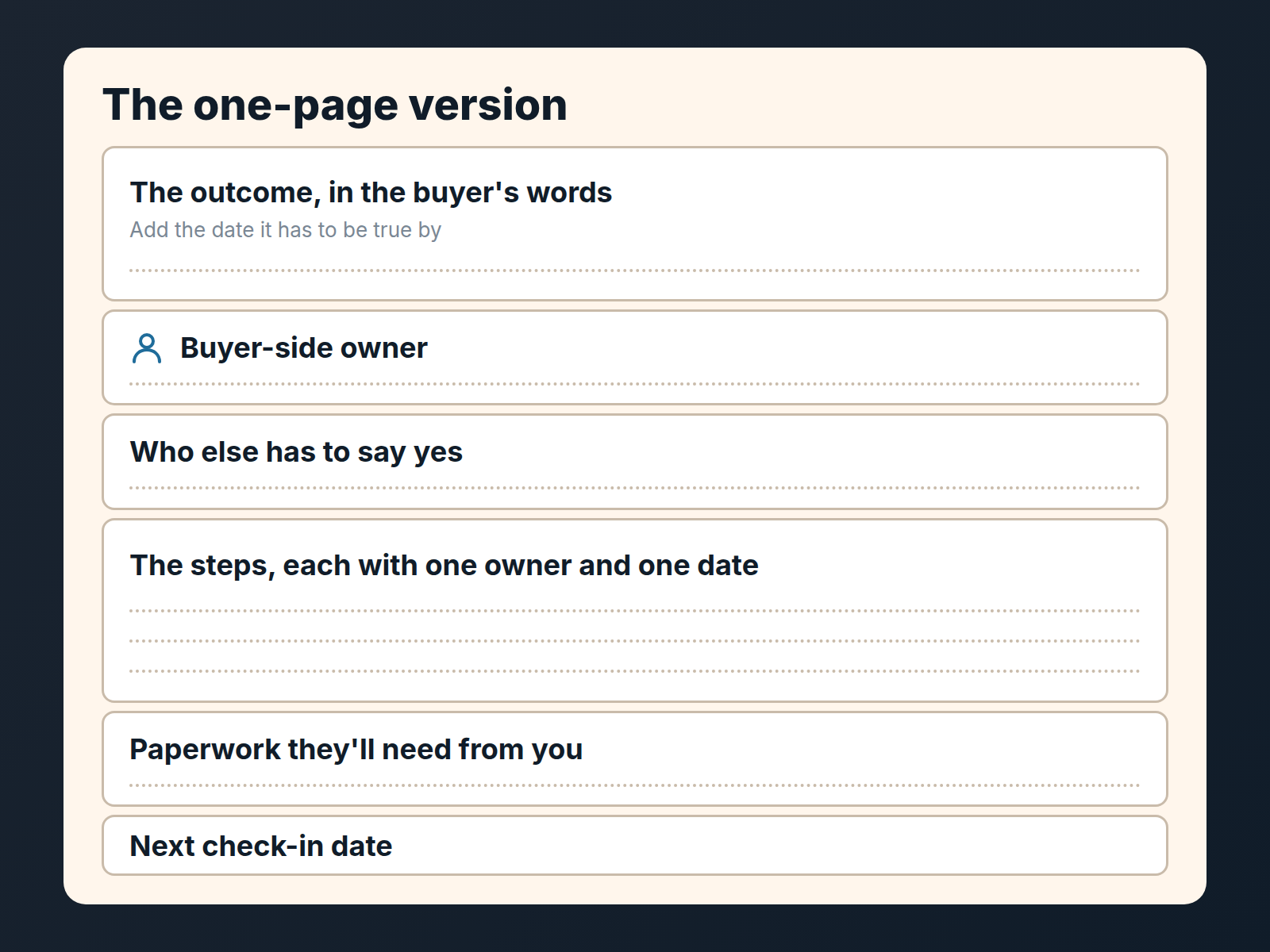
A one-page mutual action plan has six lines. They don’t all get the same attention.
- The outcome, in the buyer’s words. Use their phrasing from the call (“reps stop updating two systems”), not your version of it (“implement the CRM integration”). Add the date it has to be true by, and whose date it is. If the buyer can’t give you this line, stop and go back to discovery.
- Buyer-side owner. One name, a person on their side who has agreed to keep the plan moving. Your name goes next to it, but theirs is the one that counts.
- Who else has to say yes: names where you have them, roles where you don’t yet, and a mark next to anyone you haven’t spoken to.
- The steps, each with one owner and one date. Keep it to what actually has to happen before go-live: a technical check, a pricing review, legal, a kickoff. What happens after go-live belongs on a separate client onboarding checklist. If the list runs past what fits on the page, you’re describing your internal process, not theirs. For the technical check, see when to pull in a sales engineer.
- Paperwork they’ll need from you (security answers, a DPA, references), with the date they need it.
- Next check-in date.
That’s it. No “success metrics” section with three sub-bullets, no RACI grid. Close’s guide to mutual action plans lists five components: objectives, actions, owners, timeline and metrics. The one-page version keeps all five and folds metrics into the first line, because for a small deal the outcome and the measure of it are usually the same sentence.
Where it lives matters less than who can edit it. A shared doc both sides can write in beats a PDF you email over. Salesforce’s write-up on mutual action plans also calls it a mutual close plan or joint execution plan and makes the same point from the other end: the plan should live in the CRM and be kept up to date, not sit in someone’s downloads folder.
The plan ends at signature, but the customer’s experience does not: what you learned on the way should reach the next owner through a short closed-won handoff, not through the buyer repeating it.
How to bring it up without a 20-slide deck
The fastest way to kill a mutual action plan is to present it. A buyer who sees a formatted document titled “Mutual Action Plan” hears procurement, and procurement means someone is about to be held to something.
So don’t introduce the document. Introduce the question, and pick the moment: after discovery, once the buyer has named a date, not on the first call. Toward the end of a good call, when they’ve just told you when they want this running, ask them to walk backwards from that date with you. You write while they talk. The plan is a by-product of a conversation they were already happy to have.
Here’s an example of the line, not a script to read out:
“You said you want reps on this before the new quarter. If we work back from that, what has to happen on your side, and who does it? I’ll jot it down and send it over so we’re both looking at the same list.”
Then send it the same day, as a shared doc, with their name already on the owner line and one question left open for them to fill in. The open question is deliberate. Our bet is that a buyer who has written on the plan once will do it again; one who has only read it may never open it twice. The plan sticks when it has a champion who owns the plan on the buyer side.
If you’re already in a deal where the buyer has gone quiet, this isn’t the moment to introduce a plan cold. Sort out the silence first; what to do when a prospect goes silent after the demo has the sequence for that.
Keeping it visible in Pipedrive
A plan that only lives in a Google Doc is invisible to anyone who isn’t the rep. The manager shouldn’t have to open ten docs to know which deals have a plan and which of those plans is slipping. The trick is to mirror three things in the CRM, not the whole plan.
One caveat before the steps: how many custom fields you can add depends on your Pipedrive plan’s limits, so check yours before you build anything. Here’s what we’d set up:
- Paste the link to the plan into a note on the deal and pin the note. A pinned note stays at the top of the deal’s history, so nobody has to scroll for it.
- Make the deal’s next activity the next date on the plan, and put the buyer-side owner’s name in the activity subject: “Security answers due, owner: their IT lead.” Now the plan shows up wherever your team already looks at activities.
- Add a single option custom field, something like “MAP agreed,” with Yes and No as the options. Deal filters can match on it.
With those three in place, a manager can build a filter for open deals in your later pipeline stages where “MAP agreed” is empty or no. That’s the Monday list. Its short, and every deal on it is a conversation.
If you already score deals, the plan gives you a clean input: plan agreed, buyer-side owner named, next plan date in the future. We go through how to weigh signals like that in the deal health score article.
When the buyer won’t touch it
You sent the plan. They said “looks good.” Nobody on their side has opened it since.
That is information, and it’s worth taking seriously instead of politely ignoring. A mutual action plan the buyer never edits is your checklist with a nicer name. It tells you what you intend to do, and nothing about what they intend to do.
The most telling gap is the owner line. If you can’t get a person on the buyer’s side to put their name next to the plan, you don’t have a champion, you have a friendly contact. That’s a deal-risk signal on its own, regardless of how warm the calls feel. It usually means one of three things: the person you’re talking to doesn’t have the authority to commit their colleagues’ time, the project isn’t a priority for them this quarter, or they’re comparing you with someone else and don’t want to be seen committing. Each needs a different response, but none of them is fixed by sending the plan again with a friendlier cover note.
What does help is asking directly, once, and in plain words. Something like: “I’ve noticed the plan hasn’t moved. Is the date still real, or has something changed on your side?” A buyer who’s still serious will tell you what changed. A buyer who isn’t will usually tell you that too, just more slowly.
The same test applies when the buyer asks for a trial: a pilot with a named decision-maker and a decision date is a deal, anything else is a favour.
Hypothetical example: a rep has a deal where the buyer agreed to the plan on a call, but the owner line still reads “TBD” three weeks later and every step on the list belongs to the rep. The deal still sits in a late stage with a confident close date. On the plan, it’s a deal nobody on the buyer’s side has claimed. That is the one to talk about in the pipeline review, before the close date slips rather than after.
Where a MAP doesn’t help
Short, transactional sales. If one person can decide, the price is on your website, and deals close in a call or two, a plan adds a step between the buyer and the purchase. Skip it. The same goes for for renewals where nothing is changing and for deals where the buyer has already sent you their own procurement timeline; in that case, use theirs and mirror its dates the same way.
And a plan won’t rescue a deal where there’s no real problem to solve. It organizes a decision the buyer is already moving toward. It can’t create one.