Pull a technical person into a deal when the buyer’s question goes past what the rep can answer, and write three things down once: why you are calling them in, who is in, and what they found out. In Pipedrive that is one explicit mark on the deal, one note before, one note after. You do not need a sales engineer on the payroll. You need the ritual.
Most of what ranks for “sales engineer responsibilities” describes a job: the person who answers the buyer’s technical questions, runs a demo around the buyer’s own scenario and handles the security review. This is for the team of four to ten where that job goes to whoever knows the product best, usually a founder.
Three weeks of helping, and nobody knows what he said
Anders runs a nine-person company and still knows the product more deeply than anyone selling it. Over three weeks he joins calls on three deals because the reps asked. On one he explains how the API handles rate limits. On another, data residency. On the third he says, roughly, “we could probably have that export format ready by the end of the quarter.”
None of it is in Pipedrive. When the proposal for deal three gets built, nobody building it knows an export format was promised. The buyer does.
That is the whole problem. Not that Anders joined. That the deal has no trace of why he joined or what he left behind.
Three signs it is time to call in a sales engineer
“When the deal is complex” is not a trigger. Complexity is a feeling, and every rep feels it differently. What works is something you can see in the deal itself. We use three signs.
The first is the second “I’ll check.” A buyer asks about an integration or a security control, and the rep says “let me confirm that.” Fine, once. The second time, the rep is relaying between two people who should be talking directly, and every relay loses detail. Schedule the person who knows. If the question arrived as a formal document, the security questionnaire has its own routine.
The second is a new name on the buyer’s side. Usually small-team deals run through one or two contacts. When an IT lead or a developer asks to join the next call, the buyer has decided the decision is partly technical. Put a technical person of your own opposite them. (If the person you need is a manager rather than an engineer, that is a different routine.)
The third is the demo leaving the script. The moment the buyer says “can you show me what happens if” and the rep starts improvising, the rep is making product claims in real time. Some will be right. Some will be the export format by end of quarter. Offer a second session with someone who can actually show it.
A manager can ask on Monday which open deals have had a second “I’ll check” and get an answer. Nobody can answer “which deals feel complex?”
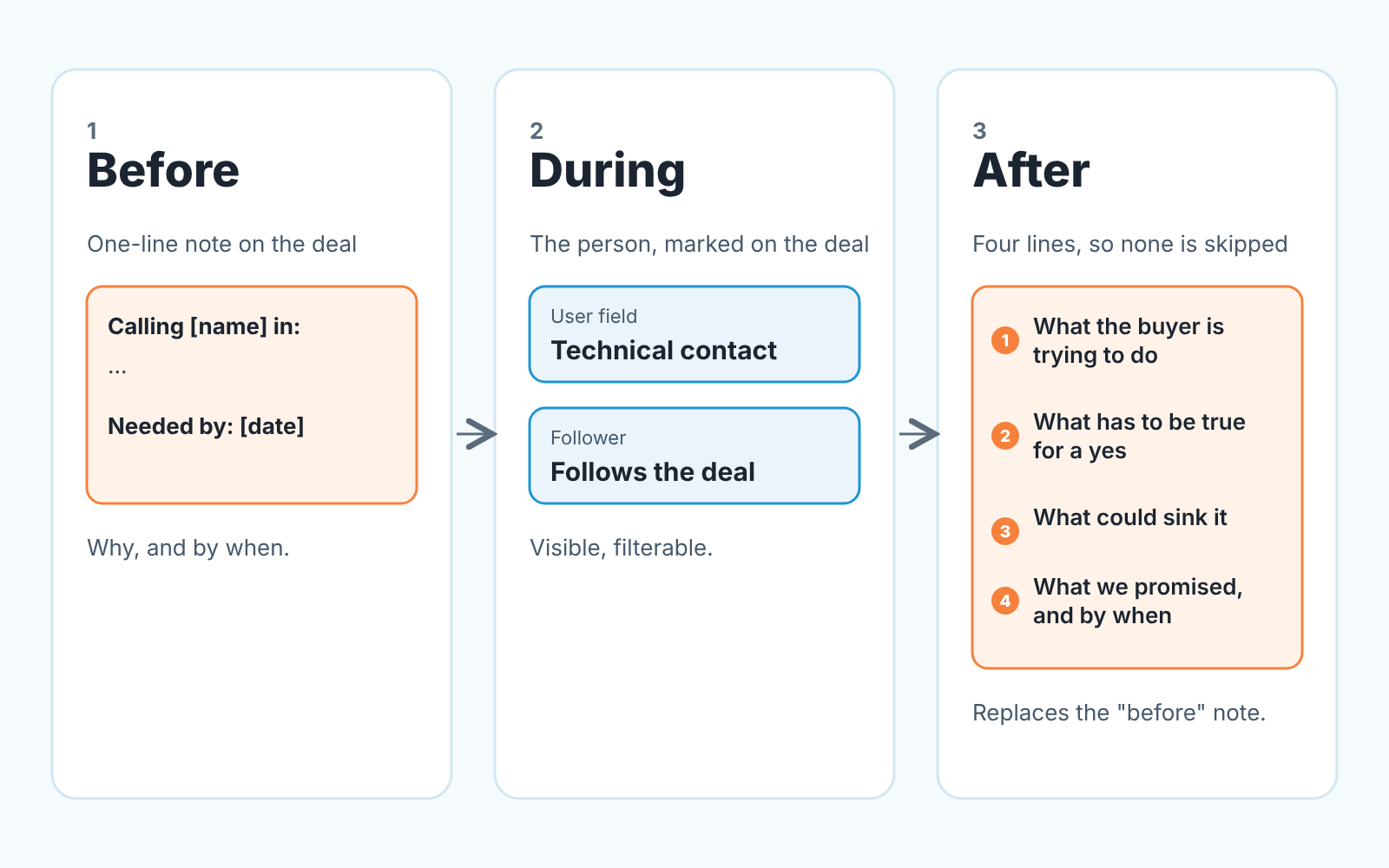
Before: one sentence that says why
Most teams skip the the note before the call because it feels like admin. It is really the brief for the technical person, and it stops a product tour when the buyer wanted one answer. One sentence plus a date, on the deal:
Calling Anders in: buyer’s IT lead (Hedda) needs to know whether our SSO works with their identity provider and what the audit log covers. Answer needed before their Thursday review.
Anders reads it in ten seconds and knows what to prepare. Writing it also makes the rep pin down the real question, which often shrinks it. If your team already uses mentions and pinned notes, pin this one until the “after” note replaces it.
Marking the person on the deal: User field or follower
A Slack message does not count. If the involvement is not visible in Pipedrive, nobody can filter for it or see who to ask. Pipedrive gives you two ways to make it visible.
A custom field of type User lets you “tag a Pipedrive user from your Pipedrive account”; it is one of 16 custom field types (Pipedrive: custom field types). The tagged person gets nothing automatic, but the team gets a column to filter on: open deals where “Technical contact” is not empty. You create it once under Personal preferences > Data fields, and it needs the right global permissions (Pipedrive: custom fields).
A follower is a subscription to the deal, added via “Add follower” in the menu at the top of the detail view. The follower sees changes to the deal in their Notifications panel in real time (Pipedrive: followers). No setup, and nothing to filter the pipeline by.
We use both: the field for the manager, the follower for the technical person. Follow the deal, not the user, since following a user shows everything they own regardless of visibility groups (the out-of-office routine covers why).
Neither one assigns a role. The process is the two notes around the mark.
After: a note in four lines
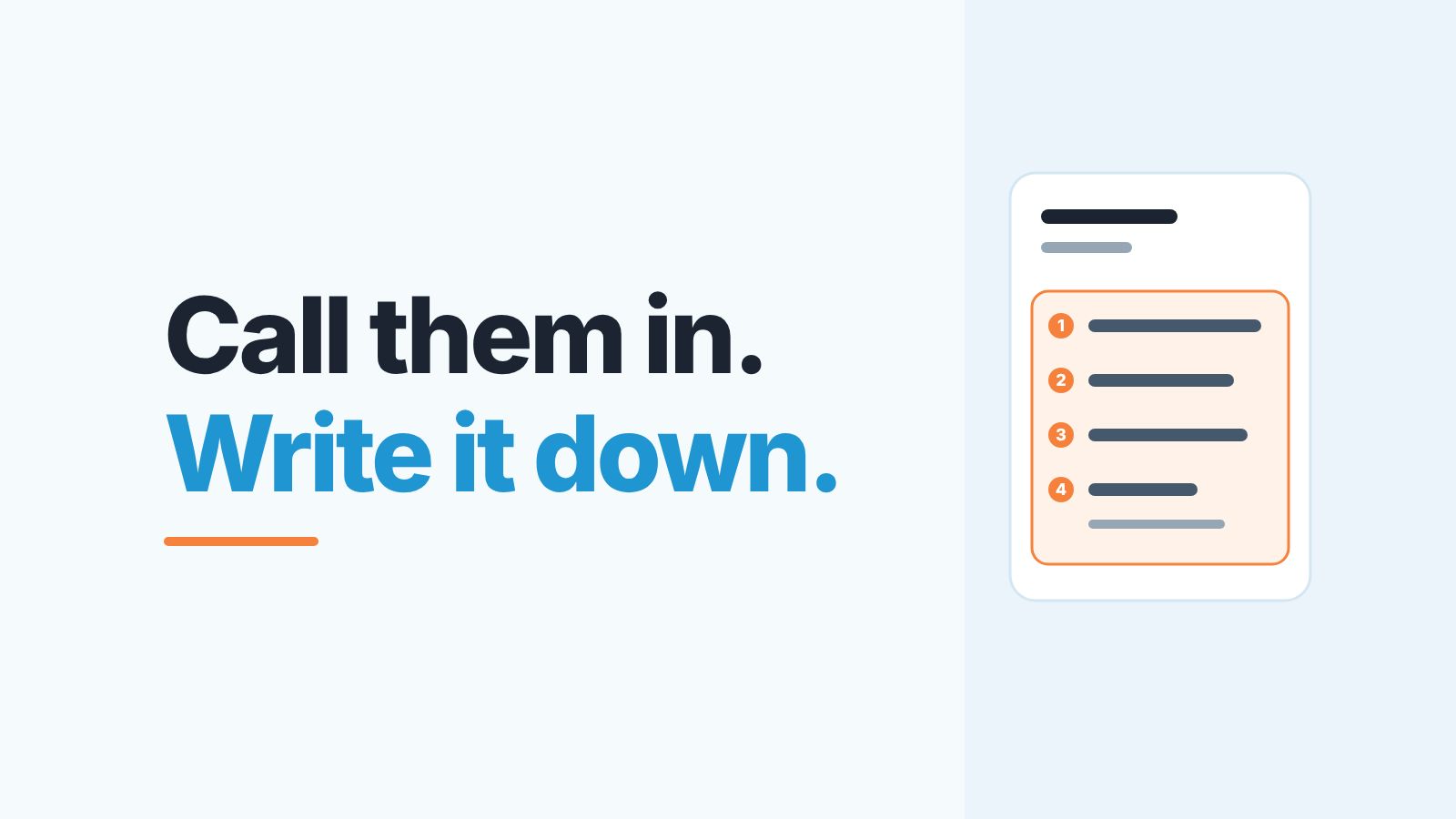
The technical person is done when the next person to open the deal can read what happened without asking. Four numbered lines, so nobody skips one:
- What the buyer is trying to do: “SSO, because their policy forbids local passwords for vendor tools.”
- What has to be true for a yes: “Audit log shows who exported what.”
- What could sink it: “Their identity provider is one we have not tested.”
- What we promised technically, and by when: integration dates, file formats, anything engineering now owes. “Confirm the identity provider by Friday.”
Line four is the one that saves you. It is where “export format by end of quarter” would have lived, visible to whoever builds the proposal. The deal never changed hands, so this is not the closed-won handoff. Note in, activity closed, rep carries on.
We build SalesBond, a sales management layer on top of the CRM a team already uses; we started with Pipedrive. Deal Health checks every deal against the rules you have switched on. It does not know who joined a call or read their notes, but it does see a deal with a call last week and no fresh note or next activity since, which is exactly where Anders helped and nobody wrote it down. Check your CRM with SalesBond to get that list without building the filter yourself.
When the ritual stops being enough
The ritual works while the technical person helps on a handful of deals a month. It stops working when answer dates in the “before” notes keep slipping because that person has a day job and thier own deadlines. Or when the rep writes the note and never books the call, because a fourth hour from the founder this week feels like too much. The deal record is telling you that technical questions are now a steady part of how you sell.
That is the moment to hire, or to give someone the role with the time to do it. You will not hire blind: the notes already say what buyers keep asking and what kept being promised. The same record makes a founder stepping back from sales survivable.
For now, start with the next deal where someone says “I’ll check” twice. Anders can keep helping. The deal just has to remember it.