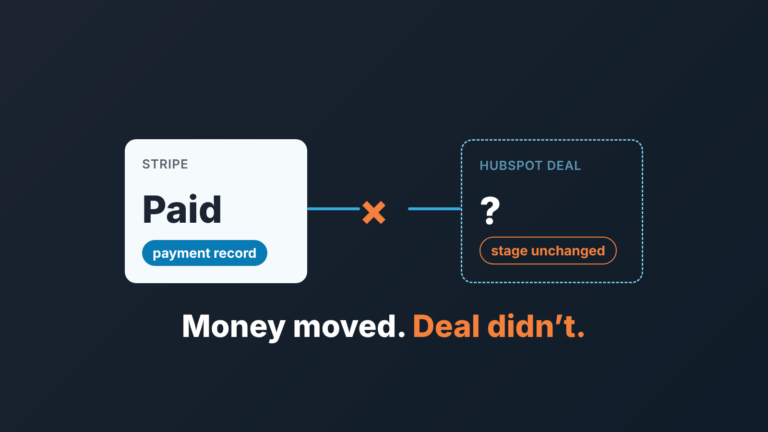
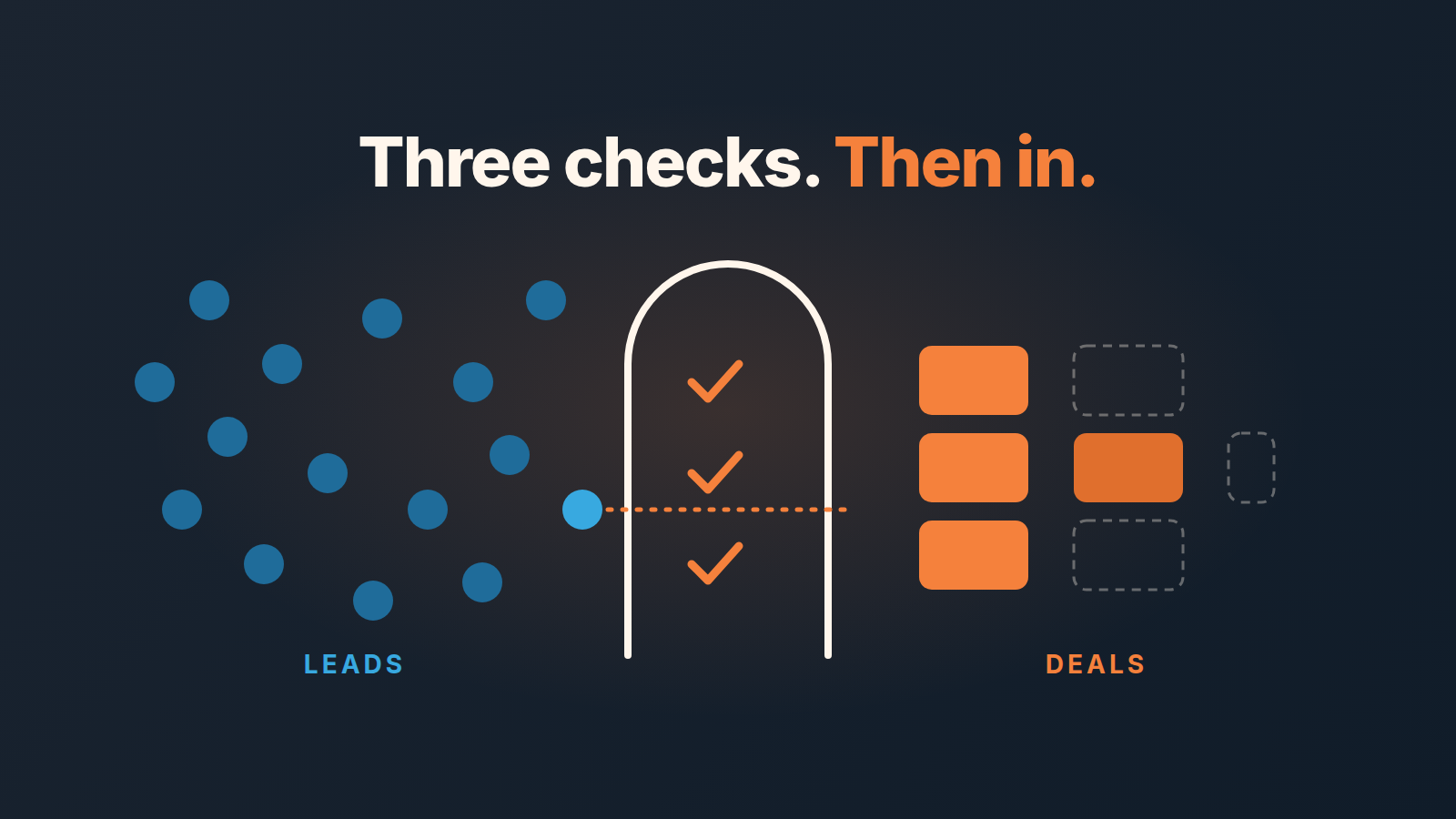
A lead becomes a deal in Pipedrive when three things are true at once: the person has confirmed interest with a reply or a meeting, you know which pipeline the opportunity belongs in, and a next activity with a date is on the calendar. Anything short of that stays in the Leads Inbox, with a label and an expiry, and stays out of your stage statistics. That is the whole rule. The rest of this article is about why the line sits there, how to write it into a team agreement that five people apply the same way, and what to do with the leads that are already piling up.
Why your pipeline has 60 deals and nobody can say what half of them are
Picture the Monday review. The manager opens the first stage, scrolls, and starts asking. “Who is Acme?” A web form from March. “And this one?” A badge scanned at a trade show. “This one has a value of 12,000, where did that come from?” The rep shrugs; it was a guess, the field was required. Twenty minutes in nobody has discussed a deal that might close this month.
This is not a discipline problem. It is a default problem. “Add deal” is the button everyone learns first, and a deal in the first stage looks better on the Monday report than nothing does. The Leads Inbox is a separate place that someone has to decide to use, and Pipedrive’s own guidance on when to use it is soft on purpose: convert when you are confident a sale is possible, for example when a prospect replies to an automated email with interest, when they match your business goals, or when you take the first outbound action for the first stage (Pipedrive: when should a lead become a deal). Those are good instincts for one person. They are not a rule five reps apply the same way on a Tuesday afternoon.
So the fix is a rule, written down, short enough to say out loud. First, though, what a lead and a deal actually are in Pipedrive, because the common mental model is wrong.
Leads and deals are not “early” and “late”: what really differs
In Pipedrive, a lead is a record in the Leads Inbox, with no pipeline stages. A deal is a record in a pipeline, and it moves through that pipeline’s stages (Pipedrive: leads vs deals).
Most people still think of a lead as an early deal. It is a different kind of record, with less you are allowed to attach to it. A lead has no pipeline stage tracking, no documents, no formula fields, no participants, no changelog, no invoicing and no link to products or projects (same source). A deal has all of that.
Read that list again as a test rather than a limitation. Do you need a second person on the record, say the budget holder who joined the call? That is a participant, so it is a deal. Do you need to send a proposal and keep it attached? Documents, so a deal. Do you need to know how long it has been sitting between two steps? Stage tracking, so a deal. If none of those apply, if it is a name, a company and a maybe, you are holding a lead, and the lighter record is the honest one. Lighter does not mean free, though: leads and deals share one limit in Pipedrive.
Nothing is lost by waiting. When you convert, Pipedrive carries over the person, the organization, notes, mentions, comments and activities, and you can convert a whole batch from the list view in one go (same source). After conversion the lead no longer sits among the open items in the Leads Inbox; in your lead statistics it is counted as closed. So cleaning the inbox and keeping the lead report honest turn out to be one job. The road also runs the other way: a stalled deal can go back to the Leads Inbox, but check what that conversion drops first.
One consultancy argues that warm leads should skip the inbox and go straight in as deals, and that leads earn their keep mainly when you do not yet know which pipeline the opportunity belongs in (Ops Designed: lead vs deal in Pipedrive). We half agree. “Warm” is exactly where teams disagree, and the pipeline question is only one of three things to know before a deal exists.
A three-line rule for converting
Write this in the team wiki, in these words or your own, and read it at the next stand-up:
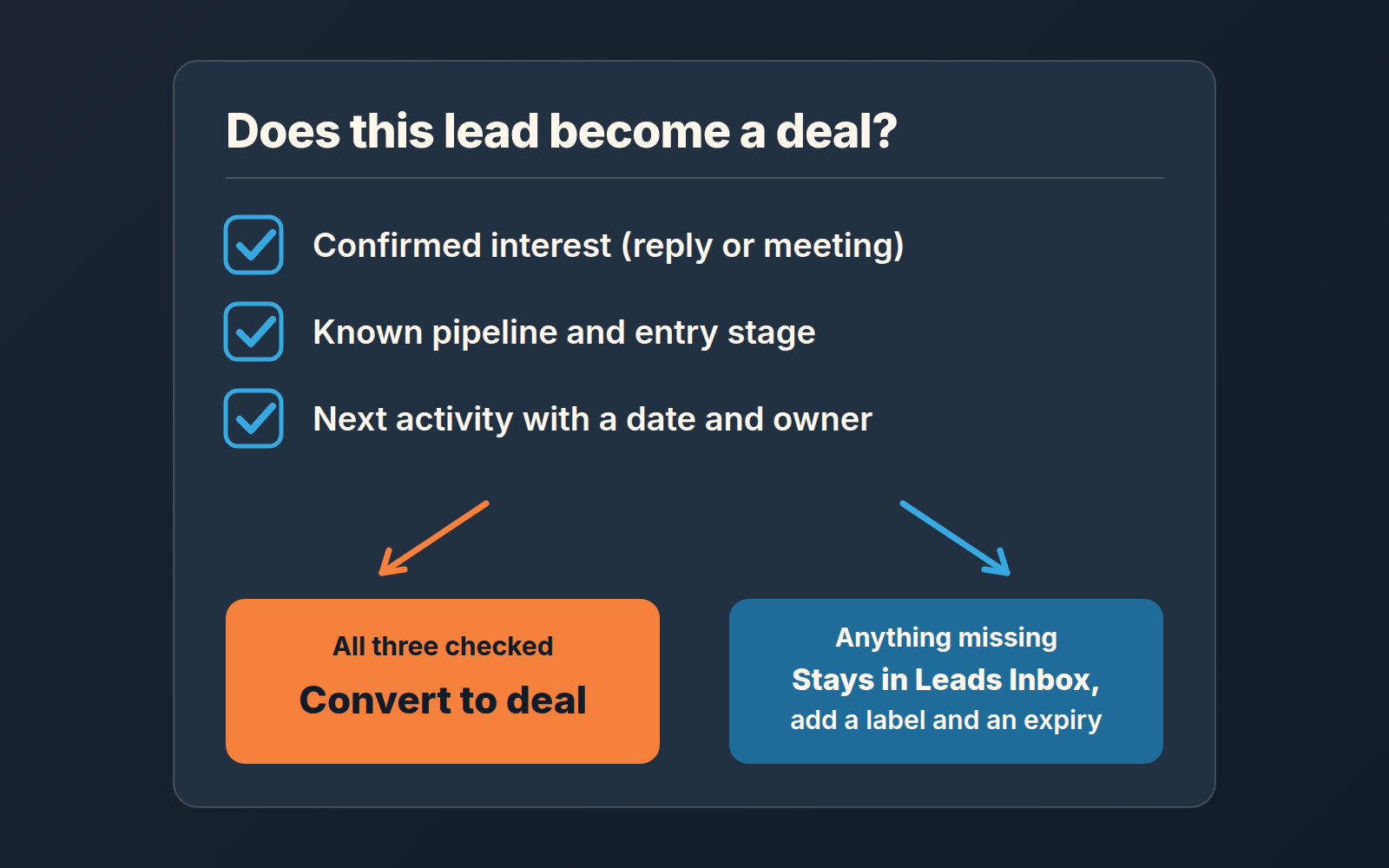
- Confirmed interest. The person replied, or a meeting took place or is booked. A form submission, a download or an automated reply does not count; someone on their side chose to talk to you.
- A known pipeline. You can name the pipeline, and the stage it enters, without guessing. If you are unsure whether it is new business or an upsell, it is not a deal yet.
- A next activity. A dated next activity with an owner exists before the deal is created, not after someone remembers.
All three, or it stays a lead. Two out of three is the usual failure: interest plus a pipeline, and no next step, which produces a deal that is real but already stalling on day one. A required next activity on the first stage closes that gap mechanically; we described how to set that up in the fields we make required in Pipedrive.
A consultancy that works on Pipedrive setups puts the reasoning behind line one well: a deal should not enter the pipeline without a non-zero chance of closing (Process Culture on the Leads Inbox). “Non-zero” is hard to see from the outside, so line one is the operational version: a human on their side responded. Not an auto-responder, not a pixel. A person.
On the stand-up it sounds like this: “From now on, nobody creates a deal from a form. Forms land in the inbox. A deal gets created when they have answered you, you know the pipeline, and the next call is on the calendar. If you are not sure, it is a lead.”
When a form does land in the inbox, let it fill the source too; our guide to lead source from web forms shows how.
The Leads Inbox needs an expiry date
Leads that have not passed the rule live in the Leads Inbox, each with a label, an expiry and a weekly archive pass. Leads sent back with a date are a special case, because the archive is the one place they must not go: see lead recycling in Pipedrive. The rule stops new junk from reaching the pipeline. It does nothing about the two hundred leads already sitting in the inbox, and an inbox nobody trusts gets ignored, which is where response time goes to die (we covered that side in speed to lead).
What makes the inbox workable is that Pipedrive gives you labels, filters whose results can be exported, bulk editing of Title, Labels, Value, Owner, Visible to and Source channel, and an archive (Pipedrive: Leads Inbox). That is enough for a lifecycle, as long as you decide teh lifecycle. A label only helps if everyone reads it the same way, so it is worth writing a label rule too. Ours has three labels and a clock:
| Label | What it means | Lives for | Friday action |
|---|---|---|---|
| Waiting on them | We reached out; no reply yet | 30 days from the last touch | Archive if still silent, or convert if they answered |
| Nurture | Real company, no project this quarter | 90 days, then review | Re-touch once; archive if nothing changed |
| No fit | Wrong size, wrong country, student, competitor | 0 days | Archive the day you decide |
Archive, not delete. Pipedrive keeps the lead’s files through archiving and unarchiving (same source), so a lead that comes back in six months comes back with its history. Deleting feels tidier and costs you the one thing the inbox was for, which is memory. Deals need one extra step first, and there is a separate guide on how to archive old deals and leads in Pipedrive.
The Friday part is a fifteen-minute habit, one person, same time every week. Filter the inbox by label and last activity, select the batch, bulk edit or archive, done. The week it gets skipped is the week the inbox starts growing again, so put it in the calendar of whoever owns inbound, not “the team.”
What stuffed-in leads do to your numbers
A lead that gets created as a deal lowers your stage-one conversion and your win rate, and it stretches the average time deals spend in the first stage. This is usually the part that convinces a manager, because the damage is quiet.
Stage conversion first. Conversion from stage one to stage two is the share of deals that entered the first stage and made it to the second (how we read stage conversion rates in Pipedrive). A lead-deal enters stage one and dies there. Every one of them lowers that first conversion and the manager reads the drop as “our discovery call is weak” when the real story is that half the input was never a conversation. You then spend a quarter coaching the wrong step.
Win rate next. Win rate counts won deals against everything that closed, won or lost (win rate in Pipedrive, and what to count). Lead-deals end as lost, months later, in a cleanup, so they land in the denominator with no chance of ever having been in the numerator. Or they never close at all and sit in open pipeline, where your forecast picks them up at whatever value the rep guessed when the field was required.
And cycle length: a record that sat untouched for a season before someone marked it lost drags the average time in stage one upward.
Here is an illustration with invented numbers, only to show the shape. Take a team with 40 real deals in a quarter, all of them closed by the end of it: 28 reach stage two, so stage-one conversion is 70%, and 12 are won, so win rate is 30%. Now add 20 lead-deals that sat in stage one and were eventually marked lost. Same 28 reach stage two, but out of 60, so the first conversion reads 47%. Same 12 won, but out of 60 closed, so win rate reads 20%. Nothing about the selling changed. If the 40 real deals spent 5 days each in stage one and the 20 lead-deals spent 45, the average time in stage one moves from 5 days to about 18. A manager who does not know the inbox rule was skipped starts fixing a discovery problem that does not exist.
Finding them takes about ten minutes. Open the deals list, filter for the first stage, no next activity scheduled, created more than 30 days ago. Sort by last activity. Every row with no activity ever done is a lead wearing a deal badge, and the count tells you how far your stage-one conversion is being pulled down. Then split the rows in two. The ones with a conversation still worth having, just not yet, go back where they belong: Pipedrive can convert a deal into a lead from the deal’s detail view, under the “…” menu in the top right corner (Pipedrive: when should a lead become a deal). Put the reason you might return in the lead’s title. The dead ones you close as lost, with a reason you will be able to read later (“never qualified” works). Yes, that puts them in this quarter’s lost column once. A one-off cleanup with a named reason is easier to explain at the next review than a stage-one conversion that stays wrong every quarter. The stage-by-stage version of this walk-through is in our Pipedrive audit.
A disclosure, since this is where tooling comes up. We build SalesBond, a sales management layer on top of the CRM a team already uses; we started with Pipedrive. A deal with no next activity and no sign of a conversation is the kind of record it exists to point at, every day rather than on the Friday you remember. Check your CRM with SalesBond. The rule works without it; the tool only makes a skipped rule visible sooner.
Edge cases: referrals, warm inbound, bought lists
Referrals from a current customer are the easy case. The customer has already told the person about you, the pipeline is obvious, and the first reply usually comes with the introduction. Book the call, create the deal, skip the inbox. This is the one place the “warm leads go straight to deals” advice is right as written.
A current customer asking about a renewal or more seats is just as easy if the team keeps a separate pipeline for renewals.
Warm inbound is where teams cheat. A demo request from a good-looking domain feels like interest, and the rep creates the deal at value 10,000 before anyone has spoken. It is still a form. Until the person answers an email or shows up to the slot they booked, it is a lead, and the right response is speed, not promotion. Put it in the inbox, label it “Waiting on them”, and let the the response-time target do its work. The ones who answer convert the same afternoon, which is the point. It is easier when sales and marketing agree what counts as a lead worth the time of a closer before the forms start coming in.
Bought lists and event scans are the opposite problem. Two hundred badge scans are not two hundred leads; most of them are people who wanted the pen. Load them into the inbox only with the source channel set, so the Friday cleanup can archive the whole batch with one filter when the sequence ends, or keep them out of Pipedrive entirely until a first reply exists. A list in the CRM is not pipeline. A card from a trade show is the usual test case: lead or deal after an event depends on whether anyone has actually replied, not on how good the conversation felt.
The partner-sourced lead, where you cannot tell which pipeline it belongs in, is the case leads were built for. Keep it as a lead, write the open question in the title, and let line two decide the day the answer arrives.
If the rule feels strict, that is the intent: the cost of strict is a lead that waits a day longer in the inbox, and the cost of loose is another Monday review spent on names nobody recognises. We have written before about the deals that eat your week; the lead-deal is their quieter cousin. This week, put the three lines in the team wiki, book the first Friday pass on the inbox, and see how many stage-one deals are still standing by the next Monday review.