
Lead recycling is what happens to a lead after a closer sends it back as “Not now, with a date”: it stays in the Leads Inbox under the finder’s name, carries the date as a scheduled activity, and comes back to sales when the buyer gives a signal or the date arrives, whichever is first. The archive is not part of that loop. In Pipedrive an archived lead cannot take a new activity and cannot be converted, so archiving a not-now lead is a decision to never pick it up. Here is how we run the months in between.
A lead that said March
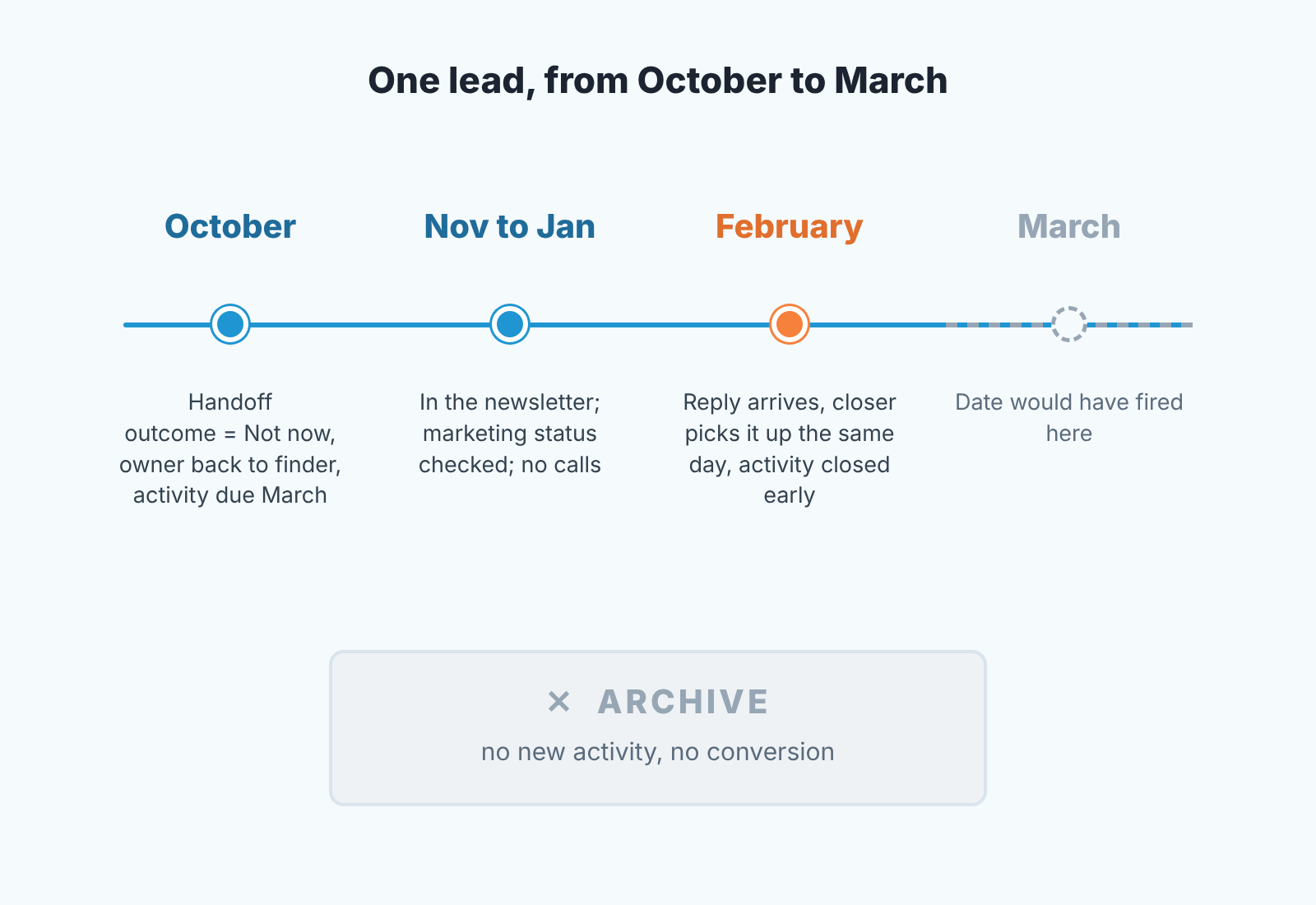
An illustrative example; the company and the people are invented. Larkspur Freight sells logistics software to warehouses. Corwin finds leads, Brenna closes them, and the two of them signed a lead handoff agreement in the spring. In October Brenna calls a warehouse operator who filled in the demo form. He is interested. He is also moving to a new site in March and will not look at software before then. She sets the Handoff outcome field to Not now, puts March in the note, and changes the owner back to Corwin.
Then nothing happens for four months, which is exactly what should happen.
In February the operator replies to Corwin’s newsletter with one line: does the price include the second site? Corwin forwards it to Brenna. The rest of this article is why that worked, and what would have happened if someone had archived the lead in October to tidy the inbox.
The one reason that comes back
The agreement already does the sorting. Of the five values in its Handoff outcome field, Not now with a date is the only one that always sends a lead back rather than closing it, because the buyer named the moment. This article is about those leads only. The other four belong to the agreement.
That is also why we did not invent a separate list of recycling reasons. Two lists for one decision means two lists that disagree within a year.
Where the date lives
Pipedrive has no “recycled” status, and we did not try to fake one. The not-now lead stays in the Leads Inbox, which Pipedrive describes as a space for unqualified leads (Pipedrive: Leads Inbox). The owner field says Corwin. The Handoff outcome field says Not now. What is new is one scheduled activity on the lead, which Pipedrive allows alongside its notes, emails and files (same source): a call titled “Pick up again”, due on the date the buyer gave. At Larkspur the lead belongs to Corwin and the March call belongs to Brenna.
We put the date on an activity, not in a custom date field, because a field is a record. It tells the truth to anyone who opens the card and reminds nobody. An activity has a due date and has to be done or consciously skipped.
No label either; the handoff article explains why a small team keeps labels for temperature. A custom filter on owner and Handoff outcome gives Corwin the whole waiting list in one view.
Who holds it in the meantime
The finder holds it. That is what sending a lead back means in the agreement, and a lead with a date four months out is a lead nobody feels responsible for unless the owner field says who.
Holding a not-now lead is light work. It stays on the newsletter and gets no calls or “just checking in” emails before its date, which teh buyer has already said he does not want. Before anything goes out, Corwin checks the contact’s marketing status, because a buyer who said “March” and also unsubscribed has told you two things, and the second one wins (marketing status and unsubscribed contacts in Pipedrive). If the contact changes jobs or the company is sold, the finder closes the lead with a different reason. Otherwise it waits.
Once a month Corwin adds one column to the ten-minute count the agreement already asks for: Source, next to Handoff outcome, for the not-now leads only. A campaign that produces most of the “call me next quarter” answers is reaching the right companies at the wrong time. That is a timing problem, not a targeting one. If Source is not filling in cleanly, start with lead source tracking for web forms.
Coming back on a signal, not on a date
The date is the fallback. The plan is a signal: a reply, a second form fill, a pricing question, a new person in the buying role at the same company. The February email at Larkspur was a signal, and Brenna picked the lead up that day instead of waiting for the March call, which she then closed.
Picking it up means changing the owner back to the closer and, when the moment is right, converting. Pipedrive’s guidance is to convert when you are confident the lead can reach a sale, for instance when the market fits and the contact has responded positively (Pipedrive: when should a lead become a deal). A price question naming a second site is that. A polite reply with no request is not. On conversion the person, organization, notes and files stay attached (Pipedrive: Leads Inbox), so the October note travels with the deal. The longer argument is in leads vs deals in Pipedrive.
And when the date arrives and nothing has come in? One attempt from the closer. A new date from the buyer makes it Not now again, on a new activity. No date makes it one of the other four outcomes. We allow this loop twice. A third “call me next quarter” with no quarter attached is a no the buyer is too polite to say. Churned customers deserve the same rule: calling a churned customer back on a signal beats calling on a date.
Let an automation create the activity
The step people skip is the activity. The field is one click; the activity needs a title and a date, and on a busy afternoon it stays undone. Pipedrive’s Automations can create it, on the Growth plan and above (Pipedrive: workflow automation).
Leads have event-based triggers for being added, updated or deleted, conditions go after the trigger, and custom fields can be used in them (same source). So the workflow is three parts: trigger on a lead being updated, condition Handoff outcome is Not now, action create an activity on that lead. The due date in the action is set relative to the trigger, with options like “In one day” or “next Tuesday”. The closer then moves it to the buyer’s month on the card while the call is still fresh.
Two limits. Date-based triggers cover deals, contacts, activities and organizations, and leads are not on that list, one more reason the date lives on an activity and not in a field. And imports do not run event-based automations, except imports that update or delete leads. A spreadsheet that sets Not now on forty leads at once creates forty activities.
Where lead recycling ends: the archive
An archived lead in Pipedrive keeps its history but takes no changes to its owner or custom fields, no new activities, and cannot be converted to a deal (Pipedrive: archive deals and leads). Had someone archived the Larkspur lead in October Brenna could have found it and read it in February, and done nothing with it short of unarchiving it first. The full list of what the archive keeps and blocks is in what to do with old deals and leads.
The archive takes the leads you have decided about: the four other outcomes once the finder is done with them, and a not-now lead that came back on its date, got its one attempt, and gave you nothing. One with a live date is not one of those, however old it’s card looks.
So the first thing to do this week is small. Open the Leads Inbox, filter on Handoff outcome Not now, and open each lead to see whether it has a scheduled activity. The ones without are the problem. Each is a buyer who told you when to call and will not hear from you. Give each one its date.
We build SalesBond, a sales management layer on top of the CRM a team already uses; we started with Pipedrive. Check your CRM with SalesBond.