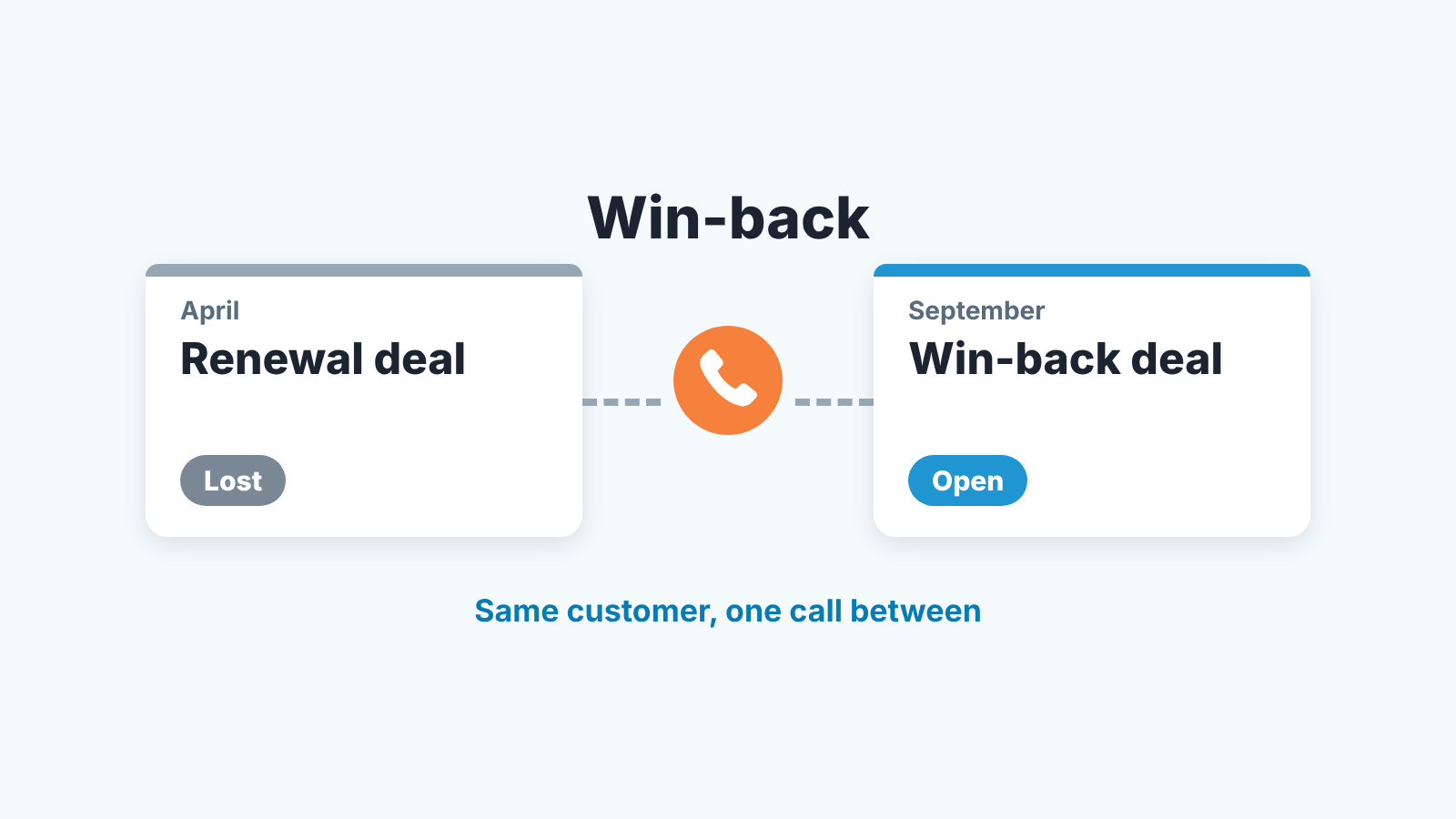
To win back a churned customer, don’t call everyone who left. Call the ones whose reason for leaving could be fixed and where something has changed since: a feature shipped, a contact moved on, a competitor raised its price. Call once, from the person who knew the account, around 60 to 90 days after they left, and sooner if a trigger shows up. Then run the return as its own deal in Pipedrive, a Duplicate of the old one with Deal type set to Win-back, so the customer’s history stays in one place and your new-business win rate isn’t distorted by people who already knew you.
A churned customer, here, is a B2B account that cancelled or didn’t renew in the last two to six months. Someone who never bought is a different problem, and so is a customer still on the phone about cancelling. This piece starts after both.
Six months gone, and Pipedrive still calls him a customer
Benedikt runs sales at a nine-person company that sells scheduling and invoicing software to physiotherapy practices. In April a practice with four locations cancelled. Zuzana, who had managed the account for two years, did the save call, heard that the practice manager wanted online card payments and they didn’t have them, and closed the renewal deal as Lost with the reason Product gap and the manager’s sentence in the note. Then she archived it. That was the right outcome, and it’s the routine from our cancellation article; nothing here replaces it.
In September, online payments shipped. Benedikt remembered the practice, opened Pipedrive, and found the organization exactly where it had been left: a Lost renewal deal, a note, a contact who, as it turned out, had changed jobs in July. Nobody had looked at it in five months.
This is the normal state of a churned account in a small team. What was never decided is whether the account is gone or merely waiting, and if waiting, for what. Until you decide it is a deal nobody owns, and the win-back conversation starts with whoever happens to remember.
Which churned customers are worth a win-back call
Start from the lost renewal deals, not from the customer list. If the save-call routine is in place, every one of them carries a lost reason and a note in the customer’s own words. Pull the ones lost between two and six months ago and read them one by one. For a team of this size that’s ten to thirty deals, an hour’s work.
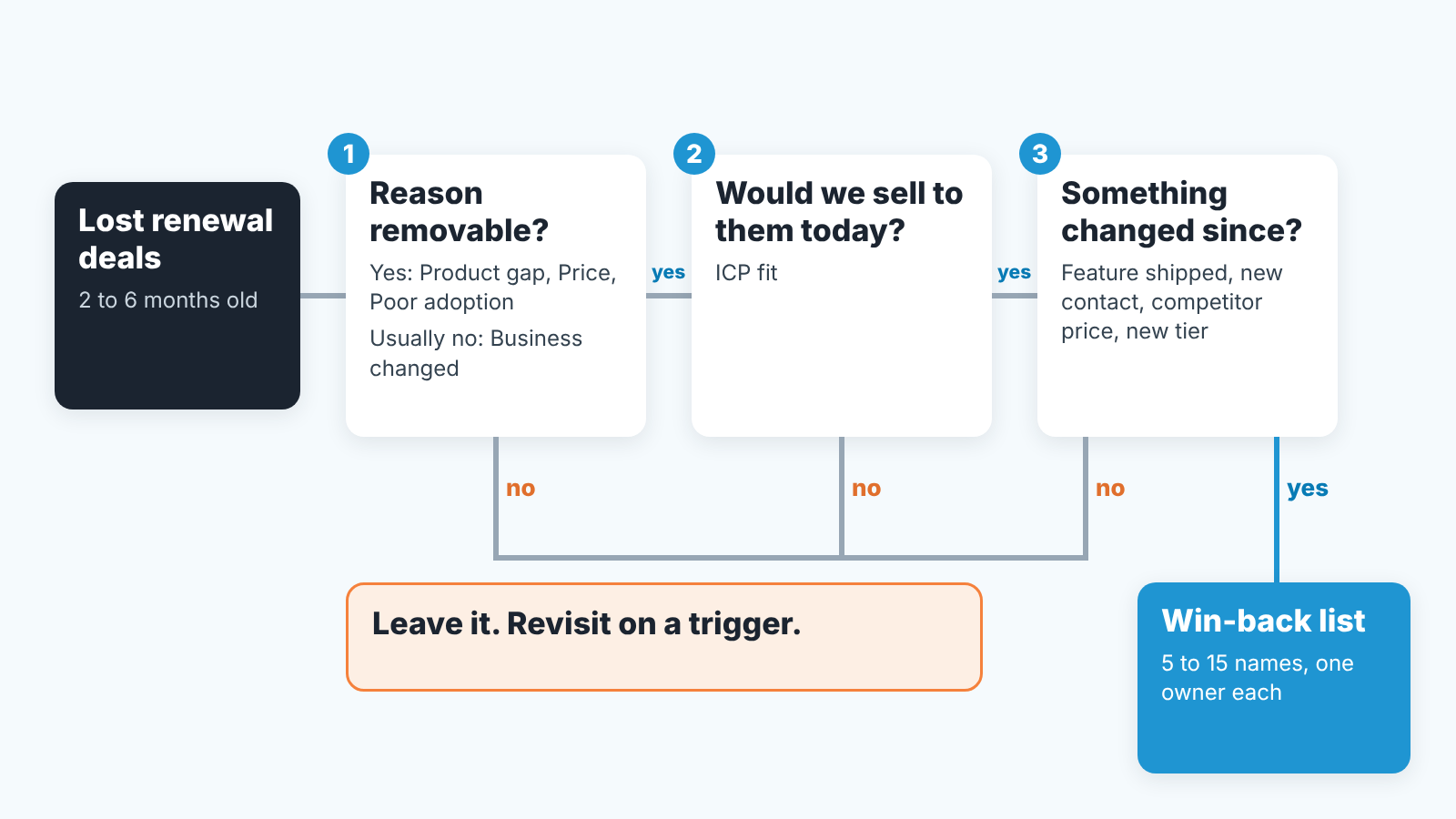
Three questions, in this order, and a name stays on the list only if all three come out yes:
- Was the reason removable? Product gap, Price and Poor adoption are reasons you can do something about. Business changed, when the practice was sold or shut, usually is not.
- Would you sell to them today? ICP fit and prior engagement decide the list, not how recently the account went quiet, as Sendspark’s guide to win-back campaigns puts it. A customer who was a poor fit the first time will be a poor fit the second.
- What changed, on your side or theirs? The feature they asked for exists now. Your pricing has a tier that would have fitted them. Their champion left, or a new one arrived. No change, no call; you’d be repeating the save call with a longer gap.
Sendspark also sorts churn by kind (silent, price, competitor, involuntary). We don’t add that as a field; the lost reason already says it. Involuntary churn can start as a declined card, and catching it before the retries run out is covered in when a HubSpot renewal deal becomes at-risk after a failed payment.
Benedikt’s pass over April to August produced seven names out of twenty-two lost deals. Seven is a list a person can work. Twenty-two is a campaign, and this is not a campaign.
Thirty, ninety or a hundred and eighty days: wait for the trigger
Published advice runs anywhere from 30 days to six months: Sendspark reports that most B2B teams make the first win-back touch between 30 and 90 days, and cites Klaviyo at six months and Marketo at 90 days (Sendspark). Those windows come from email tooling, where the question is when to send to a list. Ours is when one person should call one account.
Our position: a date is the fallback, a trigger is the reason. The practice that left over online payments should hear from Zuzana the week online payments ship, whether that is day 40 or day 200. The customer who left over price should hear from her when the new tier exists. It’s the same logic as bringing a lead back on a signal rather than a date, applied to someone who already bought.
The date still matters as a floor and a ceiling. Below about 60 days the call reads as the save call continued; the customer hasn’t lived with the alternative long enough to have an opinion about it. Past six months the contact has often moved on or forgotten you. So: trigger first; if none has appeared by day 90, Zuzana calls anyway with whatever is genuinely new, and if nothing is, the name comes off the list.
In Pipedrive, the list is a set of activities. When a name makes it, its owner creates one Call activity on the organization, due on the earlier of the expected trigger and day 90, subject “Win-back: “. Why the organization and not the lost deal? Because the lost deal is usually archived by now, and Pipedrive doesn’t link new activities to archived deals (Pipedrive: archiving deals and leads). There is no spreadsheet.
One call, then one email. Not a discount.
The call comes from the person who knew the account. Not the founder, unless the founder was the relationship, and not a new SDR with a script. The customer left a relationship, and the first thing they will notice is whether the the relationship is who called.
What Zuzana said to the practice, more or less: “You told me in April the thing missing was card payments. It shipped last week. I’m not calling to sell you anything today; I wanted you to know, and to ask how the last few months have gone with the other system.” Then she stopped talking.
Three things belong in the call: the reason they gave, quoted back; the thing that changed; a question about their experience since leaving. One thing does not: a discount in the first minute. A customer who left over a missing feature and is offered 20% off hears that the feature still isn’t worth full price. One who left over price learns the price was negotiable all along. If price is the real block, that’s for the second call, with a reason and an end date attached.
The email goes out the same day and is short: what was said, the one link that matters (the release note, the new pricing page), and the date you agreed to speak again. Voicemail? Same email, plus the day you’ll try once more. One call, one email, one follow-up. After that, silence is an answer.
Recording the return: Duplicate, then Deal type = Win-back
The practice said yes in principle and wanted a demo for the new practice manager. So where does this sales process live? Not in the old Lost deal: reopening it would overwrite the April outcome and the reason, and the quarterly list of who left and why would lose a row. Not in a blank deal either, because the products, the people and the organization are already attached to the old one.
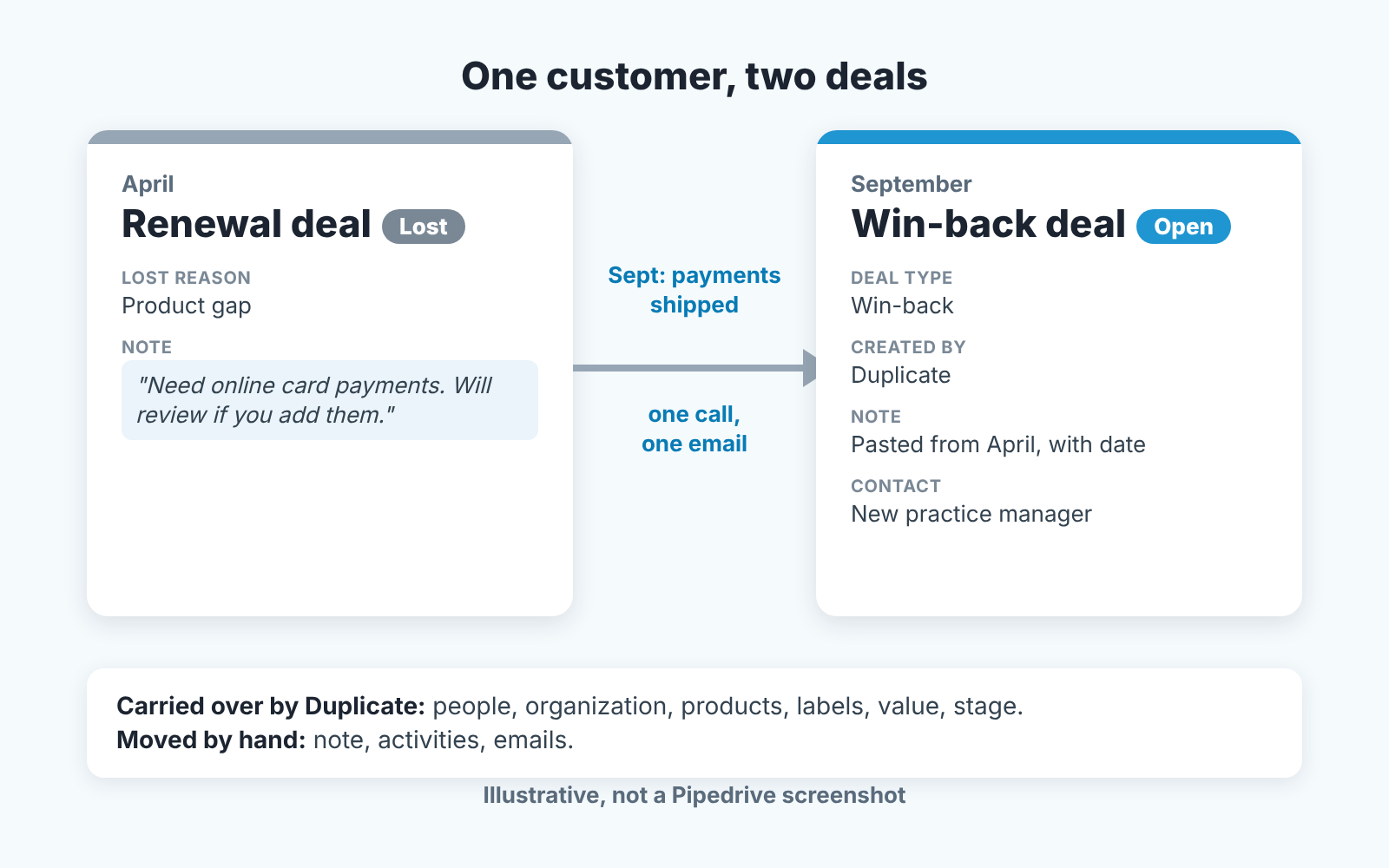
Duplicate the lost renewal deal. Pipedrive copies the linked people, organizations, products and projects, the labels, the value and probability, and the stage and pipeline. It doesn’t copy activities, emails, notes, @mentions and comments, files, or subscriptions and recurring payments (Pipedrive: how can I duplicate a deal). That list is teh exact boundary of what you now move by hand:
- Set Deal type to Win-back first. Custom field values aren’t on Pipedrive’s list of what Duplicate copies.
- Rename the copy. Ours read “Riverside Physio, win-back, Sep 2026”.
- Move it to the first stage of the pipeline the return will go through; the copy lands wherever the old deal sat.
- Paste the April note into the new deal, with its date. It’s the most important sentence in the new deal.
- Replace the contact if the champion changed, and keep the old person linked.
- Check the value against today’s price list, not April’s.
Deal type is the single-option custom field from repeat orders in Pipedrive, where it holds New and Repeat. Win-back is the one value we add. A reorder is the same goods bought again on schedule; a win-back is a lost relationship being rebuilt, with a different cycle and often a different price.
The number to track is not win rate
Don’t put win-back deals into the same win-rate report as everything else. Win-back deals close at a different rate from new business, in either direction, and once they’re in the blend the blend describes nothing. Filter win rate on Deal type = New and leave it there.
The win-back number is simpler: of the names that made the list, how many bought again? Benedikt’s list had seven names in September. Count the won win-back deals against those seven, not against the twenty-two lost deals. The list is the denominator because the list was the decision; measuring against it tells you whether the three questions were the right questions. Count it at a fixed point, 90 days after the list was made, so a slow yes and a fast no are compared fairly.
Next to it, keep the noes and their reasons. A customer who says “we would, but the new system has our two years of patient history now” has told you the real cost of leaving and that sentence belongs in the lost reason note of the win-back deal. Two filters cover it, won and lost deals with Deal type = Win-back, and Benedikt reads them once a quarter.
Who you stop calling, and where their record goes
The practice that didn’t pick up twice and didn’t answer the email is not a lead to keep warm. Close the win-back deal as Lost, with a reason. “No response” is the honest one for silence; otherwise, the reason they gave this time, which is often not the reason they gave in April. Put the dates in the note: “Called 12 Sep and 19 Sep, emailed 12 Sep, no reply.”
Once its counted, archive it, the same way you’d archive the April renewal. Archived deals drop out of most lists and pipeline views but stay linked to the organization and the person (how we archive old deals and leads). So the two deals, the April loss and the September attempt, are still on the organization for whoever looks next year.
What you don’t do is call a third time, or hand the name to someone else to try their luck. A churned customer gets one honest attempt per trigger. A new trigger, a feature they specifically asked for or a new decision-maker, can earn a new attempt, and it starts the same way: the three questions again, and a new Call activity on the organization.
Two kinds of names never go on the list at all: the ones who asked not to be contacted (that goes in the organization’s notes the day they say it), and the ones where the business is gone. Sendspark keeps a longer list of when to let an account go (Sendspark). A practice sold to a group that already uses something else is Business changed, and Business changed doesn’t get a win-back call. It gets a note and, if the group’s head office is a real prospect, a new lead with a new owner.
Most of the cost of a win-back is the gap between April and September, when nobody was looking. The cheaper version is noticing the account while it was still a customer, when its purchases stopped landing on their usual cycle. The statuses we use for that are in customer health in Pipedrive, and the filter that surfaces accounts nobody has touched is in finding inactive customers in Pipedrive. We build SalesBond, a sales management layer on top of the CRM a team already uses; we started with Pipedrive. Its Customer Health marks each repeat customer as on track, overdue or leaving against their own buying cycle, with no score and no prediction behind it, so the April conversation can happen in February. If you want to see which of your customers are already overdue, check your CRM with SalesBond.
Zuzana’s September deal closed in October. The first thing Zuzana said on the demo was the sentence the previous manager had given her in April. The deal is marked Win-back. It isn’t in Benedikt’s new-business win rate, and it never will be.